We are living in unprecedented times, which calls for extraordinary measures. This involves thinking outside the box to re-frame how you communicate with clients, bring in new business, and change your marketing and sales approach.
At Treefrog, we are working to help our clients through challenges brought on by COVID-19. We have compiled a checklist of business essentials to leverage during these challenging times.
"*" indicates required fields
Should you and your business need help to implement any of the activities included in the checklist, or you have any questions, please feel free to reach out by giving us a call at 905-836-4442 or emailing us at info@treefrog.ca.
To our valued clients, we wanted to provide an update on some of the changes we have made in our offices during the current COVID-19 situation. While some businesses could experience turbulence during these uncertain times, Treefrog wants to ensure we are committed to helping you navigate this situation both internally with your employees, and externally with your clients and customers.
As a Digital Transformation Agency, we are uniquely equipped to ensure our clients are capable of shifting to a more digital future, tomorrow and beyond. One way we want to help you is by providing some examples of how we at Treefrog are transforming our workplace and procedures to ensure the health and safety of our employees, clients, and the community to which we belong.
We have implemented the following measures to ensure the health and safety of our employees, clients and community:
Implementing a work from home policy for our employees, effective beginning March 16
This means our office will be closed to the public (including clients) for a minimum of 3 weeks
Shifting to remote meetings via telephone or video call, where possible, both internally and externally
Enforcing a no handshake policy
Enhanced cleaning protocols and antiviral sanitation of our office space
Increased employee education and communications regarding the ongoing situation, with daily updates via our internal communications channels
Providing the tools and technology to ensure that all of our employees have the ability to work remotely
Should you and your business need help to implement any of the above policies, provide communications to your clients, and/or transition to a more agile work environment, or you have any questions at all, please feel free to call 905-836-4442 or email us at info@treefrog.ca.
One of Treefrog’s special sauces is our experience and skill integrating ERPs with web technologies. We have experience with numerous ERPs (for example, SAP, Epicor, SYSPRO, etc.) and many web platforms (for example, Magento, Shopify, WordPress, etc.).
What benefits to closing the gap between your ERP data and your web platform look like?
Here are some examples;
1. Synchronize Inventory
Inventory levels that are accessible to your customers, along with stocking dates for out of stock products, photos and specifications that are always accurate empowers your customers to plan, to make decisions and to take action whenever and however it suits them, whether you’re selling B2C or B2B.Combine this information with web analytics can help you gain visibility into what products your customers are browsing, what items they’re purchasing together and what products they’re searching for that you don’t yet have.
2. Synchronize Pricing
Synchronizing your web information with your ERP data means making pricing changes once and only once.Customer-specific pricing, even on a product-by-product level, becomes much more manageable through customer portals and logins.Pricing levels can even be time-based for a specific category of customer for the duration of a marketing campaign or seasonal promotion.
3. Ditch Data Entry
Are your users manually re-entering web data into your ERP?Sales Orders? Quotes requests?Your manual processes, wherever they exist, are completely unnecessary!They are compensating for the inability of your systems to move data between them.This makes room for error, is an unproductive use of your people’s time and makes it difficult to capture customer information and track sales analytics.Every company we work with is finding it harder to fill key positions.Why not leverage the time of your best people toward high-value activities?By automating those that don’t require their judgment and intellect, you free up capacity and make their work experience more fulfilling.
4. Know What’s Happened (Revenue analytics)
Capturing your web data and ERP data in one place means more visibility into monthly, quarterly and annual revenues, quoting activity and browsing activity.Not only does integration enable more accurate and detailed revenue reports, you can now combine this revenue data with other customer data to help you understand what your customers are thinking and doing.Now, you can understand what’s working for your customers and what isn’t, enabling to you respond.
5. Know What’s Coming (Revenue Forecasting)
When a customer requests a quote from you today, where does that information go?More importantly, when a customer sends a quote to their customer for one of your products, do you even know about it?Our ERP-web integrations bring visibility to the entire sales channel, not just the first link in the chain (your direct customer).When you know what kind of activity your customers are up to with their customers, you can more reliably anticipate what’s coming for your business.
6. Notify Customers
If you asked your customers what they’d like to be notified of in real-time what would they say?In-stock notifications? Shipping notifications?Price changes? Quote responses? New products?Notifications can significantly impact the experience of your customers, and with web-ERP integration, you have options.You can notify them on almost any change in data that you choose, as long as it exists in either your web data or your ERP data.
7. Help your Customers Help their Customers
In the B2B world, the most impactful difference you can make in the life of your customer is enabling them to positively impact their customers.What if your B2B customer could take a quote you’ve given them and convert it into a quote for their customer, by adding their own materials, labour and markup?Simplifying the quoting process for your customers means faster turnaround for their customers.What if you could directly tie-in to the distribution systems of your customers?
8. Support Growth
Once you’ve automated processes and put key information directly in the hands of your customers, you’ve created an infrastructure that enables growth without creating additional demands on your people – to answer questions, enter orders or pull together data from multiple sources to answer key questions.
9. Be Flexible
With the integration of your ERP and web data, you create flexibility.Your have the flexibility to add new online or traditional sales channels, add new product lines, new markets (local or international) or any combination of these three opportunities without sacrificing operational efficiency or overall performance.
10. Be Future Ready
Technology is changing at an increasing pace.Creating the infrastructure for your front-end and back-end data to work together enables you to leverage other emerging technologies for even more opportunities – with IoT, big data predictive analytics, AI, VR.Once a central reservoir is in place, capturing all your key data, we can leverage that data to make use of other forms of technology.
11. Leverage your Legacy ERP
ERP upgrades are hard.Hard on cash flow, hard on your people, and hard on your customers and suppliers.They are the change that every business dreads, but cannot avoid.Integrating data between your web and ERP can buy you time by putting the data you already have to work for you…while you plan for the upgrade you know you ultimately need.
If you are unsure where to start with integrating your ERP into your digital platform, we would love to chat. We have helped several organizations identify gaps and solve major issues in your company’s efficiency and growth opportunities. Contact us today. We’d love to chat!
2020 is almost upon us. At this time of year, we see many articles reflecting on the year that’s just past. We know what happened in 2019 – but are we prepared for 2020?
The definition of “foresight” is: “the ability to predict or the action of predicting what will happen or be needed in the future.” And yet, we often forget, when planning for our business success in the coming year, what drives sales and interest in our product or services: marketing strategy.
Towards this end, we have decided this year to share one of our most valuable tools for planning upcoming marketing with our “Marketing Partners” (i.e. people who use us for their outsourced marketing needs). After your Christmas Turkey has settled and your gifts have been unwrapped and stowed away – this is the perfect time to reflect on what worked last year and what actions you should take next year to grow your business.
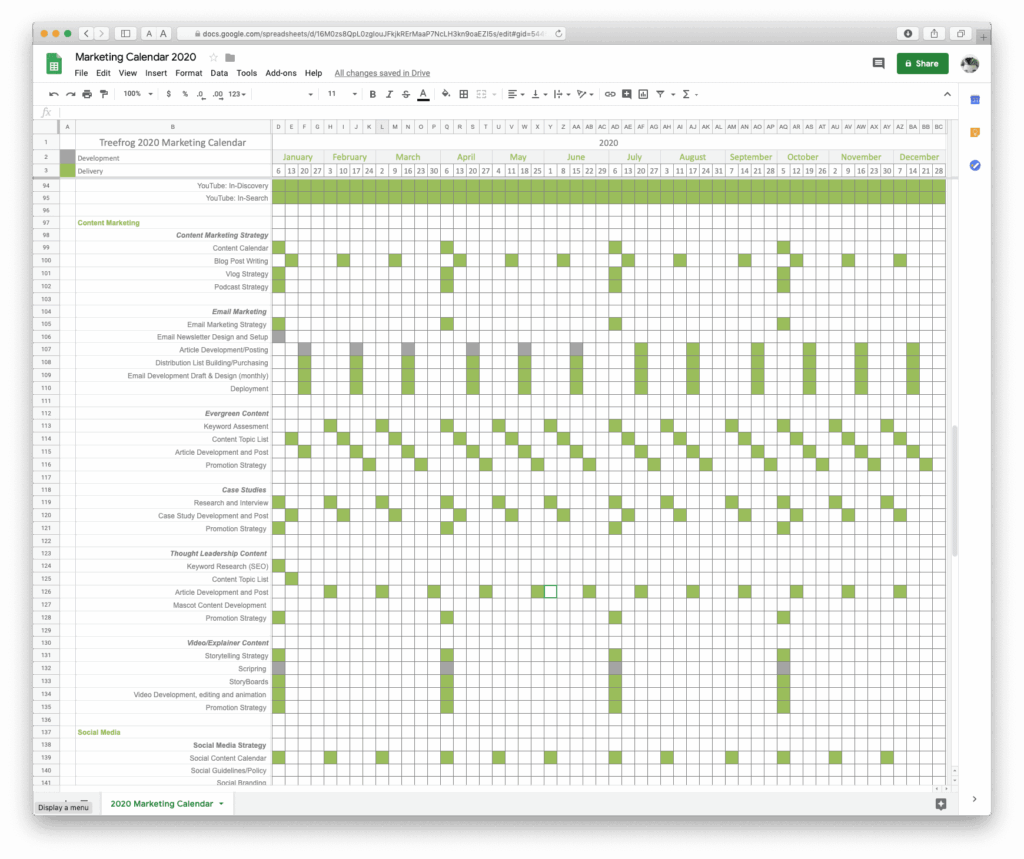
The Treefrog 2020 Marketing Calendar Worksheet
This worksheet is an easy-to use spreadsheet of various marketing activities to stimulate your brain into thinking about how to gear up over the coming year for growth. If you are a CEO or business owner, you should have this plan in front of you. If you are a marketing person, you should be creating and customizing this plan based on a budget or what you already know works.
At the very least, it’s certainly a lot easier to decide what marketing activities aren’t part of your plan for 2020, so you don’t waste any energy wondering what could have been.
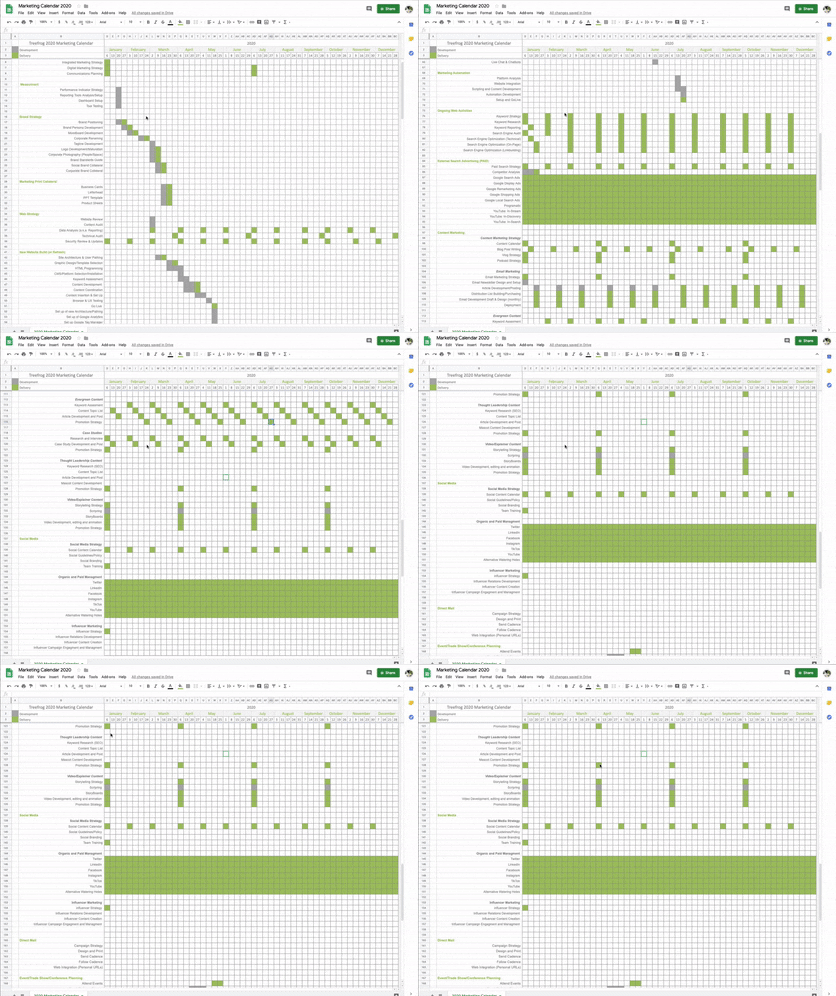
Here is an example of it in action;
If we can help you with your strategy or with any of the tactics in 2020, let us know! We can help you design, build and execute your strategy once it’s been intelligently reviewed and lined up with your budget and business goals for the next decade.
At least, with a little elbow grease in the coming week or so, you’ll know what you are doing to grow your business going into the new year.
Happy Holidays!
How to Use this Document
It’s easy. Go through the document, line by line. Decide what week you would or should be working on components of your marketing. Color in the weeks that you believe you should be doing a marketing activity of that type (each square represents the Monday of a new week).
This document contains an example of how a marketing strategy should look. You might start by erasing it all and starting again! Or perhaps just edit from the example input already in the document.
We at Treefrog take these draft strategies and put them into a professional project management tool (we use Wrike) – but this document is a perfectly good substitute to get your mind engaged and get your creative and strategic juices flowing.
Enjoy!
Fill out the form below and your copy of the 2020 Marketing Calendar Worksheet will be emailed to you
"*" indicates required fields
Not sure where to start? Or Don’t you have time as you work in the business to work on your marketing? Let’s chat. We can offer a complimentary 30-minute consult to get you started, and help you design, build and execute your strategy once it’s been intelligently reviewed and lined up with your budget and business goals for the next decade.
Social media sites have become popular platforms for brands looking to communicate with their customers, and they provide an opportunity to deliver stellar customer service experiences. Social media is useful for improving people’s impressions of brands compared to traditional means of communication because when you solve problems for your customers online, thousands of others may also see your great response.
That being said, the risk still exists for things to go wrong. We’ve outlined a few best practices for providing exceptional customer service on social media that will make sure you kill it, and not your brand image.
Find Your Customers
Providing exceptional customer service takes time and resources, and you should allocate these wisely by determining which social media sites your customers use the most. For most companies, LinkedIn, Facebook and Twitter are popular but depending on your industry, your audience might be more engaged through Instagram or YouTube.
The social media sites where you are having the most success (most shares, likes, and other engagements) should be the platforms you invest in since they are where:
Your target audience is most active.
Your customers are more likely to contact you if they have a concern.
Once you have identified your audiences watering holes for information, reviews and engagement. It’s important to have a strategy for engagement.
Listen, Listen, Listen!
Social media has changed the way customers interact with brands and vise versa. Marketing is no longer placing ads in front of people that communicate your brand message, product and telling what the end-user should feel or think about your brand. Social Media has created two-way communication between your customers, potential customers and you. It’s now an outlet to directly respond to you and express their thoughts about your product or services. Therefore, you must pay attention to what people are saying to you and about you, and respond accordingly.
Doing this involves more than just checking your direct messages or having an auto-responder set to reply when you can not. You need to have a plan in place for ongoing checks for negative (and positive) comments left on your posts and also check for posts outside your accounts where people may comment about you. By using tools like Hootsuite, you can be notified whenever someone mentions your brand, regardless of whether or not they mention you or contact you directly.
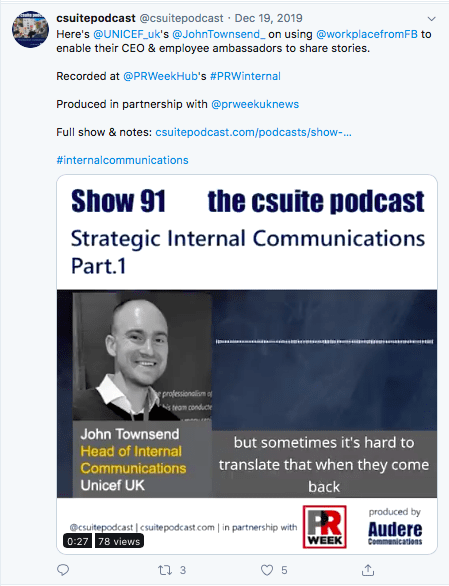
People don’t just message brands, they Tweet at them – which is out there for the world to see.
Respond, Always!
No one likes being ignored, and making sure you respond to people who communicate with your brand is crucial. Negative comments that go unanswered remain there for the world to see and make your brand look careless and cold.
Also, never delete negative comments. People who are willing to go to the effort of posting a negative comment are more than willing to point out when their comments have been deleted, and this can spell social suicide for you. Instead, own how you take their criticism (it will make you look good) and try to turn the negative situation into a positive one, turning the relationship around.
Responding to positive feedback is also a good idea as it builds profitable relationships with people and makes your brand appear positive and proactive to others – especially if these conversations happen in public places like comments.
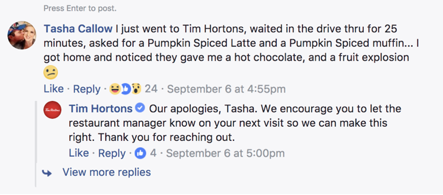
Tim Horton’s constantly monitors comments on its Facebook posts, and responds promptly to frustrated customers.
Make things Efficient
Optimize your social media profiles so that communicating with your brand is as easy as possible for consumers. This is important if you receive or expect to receive a high volume of messages. Below are just some tips for accomplishing this goal:
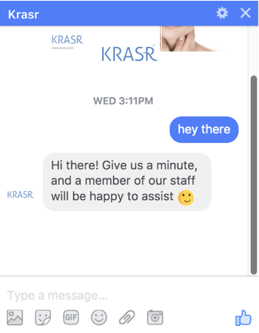
For Facebook pages, enable instant replies or initial messages to let customers know you’ll be responding and addressing their concerns as soon as possible.
Add a “message” button directly to your Facebook page as well as various contact buttons onto your Instagram page – increasing accessibility for those looking to contact you.
It’s a good habit to have your social profiles downloaded and accessible on your phone so that you can respond at all times (rocking social media means living on it!).
If quick response time isn’t possible, you can set your Facebook messenger status to ‘away’ so that people at least know when you’re not available.
Keep in mind: Facebook calculates your average response time to messages and will display this to everyone who visits your page. Replying quickly is therefore crucial.
Facebook replies can be automated to let people know you will be with them shortly.
Monitoring social media to reply to customer service issues can be impossible if you don’t have the time. At Treefrog, our social media team specialises in reputation management and can keep up with what’s being said about your brand 24/7 – so that you maintain a positive brand image online.
Facebook replies can be automated to let people know you will be with them shortly.
Social media isn’t a question of if, but how. Before engaging, think about what, when and how. Having a strong strategy of which channels you are going to communicate what message and the level of activity are all factors in your success. Especially when it comes to providing exceptional customer service through one of the fast-growing communication mechanisms.
Don’t have the time?
At Treefrog, our social media team specializes in branding, account security, strategy, calendering, content curation and reputation management. Whether you are just starting out or have been on the road of social media for some time now, we can help get you set up and tracking with a social media plan that meets your time and interest or better yet, your customers’ appetite on social.
Let’s chat. Call or email today for a free quote at 905-836-4442 today!
Every business wants to connect, to make an impact, and to grow. To do so, a brand must be so closely identified with the industry’s defining characteristic that they become known for it.
There is a very precise science to creating a strong brand and maintaining that strength. As humans, we are bombarded with so many stimuli every second that our brain creates a filter – known as sensory gating – to only take in the information that is deemed valuable. This may seem like an exaggerated statement at first, but think about your morning routine today. You most likely turned off the alarm on your phone, scrolled through social media, showered, ate breakfast, and drove to work. In every single one of these steps, despite your brain’s best efforts to block out all the promotional noise, your choices were affected by the power of strong brands.
So how do you ensure that your brand gets through the filter?
5 Basic Branding Barriers
A strong brand must satisfy the needs and wants of the target audience to last through the ages. Consider the list of characteristics below and see how many boxes your brand checks:
Emotive: consumers today are more driven by emotion than necessity, and a brand is the visual conveyance of a feeling that is most closely related to the target audience’s decision-making process.
Memorable: 50 per cent of consumers are more likely to click on a particular brand name if that brand name shows up more than once in a search engine. A strong SEO presence is essential.
Identifiable: a brand should be visually appealing and streamlined across all platforms. A simple yet powerful logo design can help with this.
Accessible: even with a brick and mortar storefront, studies show that 82 per cent of consumers will use their phone to help them make an in-store purchase. Without a digital presence, a brand will suffer.
Results-Driven: consumers will not return to a brand that has let them down in the past. Your clients’ success is your success.
The need to get past these “barriers” is what makes graphic design so important. At Treefrog, we have spent years studying the exact science of what makes or breaks a brand. The business world looks very different today than it did 20 years ago. Before digital marketing was ever an option – or even existed – companies were built on recommendations from friends and family. Now, this word-of-mouth has gone digital, and instead of close relations, consumers can get recommendations from millions of people at the click of a button.
Building Brand Recognition
Consumers are far more likely to choose a brand that they recognize over something unfamiliar, even if they don’t know a great deal about the company at the time. This means that even if a consumer has not made up their mind about a brand – and 90 per cent of searchers fall into this category – they are more likely to use a business simply because they know it. Consider the following benefits that come from a powerful, easily recognized brand:
Customer recognition
Competitive edge in the market
Easy introduction of new products
Customer loyalty and shared values
Enhanced credibility
Business Branding Experts
Are you ready to strengthen your brand and build your business? At Treefrog, we take a top-down approach to helping you develop your brand strategy. Whether it’s logo design, logo maturation, corporate identity or graphic design services, we’re your business branding experts.
Give us a call at 905-836-4442; our team of graphic design and branding experts are ready to help!
It is not uncommon for a company, country, or an individual to have an annual theme. At Treefrog, our CEO has set one for the company each year, and while most often they have remained internal; this year, we’ve decided to launch a marketing theme along with an internal monologue:
“What does Treefrog do?”
While this might seem like a strange question to be asking after nearly 20-years of business, as a digital agency, we have evolved incredibly over the last two decades; from CD burning to website development, creating a content management system (LEAP), to the additions of search ranking and social, to bleeding edge innovation around AI, AR, and IoT. And throughout all of this change, we hold one common theme: innovation and ideation.
But, we are no longer the people in a basement designing websites by day and coding them by night. We’ve grown into a 40+ team. Our clients have matured and grown, just as the small Town of Newmarket has too.
There comes a time in every organization where you need to step back and ask: Based on our growth, are our clients of yesterday still our clients today? And will they be our clients of tomorrow?
At the end of 2018, we set out to answer this very question.
Let us share how we did this:
Our goal was to identify ten words or fewer that would succinctly recognize who our client is. We began by listing out a variety of clients (both past and present), what types of services they offer, and the successes we’ve had with them. This was followed by a lengthy exercise of identifying attributes of these many customers and how we work with our clients.
During the process, we started to notice patterns in the clients and attributes. While some clients were our long-time partners of 15+ years, others had been working with us for less than two years. Some clients were multi-million dollar organizations, with operations around the world, and others were less than five team members and under half million in revenue.
Fascinating similarities in connection for all clients regardless of size, location, industry or income started to emerge. Attributes such as:
Relationship-focused
Growth-Oriented
Collaborative
Curious
Patient
Experts in their field
We then categorized the attributes, in the hopes of boiling our brainstorming session down into one sentence that was evident in all the clients that we selected, both prosperous and less successful (yes we looked at our failures too).
In all cases, we were dealing with the CEO or lead decision-maker; even in the $80-million company, we had a direct line to the CEO.
However, we also realized that in focusing on our clients, what they asked of us was only part of the equation. How we behave, and our values played an essential role in this process too.
As we mingled our values with the attributes of our clients, we landed on something very close to “who” our ideal client is. This included a definition of each client, and a description that would be lasting regardless of the services that we offer or the ways to which we provide support.
“Courageous, aspirational decision-makers concerned about being digitally underdeveloped who want an invested partner.”
It’s not marketing speak. It’s not meant to be pretty. It’s an internal dialogue for whom we define as our partner. Let’s unpack this definition:
Courageous
Courage defined as ‘being afraid of something and doing it anyway.’
Starting a company, inheriting a company, or gaining the position of leader in an organization is an act of courage. Sometimes it’s the only act of courage a leader makes (that’s an article for another time). But, taking on that role can be scary. Leading an organization takes courage, on a daily basis.
This word was especially crucial to our team, as many of the clients we looked at need a lot of courage in both their companies and industries. Also, when you think about technologies and the digital industry, there are a lot of unknowns, it’s intimidating to many individuals, yet the courageous person moves forward even in the face of uncertainty.
Aspirational
Aspirational or Aspiration has a dual significance in the hope or ambition to go-after or achieve something paired with the action or process to get it. Aspirational individuals are decisive, visionary, curious, and willing to take risks. At Treefrog, we are aspirational; we take risks, we go after big ideas with curiosity and joy. Our best clients are aspirational, taking risks in business, achieving something beautiful.
Decision-Maker
Let’s be real. We all want to be dealing with the decision-maker, that’s a given. But, this decision-maker is unique, they go after new things, and they embrace or welcome innovation, thinking outside the box. They are not just any decision-maker but one who eagerly craves success.
Concerned
This word is especially significant in our definition. Several businesses in the world are happily digitally underdeveloped or non-existent. These are not our clients. We are not seeking to find these decision-makers.
We have one of these businesses leaders on our team right now, a hired consultant working with us part-time: but she is not our client, as she isn’t concerned about her digital footprint.
We are instead interested in working with (and for) companies and decision-makers who are worried about their place in the digital space, who fear missing out, who recognize they are lagging in the digital arena even though they may be experts in their industry.
Digitally Underdeveloped
What does it mean to be digitally underdeveloped? It is relative to the business, knowledge holders, competitors in the industry, and the company itself. It could mean a variety of status points, having an out-dated website, lagging in social engagements, using antiquated systems such as Excel for essential business functions, and more.
This is the one area we’ve spent the most amount of time on, defining and understanding what this could mean to many businesses including our past, current, and future clients. Stay tuned for part two of this article next month, as we will unpack this even more.
Want
Desire. Need. Want. Again, another impactful word in our definition as it describes the mental state of the decision-maker. They aren’t merely looking to fill a gap; this is something they crave or seek. It’s like breathing or nourishment to them, and they see the importance, they are willing to explore and find more than just the bare minimum.
Invested Partner
Lastly, a partner, yet not just any partner but one who is there for the long journey. At Treefrog, this is one of our strongest values, almost to a fault. We think of our clients and their businesses as if they are our businesses and our families. We pride our relationships with authenticity and love. When we engage in a new project, we look at the contract like that of the full depth and sanctity. For better, for worse, for richer, for poorer, in sickness and in health, to love and to cherish. We are there side-by-side with our clients.
What’s next for Treefrog?
Now that we have a defined a clear path of the types of individuals for whom we have seen through evidence-based work and by aligned values, partnership, and longevity, we can start to examine the ‘what’ in: What does Treefrog do?
We hope you’ve found this article informative as to how we discovered our “who,” a question most businesses struggle to articulate.
At Treefrog, we encourage innovation and thought leadership in all that we do. If you would like help in finding your “who,” we offer no-charge innovation ideation sessions for our clients. We merely ask for a 10-15 minute pre-call to learn about your business and what keeps you up at night.
“If you don’t know where you’re going, you’ll end up somewhere else” – Yogi Berra
At Treefrog, we value client success
As a digital transformation agency, our specialty is helping organizations tap into their full potential in the digital space; whether it’s underdeveloped or underutilized resources to drive change in the company or industry space.
Often when we start the conversation, there are so many unknowns that it can be hard to put a plan in place. For example, if you want to take your product or services online to sell, there are several things to consider:
What will the shipping be? By Weight? Location?
How will you handle taxes?
What about International currencies?
Inventory Management?
Discounts? Specials?
So the list goes on. Having a trusted partner to guide you through the process is essential. Whether it is an e-commerce system, ERP integration, building a customer portal, app development, augment Reality, or otherwise, we know the pain and uncertainty that can come with a project of this magnitude. Thus, we want to help you identify and reduce risk as much as possible.
To help reduce your risk, Scoping is extremely important in leading us in the proper direction. However, have you ever started a project with a plan and realized a stronger approach along the way? Digital projects can never be planned from start to finish, and they have several unknown variables in the early stages. So, the best option is to prepare for a goal and make changes along the way to produce ample results.
If you have done renovations to your home, you may be familiar with this concept. At the start of the project, you explain to the contractor your vision, and a blueprint is created. However, once the renovations have begun changes must be made for a perfect result.
Most digital agencies will manage projects using a top-down approach (also known as the waterfall method). This fixed approach can cause projects to be unsuccessful as the plan is so set in stone there is no room for improvement along the way. The scope is often made at the start, with little room for change without a high cost. Often clients will be disappointed when great ideas are ignored to adhere to the timeline and budget. We find this is due to the three constraints faced by any project: Budget, Timeline, and Resources.
Typically referred to as the iron triangle, these constraints faced by project managers are the scope, schedule, and cost. They work interdependently together, and none of them can be adjusted without affecting the other. For example, if the deadline of a project is moved up, the scope will be changed, as goals may not be achieved.
At Treefrog, we believe following a top-down approach often leads to disappointment and a lack of success. These fixed plans at the start of projects lead to distress, as there is a strict goal to maintain a scope, budget, and time constraints. However, like most things in life, it takes getting your hands dirty to figure out the best solution.
We have found that the following method reduces uncertainties based on continuous collaboration. The Scope/Discovery Process is unique to each client and includes some part of:
Understanding the clients business goals
Defining the client’s target audience
Creating a list of tasks that will assist the client in achieving goals
Outlining in detail what we can offer the client
Although the discovery process helps the initial scope, there is always a cone of uncertainty when starting a new project. This idea emerged from the engineering industry in the 1950s, but it is highly applicable to today’s digital world. The basic premise of this is that all projects have a large number of uncertainties in the early stages. However, as more hours are put in, and great ideas begin to flow masterpieces are created. The reason for this is, no two projects ever have:
The same requirements
The same people
The same technology
The same user audience
The same priorities & constraints
The same business strategy
We have learned to be agile in our creative process. Thus going through the initial scope and wireframing of a project increases the depth of knowledge, available technologies, budgets, and resources. This gives all involved the time to unpack uncertainties, brainstorm on the grand scope of the project, be upfront and honest with the expectations. Much like an actual Treefrog, we are highly adaptable to change. We want our clients to love what we produce for them— and we want to brag about it too.
Do you have an idea or project that you haven’t fully conceptualized yet? Are you looking for some grounded feedback? Give us a call; we’d love to hear about your idea(s).
Owning an e-commerce business can be challenging (to say the least), as many factors that can damage a reputation, a brand, and an end product.
If you wish to be successful online, look like a credible business, and be known worldwide, it is important to avoid making these five e-commerce business mistakes:
1. Under Researching Your Competition
Research, research, and more research is key to starting any business. Understanding the market and studying up on your competition will get you one step closer to owning a successful online brand.
Reading case studies on other e-commerce businesses in your market to see what you may want to do better or differently is a good start. In this process, we suggest that you learn how to conduct a competitive analysis.
What is a competitive analysis?
A competitive analysis is an evaluation of what makes you unique when compared to other competing brands. This process will allow you to more clearly differentiate yourself from the competition and make more informed decisions in your marketing strategy.
Search Engine Optimization helps to generate more organic traffic to your website. Before building an online store, you should understand how search engine optimization works and how to use it to your advantage.
When a website is created with Google and other search engines in mind, it is more successful. In other words, it will have a better chance of being found, viewed, and enjoyed.
The higher your website appears organically on a Google results page, the better and more relevant it has been ranked.
Learning how to use the right keywords for your site is a good start when studying and writing for SEO. At Treefrog, we can help you to improve your SEO with a suite of strategies and best practices. We will also help you create, organize, and optimize your web content so that you will be visible when it matters – when your potential customers are looking for services you provide.
3. Choosing The Wrong Web Platform
When starting a business, it is often confusing which website platform to use. If you use a website platform that fits with your business requirements, it must also be reputable and good quality.
The landing page of a website is the first thing users will see when they enter your site. Some elements a website should have to keep potential customers on your site include:
Appealing Design: This will ensure your e-commerce business looks like a professional store, as some web users feel uneasy when shopping online.
Easy Navigation
Category Pages: If you sell a large variety of products in your e-commerce business, this will organize the items so users can find exactly what they are looking for
At Treefrog, we work in many platforms to ensure our clients receive the best website for their specific needs. Some of these include; WordPress, Shopify, Wix, Magento, Drupal, Leap, and custom systems.
4. Neglecting To Optimize Your Site For Mobile Users
Many people have ditched desktop and laptop computers for their mobile devices, which are easier to handle and use on the go. Therefore, it should be of no surprise that mobile commerce is vastly growing.
A research study conducted through Think with Google states that if people have a negative online experience from a mobile device, they are 62% less likely to purchase from your e-commerce store in the future.
As more people are using their phones or tablets when looking to order furniture, clothing, or the latest gadget, it is essential to make sure your website is responsive (mobile-friendly). Mobile optimization will create a more frictionless buyer’s experience.
5. Settling For Slow
We live in an age where everyone is in a rush; we can now order coffee from our phone, we can choose a self checkout lane at the grocery store, and we expect packages to be shipped in a day.
The quickness of technology may be convenient at times, but we’d argue it has created some very impatient people. This is especially true when it comes to your website.
For example, if someone is waiting more than three seconds for your website’s page to load, it is highly likely they will close the page and look for information elsewhere. Therefore, a slow loading page can profoundly impact a website’s conversion rate, engagement, and brand reputation.
Why is page speed so critical?
It is vital to have a fast-loading page so users can get to where they want to go quickly.
Amazon stated that just one second of leg load time on their website would cause a loss of $1.6 billion in sales each year. That’s billion with a B!
Google has the same issue, stating an addition of 0.5 seconds of loading to its search pages causes traffic to drop by 20%.
At Treefrog Inc., we understand that starting an e-commerce business is hard and we want to help! Our Frogs are experts in many fields that can be beneficial to your online marketplace.
Visit our website at www.treefrog.ca for more information, or give us a call at 905-836-4442.
Over the years, we’ve had several co-op students at Treefrog. They’ve worked with a variety of pods from social and content to programming and project management. This year, we asked our content co-op student, Madeline, to share her thoughts on her internship and what the co-op experience meant to her.
Discovering The World Of Digital Marketing
At the start of grade 11, I had no idea what my passion was or how to uncover it. This was really scary since I only have two years left to figure out what’s next in this journey called life. After completing and finding interest in my marketing course, I talked to my school guidance counsellor who suggested I take a cooperative education course to help me get a sense of how the field really works. I decide to take her advice and began my research for a company in Newmarket that could fill this need.
Through my research, I found Treefrog and decided to reach out to see if they would be interested in a co-op student. Luckily, they responded and invited me for an interview. At first, I was very nervous, as I’ve never had a job before, so I didn’t know what to expect. I interviewed with Kellie, Dylan and Laurie, and they were welcoming and easy to talk to. I was overjoyed when they offered me a placement, which I value greatly to this day.
My Co-op Experience At Treefrog
On my first day at Treefrog, I was very shy, as I didn’t know anyone or much about how Treefrog worked. It was like going into a new class with all new class mates, only these people were the real deal. Everyone was so kind and instantly made me feel accepted.
The relaxed atmosphere made coming to Treefrog every day fun. Everyone made jokes, listened to music or just talked about current events happening in the world around us. I didn’t feel like I was working even though we were accomplishing a lot every day.
My first couple of projects were pretty simple, with the team being extremely supportive if I needed guidance. I’ve always thought of my writing skills as one of my strengths, but when I was asked to write a blog article, I was pretty nervous about what the outcome would be. After writing a draft and getting it edited by my supervisor I was surprised that I had just wrote my very own article! And it got posted, check it out here.
I’ve always had a love for social media and sharing my opinions online, so being able to write about topics that interested me was so much fun. After five months of writing blogs for different clients on topics ranging from personality to environmental issues and mental heath to professional services, I’ve discovered a passion for writing that I never knew I had and gained confidence in my writing skills.
During my time at Treefrog, I often got invited into meetings with clients, mostly for the purpose of taking notes. While this might seem boring, it was really interesting and helped me learn about the wide variety of clients and their different needs. This expanded my knowledge on things such as search engine optimization (SEO) and social media marketing.
As I was the youngest in the office, I was often asked for my opinion as a high school student. This made me feel valued as often my ideas and input would be considered and put into action.
“Having such a supportive and inclusive team helped me step out of my comfort zone to voice my own opinions and not worry about if my opinion was right or wrong.”
Going into my co-op, I had very little experience, but during my time at Treefrog I was able to learn about Facebook analytics, website tracking, SEO, content creation and social media as more than just “posts” online. I learned how to cater to different companies and how all the different Treefrog pods fit together. While being immersed in the workplace, I was exposed to a variety of different roles, from sales, to programming, to design.
After an amazing 5 months, I know I will always value and be grateful for this co-op experience. I’ve met so many talented people who have helped me learn about Treefrog and the workplace. I’ve learned so much about digital marketing, SEO and social media that I’ve developed a love for this and hope to continue my studies in this field for post secondary.
Interested in a high school coop placement with Treefrog? Please email us for availabilities.