
Web Design & Development

Artificial Intelligence, Growth Strategy, Leads, SEO, Web Design & Development

AI Changed Search. Now No One Knows What Matters

A lot of marketing managers are quietly (or not so quietly) panicking because they are suddenly looking at the SEO work they poured into their websites and wondering what good it was if the reward no longer results in a visit, but a Google snippet, an AI Overview, or an answer that never requires someone to actually land on their site.

You Did Everything Right

And still you end up asking the same uncomfortable questions. If Google answers the question directly, how do I get people to my website? If someone asks the same question in ChatGPT, do we even show up? Is there anything I can actually do to influence how I get found by AI? Oh, and the most obvious question of all: When exactly am I supposed to find the time to figure this out while still running campaigns, reporting on performance, updating the site, and answering leadership when they ask how I’m going to solve this problem?

You’re Not Alone

This anxiety is not isolated. Nearly 90 percent of businesses say they are worried about losing organic visibility and search traffic as AI changes how people find information online. The most common fear is simple and blunt, not being able to get my business found online at all. Close behind that is the fear of a total loss of organic traffic, followed by growing frustration around traffic attribution just as pressure to prove ROI continues to increase.
What makes this worse is that the fear is not hypothetical anymore. Early research into AI powered search experiences, including Google’s AI Overviews, suggests that traditional websites can see anywhere from a 15 percent to as much as a 64 percent decline in organic traffic depending on the type of query, the industry, and how much of the answer gets surfaced before a click is ever required. Even when brands still rank well, the behavior around those rankings has changed, and visibility no longer guarantees visits in the way it used to.

Traffic Was the Scoreboard

This is the part no one really prepared marketers for. 

  • SEO did not suddenly stop working, but the feedback loop that made it feel manageable and predictable has started to break down. 
  • Traffic used to be the scoreboard. Rankings moved, clicks followed, leads came in and you had a chart to prove it!
  • Now the scoreboard is harder to read, and in some cases it feels like it has disappeared altogether.

Here’s Our Take On It

From an agency perspective, the conversations have changed too. Clients are no longer just asking how to rank higher or what keywords to target next, they are asking whether their website still has a job if search engines and AI tools are answering questions on their behalf. They want to know why they still show up in search but see fewer leads, why being visible feels emptier than it used to, and whether all the foundational work they invested in still matters.

The uncomfortable truth is that there is no clean, universal answer yet, and anyone claiming they have fully solved AI search is either very early or selling you something that does not exist. 
What we do know is that search is no longer a straight line from query to website to conversion.

Your website still matters

What seems to be changing is not the importance of having a strong website, but the role it plays. Your site is not always the destination anymore. Sometimes it is the source that informs an answer, influences a decision, or builds familiarity without a click ever happening, which is harder to measure, harder to explain internally, and harder to budget for using the same frameworks we relied on in the past.

SEO is not dead, but it does mean that SEO alone is no longer enough to carry the full weight of growth expectations. The work still matters, but the way success shows up is shifting, and that shift is what so many marketing teams are struggling to get their arms around right now.

If you feel like the ground is moving under your feet, it is, and clinging to old metrics will not make it stop. What matters now is being clear about what outcomes actually drive the business, testing what influences those outcomes in a world shaped by AI, and being willing to admit when familiar tactics are no longer pulling their weight.

shopify vs. magento
Web Design & Development

Shopify vs. Magento: Which Platform is Right for Your Business

Today, it’s critical to have an online store to reach a wider audience and increase sales. Whether you’re a new company or rethinking your online platform, you need to consider the two best platforms out there, Shopify or Magento. Though Shopify and Magento are often in a battle against each other as the best, they’re both vastly different platforms, and each has its own pros and cons. 

When comparing these two platforms to determine which one to use, it can be challenging to decide which one is the best for your business. That’s why today we’re going to tell you the difference between Shopify and Magento, so you can quickly determine which platform is right for your business.

Costs

Firstly, let’s talk about the cost of each platform. Though this shouldn’t be your only deciding factor when it comes to which platform to use, it is something you need to take into consideration. 

Shopify is a SAAS software (software-as-a-service), which means users pay monthly fees to host their online store. There are three membership tiers, basic which is $29 a month, Shopify at $79 a month, and advanced Shopify at $179 a month. The downfall of Shopify is that the more you play, the more options you get, like abandoned cart recovery and gift cards. 

Magento is a little different, as it costs nothing to use their software. They offer an enterprise solution, which does have a cost to use, though the cost solely depends on your needs.

User Experience 

User experience is critical to customer retention and driving sales on your online store, which is why it’s essential to pick a platform that has the best user experience. So which platform has the best user experience? 

Shopify is the easier of the two platforms and is the better option for companies that don’t have developers. However, Magento offers many extensions that don’t require any coding, making it just as easy to use as Shopify.

SEO

Search engine optimization (SEO) is critical for your website and online store. It’s how you end up on the front page of Google. If you want your business to increase sales and organic traffic, you need SEO. Both Shopify and Magento rank high for their SEO capabilities. 

Though when it comes to SEO, Magento is in the first place. Magento SEO capabilities include headings, meta descriptions, and page URLs and titles. Unfortunately, Magento is not fully optimized for SEO. If you want to fully optimize your online store, you’ll need to hire an agency to help you.

user experience

Themes 

Designing a beautifully branded website is critical to creating brand awareness and recognition. So it’s essential to find a platform that offers themes that can be easily edited and branded to your liking. 

Both Shopify and Magento offer themes, with Shopify offering 69 different themes to choose from. In contrast, Magento offers thousands of themes to choose from. Both have responsive themes, ensuring whether a user is on their phone or desktop, your site will perform flawlessly. 

The downfall of Shopify themes is that they don’t allow for many changes to be made to them, whereas Magento allows for more design options. Magento even has a drop and drag option to make design pages quicker and easier.

Conclusion

There are several differences between Shopify and Magento, so whatever you choose, make sure you choose wisely. You want to ensure you select the right platform for your business.

Take Your Business Online

At Treefrog Inc., our Frogs are experts in many fields that can benefit your online marketplace. For more information on how our team can help, give us a call at 905-836-4442.

Digital Marketing, Web Design & Development

Best E-Commerce Platforms to Sell Your Products Online

Selling online is a big step to take for your business. It can help you grow your business in ways you could not have imagined. Taking such a massive action requires time and research to ensure you’re picking the best platform for your business.

When picking a platform, you need to consider how customizable it is, the cost of getting started, and where your audience is? However, the number one thing you need to consider is how much they’re taking off your product’s sales. All of this can seem overwhelming and time-consuming, which is why we’ve done the hard part for you. We’ve compiled a list of four e-commerce platforms and covered all the things you need to know about each platform. So let’s get started!

Wix

Wix is an excellent place for beginners to start. It’s low cost and very easy to use. Wix also has a library of pre-made templates to help you get your online store up and running quickly. Don’t be fooled though, Wix still has some downfalls, such as being weak for search engine optimization (SEO) and e-commerce only being available to those with paid plans. You will also need to pay additional fees for integrations and add-ons. These are just things to keep in mind when picking a platform for your online store.

Shopify

Shopify is a Canadian platform and is a great budget-friendly option. It’s more complicated than Wix but still comes with professional themes. Shopify also has a variety of apps and add-ons, which helps with functionality. Like any online platform, they do come with some cons that should be considered. Shopify is limited to what you can do and is a higher price point for enterprise-level plans. Also, there are transaction fees for specific payment gateways. Shopify also makes it challenging to pull external data sources. We love using Shopify, but it’s critical to note that they do take a percentage of your sales, which means it’s good to look at options later down the road as the business begins to grow.

Big Commerce

Big Commerce comes with a lot of features that the previous platforms don’t give you. It’s also fully hosted and easily scalable. However, Big Commerce price lockdowns force you into enterprise accounts when you exceed a certain amount of income. It also lacks robust content management. You’ll have to decide if the pros outweigh the cons on this platform.

Woocommerce

Woocommerce comes with a lot of pros to it. For one thing, it’s free and open-sourced. It’s also highly customizable and comes with lots of support. Woocommerce also integrates with many other platforms and payment gateways. In all, Woocommerce gives you a lot of control and doesn’t take a cut of the profits. This is all great, but unfortunately, it does come with some cons. Since Woocommerce is created for WordPress, you’ll need a WordPress website. It also requires extensions for large-scale product inventory, and attachments can be expensive.

Whether you’re just starting or you’ve been selling online for years, selling online is a vital part of your business’s growth. That’s why having in-depth knowledge of all the e-commerce platforms will help you decide which platform is best for your business. We recommend that you keep researching, and if you have questions about e-commerce that Google can’t help you with, you can always contact the experts at Treefrog.

Connect With Treefrog Inc. Today!

At Treefrog Inc., we understand that starting an ecommerce business is hard, and we want to help! Our Frogs are experts in many fields that can be beneficial to your online marketplace. For more information on how our team can help, give us a call at 905-836-4442.

Computer drawn keyboard with large key depicting wheelchair and word "Accessibility"
Digital Marketing, Web Design & Development

New AODA Guidelines to Make Your Website Accessible in 2021

Treefrog specializes in helping companies ensure their websites are AODA compliant.

Does your organization or business fall under any of the categories below?

  • Businesses and non-profits with 50 or more employees
  • Municipalities
  • Libraries (all public and those private libraries with 50 or more employees);
  • Public-sector organizations; and
  • Public and private-sector educational institutions (regardless of staffing)

If so, by June 30, 2021, the expectation, as outlined in AODA, is that all websites and web content must be accessible, as per WCAG 2.0 Level AA compliance metrics.

Computer drawn keyboard with large key depicting wheelchair and word "Accessibility"

Also, businesses and organizations with over 20 employees must file an accessibility compliance report with the Government of Ontario by June 30, 2021, which was recently extended from Dec 30, 2020.

Businesses and nonprofits must meet the standards of Accessibility rules in Ontario. The Province of Ontario’s website has a full list of accessibility rules and guidelines that should be followed and any critical updates.

What are the top 5 Accessibility Compliance Issues?

1. No alt-text on images

Simply stated, all images require an alt tag.

If an image discloses information that helps understand the message, you must provide alternative text that describes the information.

For more complex images, like a graphic, table, pie chart, etc, your alternative text must summarize the image’s content.

Logos are an exception, but they should have null alt text to allow adaptive technologies to skim over them.

For more information on alt text on images, you’ll find all the Accessibility rules on the Government of Ontario’s website.

2. Links without proper context

City skyline with arching lights depicting "links"

Including backlink on your website is a great way to strengthen your SEO, but with the new AODA rules, you have to be more careful. If you are using terms like “click here” or “learn more,” unfortunately, that is not enough. You now must explain where the link is going before it gets clicked. For example, an acceptable alteration would be “Learn more on how to be AODA compliant.”

You should also avoid opening links in a new window, and you should avoid having multiple links directing to different locations that share the same text.

More information regarding the proper use of links can be found on the Government of Ontario’s website.

3. Colour contrast issues

A red apple in the middle of a large number of green apples

In some cases, having a particular colour combination can be challenging for someone to see. In the case of a dark background, you need to make the fonts lighter and when you are using a light background, you need to make the fonts darker.

Your contrast ratio should be 4.5:1 for standard text and 3:1 for large text. According to WCAG 2.1, the large-scale text must have at least 18 point or 14 point bold font size.

4. Social media platforms

A woman looking at a cell phone, with icons representing social media floating past

In essence, social media platforms should be used to supplement your webpage. If you do link your social media content to your website, it must also be accessible to the best of your ability.

5. Audio and video

Close up of woman's hand using mobile phone, video controls superimposed over image

All prerecorded audio and video must have closed captions and a text transcript. The text transcript must be as descriptive as possible.

The user must have full control over the video, which means they should be able to pause, stop and rewind all audio and video files.

What’s the next step?

Do your research and make sure you are compliant. In case you aren’t taking this seriously, you could receive a fine of up to $100,000 a day if your website doesn’t align with AODA standards. This is a risk you do not want to take.

Visiting the Government of Ontario’s website can help with gathering information, but if you seem to be overwhelmed by the situation, don’t worry. Thankfully our team of web design experts can help you avoid any unforeseen charges.

Download our AODA Checklist

"*" indicates required fields

This field is for validation purposes and should be left unchanged.
This field is hidden when viewing the form
The outside window of Treefrog showing circular window decals
Branding & Design, Digital Marketing, Web Design & Development

2020 Foresight

Your 2020 Marketing Calendar

2020 is almost upon us. At this time of year, we see many articles reflecting on the year that’s just past. We know what happened in 2019 – but are we prepared for 2020?

The definition of “foresight” is: “the ability to predict or the action of predicting what will happen or be needed in the future.” And yet, we often forget, when planning for our business success in the coming year, what drives sales and interest in our product or services: marketing strategy.

Towards this end, we have decided this year to share one of our most valuable tools for planning upcoming marketing with our “Marketing Partners” (i.e. people who use us for their outsourced marketing needs). After your Christmas Turkey has settled and your gifts have been unwrapped and stowed away – this is the perfect time to reflect on what worked last year and what actions you should take next year to grow your business.

The Treefrog 2020 Marketing Calendar Worksheet

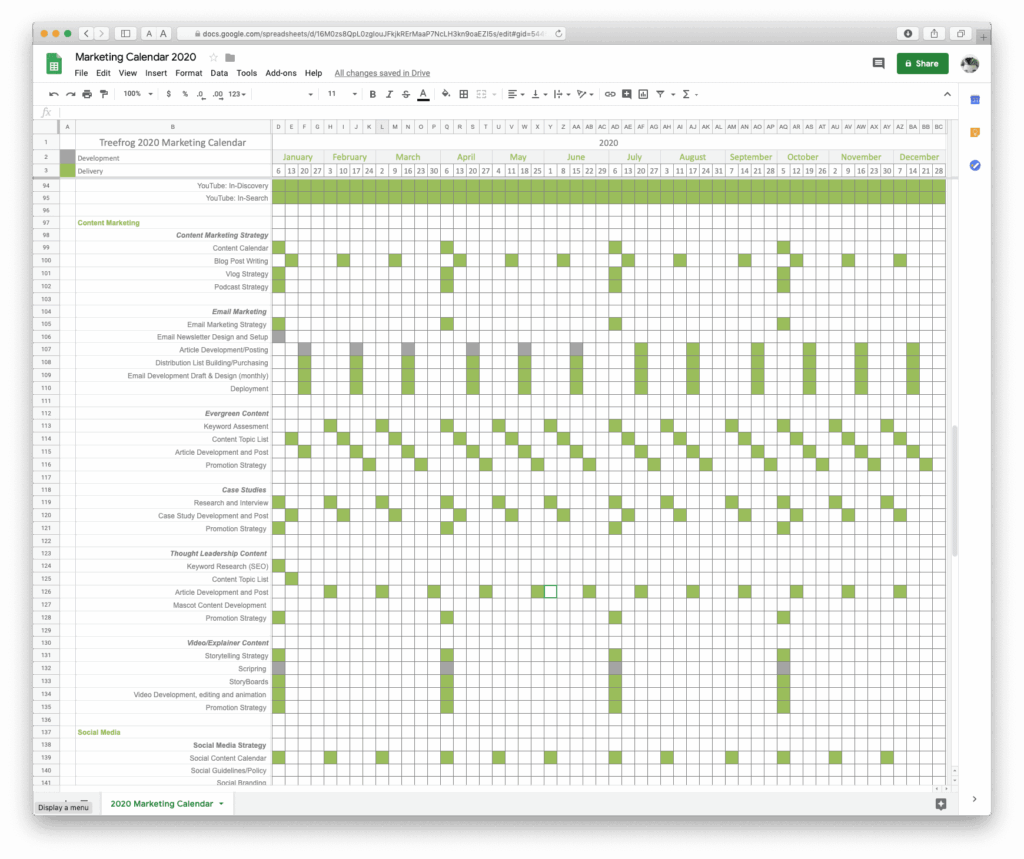
This worksheet is an easy-to use spreadsheet of various marketing activities to stimulate your brain into thinking about how to gear up over the coming year for growth. If you are a CEO or business owner, you should have this plan in front of you. If you are a marketing person, you should be creating and customizing this plan based on a budget or what you already know works.

At the very least, it’s certainly a lot easier to decide what marketing activities aren’t part of your plan for 2020, so you don’t waste any energy wondering what could have been.

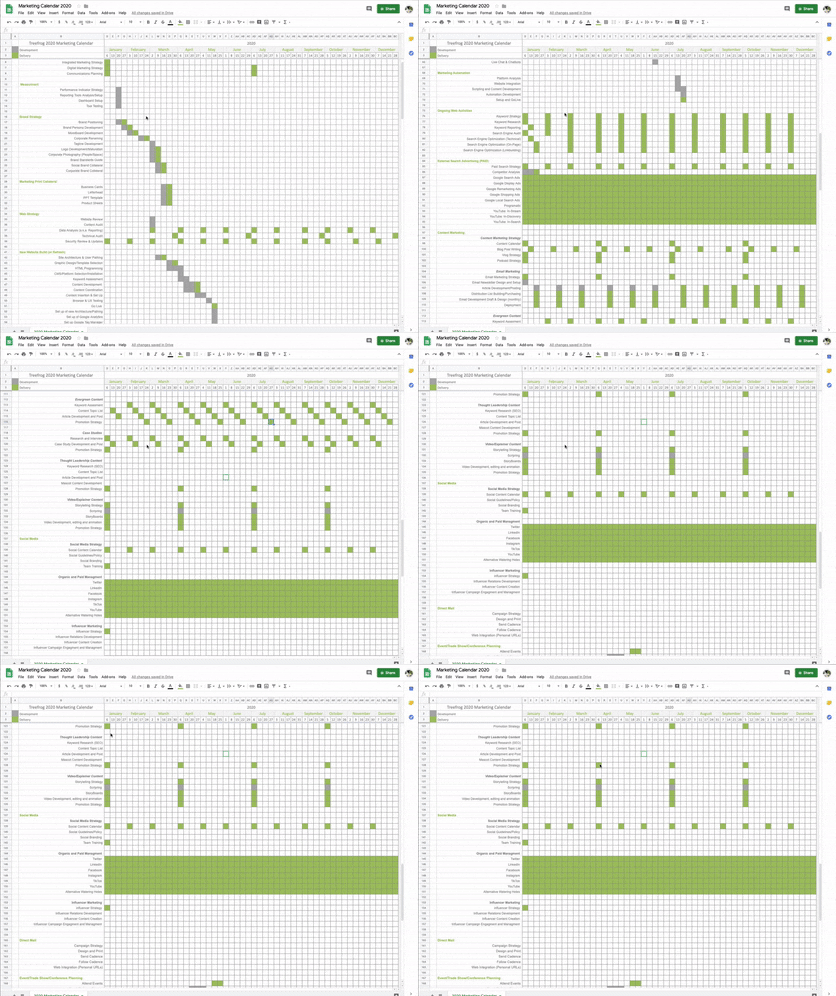
 Here is an example of it in action;


If we can help you with your strategy or with any of the tactics in 2020, let us know! We can help you design, build and execute your strategy once it’s been intelligently reviewed and lined up with your budget and business goals for the next decade.

At least, with a little elbow grease in the coming week or so, you’ll know what you are doing to grow your business going into the new year.

Happy Holidays!

How to Use this Document

It’s easy. Go through the document, line by line. Decide what week you would or should be working on components of your marketing. Color in the weeks that you believe you should be doing a marketing activity of that type (each square represents the Monday of a new week).

This document contains an example of how a marketing strategy should look. You might start by erasing it all and starting again! Or perhaps just edit from the example input already in the document.

We at Treefrog take these draft strategies and put them into a professional project management tool (we use Wrike) – but this document is a perfectly good substitute to get your mind engaged and get your creative and strategic juices flowing.

Enjoy!


Fill out the form below and your copy of the 2020 Marketing Calendar Worksheet will be emailed to you

"*" indicates required fields

This field is for validation purposes and should be left unchanged.
This field is hidden when viewing the form

Not sure where to start? Or Don’t you have time as you work in the business to work on your marketing? Let’s chat. We can offer a complimentary 30-minute consult to get you started, and help you design, build and execute your strategy once it’s been intelligently reviewed and lined up with your budget and business goals for the next decade.

Treefrog logo made of moss
Artificial Intelligence, Augmented & Virtual Reality, Branding & Design, Digital Marketing, Hosting & Infrastructure, IoT, NFC and Beacons, Mobile App Development, Web Application Development, Web Design & Development

What Does Treefrog Do?

Our “Who”

It is not uncommon for a company, country, or an individual to have an annual theme. At Treefrog, our CEO has set one for the company each year, and while most often they have remained internal; this year, we’ve decided to launch a marketing theme along with an internal monologue:

“What does Treefrog do?”

While this might seem like a strange question to be asking after nearly 20-years of business, as a digital agency, we have evolved incredibly over the last two decades; from CD burning to website development, creating a content management system (LEAP), to the additions of search ranking and social, to bleeding edge innovation around AI, AR, and IoT. And throughout all of this change, we hold one common theme: innovation and ideation.

Wall with full of multi coloured adhesive, sticky notes, project planning.

But, we are no longer the people in a basement designing websites by day and coding them by night. We’ve grown into a 40+ team. Our clients have matured and grown, just as the small Town of Newmarket has too.

There comes a time in every organization where you need to step back and ask: Based on our growth, are our clients of yesterday still our clients today? And will they be our clients of tomorrow?

At the end of 2018, we set out to answer this very question.

Let us share how we did this:

Our goal was to identify ten words or fewer that would succinctly recognize who our client is. We began by listing out a variety of clients (both past and present), what types of services they offer, and the successes we’ve had with them. This was followed by a lengthy exercise of identifying attributes of these many customers and how we work with our clients.

During the process, we started to notice patterns in the clients and attributes. While some clients were our long-time partners of 15+ years, others had been working with us for less than two years. Some clients were multi-million dollar organizations, with operations around the world, and others were less than five team members and under half million in revenue.

Fascinating similarities in connection for all clients regardless of size, location, industry or income started to emerge. Attributes such as:

  • Relationship-focused
  • Growth-Oriented
  • Collaborative
  • Curious
  • Patient
  • Experts in their field

We then categorized the attributes, in the hopes of boiling our brainstorming session down into one sentence that was evident in all the clients that we selected, both prosperous and less successful (yes we looked at our failures too).

In all cases, we were dealing with the CEO or lead decision-maker; even in the $80-million company, we had a direct line to the CEO.

However, we also realized that in focusing on our clients, what they asked of us was only part of the equation. How we behave, and our values played an essential role in this process too.

As we mingled our values with the attributes of our clients, we landed on something very close to “who” our ideal client is. This included a definition of each client, and a description that would be lasting regardless of the services that we offer or the ways to which we provide support.

“Courageous, aspirational decision-makers concerned about being digitally underdeveloped who want an invested partner.”

TREEFROG INC.

It’s not marketing speak. It’s not meant to be pretty. It’s an internal dialogue for whom we define as our partner. Let’s unpack this definition:

Courageous

Courage defined as ‘being afraid of something and doing it anyway.’

Starting a company, inheriting a company, or gaining the position of leader in an organization is an act of courage. Sometimes it’s the only act of courage a leader makes (that’s an article for another time). But, taking on that role can be scary. Leading an organization takes courage, on a daily basis.

This word was especially crucial to our team, as many of the clients we looked at need a lot of courage in both their companies and industries. Also, when you think about technologies and the digital industry, there are a lot of unknowns, it’s intimidating to many individuals, yet the courageous person moves forward even in the face of uncertainty.

Aspirational

Aspirational or Aspiration has a dual significance in the hope or ambition to go-after or achieve something paired with the action or process to get it. Aspirational individuals are decisive, visionary, curious, and willing to take risks. At Treefrog, we are aspirational; we take risks, we go after big ideas with curiosity and joy. Our best clients are aspirational, taking risks in business, achieving something beautiful.

Decision-Maker

Let’s be real. We all want to be dealing with the decision-maker, that’s a given. But, this decision-maker is unique, they go after new things, and they embrace or welcome innovation, thinking outside the box. They are not just any decision-maker but one who eagerly craves success.

Concerned

This word is especially significant in our definition. Several businesses in the world are happily digitally underdeveloped or non-existent. These are not our clients. We are not seeking to find these decision-makers.

We have one of these businesses leaders on our team right now, a hired consultant working with us part-time: but she is not our client, as she isn’t concerned about her digital footprint.

We are instead interested in working with (and for) companies and decision-makers who are worried about their place in the digital space, who fear missing out, who recognize they are lagging in the digital arena even though they may be experts in their industry.

Digitally Underdeveloped

What does it mean to be digitally underdeveloped? It is relative to the business, knowledge holders, competitors in the industry, and the company itself. It could mean a variety of status points, having an out-dated website, lagging in social engagements, using antiquated systems such as Excel for essential business functions, and more.

This is the one area we’ve spent the most amount of time on, defining and understanding what this could mean to many businesses including our past, current, and future clients. Stay tuned for part two of this article next month, as we will unpack this even more.

Want

Desire. Need. Want. Again, another impactful word in our definition as it describes the mental state of the decision-maker. They aren’t merely looking to fill a gap; this is something they crave or seek. It’s like breathing or nourishment to them, and they see the importance, they are willing to explore and find more than just the bare minimum.

Invested Partner

Lastly, a partner, yet not just any partner but one who is there for the long journey. At Treefrog, this is one of our strongest values, almost to a fault. We think of our clients and their businesses as if they are our businesses and our families. We pride our relationships with authenticity and love. When we engage in a new project, we look at the contract like that of the full depth and sanctity. For better, for worse, for richer, for poorer, in sickness and in health, to love and to cherish. We are there side-by-side with our clients.

What’s next for Treefrog?

Now that we have a defined a clear path of the types of individuals for whom we have seen through evidence-based work and by aligned values, partnership, and longevity, we can start to examine the ‘what’ in: What does Treefrog do?

We hope you’ve found this article informative as to how we discovered our “who,” a question most businesses struggle to articulate.

At Treefrog, we encourage innovation and thought leadership in all that we do. If you would like help in finding your “who,” we offer no-charge innovation ideation sessions for our clients. We merely ask for a 10-15 minute pre-call to learn about your business and what keeps you up at night.

Interested? Please let us know by emailing info@treefrog.ca.

Close up of an office table covered in brainstorming notes. Several people are leaning over the notes.
Web Design & Development

The Importance of Scoping

“If you don’t know where you’re going, you’ll end up somewhere else”
– Yogi Berra

At Treefrog, we value client success

As a digital transformation agency, our specialty is helping organizations tap into their full potential in the digital space; whether it’s underdeveloped or underutilized resources to drive change in the company or industry space.

Often when we start the conversation, there are so many unknowns that it can be hard to put a plan in place. For example, if you want to take your product or services online to sell, there are several things to consider:

  • What will the shipping be? By Weight? Location?
  • How will you handle taxes?
  • What about International currencies?
  • Inventory Management?
  • Discounts? Specials?

So the list goes on. Having a trusted partner to guide you through the process is essential. Whether it is an e-commerce system, ERP integration, building a customer portal, app development, augment Reality, or otherwise, we know the pain and uncertainty that can come with a project of this magnitude. Thus, we want to help you identify and reduce risk as much as possible.

To help reduce your risk, Scoping is extremely important in leading us in the proper direction. However, have you ever started a project with a plan and realized a stronger approach along the way? Digital projects can never be planned from start to finish, and they have several unknown variables in the early stages.  So, the best option is to prepare for a goal and make changes along the way to produce ample results.

If you have done renovations to your home, you may be familiar with this concept. At the start of the project, you explain to the contractor your vision, and a blueprint is created. However, once the renovations have begun changes must be made for a perfect result.

Most digital agencies will manage projects using a top-down approach (also known as the waterfall method). This fixed approach can cause projects to be unsuccessful as the plan is so set in stone there is no room for improvement along the way. The scope is often made at the start, with little room for change without a high cost. Often clients will be disappointed when great ideas are ignored to adhere to the timeline and budget. We find this is due to the three constraints faced by any project: Budget, Timeline, and Resources.

Typically referred to as the iron triangle, these constraints faced by project managers are the scope, schedule, and cost. They work interdependently together, and none of them can be adjusted without affecting the other.  For example, if the deadline of a project is moved up, the scope will be changed, as goals may not be achieved.

At Treefrog, we believe following a top-down approach often leads to disappointment and a lack of success. These fixed plans at the start of projects lead to distress, as there is a strict goal to maintain a scope, budget, and time constraints. However, like most things in life, it takes getting your hands dirty to figure out the best solution.

We have found that the following method reduces uncertainties based on continuous collaboration. The Scope/Discovery Process is unique to each client and includes some part of:

  •  Understanding the clients business goals
  • Defining the client’s target audience
  • Creating a list of tasks that will assist the client in achieving goals
  • Outlining in detail what we can offer the client

Although the discovery process helps the initial scope, there is always a cone of uncertainty when starting a new project.  This idea emerged from the engineering industry in the 1950s, but it is highly applicable to today’s digital world. The basic premise of this is that all projects have a large number of uncertainties in the early stages. However, as more hours are put in, and great ideas begin to flow masterpieces are created. The reason for this is, no two projects ever have:

  • The same requirements
  • The same people
  • The same technology
  • The same user audience
  • The same priorities & constraints
  • The same business strategy

We have learned to be agile in our creative process. Thus going through the initial scope and wireframing of a project increases the depth of knowledge, available technologies, budgets, and resources. This gives all involved the time to unpack uncertainties, brainstorm on the grand scope of the project, be upfront and honest with the expectations. Much like an actual Treefrog, we are highly adaptable to change. We want our clients to love what we produce for them— and we want to brag about it too.

Do you have an idea or project that you haven’t fully conceptualized yet? Are you looking for some grounded feedback? Give us a call; we’d love to hear about your idea(s).

Female owner of a small business packing her product in boxes, and preparing it for delivery.
Digital Marketing, Web Design & Development

Don’t Make These 5 E-commerce Business Mistakes

Owning an e-commerce business can be challenging (to say the least), as many factors that can damage a reputation, a brand, and an end product.

If you wish to be successful online, look like a credible business, and be known worldwide, it is important to avoid making these five e-commerce business mistakes:

1. Under Researching Your Competition

Research, research, and more research is key to starting any business. Understanding the market and studying up on your competition will get you one step closer to owning a successful online brand.

Reading case studies on other e-commerce businesses in your market to see what you may want to do better or differently is a good start. In this process, we suggest that you learn how to conduct a competitive analysis.

What is a competitive analysis?

A competitive analysis is an evaluation of what makes you unique when compared to other competing brands. This process will allow you to more clearly differentiate yourself from the competition and make more informed decisions in your marketing strategy.

How To Conduct A Competitive Analysis

2. Avoiding SEO

Search Engine Optimization helps to generate more organic traffic to your website. Before building an online store, you should understand how search engine optimization works and how to use it to your advantage.

When a website is created with Google and other search engines in mind, it is more successful. In other words, it will have a better chance of being found, viewed, and enjoyed.

The higher your website appears organically on a Google results page, the better and more relevant it has been ranked.

Learning how to use the right keywords for your site is a good start when studying and writing for SEO. At Treefrog, we can help you to improve your SEO with a suite of strategies and best practices. We will also help you create, organize, and optimize your web content so that you will be visible when it matters – when your potential customers are looking for services you provide.

3. Choosing The Wrong Web Platform

When starting a business, it is often confusing which website platform to use. If you use a website platform that fits with your business requirements, it must also be reputable and good quality.

The landing page of a website is the first thing users will see when they enter your site. Some elements a website should have to keep potential customers on your site include:

  • Appealing Design: This will ensure your e-commerce business looks like a professional store, as some web users feel uneasy when shopping online.
  • Easy Navigation
  • Category Pages: If you sell a large variety of products in your e-commerce business, this will organize the items so users can find exactly what they are looking for

At Treefrog, we work in many platforms to ensure our clients receive the best website for their specific needs. Some of these include; WordPress, Shopify, Wix, Magento, Drupal, Leap, and custom systems.

4. Neglecting To Optimize Your Site For Mobile Users

Many people have ditched desktop and laptop computers for their mobile devices, which are easier to handle and use on the go. Therefore, it should be of no surprise that mobile commerce is vastly growing.

A research study conducted through Think with Google states that if people have a negative online experience from a mobile device, they are 62% less likely to purchase from your e-commerce store in the future.

As more people are using their phones or tablets when looking to order furniture, clothing, or the latest gadget, it is essential to make sure your website is responsive (mobile-friendly). Mobile optimization will create a more frictionless buyer’s experience.

5. Settling For Slow

We live in an age where everyone is in a rush; we can now order coffee from our phone, we can choose a self checkout lane at the grocery store, and we expect packages to be shipped in a day.

The quickness of technology may be convenient at times, but we’d argue it has created some very impatient people. This is especially true when it comes to your website.

For example, if someone is waiting more than three seconds for your website’s page to load, it is highly likely they will close the page and look for information elsewhere. Therefore, a slow loading page can profoundly impact a website’s conversion rate, engagement, and brand reputation.

Why is page speed so critical?

It is vital to have a fast-loading page so users can get to where they want to go quickly.

Amazon stated that just one second of leg load time on their website would cause a loss of $1.6 billion in sales each year. That’s billion with a B!

Google has the same issue, stating an addition of 0.5 seconds of loading to its search pages causes traffic to drop by 20%.

The Importance of Page Speed

Connect With Treefrog Inc. Today!

At Treefrog Inc., we understand that starting an e-commerce business is hard and we want to help! Our Frogs are experts in many fields that can be beneficial to your online marketplace.

Visit our website at www.treefrog.ca for more information, or give us a call at 905-836-4442.

Happy intern listening to their mentor explaining a computer task
Branding & Design, Digital Marketing, Web Design & Development

Why Invest In A Co-op Student?

Over the years, we’ve had several co-op students at Treefrog. They’ve worked with a variety of pods from social and content to programming and project management. This year, we asked our content co-op student, Madeline, to share her thoughts on her internship and what the co-op experience meant to her.

Discovering The World Of Digital Marketing

At the start of grade 11, I had no idea what my passion was or how to uncover it. This was really scary since I only have two years left to figure out what’s next in this journey called life. After completing and finding interest in my marketing course, I talked to my school guidance counsellor who suggested I take a cooperative education course to help me get a sense of how the field really works. I decide to take her advice and began my research for a company in Newmarket that could fill this need.

Through my research, I found Treefrog and decided to reach out to see if they would be interested in a co-op student. Luckily, they responded and invited me for an interview. At first, I was very nervous, as I’ve never had a job before, so I didn’t know what to expect. I interviewed with Kellie, Dylan and Laurie, and they were welcoming and easy to talk to. I was overjoyed when they offered me a placement, which I value greatly to this day.

My Co-op Experience At Treefrog

On my first day at Treefrog, I was very shy, as I didn’t know anyone or much about how Treefrog worked. It was like going into a new class with all new class mates, only these people were the real deal. Everyone was so kind and instantly made me feel accepted.

The relaxed atmosphere made coming to Treefrog every day fun. Everyone made jokes, listened to music or just talked about current events happening in the world around us. I didn’t feel like I was working even though we were accomplishing a lot every day.

My first couple of projects were pretty simple, with the team being extremely supportive if I needed guidance. I’ve always thought of my writing skills as one of my strengths, but when I was asked to write a blog article, I was pretty nervous about what the outcome would be. After writing a draft and getting it edited by my supervisor I was surprised that I had just wrote my very own article! And it got posted, check it out here.

I’ve always had a love for social media and sharing my opinions online, so being able to write about topics that interested me was so much fun. After five months of writing blogs for different clients on topics ranging from personality to environmental issues and mental heath to professional services, I’ve discovered a passion for writing that I never knew I had and gained confidence in my writing skills.

During my time at Treefrog, I often got invited into meetings with clients, mostly for the purpose of taking notes. While this might seem boring, it was really interesting and helped me learn about the wide variety of clients and their different needs. This expanded my knowledge on things such as search engine optimization (SEO) and social media marketing.

As I was the youngest in the office, I was often asked for my opinion as a high school student. This made me feel valued as often my ideas and input would be considered and put into action.

“Having such a supportive and inclusive team helped me step out of my comfort zone to voice my own opinions and not worry about if my opinion was right or wrong.”

MADELINE

Going into my co-op, I had very little experience, but during my time at Treefrog I was able to learn about Facebook analytics, website tracking, SEO, content creation and social media as more than just “posts” online. I learned how to cater to different companies and how all the different Treefrog pods fit together. While being immersed in the workplace, I was exposed to a variety of different roles, from sales, to programming, to design.

After an amazing 5 months, I know I will always value and be grateful for this co-op experience. I’ve met so many talented people who have helped me learn about Treefrog and the workplace. I’ve learned so much about digital marketing, SEO and social media that I’ve developed a love for this and hope to continue my studies in this field for post secondary.

Interested in a high school coop placement with Treefrog? Please email us for availabilities.

A green potted plant near a laptop on a wooden table
Artificial Intelligence, Augmented & Virtual Reality, Branding & Design, Digital Marketing, Hosting & Infrastructure, IoT, NFC and Beacons, Mobile App Development, Web Application Development, Web Design & Development

Why The Frogs Are Green

Here at Treefrog, we like to look at the bigger picture. Instead of thinking about the here and now, we see far into the future and understand that the decisions we make today, can greatly impact the next generation of Frogs.

We must share our beautiful world with everyone, and everything that resides here. While we might only live in a small pond we’ve found that a few simple changes can make a BIG difference.

At Treefrog, we are constantly looking for ways to reduce our carbon footprint.

Here are a few little changes that have made a big impact:

We Are Paperless

Saving trees starts with ditching paper. Once upon a time our entire project management office was run from coloured folders and stapled dockets. Moving the team away from the colour folder project system and into project management software was no small task. Our design team moved from sketchbooks and carbon pencils to a Wacom for digital mind mapping. Our Sales team moved to virtual notes directly in our CRM software (Salesforce), ditching the spiral Hilroy’s. Our cleaning team moved from paper towels to washable cloths, and we changed our washrooms to compostable towels.

The production and distribution of paper has a significant impact on the environment. Paper production poses issues on air, water and land. And as frogs, we dislike when deforestation destroys our homes. So we ask… why use paper when we have a virtual environment that can help us produce and deliver documents? And who likes paper cuts anyways? We do not.

We Started a Recycle and Compost Program

When we made the move from 12 Vincent to 567 Davis, we didn’t realize this change would mean giving up the ability to recycle and compost as we moved from a zoned-commercial/residential location to a pure commercial location. Unfortunately, the Town of Newmarket doesn’t offer pick up service for businesses.

Recyclable and non-recyclable garbage can indoors.

We were faced with an issue of how to maintain our recycling and composting habits – since throwing out cans just didn’t seem like an option for the frogs. For the first few months, frogs would boomerang their lunches until we were able to convince the town to offer us curbside services too.

As Bill Nye the Science Guy would say: “To leave the world better than you found it, sometimes you have to pick up other people’s trash.” But, this was not enough.

The frogs lobbied for these services, and won! We are one of the only businesses in Newmarket with this opportunity, so we do our very best to ensure we are properly recycling and composting.

We Smart Commute

Commuting to work sucks. Especially when you are stuck sitting in traffic. And hello, the prices of gas are crazy!  Speaking of gas, it is extremely harmful to our planet.

That is why Treefrog has implemented a Smart Commute Program. Before Smart Commute opened its doors to under 50 employee employers, we offered our Frogs cash bonuses when they choose to smart commute. This included carpooling, taking public transportation, walking to work (some frogs prefer hopping), or even skipping the drive and working from home1.

We Buy and Grow Locally

You can catch flies with honey. And frogs love flies. So, we go through lots of honey. However, we only buy locally sourced honey for our office. There are many environmental benefits in supporting local honey farmers. Farm-raised bees help to pollinate plants, which is beneficial to local wildlife. In addition, buying local supports honey farmers who are properly caring for and raising the endangered bees.

We also love to grow fruits and vegetables in our Treefrog garden. While having a garden may seem like a small impact, it has huge environmental benefits. Growing your own food can reduce carbon emission and waste. Food travels long distances to arrive at the grocery store, on average it takes over 1500 miles of travel before the fruits and veggies we love get placed in our carts. In addition, growing food can reduce waste as it eliminates the need for packaging such as plastic and cardboard. So, if you are ever passing Davis Drive in the summer, feel free to enjoy a tomato (or two) from our garden2.

We Only Drive Electric

Our Frogs are always on the go, whether we have a meeting with a client, a networking event or one of us is speaking at a workshop or conference; we have an electric car that will get us where we need to go. We invested in two fully electric cars to reduce our carbon footprint and protect our planet. While this might require some extra planning on our part when navigating to and fro, it’s worth the effort knowing that in the last five years we’ve reduced our carbon footprint by 130,000 km through the use of electric vehicles.

Vehicles that run on gas emit toxic greenhouse gases into the environment and pollute our air. Greenhouse gas emissions are the leading cause of climate change.

We Made Small Changes Around the Office

Change starts with the low hanging fruit, and at Treefrog, those are the simple things like batteries and lights.

As a digital marketing agency, it’s no surprise that we go through a lot of battery power. We recently started a new tactic with the goal of minimizing our environmental impact through battery conditioning. We converted all our batteries to brand new, top-of-the-line Eneloop batteries with a life of 2100 charges. So, no more one-time use batteries, only rechargeable!

A pair of rechargeable batteries.

Apart from the batteries, we also have a Nest Learning Thermostat that programs itself and helps save energy. Not only does it save us money on our heating bill, but it also helps us avoid running the air when no one’s home. We also use a combination of compact fluorescent lamp (CFL) lights and LEDs, which are more energy efficient.

These small things make a big difference in saving our planet.  We want Treefrog to live on for many generations, and we hope you do too.

What are you doing in your space to reduce your footprint? We’d love to hear from you!

Resources

https://www.worldwildlife.org/threats/deforestation-and-forest-degradation
https://www.tomsofmaine.com/good-matters/natural-products/the-amazing-benefits-of-local-honey

1 Smart commute bonus is only for in-office commuters.
2 Garden options tend to change from year to year.

Scroll to Top