It’s tempting to think that (successful) brands are only skin-deep. After all, aren’t colours and logos important? Visual branding is essential, but the ultimate goal is to establish a strong brand identity, combining both Branding Elements (logos, colours, shapes, imagery) and a Brand Persona (values, ethos, personality and traits).
While most brands have a handle on basic branding, few brands can claim they have an ‘identity without a Brand Persona. A Brand Persona is what ‘humanizes’ a brand, making it primed to interact with us on a deeper, intellectual and emotional level. Just like it sounds, a Brand Persona is not dissimilar to a person, having a unique ideology, character traits, values, ethos and culture. These aspects make it possible to develop a more profound emotional experience and build a relationship – potentially lasting a lifetime.
As humans, our lives and our relationships are incredibly diverse and complex. At a basic level, though, Maslov described that all humans have the exact fundamental physical and emotional needs to fill. These needs are “physiological,” “safety,” “belonging,” “esteem,” and “self-actualization.” They directly influence our behaviours, manifesting as desires, impulses and decisions. We never make a decision that is not linked in some way back to one of these core needs. We might not always be aware of this, but brands knowingly work hard to leverage this fact and use our emotions – as a gateway to selling us things. Targeting certain desired emotions has long been the specialty of good branding. It was initially used to reduce our anxiety about making buying decisions (thus leading to more significant profit for those companies who branded their products). Branding today still offers to show us what feelings or experiences we can expect: to feel happy, imaginative, loved, sexy, in control, witty, healthy, secure, prepared, strong, etc.
Brand Personas emerged to take things a step further by looking to our rational brain and psychology. They are designed to reach our deepest intellectual thoughts, principles, judgements and beliefs. To illustrate this, consider for a moment that on an interpersonal level, we will rarely develop a connection with people that we find nothing in common with; yet as soon as we discover common ground on something, we feel closer to them and take a greater interest in them.
This concept underpins the development of a Brand “Tribe”; defined as a group of people who align themselves with a Brand Identity as a true reflection
of themselves. Psychologically speaking, Brand Identities are fully developed in mind, just like people. These brands exhibit a detailed ideology and philosophy – they share a world perspective, outlining their values, speaking in a unique voice and showing off their personality. This level of complexity naturally mirrors the complexities we hold within ourselves, both attracting us and deepening our connection.
This is both how and why strong Brand Identities shape our lives, our experiences and eventually come to receive mass-market traction across the world. Far from being a negative situation, the inherent potential for brand identities to positively influence people’s lives and bring commonalities (bridging divides) gives designers around the world their hope and challenge for the future.
Branding Experts
Are you ready to strengthen your brand and build your business? At Treefrog, we can help you develop your brand strategy. Whether it’s logo design, logo maturation, corporate identity or graphic design services, we’re your business branding experts.
Give us a call at 905-836-4442; our team of branding experts are ready to help!
Today, it’s common to think of a “brand” as another word for a logo; after all, many people believe that branding is a term coined from branded livestock on cattle farms. However, the real history of branding goes back much further. The recorded practice of branding began as early as the Babylonian era when leaving a mark on an object was meant to signify ownership or a legacy of that property. It was a way of safeguarding its use against others. The actual term ‘brand’ used today was developed with a new desired purpose. Our intention now is to put a ‘reputation’ onto something for it to be sought-out and ideally stand out from its competitors.
Suppose modern branding aims to suggest a reputation. In that case, the psychology of modern branding is to help quell the anxiety of the consumer. Let’s consider how many choices we face in our daily lives. We can appreciate how this bombardment might affect how easy it is to make decisions.
Despite our vast technological advances and our ever-increasing knowledge, our brains’ decisions are still based upon a reptilian system rooted in a fight or flight mode. What we rationalize in front of us is not the same as what we perceive in this part of our brain, which is why not having a straightforward or easy choice can often make us feel uneasy and exhausted.
Understanding and working around this dilemma is what branding does best. Using visuals to tell an audience what to expect and what desired experience they will have even before their choice is made.
At the end of it all, the uncomfortable truth about branding is that it’s never in the hands of the makers. Those who decide what kind of brand is formed are actually the consumers; it is in their minds where a brand reputation is actually created and propagated.
Since the consumer gets to decide whether the brand reputation has true merit or not, branding must balance what is true and idealized. The promise vis-a-vie the packaging or other touch-points and interactions must all be delivered upon. This is how the brand earns its ‘reputation,’ albeit a positive or negative one. It is vitally important that every business understands that their brand is constantly being branded, either for better or worse. Although it is put out by companies, it is ultimately cemented by the experience of the customer.
Where art thou, logo?
Where does a logo fit in the experience of branding, and how important is it really? If we can think of branding like a person (we are all our own personal brand already). In that case, a logo is its face, a means of recognizing and remembering a unique identity and experience among the crowd. At its core, a logo’s purpose is to take a complex emotional experience across many different interactions and to distill it into something simple and easy to remember, like a single name and/or shape.
Business Branding Experts
Are you ready to strengthen your brand and build your business? At Treefrog, we take a top-down approach to helping you develop your brand strategy. Whether it’s logo design, logo maturation, corporate identity or graphic design services, we’re your business branding experts.
Give us a call at 905-836-4442; our team of graphic design and branding experts are ready to help!
All companies go through periods of growth, and in these growth stages, not every brand can endure the growing pains that may or may not require changes to your brand. Many companies believe that a brand is just your name and logo when in reality, it’s so much more than that, it’s your entire brand identity.
This is why many companies put off rebranding their business. However, by rebranding sooner rather than later, you can save yourself a lot of trouble in the long run. If you’re unsure whether or not you should rebrand, we’ve compiled a list of sure signs it’s time to rebrand. Keep in mind that just by searching for this blog, you already might know the answer you’re looking for.
1. It’s Been More Than Five Years Since You Branded
When was the last time you branded or rebranded your company? If you can’t remember, it’s probably time to start considering a rebrand. A lot can change in a year, which means your brand is becoming more outdated and irrelevant with each passing year. Remember, branding is not all about mood boards and logos, it’s also about your buyer personas. So rebranding is critical to keep updated with your brand’s aspects, not just your design elements.
2. Your Company is Switching Gears
If your company is beginning to expand into other markets or switching gears entirely, it’s time to consider a rebrand. The rebranding will help your new target market resonate and relate to your brand. Consider this; you’re a jewelry business. Suddenly you decided to expand into clothing. Your current brand might not reflect this new aspect of your business. If that’s the case, it’s likely time that you begin the process of rebranding.
3. Poor Reputation
All companies can go through a period of negative reputation, and some companies come out of it more robust. In contrast, others can feel the effects for years to come. If you’re still feeling the results of a poor reputation that you can’t shake, it’s time for a rebrand. Rebranding your company can help consumers see you in a positive light, especially if it’s done correctly.
The Red Ocean is a huge problem with companies today. Suppose your company has a generic logo, name and brand colours. In that case, you’re not standing out, you’re blending in, and its negativity is affecting your brand. The quickest way to stand out and start rebuilding is an overhaul and rebrand of your business. This will help you showcase why your company is different and better from your competitors.
Business Branding Experts
Are you ready to strengthen your brand and build your business? At Treefrog, we take a top-down approach to helping you develop your brand strategy. Whether it’s logo design, logo maturation, corporate identity or graphic design services, we’re your business branding experts.
Give us a call at 905-836-4442; our team of graphic design and branding experts are ready to help!
Whether you’re starting a new business or have been in the business world for years, you’ve likely heard the term “buyer persona” at one point or time. Though, what exactly is buyer personas, and why is it so critical for your business?
We’re going to unpack that in this blog and explain why it’s critical to create and understand these personas.
What is a Buyer Persona
The term persona derives from Latin and originally referred to a theatrical mask. Actors wore masks to assume a persona or character. Think of the classic comedy and tragedy masks we still see in reference to the theatre today.
In the marketing world, personas are in-depth profiles of a brand’s target consumers. Rather than create a false identity, marketing personas seek to show the most realistic portrait of a consumer possible as a means of better understanding their needs and the best way to communicate with them.
Most brands will have more than one consumer persona because different individuals may support the brand, while others may heavily influence consumers, and these influencers need personas as well. For example, a typical business-to-business sales process might include the H.R. Director endorsing a product to the V.P. of H.R., who in turn seeks the approval of the V.P. of finance, who then seeks the approval of the CEO. Each of these individuals will have different needs for the product based on their position, and it is essential to understand how each will respond to the brand proposition. That is why personas are as relevant to B2B brands as those selling to the general public.
How are Buyer Personas Used
Personas are not new to the marketing world. In the beginnings of modern marketing in the 1960s (think Madmen), ad agencies used to write in-depth target customers’ profiles, giving them names and families and backstories.
Today, however, personas are even more critical because they have empowered consumers and democratized marketing. Brands now engage in conversations with their customers and prospects via digital and social platforms in addition to traditional media.
In life, we tailor our conversation based on what we know of the individual we are addressing; we talk to our Mom differently than our best friend. The same is true in marketing. We need to tailor our message to suit the audience, and as previously noted, a brand may have several audiences. This is not to suggest that a brand should be inconsistent in its approach. A brand, like a human being, communicates based on a set of characteristics and values. You will tell Mom you love wine just as you will tell your best friend. You will express it differently to each.
Why Buyer Personas are Important
1. Personas will help you narrow down your target audience
Buyer personas are critical to your business, as they’re the guiding force on how to market your business to your target audience. They’ll give you insight into how your target market thinks. Thus, helping you to tailor messages to your specific target audience.
2. Buyer personas will help to determine the strategic decisions you make
Buyer personas will help to determine the strategic decisions you make. You will know how your personas will react to marketing campaigns, how to best deliver information to them and what type of content is most valuable to them. A persona takes away the guesswork when it comes to your marketing activities.
3. Insight into Audience Behaviour
Buyer personas are critical to your business, as they’re the guiding force on how to market your business to your target audience. They’ll give you insight into how your target market thinks. Thus, helping you to tailor messages to your specific target audience. It should be noted that buyer personas are a constant work in progress and should be updated frequently. As your target audience grows and changes, your buyer personas should as well.
Conclusion
Buyer personas are in-depth profiles of a brand’s target consumers. They’re critical to your business and your efforts to attract and retain customers. For your business to grow and succeed, you need buyer personas.
Buyer Persona Experts
Are you ready to strengthen your brand and build your business? At Treefrog, we take a top-down approach to helping you develop your brand strategy. Contact us today to learn more about our branding services or get an instant brand quote.
2020 is almost upon us. At this time of year, we see many articles reflecting on the year that’s just past. We know what happened in 2019 – but are we prepared for 2020?
The definition of “foresight” is: “the ability to predict or the action of predicting what will happen or be needed in the future.” And yet, we often forget, when planning for our business success in the coming year, what drives sales and interest in our product or services: marketing strategy.
Towards this end, we have decided this year to share one of our most valuable tools for planning upcoming marketing with our “Marketing Partners” (i.e. people who use us for their outsourced marketing needs). After your Christmas Turkey has settled and your gifts have been unwrapped and stowed away – this is the perfect time to reflect on what worked last year and what actions you should take next year to grow your business.
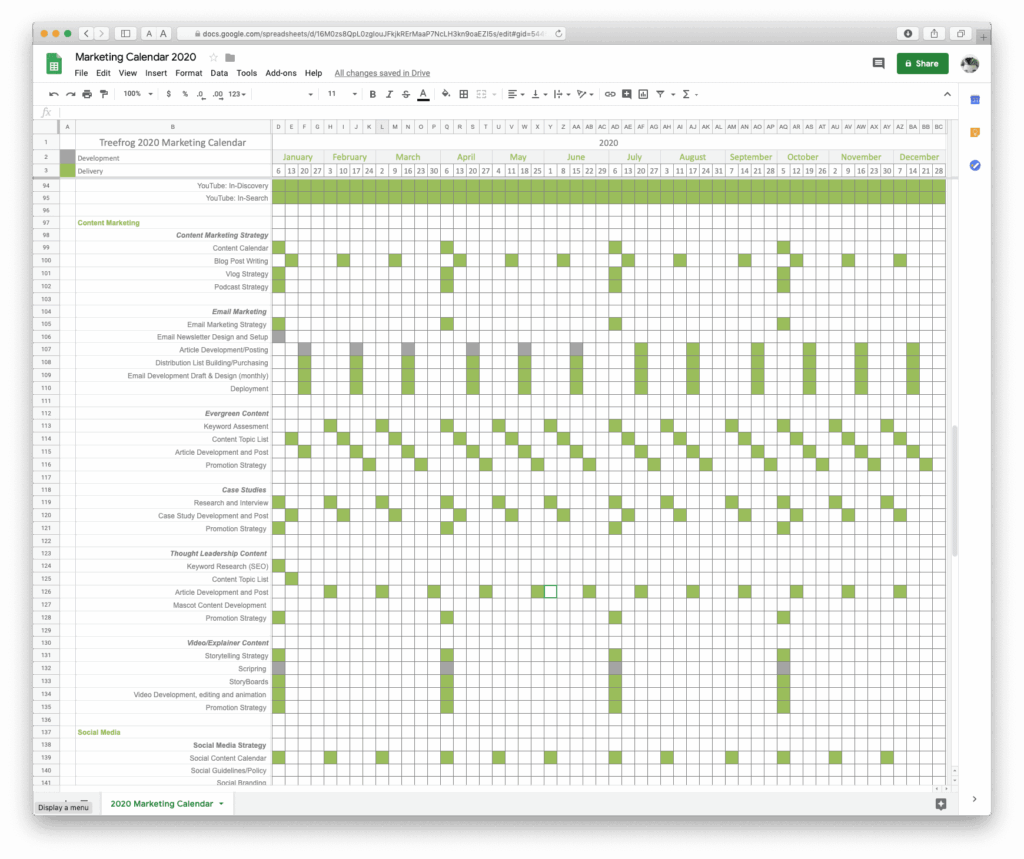
The Treefrog 2020 Marketing Calendar Worksheet
This worksheet is an easy-to use spreadsheet of various marketing activities to stimulate your brain into thinking about how to gear up over the coming year for growth. If you are a CEO or business owner, you should have this plan in front of you. If you are a marketing person, you should be creating and customizing this plan based on a budget or what you already know works.
At the very least, it’s certainly a lot easier to decide what marketing activities aren’t part of your plan for 2020, so you don’t waste any energy wondering what could have been.
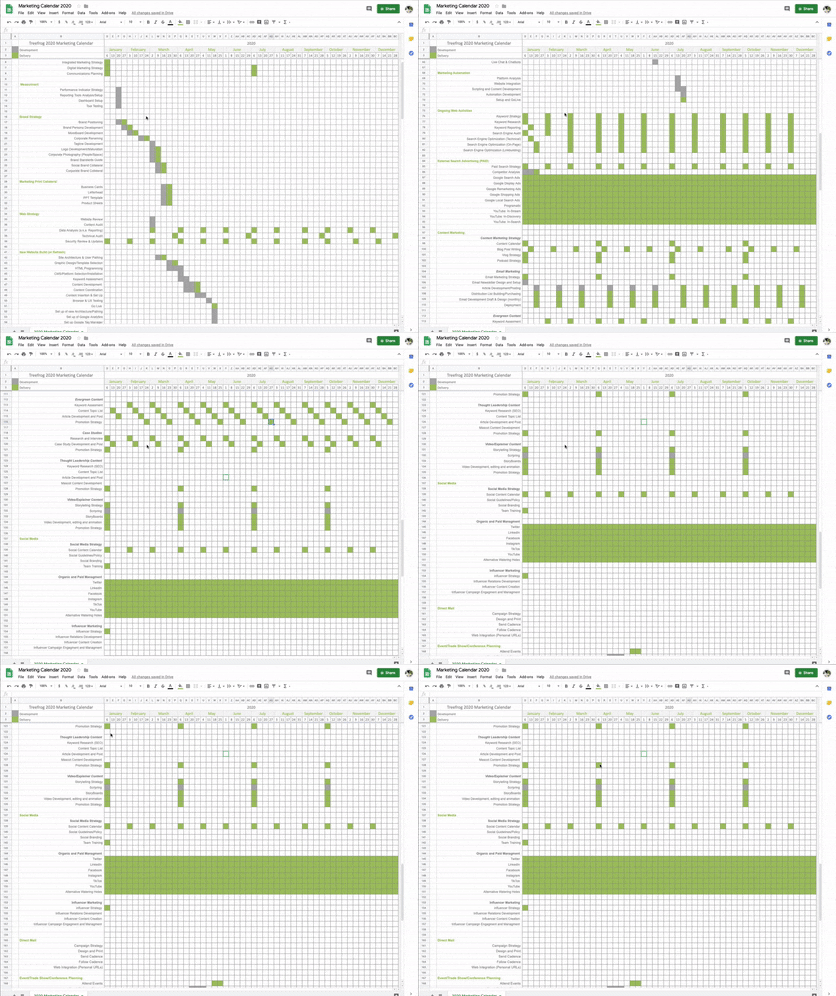
Here is an example of it in action;
If we can help you with your strategy or with any of the tactics in 2020, let us know! We can help you design, build and execute your strategy once it’s been intelligently reviewed and lined up with your budget and business goals for the next decade.
At least, with a little elbow grease in the coming week or so, you’ll know what you are doing to grow your business going into the new year.
Happy Holidays!
How to Use this Document
It’s easy. Go through the document, line by line. Decide what week you would or should be working on components of your marketing. Color in the weeks that you believe you should be doing a marketing activity of that type (each square represents the Monday of a new week).
This document contains an example of how a marketing strategy should look. You might start by erasing it all and starting again! Or perhaps just edit from the example input already in the document.
We at Treefrog take these draft strategies and put them into a professional project management tool (we use Wrike) – but this document is a perfectly good substitute to get your mind engaged and get your creative and strategic juices flowing.
Enjoy!
Fill out the form below and your copy of the 2020 Marketing Calendar Worksheet will be emailed to you
"*" indicates required fields
Not sure where to start? Or Don’t you have time as you work in the business to work on your marketing? Let’s chat. We can offer a complimentary 30-minute consult to get you started, and help you design, build and execute your strategy once it’s been intelligently reviewed and lined up with your budget and business goals for the next decade.
Every business wants to connect, to make an impact, and to grow. To do so, a brand must be so closely identified with the industry’s defining characteristic that they become known for it.
There is a very precise science to creating a strong brand and maintaining that strength. As humans, we are bombarded with so many stimuli every second that our brain creates a filter – known as sensory gating – to only take in the information that is deemed valuable. This may seem like an exaggerated statement at first, but think about your morning routine today. You most likely turned off the alarm on your phone, scrolled through social media, showered, ate breakfast, and drove to work. In every single one of these steps, despite your brain’s best efforts to block out all the promotional noise, your choices were affected by the power of strong brands.
So how do you ensure that your brand gets through the filter?
5 Basic Branding Barriers
A strong brand must satisfy the needs and wants of the target audience to last through the ages. Consider the list of characteristics below and see how many boxes your brand checks:
Emotive: consumers today are more driven by emotion than necessity, and a brand is the visual conveyance of a feeling that is most closely related to the target audience’s decision-making process.
Memorable: 50 per cent of consumers are more likely to click on a particular brand name if that brand name shows up more than once in a search engine. A strong SEO presence is essential.
Identifiable: a brand should be visually appealing and streamlined across all platforms. A simple yet powerful logo design can help with this.
Accessible: even with a brick and mortar storefront, studies show that 82 per cent of consumers will use their phone to help them make an in-store purchase. Without a digital presence, a brand will suffer.
Results-Driven: consumers will not return to a brand that has let them down in the past. Your clients’ success is your success.
The need to get past these “barriers” is what makes graphic design so important. At Treefrog, we have spent years studying the exact science of what makes or breaks a brand. The business world looks very different today than it did 20 years ago. Before digital marketing was ever an option – or even existed – companies were built on recommendations from friends and family. Now, this word-of-mouth has gone digital, and instead of close relations, consumers can get recommendations from millions of people at the click of a button.
Building Brand Recognition
Consumers are far more likely to choose a brand that they recognize over something unfamiliar, even if they don’t know a great deal about the company at the time. This means that even if a consumer has not made up their mind about a brand – and 90 per cent of searchers fall into this category – they are more likely to use a business simply because they know it. Consider the following benefits that come from a powerful, easily recognized brand:
Customer recognition
Competitive edge in the market
Easy introduction of new products
Customer loyalty and shared values
Enhanced credibility
Business Branding Experts
Are you ready to strengthen your brand and build your business? At Treefrog, we take a top-down approach to helping you develop your brand strategy. Whether it’s logo design, logo maturation, corporate identity or graphic design services, we’re your business branding experts.
Give us a call at 905-836-4442; our team of graphic design and branding experts are ready to help!
It is not uncommon for a company, country, or an individual to have an annual theme. At Treefrog, our CEO has set one for the company each year, and while most often they have remained internal; this year, we’ve decided to launch a marketing theme along with an internal monologue:
“What does Treefrog do?”
While this might seem like a strange question to be asking after nearly 20-years of business, as a digital agency, we have evolved incredibly over the last two decades; from CD burning to website development, creating a content management system (LEAP), to the additions of search ranking and social, to bleeding edge innovation around AI, AR, and IoT. And throughout all of this change, we hold one common theme: innovation and ideation.
But, we are no longer the people in a basement designing websites by day and coding them by night. We’ve grown into a 40+ team. Our clients have matured and grown, just as the small Town of Newmarket has too.
There comes a time in every organization where you need to step back and ask: Based on our growth, are our clients of yesterday still our clients today? And will they be our clients of tomorrow?
At the end of 2018, we set out to answer this very question.
Let us share how we did this:
Our goal was to identify ten words or fewer that would succinctly recognize who our client is. We began by listing out a variety of clients (both past and present), what types of services they offer, and the successes we’ve had with them. This was followed by a lengthy exercise of identifying attributes of these many customers and how we work with our clients.
During the process, we started to notice patterns in the clients and attributes. While some clients were our long-time partners of 15+ years, others had been working with us for less than two years. Some clients were multi-million dollar organizations, with operations around the world, and others were less than five team members and under half million in revenue.
Fascinating similarities in connection for all clients regardless of size, location, industry or income started to emerge. Attributes such as:
Relationship-focused
Growth-Oriented
Collaborative
Curious
Patient
Experts in their field
We then categorized the attributes, in the hopes of boiling our brainstorming session down into one sentence that was evident in all the clients that we selected, both prosperous and less successful (yes we looked at our failures too).
In all cases, we were dealing with the CEO or lead decision-maker; even in the $80-million company, we had a direct line to the CEO.
However, we also realized that in focusing on our clients, what they asked of us was only part of the equation. How we behave, and our values played an essential role in this process too.
As we mingled our values with the attributes of our clients, we landed on something very close to “who” our ideal client is. This included a definition of each client, and a description that would be lasting regardless of the services that we offer or the ways to which we provide support.
“Courageous, aspirational decision-makers concerned about being digitally underdeveloped who want an invested partner.”
It’s not marketing speak. It’s not meant to be pretty. It’s an internal dialogue for whom we define as our partner. Let’s unpack this definition:
Courageous
Courage defined as ‘being afraid of something and doing it anyway.’
Starting a company, inheriting a company, or gaining the position of leader in an organization is an act of courage. Sometimes it’s the only act of courage a leader makes (that’s an article for another time). But, taking on that role can be scary. Leading an organization takes courage, on a daily basis.
This word was especially crucial to our team, as many of the clients we looked at need a lot of courage in both their companies and industries. Also, when you think about technologies and the digital industry, there are a lot of unknowns, it’s intimidating to many individuals, yet the courageous person moves forward even in the face of uncertainty.
Aspirational
Aspirational or Aspiration has a dual significance in the hope or ambition to go-after or achieve something paired with the action or process to get it. Aspirational individuals are decisive, visionary, curious, and willing to take risks. At Treefrog, we are aspirational; we take risks, we go after big ideas with curiosity and joy. Our best clients are aspirational, taking risks in business, achieving something beautiful.
Decision-Maker
Let’s be real. We all want to be dealing with the decision-maker, that’s a given. But, this decision-maker is unique, they go after new things, and they embrace or welcome innovation, thinking outside the box. They are not just any decision-maker but one who eagerly craves success.
Concerned
This word is especially significant in our definition. Several businesses in the world are happily digitally underdeveloped or non-existent. These are not our clients. We are not seeking to find these decision-makers.
We have one of these businesses leaders on our team right now, a hired consultant working with us part-time: but she is not our client, as she isn’t concerned about her digital footprint.
We are instead interested in working with (and for) companies and decision-makers who are worried about their place in the digital space, who fear missing out, who recognize they are lagging in the digital arena even though they may be experts in their industry.
Digitally Underdeveloped
What does it mean to be digitally underdeveloped? It is relative to the business, knowledge holders, competitors in the industry, and the company itself. It could mean a variety of status points, having an out-dated website, lagging in social engagements, using antiquated systems such as Excel for essential business functions, and more.
This is the one area we’ve spent the most amount of time on, defining and understanding what this could mean to many businesses including our past, current, and future clients. Stay tuned for part two of this article next month, as we will unpack this even more.
Want
Desire. Need. Want. Again, another impactful word in our definition as it describes the mental state of the decision-maker. They aren’t merely looking to fill a gap; this is something they crave or seek. It’s like breathing or nourishment to them, and they see the importance, they are willing to explore and find more than just the bare minimum.
Invested Partner
Lastly, a partner, yet not just any partner but one who is there for the long journey. At Treefrog, this is one of our strongest values, almost to a fault. We think of our clients and their businesses as if they are our businesses and our families. We pride our relationships with authenticity and love. When we engage in a new project, we look at the contract like that of the full depth and sanctity. For better, for worse, for richer, for poorer, in sickness and in health, to love and to cherish. We are there side-by-side with our clients.
What’s next for Treefrog?
Now that we have a defined a clear path of the types of individuals for whom we have seen through evidence-based work and by aligned values, partnership, and longevity, we can start to examine the ‘what’ in: What does Treefrog do?
We hope you’ve found this article informative as to how we discovered our “who,” a question most businesses struggle to articulate.
At Treefrog, we encourage innovation and thought leadership in all that we do. If you would like help in finding your “who,” we offer no-charge innovation ideation sessions for our clients. We merely ask for a 10-15 minute pre-call to learn about your business and what keeps you up at night.
Over the years, we’ve had several co-op students at Treefrog. They’ve worked with a variety of pods from social and content to programming and project management. This year, we asked our content co-op student, Madeline, to share her thoughts on her internship and what the co-op experience meant to her.
Discovering The World Of Digital Marketing
At the start of grade 11, I had no idea what my passion was or how to uncover it. This was really scary since I only have two years left to figure out what’s next in this journey called life. After completing and finding interest in my marketing course, I talked to my school guidance counsellor who suggested I take a cooperative education course to help me get a sense of how the field really works. I decide to take her advice and began my research for a company in Newmarket that could fill this need.
Through my research, I found Treefrog and decided to reach out to see if they would be interested in a co-op student. Luckily, they responded and invited me for an interview. At first, I was very nervous, as I’ve never had a job before, so I didn’t know what to expect. I interviewed with Kellie, Dylan and Laurie, and they were welcoming and easy to talk to. I was overjoyed when they offered me a placement, which I value greatly to this day.
My Co-op Experience At Treefrog
On my first day at Treefrog, I was very shy, as I didn’t know anyone or much about how Treefrog worked. It was like going into a new class with all new class mates, only these people were the real deal. Everyone was so kind and instantly made me feel accepted.
The relaxed atmosphere made coming to Treefrog every day fun. Everyone made jokes, listened to music or just talked about current events happening in the world around us. I didn’t feel like I was working even though we were accomplishing a lot every day.
My first couple of projects were pretty simple, with the team being extremely supportive if I needed guidance. I’ve always thought of my writing skills as one of my strengths, but when I was asked to write a blog article, I was pretty nervous about what the outcome would be. After writing a draft and getting it edited by my supervisor I was surprised that I had just wrote my very own article! And it got posted, check it out here.
I’ve always had a love for social media and sharing my opinions online, so being able to write about topics that interested me was so much fun. After five months of writing blogs for different clients on topics ranging from personality to environmental issues and mental heath to professional services, I’ve discovered a passion for writing that I never knew I had and gained confidence in my writing skills.
During my time at Treefrog, I often got invited into meetings with clients, mostly for the purpose of taking notes. While this might seem boring, it was really interesting and helped me learn about the wide variety of clients and their different needs. This expanded my knowledge on things such as search engine optimization (SEO) and social media marketing.
As I was the youngest in the office, I was often asked for my opinion as a high school student. This made me feel valued as often my ideas and input would be considered and put into action.
“Having such a supportive and inclusive team helped me step out of my comfort zone to voice my own opinions and not worry about if my opinion was right or wrong.”
Going into my co-op, I had very little experience, but during my time at Treefrog I was able to learn about Facebook analytics, website tracking, SEO, content creation and social media as more than just “posts” online. I learned how to cater to different companies and how all the different Treefrog pods fit together. While being immersed in the workplace, I was exposed to a variety of different roles, from sales, to programming, to design.
After an amazing 5 months, I know I will always value and be grateful for this co-op experience. I’ve met so many talented people who have helped me learn about Treefrog and the workplace. I’ve learned so much about digital marketing, SEO and social media that I’ve developed a love for this and hope to continue my studies in this field for post secondary.
Interested in a high school coop placement with Treefrog? Please email us for availabilities.
Here at Treefrog, we like to look at the bigger picture. Instead of thinking about the here and now, we see far into the future and understand that the decisions we make today, can greatly impact the next generation of Frogs.
We must share our beautiful world with everyone, and everything that resides here. While we might only live in a small pond we’ve found that a few simple changes can make a BIG difference.
At Treefrog, we are constantly looking for ways to reduce our carbon footprint.
Here are a few little changes that have made a big impact:
We Are Paperless
Saving trees starts with ditching paper. Once upon a time our entire project management office was run from coloured folders and stapled dockets. Moving the team away from the colour folder project system and into project management software was no small task. Our design team moved from sketchbooks and carbon pencils to a Wacom for digital mind mapping. Our Sales team moved to virtual notes directly in our CRM software (Salesforce), ditching the spiral Hilroy’s. Our cleaning team moved from paper towels to washable cloths, and we changed our washrooms to compostable towels.
The production and distribution of paper has a significant impact on the environment. Paper production poses issues on air, water and land. And as frogs, we dislike when deforestation destroys our homes. So we ask… why use paper when we have a virtual environment that can help us produce and deliver documents? And who likes paper cuts anyways? We do not.
We Started a Recycle and Compost Program
When we made the move from 12 Vincent to 567 Davis, we didn’t realize this change would mean giving up the ability to recycle and compost as we moved from a zoned-commercial/residential location to a pure commercial location. Unfortunately, the Town of Newmarket doesn’t offer pick up service for businesses.
We were faced with an issue of how to maintain our recycling and composting habits – since throwing out cans just didn’t seem like an option for the frogs. For the first few months, frogs would boomerang their lunches until we were able to convince the town to offer us curbside services too.
As Bill Nye the Science Guy would say: “To leave the world better than you found it, sometimes you have to pick up other people’s trash.” But, this was not enough.
The frogs lobbied for these services, and won! We are one of the only businesses in Newmarket with this opportunity, so we do our very best to ensure we are properly recycling and composting.
We Smart Commute
Commuting to work sucks. Especially when you are stuck sitting in traffic. And hello, the prices of gas are crazy! Speaking of gas, it is extremely harmful to our planet.
That is why Treefrog has implemented a Smart Commute Program. Before Smart Commute opened its doors to under 50 employee employers, we offered our Frogs cash bonuses when they choose to smart commute. This included carpooling, taking public transportation, walking to work (some frogs prefer hopping), or even skipping the drive and working from home1.
We Buy and Grow Locally
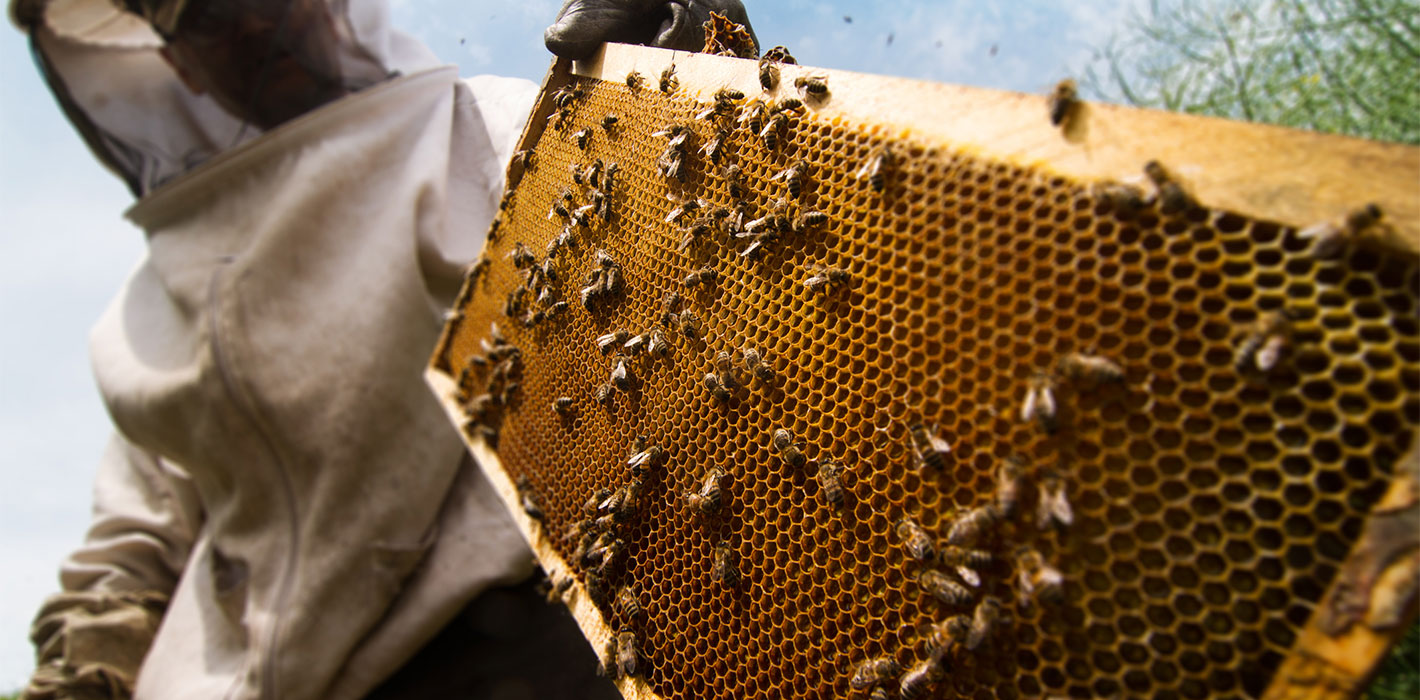
You can catch flies with honey. And frogs love flies. So, we go through lots of honey. However, we only buy locally sourced honey for our office. There are many environmental benefits in supporting local honey farmers. Farm-raised bees help to pollinate plants, which is beneficial to local wildlife. In addition, buying local supports honey farmers who are properly caring for and raising the endangered bees.
We also love to grow fruits and vegetables in our Treefrog garden. While having a garden may seem like a small impact, it has huge environmental benefits. Growing your own food can reduce carbon emission and waste. Food travels long distances to arrive at the grocery store, on average it takes over 1500 miles of travel before the fruits and veggies we love get placed in our carts. In addition, growing food can reduce waste as it eliminates the need for packaging such as plastic and cardboard. So, if you are ever passing Davis Drive in the summer, feel free to enjoy a tomato (or two) from our garden2.
We Only Drive Electric
Our Frogs are always on the go, whether we have a meeting with a client, a networking event or one of us is speaking at a workshop or conference; we have an electric car that will get us where we need to go. We invested in two fully electric cars to reduce our carbon footprint and protect our planet. While this might require some extra planning on our part when navigating to and fro, it’s worth the effort knowing that in the last five years we’ve reduced our carbon footprint by 130,000 km through the use of electric vehicles.
Vehicles that run on gas emit toxic greenhouse gases into the environment and pollute our air. Greenhouse gas emissions are the leading cause of climate change.
We Made Small Changes Around the Office
Change starts with the low hanging fruit, and at Treefrog, those are the simple things like batteries and lights.
As a digital marketing agency, it’s no surprise that we go through a lot of battery power. We recently started a new tactic with the goal of minimizing our environmental impact through battery conditioning. We converted all our batteries to brand new, top-of-the-line Eneloop batteries with a life of 2100 charges. So, no more one-time use batteries, only rechargeable!
Apart from the batteries, we also have a Nest Learning Thermostat that programs itself and helps save energy. Not only does it save us money on our heating bill, but it also helps us avoid running the air when no one’s home. We also use a combination of compact fluorescent lamp (CFL) lights and LEDs, which are more energy efficient.
These small things make a big difference in saving our planet. We want Treefrog to live on for many generations, and we hope you do too.
What are you doing in your space to reduce your footprint? We’d love to hear from you!
One of the fundamental ways to make sure your social media posts are getting engagement is to include visuals. Images, infographics, and videos are more likely to capture a person’s attention when compared to text. If your post doesn’t include visual content, it risks getting lost in people’s timelines amidst all of the posts that do include visuals. To illustrate this point, let’s explore the facts (yay, statistics!)
According to Buffer, Tweets with images are retweeted 150% more than Tweets without.
74% of social media marketers use visual assets in their social media marketing, ahead of blogs (68%) and videos (60%).
Eye tracking studies performed by Nielsen Norman Group suggested that when people find images relevant, they spend more time looking at them on a webpage than reading the text.
Bottom Line: Visuals. Use Them. Whether it’s a photo, an infographic, a video, or anything else!
But keep in mind, all visuals are not created equal, and there are things that make certain visuals more engaging than others. While these will differ depending on your industry (different audiences react differently to images), here are some general tips that are crucial when selecting visuals to include in your post:
1. Include Eyes
A tried and true method of getting people to stop at your image when scrolling through their newsfeeds is to include images where people appear to be staring at the viewer. Eye contact is a super engaging visual, and if your image draws eyes to your post, the viewer is more likely to stop, stare, and read your content.
This is a perfect example of an image where the entire visual appeal is based on eye contact.
2. Include a Lot of Colours, when Appropriate
We generally recommend sticking to a similar colour scheme (preferably your brand colours) when creating images – in order to make sure people are able to quickly connect the visuals to your brand. However, visuals that include a variety of colours are more eye-catching than those with few colours. So, whichever colour scheme you choose, at the very least, avoid images with only shades or dark colours.
Good:
Bad:
3. Design them for Easy Comprehension
Because the brain is able to quickly determine relationships between objects, people can create connections more quickly by looking at visuals than reading text. In the clever image below, Coke uses this idea to quickly teach people a new way of making iced tea – all without using a single word of text. Talk about taking advantage of the human brain!
4. Try Incorporating Humour
If you’re ever struggling to figure out how to connect with your audience, try using humour! Different types of people like different things, but a sense of humour is innate (we laugh even before we learn to talk).
Old Spice is a master at creating visuals that catch people’s eyes by using humour that’s immediately noticeable. This image is simple, creative, and effective!
5. Guide the Eyes with Lines
Using lines can help guide people’s eyes to sections of images that you want them to see. For example, try using lines to guide people’s eyes to an image labelled “call now” (or similar) – to direct their attention where you’d like it to be.
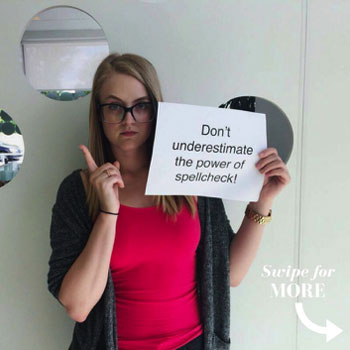
In the post below, we used arrows to encourage people to swipe left and see the next image in the post. This is perfect for Instagram, where you can include multiple photos in one post.
Treefrog Tip: When you are absolutely out of ideas for what visuals to include, or simply don’t have the resources to generate ones, use royalty-free image websites like Pixabay or PEXELS to search for images relevant to your post.
Keep in mind, you can’t always Google image search photos to include in your posts, as someone else may own the rights to them, and you may end up in trouble if you use them.
Need help creating eye-catching visuals that get noticed? Our graphic design and social media teams are made up of experts who understand the power of captivating imagery.