
Hosting & Infrastructure

Treefrog logo made of moss
Artificial Intelligence, Augmented & Virtual Reality, Branding & Design, Digital Marketing, Hosting & Infrastructure, IoT, NFC and Beacons, Mobile App Development, Web Application Development, Web Design & Development

What Does Treefrog Do?

Our “Who”

It is not uncommon for a company, country, or an individual to have an annual theme. At Treefrog, our CEO has set one for the company each year, and while most often they have remained internal; this year, we’ve decided to launch a marketing theme along with an internal monologue:

“What does Treefrog do?”

While this might seem like a strange question to be asking after nearly 20-years of business, as a digital agency, we have evolved incredibly over the last two decades; from CD burning to website development, creating a content management system (LEAP), to the additions of search ranking and social, to bleeding edge innovation around AI, AR, and IoT. And throughout all of this change, we hold one common theme: innovation and ideation.

Wall with full of multi coloured adhesive, sticky notes, project planning.

But, we are no longer the people in a basement designing websites by day and coding them by night. We’ve grown into a 40+ team. Our clients have matured and grown, just as the small Town of Newmarket has too.

There comes a time in every organization where you need to step back and ask: Based on our growth, are our clients of yesterday still our clients today? And will they be our clients of tomorrow?

At the end of 2018, we set out to answer this very question.

Let us share how we did this:

Our goal was to identify ten words or fewer that would succinctly recognize who our client is. We began by listing out a variety of clients (both past and present), what types of services they offer, and the successes we’ve had with them. This was followed by a lengthy exercise of identifying attributes of these many customers and how we work with our clients.

During the process, we started to notice patterns in the clients and attributes. While some clients were our long-time partners of 15+ years, others had been working with us for less than two years. Some clients were multi-million dollar organizations, with operations around the world, and others were less than five team members and under half million in revenue.

Fascinating similarities in connection for all clients regardless of size, location, industry or income started to emerge. Attributes such as:

  • Relationship-focused
  • Growth-Oriented
  • Collaborative
  • Curious
  • Patient
  • Experts in their field

We then categorized the attributes, in the hopes of boiling our brainstorming session down into one sentence that was evident in all the clients that we selected, both prosperous and less successful (yes we looked at our failures too).

In all cases, we were dealing with the CEO or lead decision-maker; even in the $80-million company, we had a direct line to the CEO.

However, we also realized that in focusing on our clients, what they asked of us was only part of the equation. How we behave, and our values played an essential role in this process too.

As we mingled our values with the attributes of our clients, we landed on something very close to “who” our ideal client is. This included a definition of each client, and a description that would be lasting regardless of the services that we offer or the ways to which we provide support.

“Courageous, aspirational decision-makers concerned about being digitally underdeveloped who want an invested partner.”

TREEFROG INC.

It’s not marketing speak. It’s not meant to be pretty. It’s an internal dialogue for whom we define as our partner. Let’s unpack this definition:

Courageous

Courage defined as ‘being afraid of something and doing it anyway.’

Starting a company, inheriting a company, or gaining the position of leader in an organization is an act of courage. Sometimes it’s the only act of courage a leader makes (that’s an article for another time). But, taking on that role can be scary. Leading an organization takes courage, on a daily basis.

This word was especially crucial to our team, as many of the clients we looked at need a lot of courage in both their companies and industries. Also, when you think about technologies and the digital industry, there are a lot of unknowns, it’s intimidating to many individuals, yet the courageous person moves forward even in the face of uncertainty.

Aspirational

Aspirational or Aspiration has a dual significance in the hope or ambition to go-after or achieve something paired with the action or process to get it. Aspirational individuals are decisive, visionary, curious, and willing to take risks. At Treefrog, we are aspirational; we take risks, we go after big ideas with curiosity and joy. Our best clients are aspirational, taking risks in business, achieving something beautiful.

Decision-Maker

Let’s be real. We all want to be dealing with the decision-maker, that’s a given. But, this decision-maker is unique, they go after new things, and they embrace or welcome innovation, thinking outside the box. They are not just any decision-maker but one who eagerly craves success.

Concerned

This word is especially significant in our definition. Several businesses in the world are happily digitally underdeveloped or non-existent. These are not our clients. We are not seeking to find these decision-makers.

We have one of these businesses leaders on our team right now, a hired consultant working with us part-time: but she is not our client, as she isn’t concerned about her digital footprint.

We are instead interested in working with (and for) companies and decision-makers who are worried about their place in the digital space, who fear missing out, who recognize they are lagging in the digital arena even though they may be experts in their industry.

Digitally Underdeveloped

What does it mean to be digitally underdeveloped? It is relative to the business, knowledge holders, competitors in the industry, and the company itself. It could mean a variety of status points, having an out-dated website, lagging in social engagements, using antiquated systems such as Excel for essential business functions, and more.

This is the one area we’ve spent the most amount of time on, defining and understanding what this could mean to many businesses including our past, current, and future clients. Stay tuned for part two of this article next month, as we will unpack this even more.

Want

Desire. Need. Want. Again, another impactful word in our definition as it describes the mental state of the decision-maker. They aren’t merely looking to fill a gap; this is something they crave or seek. It’s like breathing or nourishment to them, and they see the importance, they are willing to explore and find more than just the bare minimum.

Invested Partner

Lastly, a partner, yet not just any partner but one who is there for the long journey. At Treefrog, this is one of our strongest values, almost to a fault. We think of our clients and their businesses as if they are our businesses and our families. We pride our relationships with authenticity and love. When we engage in a new project, we look at the contract like that of the full depth and sanctity. For better, for worse, for richer, for poorer, in sickness and in health, to love and to cherish. We are there side-by-side with our clients.

What’s next for Treefrog?

Now that we have a defined a clear path of the types of individuals for whom we have seen through evidence-based work and by aligned values, partnership, and longevity, we can start to examine the ‘what’ in: What does Treefrog do?

We hope you’ve found this article informative as to how we discovered our “who,” a question most businesses struggle to articulate.

At Treefrog, we encourage innovation and thought leadership in all that we do. If you would like help in finding your “who,” we offer no-charge innovation ideation sessions for our clients. We merely ask for a 10-15 minute pre-call to learn about your business and what keeps you up at night.

Interested? Please let us know by emailing info@treefrog.ca.

A green potted plant near a laptop on a wooden table
Artificial Intelligence, Augmented & Virtual Reality, Branding & Design, Digital Marketing, Hosting & Infrastructure, IoT, NFC and Beacons, Mobile App Development, Web Application Development, Web Design & Development

Why The Frogs Are Green

Here at Treefrog, we like to look at the bigger picture. Instead of thinking about the here and now, we see far into the future and understand that the decisions we make today, can greatly impact the next generation of Frogs.

We must share our beautiful world with everyone, and everything that resides here. While we might only live in a small pond we’ve found that a few simple changes can make a BIG difference.

At Treefrog, we are constantly looking for ways to reduce our carbon footprint.

Here are a few little changes that have made a big impact:

We Are Paperless

Saving trees starts with ditching paper. Once upon a time our entire project management office was run from coloured folders and stapled dockets. Moving the team away from the colour folder project system and into project management software was no small task. Our design team moved from sketchbooks and carbon pencils to a Wacom for digital mind mapping. Our Sales team moved to virtual notes directly in our CRM software (Salesforce), ditching the spiral Hilroy’s. Our cleaning team moved from paper towels to washable cloths, and we changed our washrooms to compostable towels.

The production and distribution of paper has a significant impact on the environment. Paper production poses issues on air, water and land. And as frogs, we dislike when deforestation destroys our homes. So we ask… why use paper when we have a virtual environment that can help us produce and deliver documents? And who likes paper cuts anyways? We do not.

We Started a Recycle and Compost Program

When we made the move from 12 Vincent to 567 Davis, we didn’t realize this change would mean giving up the ability to recycle and compost as we moved from a zoned-commercial/residential location to a pure commercial location. Unfortunately, the Town of Newmarket doesn’t offer pick up service for businesses.

Recyclable and non-recyclable garbage can indoors.

We were faced with an issue of how to maintain our recycling and composting habits – since throwing out cans just didn’t seem like an option for the frogs. For the first few months, frogs would boomerang their lunches until we were able to convince the town to offer us curbside services too.

As Bill Nye the Science Guy would say: “To leave the world better than you found it, sometimes you have to pick up other people’s trash.” But, this was not enough.

The frogs lobbied for these services, and won! We are one of the only businesses in Newmarket with this opportunity, so we do our very best to ensure we are properly recycling and composting.

We Smart Commute

Commuting to work sucks. Especially when you are stuck sitting in traffic. And hello, the prices of gas are crazy!  Speaking of gas, it is extremely harmful to our planet.

That is why Treefrog has implemented a Smart Commute Program. Before Smart Commute opened its doors to under 50 employee employers, we offered our Frogs cash bonuses when they choose to smart commute. This included carpooling, taking public transportation, walking to work (some frogs prefer hopping), or even skipping the drive and working from home1.

We Buy and Grow Locally

You can catch flies with honey. And frogs love flies. So, we go through lots of honey. However, we only buy locally sourced honey for our office. There are many environmental benefits in supporting local honey farmers. Farm-raised bees help to pollinate plants, which is beneficial to local wildlife. In addition, buying local supports honey farmers who are properly caring for and raising the endangered bees.

We also love to grow fruits and vegetables in our Treefrog garden. While having a garden may seem like a small impact, it has huge environmental benefits. Growing your own food can reduce carbon emission and waste. Food travels long distances to arrive at the grocery store, on average it takes over 1500 miles of travel before the fruits and veggies we love get placed in our carts. In addition, growing food can reduce waste as it eliminates the need for packaging such as plastic and cardboard. So, if you are ever passing Davis Drive in the summer, feel free to enjoy a tomato (or two) from our garden2.

We Only Drive Electric

Our Frogs are always on the go, whether we have a meeting with a client, a networking event or one of us is speaking at a workshop or conference; we have an electric car that will get us where we need to go. We invested in two fully electric cars to reduce our carbon footprint and protect our planet. While this might require some extra planning on our part when navigating to and fro, it’s worth the effort knowing that in the last five years we’ve reduced our carbon footprint by 130,000 km through the use of electric vehicles.

Vehicles that run on gas emit toxic greenhouse gases into the environment and pollute our air. Greenhouse gas emissions are the leading cause of climate change.

We Made Small Changes Around the Office

Change starts with the low hanging fruit, and at Treefrog, those are the simple things like batteries and lights.

As a digital marketing agency, it’s no surprise that we go through a lot of battery power. We recently started a new tactic with the goal of minimizing our environmental impact through battery conditioning. We converted all our batteries to brand new, top-of-the-line Eneloop batteries with a life of 2100 charges. So, no more one-time use batteries, only rechargeable!

A pair of rechargeable batteries.

Apart from the batteries, we also have a Nest Learning Thermostat that programs itself and helps save energy. Not only does it save us money on our heating bill, but it also helps us avoid running the air when no one’s home. We also use a combination of compact fluorescent lamp (CFL) lights and LEDs, which are more energy efficient.

These small things make a big difference in saving our planet.  We want Treefrog to live on for many generations, and we hope you do too.

What are you doing in your space to reduce your footprint? We’d love to hear from you!

Resources

https://www.worldwildlife.org/threats/deforestation-and-forest-degradation
https://www.tomsofmaine.com/good-matters/natural-products/the-amazing-benefits-of-local-honey

1 Smart commute bonus is only for in-office commuters.
2 Garden options tend to change from year to year.

water drops on leaf
Hosting & Infrastructure, Web Design & Development

Domain Registry of Canada

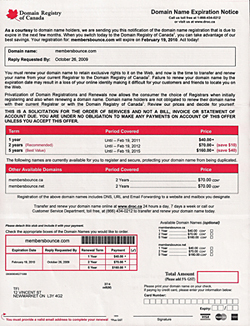
We receive calls from customers every few months asking if the letter they received from the “Domain Registry Of Canada” is a legitimate registrar… and they are!

But they prey on anyone Canadian who owns a domain name out there and hope that the customer will take their service over their current registrar and ten times out of ten you shouldn’t go through with it honestly.

We understand it looks like an official document from even the government, but it is not – this is just a registar out there preying on customers who may be unaware of this scam.

It’s very expensive alternative and they provide no service, and gives away the control of your domain to them and we’ve heard it gets even more difficult to make changes to your domain once in their control – be very careful!

If you receive a letter and have your domain with Treefrog call us immediately, do not fill out their form. Once you do we are unable to assist you and you’ll be out the cash (although we have saved a few domains because we were the admin contact and just cancelled their transfer).

This is a warning! Be careful!

(We’re not linking to them, they don’t deserve the link but you can Google their name if you’re that inclined or have received a letter – contact them, or shred the letter and burn the pieces)

Honeycomb with a bee
Hosting & Infrastructure, Web Design & Development

Understanding Website Hosting and Domains

Domains, hosting, registrar… you may know that these terms have something to do with a website, but what do they mean, and why should you care?

Do you know where your website is hosted? Who hosts your email? Who hosts your domain and where is that domain registered? Do you know who the administrative and technical contacts are within your company?

If you have been involved with a new website migration or build, you probably will have heard of the terms domain, hosting and registrar. But few people actually know what these things are, or why they are relevant to a website.

We’re going to try to break these things down a bit. Keep in mind that this is a complicated topic, so we’ll be using general terms and in some cases over-simplifying. Hopefully you’ll at least understand the basics once we’re done.

The main terms we’ll concentrate on are: Domain Registrar, Domain Name Server, Email and Website Hosting.

So what do these things mean? First of all, it helps to think of these terms in a hierarchical format.

Keep this structure in mind as we continue. Notice that we’ve arranged these in a top-down hierarchy.

At the top: The Registrar

It all starts at the top with the domain registrar. The domain registrar handles the registration of your website domain name, specifically what comes after the “www”.

It’s always important to make sure you know who has control of your domain, and that a reputable company is handling the renewal process. Domain names come up for renewal every few years, depending on the renewal plan. The last thing you want is to find out that you had unknowingly allowed your domain to expire.

In this same way, the registrar will handle the sale of multiple associated domains, for example .com .ca and .net versions of your website, or even similar URLs, like www.bakesale.com and www.bakesales.com

These companies have varying renewal policies for domains rentals. Keep in mind that you never actually “own” the domain, you continually rent them. Sometimes the registrar will set the renewal process to be automatic so that you don’t receive a notice every year; they’ll set it to renew automatically for 5 or 10 years. They’ll also have transfer policies in the event that you want to move your domain to another registrar.

Examples of Domain Registrar companies are: Treefrog, Tucows, GoDaddy, Network Solutions and NetFirms.

In the middle: The Domain Name Server (DNS)

Without getting too involved, a domain name server (DNS) is a massive database that stores website IP addresses and their associated “names”, in order for people to find sites on the Internet.

Brief explanation: each website has its own unique IP address, which is a set of numbers and periods. A domain name server translates those numbers into plain English. As opposed to seeing 234.543.345, we see the much prittier www.website.com.

Domain Name Servers handle website as well as email requests. Again, instead of having to remember some random string of numbers, the Domain Name Server allows you to send an email message to “somebody@website.com” and the servers handle all the necessary redirecting behind the scenes.

Examples of Domain Name Server companies are: Tucows, GoDaddy, Google, OpenDNS and Network Solutions.

At the bottom: Email/Website Hosting

Email and website hosting is on the bottom of the food chain in terms of access and control. These are on the same level in our diagram because technically they are not contingent on one another.

Email and website hosting can technically be handled by two different companies, but are often handled by the same one. A client can choose to migrate their website to another hosting company, and keep their email where it is. It is not necessary to host your website and your email in the same place.

Hosting a website basically means storing all of the website data: pages, files, images, and everything that would accept and serve up requests from users.

In the same way, email hosting entails storing all of the email messages and email files for that domain.

Even though website hosting and email hosting are on the same line in our diagram because they are not dependent on one another as far as permissions go, they are two very different entities. They operate on two completely different protocols—which is something that often confuses people, especially now that there are so many web-based email services like Gmail. Something to keep in mind: the Internet is the network; the World Wide Web and email are services used within it.

Now that we know a little bit more about the different pieces and what they are dependent on, let’s create a scenario.

“Knowing this information will help save time if you are getting into a website migration or new website build.”

Registering Your Domain

So you want to register your domain. This usually means that you have selected a website domain that you want to register (such as www.thiswebsiterules.com) and you’re ready to make it legit. By the way, don’t waste your time trying to register www.thiswebsiterules.com—it’s already taken.

Treefrog is a domain registrar, so we can handle this for you, or you can go through one of the examples of registrars listed above.

Normally you will need to assign an administrator, as well as a technical contact for your domain. Each contact is affiliated with an email address. It is very important to keep track of which email addresses are associated with these contacts. Sometimes people leave businesses and their email addresses are never changed. However this is the address that will receive notices about the domain expiration. If no one is getting those emails, then you could potentially miss the registration deadline, and your domain could legitimately be up for grabs.

The technical contact is normally the person who will handle technical questions regarding the domain. For example, someone notices that your DNS, website or email has stopped working, someone might look up your technical contact information and send that contact a notice. Again, keep track of who this person is. Sometimes critical notices are sent to this email address, and you want to make sure nothing gets missed.

Transferring domains

Some registrars will have made you confirm an agreement prior to getting on board, in which case you will need to know the details of that agreement before proceeding.

If a web agency (like Treefrog, for example) is going to be taking over as your domain registrar, then we will need access to the usernames and passwords for the accounts affiliated with your website. We’ll need to know the administrative and the technical contacts (where applicable) so that we can coordinate the transfer.

Alternatively, if we are going to be your DNS company, but you wish to remain with your current registrar, then we will need to know:

  • Who the registrar is
  • Who the administrative and technical contact are from your company for the associated domain
  • What the passwords and login information is in order to access the registrar information and properly set up the Domain Name server settings.

Hosting your Website and email

Some companies want to have their website hosted with one company, and their email hosted somewhere else. This can happen if the company is launching a new website, while their email has been with the same company for years and they are uncomfortable moving it.

Know Who is Who

In an ideal situation, Treefrog would handle all four of these components. It is only ideal in the rare case that there’s an issue, so we don’t have to go to any other source; everything is housed in one place. It’s not necessary that we handle everything, and we’re very clear about the freedom our clients have to host their email, website, or DNS anywhere they choose. The only thing is, we should know who is hosting these components at the outset of a project, to save confusion.

Knowing this information will help save time if you are getting into a website migration or new website build. We suggest compiling this information and knowing where to get access to it, in the event that there’s ever an issue with domain expiration, or hosting issue, or perhaps you have an IT person leaving and they know all this stuff; you have to be able to get access to this information efficiently.

We suggest having a quick cheat sheet somewhere accessible that contains your Domain Registrar, your DNS provider, your website and email hosting company, plus all your administrative and technical contacts, and the usernames and passwords for each level. Keep this in a safe place. Even if you personally don’t know all the technical details about your website, this will be a great starting point.

Scroll to Top