
Author name: admin

Digital Marketing

Digital Marketing Trends to Guide Your Online Strategy

With 2020 now behind us, it’s time to start thinking about what 2021 has in store for marketing. The world has changed, which means the way we were marketing before needs to change.

People are now online shopping and checking social media more than ever. So it’s time to start refocusing marketing efforts and figure out new and innovative ways to connect with consumers. So what exactly should businesses be focusing on in 2021, and how do we start implementing them.

The great “digital pivot” has shown us that businesses really need an online presence to grow. Consumers are naturally shopping more online, and this comes with high expectations for brands. Consumers are looking for inclusive brands, and they want them to be informed. They’re also looking for brands that offer a seamless online experience. Today we’re helping you clear through the noise and sharing our marketing trends to focus on in 2021.

close up of hands using laptop. Social media "like" icons floating in foreground

Social Media Continues to Dominate Online Conversations

Social media has always been a useful marketing tool, but not all businesses have been using it. Many skeptics believe that it’s not a helpful tool. However, it’s now apparent that companies need to use it to help them grow their business.

Now that social media platforms such as Instagram and Facebook are adding features such as Instagram shops, making it more convenient for consumers to shop. Companies need to begin looking to expand into social selling to increase sales and discoverability.

Brands should also focus on narrowing down the social media platforms they’re currently using. Social media is not a one size fits all, so it’s essential to create a strategy and specific purpose for each channel. Focus on where your core target audience is, and make sure to nurture that channel. It’s better to focus on a specific social platform than all of them.

Virtual Events are Here to Stay

Events have always been great ways to marketing your business and generate brand awareness. Unfortunately, 2020 put a stop to in-person events forcing us to reimagine how we attend events. This helped launch virtual events of all kinds, such as webinars, networking, conferences, and winter markets. Virtual events allow you to reach a broader audience that otherwise might have been impossible due to various circumstances such as travel and cost.

Businesses have seen overwhelming growth due to virtual events. We can expect that even when the pandemic is no longer a growing concern, virtual events will be here to stay. Businesses will need to determine how to entice and drive engagement to these virtual events and create concrete marketing plans around them.

Keep Investing In Short-Form Videos

With the rise of social platforms like TikTok and Instagram Reels, it’s no wonder consumers are looking at content that is quick and easy to consume. The ability to provide short but engaging content in the form of 60 seconds has become the new way to grab your audience’s attention.

Businesses should begin refocusing their marketing efforts on short video content, podcasts and email newsletters. Using content that is quick and cut down to bite-size pieces will keep consumers engaged and have them returning for more. Businesses should also focus on providing value, as this will turn potential customers into longtime followers.

Build Your Influencer Marketing

Influencer marketing has always been an excellent way for big and small brands to market their business and create brand awareness. There has always been a focus on influencers that have over 25k followers on social media.

However, we’re now seeing a trend of influencers with a small fan base also getting deals from various brands. This is partly because, according to a recent study by Later, these smaller influencers have high engagement rates. Brands should consider the benefits of incorporating influencer marketing into their 2021 marketing plans.

Keeping up with all the marketing trends can be difficult, and not all of them will work for your business. It’s important to research current trends and determine which ones will best help your business grow. It’s also critical to come up with a marketing plan that reflects what you want to achieve. Luckily we’ve made a 2021 marketing plan just for you. You can download it here.

Connect with the Digital Marketing Team at Treefrog!

At Treefrog Inc., we understand that digital marketing can be challenging, and we want to help! Our Frogs are experts in many fields that can be beneficial to your online presence. For more information on how our team can help, give us a call at 905-836-4442.


Digital Marketing, Web Design & Development

Best E-Commerce Platforms to Sell Your Products Online

Selling online is a big step to take for your business. It can help you grow your business in ways you could not have imagined. Taking such a massive action requires time and research to ensure you’re picking the best platform for your business.

When picking a platform, you need to consider how customizable it is, the cost of getting started, and where your audience is? However, the number one thing you need to consider is how much they’re taking off your product’s sales. All of this can seem overwhelming and time-consuming, which is why we’ve done the hard part for you. We’ve compiled a list of four e-commerce platforms and covered all the things you need to know about each platform. So let’s get started!

Wix

Wix is an excellent place for beginners to start. It’s low cost and very easy to use. Wix also has a library of pre-made templates to help you get your online store up and running quickly. Don’t be fooled though, Wix still has some downfalls, such as being weak for search engine optimization (SEO) and e-commerce only being available to those with paid plans. You will also need to pay additional fees for integrations and add-ons. These are just things to keep in mind when picking a platform for your online store.

Shopify

Shopify is a Canadian platform and is a great budget-friendly option. It’s more complicated than Wix but still comes with professional themes. Shopify also has a variety of apps and add-ons, which helps with functionality. Like any online platform, they do come with some cons that should be considered. Shopify is limited to what you can do and is a higher price point for enterprise-level plans. Also, there are transaction fees for specific payment gateways. Shopify also makes it challenging to pull external data sources. We love using Shopify, but it’s critical to note that they do take a percentage of your sales, which means it’s good to look at options later down the road as the business begins to grow.

Big Commerce

Big Commerce comes with a lot of features that the previous platforms don’t give you. It’s also fully hosted and easily scalable. However, Big Commerce price lockdowns force you into enterprise accounts when you exceed a certain amount of income. It also lacks robust content management. You’ll have to decide if the pros outweigh the cons on this platform.

Woocommerce

Woocommerce comes with a lot of pros to it. For one thing, it’s free and open-sourced. It’s also highly customizable and comes with lots of support. Woocommerce also integrates with many other platforms and payment gateways. In all, Woocommerce gives you a lot of control and doesn’t take a cut of the profits. This is all great, but unfortunately, it does come with some cons. Since Woocommerce is created for WordPress, you’ll need a WordPress website. It also requires extensions for large-scale product inventory, and attachments can be expensive.

Whether you’re just starting or you’ve been selling online for years, selling online is a vital part of your business’s growth. That’s why having in-depth knowledge of all the e-commerce platforms will help you decide which platform is best for your business. We recommend that you keep researching, and if you have questions about e-commerce that Google can’t help you with, you can always contact the experts at Treefrog.

Connect With Treefrog Inc. Today!

At Treefrog Inc., we understand that starting an ecommerce business is hard, and we want to help! Our Frogs are experts in many fields that can be beneficial to your online marketplace. For more information on how our team can help, give us a call at 905-836-4442.

Digital Marketing

Marketing Strategy Planner for 2021

2021 is almost here. At this time of year, people are so focused on Christmas; they neglect to think about how to prepare their business for the new year.

Businesses need to start thinking ahead to the new year and asking themselves, what drives sales and interest in our product or services? The simple answer is a marketing strategy.

Out of all of the years we’ve done this, this is the year to share one of our most valuable tools for planning upcoming marketing. Right now is the perfect time to reflect on your business. Ask yourself what worked and what didn’t and what you should focus on in the new year to grow your business?

Treefrog’s Marketing Strategy Planner for 2021

Use this plan as your guide to marketing your business in the new year. It’s simple, free and easy to use. We’ve done all the work for you, and all you need to do is fill in the dates you want to complete the job.

At the very least, it’s a lot easier to decide what marketing activities aren’t part of your plan for 2021, so you don’t waste any energy wondering what could have been.

If we can help you with your strategy or any other tactics in 2021, let us know! We can help you design, build and execute your plan once it’s been intelligently reviewed and aligned with your budget and business goals for the next decade.

Fill out the form below and your copy of the 2021 Marketing Strategy Planner will be emailed to you.

"*" indicates required fields

This field is for validation purposes and should be left unchanged.
This field is hidden when viewing the form
group of office workers at conference table. Post-its cover the wall in behind them
Branding & Design

Personas let you get Personal with Your Customers

Whether you’re starting a new business or have been in the business world for years, you’ve likely heard the term “buyer persona” at one point or time. Though, what exactly is buyer personas, and why is it so critical for your business?

We’re going to unpack that in this blog and explain why it’s critical to create and understand these personas.

group of office workers at conference table. Post-its cover the wall in behind them

What is a Buyer Persona

The term persona derives from Latin and originally referred to a theatrical mask. Actors wore masks to assume a persona or character. Think of the classic comedy and tragedy masks we still see in reference to the theatre today.

In the marketing world, personas are in-depth profiles of a brand’s target consumers. Rather than create a false identity, marketing personas seek to show the most realistic portrait of a consumer possible as a means of better understanding their needs and the best way to communicate with them.

Most brands will have more than one consumer persona because different individuals may support the brand, while others may heavily influence consumers, and these influencers need personas as well. For example, a typical business-to-business sales process might include the H.R. Director endorsing a product to the V.P. of H.R., who in turn seeks the approval of the V.P. of finance, who then seeks the approval of the CEO. Each of these individuals will have different needs for the product based on their position, and it is essential to understand how each will respond to the brand proposition. That is why personas are as relevant to B2B brands as those selling to the general public.

How are Buyer Personas Used

Personas are not new to the marketing world. In the beginnings of modern marketing in the 1960s (think Madmen), ad agencies used to write in-depth target customers’ profiles, giving them names and families and backstories.

Today, however, personas are even more critical because they have empowered consumers and democratized marketing. Brands now engage in conversations with their customers and prospects via digital and social platforms in addition to traditional media.

In life, we tailor our conversation based on what we know of the individual we are addressing; we talk to our Mom differently than our best friend. The same is true in marketing. We need to tailor our message to suit the audience, and as previously noted, a brand may have several audiences. This is not to suggest that a brand should be inconsistent in its approach. A brand, like a human being, communicates based on a set of characteristics and values. You will tell Mom you love wine just as you will tell your best friend. You will express it differently to each.

Group of people in a Café using laptops and mobile phones

Why Buyer Personas are Important

1. Personas will help you narrow down your target audience

Buyer personas are critical to your business, as they’re the guiding force on how to market your business to your target audience. They’ll give you insight into how your target market thinks. Thus, helping you to tailor messages to your specific target audience.

2. Buyer personas will help to determine the strategic decisions you make

Buyer personas will help to determine the strategic decisions you make. You will know how your personas will react to marketing campaigns, how to best deliver information to them and what type of content is most valuable to them. A persona takes away the guesswork when it comes to your marketing activities.

3. Insight into Audience Behaviour

Buyer personas are critical to your business, as they’re the guiding force on how to market your business to your target audience. They’ll give you insight into how your target market thinks. Thus, helping you to tailor messages to your specific target audience. It should be noted that buyer personas are a constant work in progress and should be updated frequently. As your target audience grows and changes, your buyer personas should as well.

Conclusion

Buyer personas are in-depth profiles of a brand’s target consumers. They’re critical to your business and your efforts to attract and retain customers. For your business to grow and succeed, you need buyer personas.

Buyer Persona Experts

Are you ready to strengthen your brand and build your business? At Treefrog, we take a top-down approach to helping you develop your brand strategy. Contact us today to learn more about our branding services or get an instant brand quote.

ERP-Web Integration

How to Plan for an ERP – Web Integration

When looking to enhance or adopt an ERP system, merely telling employees and expecting adoption can be narrowly focused. For someone in the organization, possibly an entire department, their day-to-day activities will change. There will be changes in business processes, job responsibilities, customer interactions; managing this change cannot be left to chance.

Having a plan can help your team slowly adapt to these changes and allow for a seamless transition. It can also help to ease the anxieties departments may be feeling. Coming up with a plan can be difficult, and that is why we are sharing four tips on how to internally plan for an ERP – Web integration.

“Change has a bad reputation in our society. But it isn’t all bad – not by any means. In fact, Change is necessary in life – to keep us moving, to keep us growing, to keep us interested. Imagine life without Change. It will be static, boring, dull.”
– Dr. Dennis O’Grady

1. Manage from the Top Down

Before embarking on any digital transformation project with your ERP system, ensure every person on your leadership team buys into it. This will help position the project internally with leadership stakeholders and align internal communication throughout the organization, creating excitement and kick-off for positive adoption.

2. Identify Internal Project Champions

The earlier you share the change, the more time people have to adapt. It’s essential to have some positive project champions to start spreading the word and creating excitement for the launch. Your champions are not always going to be on the project management team; however, they can be connected or are communication leaders in the organization.

3. Start Early with End User Benefits

Sharing the value and end-user benefits early in the project will accelerate the adoption on launch day. You can do this by hosting short informational sessions at weekly huddles or monthly town halls. These small actions are vital to the integration process and result in higher launch adoption.

4. Build Training into the Schedule

Training the end user might seem like common sense; all too often, this critical stage is either assumed or rushed. When you plan your training sessions, identify the end-users strengths to maximize the sessions, provide reinforcement and ensure they understand, you are setting the stage for success. If possible, hands-on training in a sandbox environment is ideal and reduces anxiety. This will also build confidence in the end-users for when the system goes live.

Integrate Your ERP System into Your Website

Your ERP and digital properties are not a set and forget post-launch. It is beneficial to schedule regular workshops and sessions with customers and employees to consider how the system is working and what could use improvement or increase productivity.

When considering an ERP-integration, get buy-in from every person on the leadership team, find early champions to spread the word, build internal excitement, share end users benefits early, and plan to train your team (not just once).

At Treefrog, we pride ourselves on helping organizations launch ERP-to-Web integrations, walking you through the entire process while applying these four principles to your organization. Let’s talk, human-to-human, we would love to share how.

Computer drawn keyboard with large key depicting wheelchair and word "Accessibility"
Digital Marketing, Web Design & Development

New AODA Guidelines to Make Your Website Accessible in 2021

Treefrog specializes in helping companies ensure their websites are AODA compliant.

Does your organization or business fall under any of the categories below?

  • Businesses and non-profits with 50 or more employees
  • Municipalities
  • Libraries (all public and those private libraries with 50 or more employees);
  • Public-sector organizations; and
  • Public and private-sector educational institutions (regardless of staffing)

If so, by June 30, 2021, the expectation, as outlined in AODA, is that all websites and web content must be accessible, as per WCAG 2.0 Level AA compliance metrics.

Computer drawn keyboard with large key depicting wheelchair and word "Accessibility"

Also, businesses and organizations with over 20 employees must file an accessibility compliance report with the Government of Ontario by June 30, 2021, which was recently extended from Dec 30, 2020.

Businesses and nonprofits must meet the standards of Accessibility rules in Ontario. The Province of Ontario’s website has a full list of accessibility rules and guidelines that should be followed and any critical updates.

What are the top 5 Accessibility Compliance Issues?

1. No alt-text on images

Simply stated, all images require an alt tag.

If an image discloses information that helps understand the message, you must provide alternative text that describes the information.

For more complex images, like a graphic, table, pie chart, etc, your alternative text must summarize the image’s content.

Logos are an exception, but they should have null alt text to allow adaptive technologies to skim over them.

For more information on alt text on images, you’ll find all the Accessibility rules on the Government of Ontario’s website.

2. Links without proper context

City skyline with arching lights depicting "links"

Including backlink on your website is a great way to strengthen your SEO, but with the new AODA rules, you have to be more careful. If you are using terms like “click here” or “learn more,” unfortunately, that is not enough. You now must explain where the link is going before it gets clicked. For example, an acceptable alteration would be “Learn more on how to be AODA compliant.”

You should also avoid opening links in a new window, and you should avoid having multiple links directing to different locations that share the same text.

More information regarding the proper use of links can be found on the Government of Ontario’s website.

3. Colour contrast issues

A red apple in the middle of a large number of green apples

In some cases, having a particular colour combination can be challenging for someone to see. In the case of a dark background, you need to make the fonts lighter and when you are using a light background, you need to make the fonts darker.

Your contrast ratio should be 4.5:1 for standard text and 3:1 for large text. According to WCAG 2.1, the large-scale text must have at least 18 point or 14 point bold font size.

4. Social media platforms

A woman looking at a cell phone, with icons representing social media floating past

In essence, social media platforms should be used to supplement your webpage. If you do link your social media content to your website, it must also be accessible to the best of your ability.

5. Audio and video

Close up of woman's hand using mobile phone, video controls superimposed over image

All prerecorded audio and video must have closed captions and a text transcript. The text transcript must be as descriptive as possible.

The user must have full control over the video, which means they should be able to pause, stop and rewind all audio and video files.

What’s the next step?

Do your research and make sure you are compliant. In case you aren’t taking this seriously, you could receive a fine of up to $100,000 a day if your website doesn’t align with AODA standards. This is a risk you do not want to take.

Visiting the Government of Ontario’s website can help with gathering information, but if you seem to be overwhelmed by the situation, don’t worry. Thankfully our team of web design experts can help you avoid any unforeseen charges.

Download our AODA Checklist

"*" indicates required fields

This field is for validation purposes and should be left unchanged.
This field is hidden when viewing the form
Two businessmen looking at a digital tablet
ERP-Web Integration

Everything You Need to Know About ERP to Web Integration

Do you wish that your website provided a more seamless experience for your customers? If so, you may benefit from integrating your ERP with your website. While the process may seem complex, the reward can be transformative for your business.

Below we will help you to understand what ERP to Web integration is, why it is vital for your organization to close the gap and how doing so can help you increase revenue and customer retention for your business.

Two businessmen looking at a digital tablet

How does ERP to web integration work?

The act of integrating an ERP to a web platform is a complex process that can result in many benefits for organizations and their customers. Essentially we take the data from your two systems – your ERP and your website – and combine it into a single reservoir of data. Once the data is combined, we can sync the data back to your two systems, so your back-end is now consistent with your front-end. We can also use this new, single source of data to reduce manual work, enhance analysis and provide a significantly improved experience for your customers.

Which ERP systems can Treefrog work with?

By following a well-proven process, Treefrog is agnostic with the platforms that our development team can develop against; this applies to both an ERP as well as the web platform or application it will integrate with. In many cases, we have technology and modules already built that allow us to deploy quicker on systems.

Group of businessperson. Graphics representing business concepts

How does the ERP to web integration process work?

While each project has elements of uniqueness, Treefrog has a proven process that has allowed you to see success after every engagement.

Step 1: Scope

The first thing we do is scope your project. We create a detailed overview of what data needs to be integrated and, most importantly, why. We want absolute clarity around what you are hoping to accomplish through integration. The final document is a piece of intellectual property that is yours to keep.

Step 2: Platform Review

Once we understand your goals, we need to understand your platforms. What systems are currently holding the data we need to combine? What is the best way for us to move that data into and out of the data reservoir?

Step 3: Data Analysis

Next, we have to look at your data to understand what format it is in and the level of completeness and accuracy of that data. Some data probably needs to be cleaned up before it can be useful in the data reservoir.

Step 4: Solution Design

Lastly, we design the solution. Maybe it’s a beautiful price list, a customized quote request or a stunning customer portal. Whatever it is you’re after, this is where we get our designers involved to ensure your solution is not only functional but visually inspiring.

How can ERP to web integration help my business?

ERP to web integration benefits multiple aspects of a business. More specifically, it benefits your customer, which benefits your business. An ERP to web integration helps customers through the buyer’s journey. It helps them to gain the ability to see invoices and order status, as well as place new orders and modify account information. This improved relationship will drive up recurring revenue, improve client satisfaction and retention, decrease operational costs, and improve revenue forecasting and financial stability.

Close-up Of A Businessperson's Hand Analyzing Bill On Digital Tablet Over Desk

Can my old ERP system still be integrated with my website?

Yes. There are many businesses that are working off older ERP technology – maybe legacy systems with legacy databases and limited integration capabilities. We believe you can experience the best of what the web can offer your customers while still using an older ERP. Upgrading your ERP is an option that is time-consuming and expensive. Integrating, using the team at Treefrog, will provide you access to every benefit discussed while staying on the current version of your ERP.

If my website is outdated, can it still be integrated with my ERP?

While an old ERP system is still collecting a lot of data when you process a transaction, the age of your ERP system doesn’t make that data unusable; it just makes it difficult to get at. However, if your website is outdated, there’s a good chance it’s not collecting much data right now, and there’s a good chance it’s not very user-friendly. Both of these are prerequisites to success, and ERP-Web integration being a value-added project for you.

How much would an ERP to web integration cost?

Our process allows organizations to phase in large projects over a longer period. Through our scoping process, we identify the steps required for every module, including options to start small and grow the project. Once the requirements are pieced together, we sit down with our client to match the expected returns and benefits to the project. While there is still a cost incurred, it is much lower when priced in phases and will provide a return to help fund the remaining components of the integration strategy.

ERP Experts at Treefrog

If you still have more questions about ERP to web integration or want to know where to start with integrating your ERP into your digital platform, we would love to chat. We have helped several organizations identify gaps and solve major issues in your company’s efficiency and growth opportunities.

Digital Marketing

Which Social Media Platforms are Best for Your Business?

Whether you are starting a new business, have been in business for decades, or are just starting out in the world of marketing, social media is an ever-changing game.

When was the last time you did an audit on your social media accounts, and how they impact your business?

Regardless of your activity levels on social media, having a plan is essential. As things change globally, social media evolves as well. Now the question begs: Where should I spend my time and money?

Let’s take a look at each platform to see which ones, if not all, are right for your business!

1. Facebook

With over 2 billion monthly users, chances are everyone you know is on Facebook, and maybe even their pets are too! Facebook’s biggest asset is being able to turn your customer base into a family, or a welcomed community.

Creating a Facebook group is very simple, free, and creates an environment for your followers to exchange information and form a sense of community.
Photos and videos are what drives success on Facebook. The key is to stand out and show a different side of your company. Don’t be afraid to step outside the box and get creative with your visuals.

If you have some money set aside for paid ads, then Facebook’s ads manager, with it’s sophisticated targeting options, is a great way to grow your business.

2. Twitter (X)

Twitter is all about timely and immediate information. With approximately 330 million monthly active users, it is a great way to raise brand awareness.

Keep in mind that you have 280 characters to convey your message, once you get the copywriting down packed, with just a simple share or like, your tweet can reach a broad audience fast!

3. Instagram

With a whopping 1 billion monthly active users, it’s hard to pass on this visual platform. If your target audience is younger, then Instagram is the right platform for you. 50 percent of users are 34 years old and under. These users are also very comfortable with the following brands on the platform and are even buying products right from the app.

Quick fun fact: 80% of users follow at least one brand on Instagram.

If influencer marketing is something you are interested in, this is the place to be. Influencer marketing is a content marketing strategy that allows you to promote products, services, or brands by partnering with an influencer.

An influencer is someone who has the power to affect the purchasing decisions of others because of their relationship with their followers. These influencers have a distinct niche, and usually have a following of over 10,000 on Instagram.

Some of the most successful brands are built around influencer marketing.

4. LinkedIn

If you are selling business to business (B2B), then LinkedIn is your best bet! With 303 million monthly users, LinkedIn should not be overlooked.

LinkedIn is a great way to showcase your brand and the knowledge that you have around your business. By building your brand’s authority and sharing insightful content, you will gain connections that can lead to conversations and sales.

Some content examples are blog posts, curated content, quick tips from an industry expert, and infographics with updated statistics.

5. Pinterest

This is one of the social media platforms where the majority of its users are female. If you are in the food, fashion, décor, art, wedding, travel business, or can produce beautiful images weekly, you may find Pinterest very helpful!

Pinterest is a great way to showcase your products. This platform is not for every business, but if implemented correctly, you will be surprised at how many people will come in contact with your beautiful crafted “pins.”

6. Tiktok

The new kid on the block. Since they launched internationally in September 2017, Tiktok has gained over 850 million monthly active users.

Tiktok really wants you to be creative and to have fun. Like other social media platforms, you can use paid advertising, organic content, and influencer marketing to promote your brand. There is a fun way that Tiktok has allowed brands to go viral, and that is hashtag challenges.

A branded hashtag challenge is when a company asks Tiktok users to perform a particular task and tag them using a specific hashtag. The brand usually gives the winning video free products.

Best of all, you don’t have to invest a lot of money in creating high-quality videos. It is all about how creative you can be!

Contact the Social Media Connoisseurs at Treefrog

There are many other social media platforms out there, and it can get overwhelming because they all offer a unique opportunity for your brand. That is why agencies like Treefrog have experts who are constantly studying these platforms and keeping up to date with the latest tools and trends.

Our goal is to provide you with the results that your brand deserves.

That being said, you can also give the social media game a shot. To give you a head start, we have a special treat. A social media posting calendar:

Download it today.

"*" indicates required fields

This field is for validation purposes and should be left unchanged.
This field is hidden when viewing the form
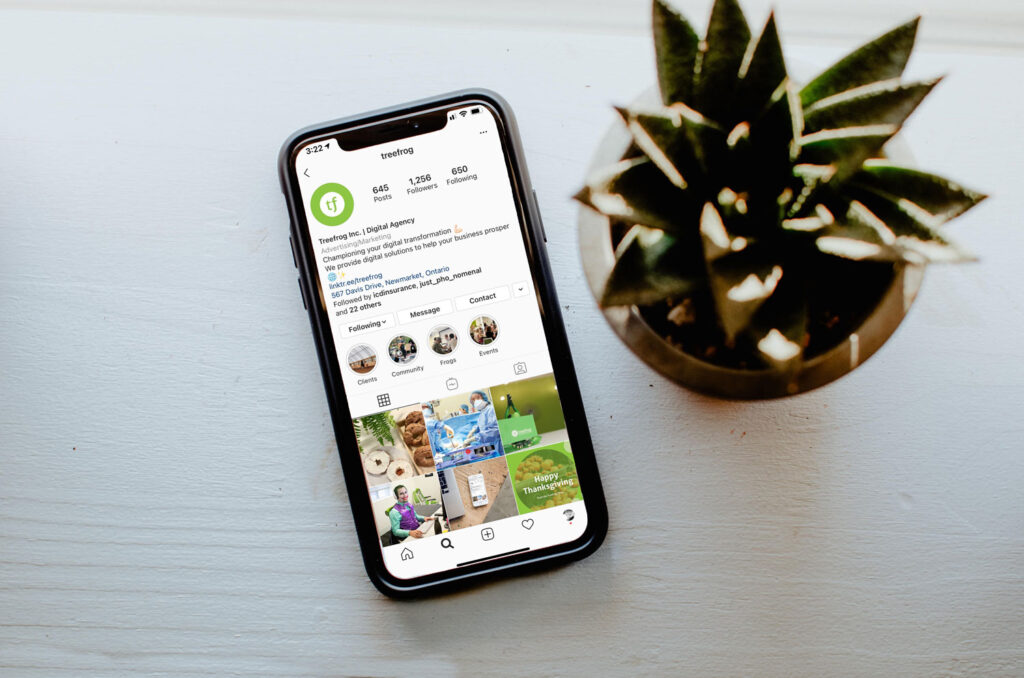
overhead view of iPhone, showing Treefrog's instagram page
Digital Marketing

6 Factors that Affect the Instagram Algorithm

Are you keeping up to date with the Instagram algorithm? Instagram is continuously evolving, and keeping up with these changes will help you perform better in the platform and create a unique bond with your Instagram community!

Instagram finally broke its silence and put some rumours to rest about how the algorithm actually works. Here are the 6 key factors, as broken down by our social media team at Treefrog:

Let’s learn more about these factors, so you don’t get left behind!

1. How interesting are your posts?

The Instagram algorithm is smarter than you think. The days of trying to trick it are over. Your feed is based on how likely you are to be interested in a particular post, and this is formulated on your actions within the app.

For example, if you are liking, watching, commenting and sharing dog content from your favourite dog influencer, then that type of content will be at the top of your news feed.

To sum it up, the friends that you are interacting with the most, the stories you watch, and even the pictures you are tagged in contribute to your behaviour in the app, which determines who and what pops up in your news feed.

Have you ever wondered why your top stories are always the same accounts? It’s because the same formula applies to Instagram stories as well!

2. Timing is, in fact, everything.

Consider Instagram as the cool kid in class, someone who wants to always be up to date with the latest news and trends. You won’t find them showing you a Halloween post when it’s Christmas season.

Group of friends looking at a smart phone outdoors in the city

That being said, using your Instagram Insights tool will help you see when your followers are the most active on the platform. That’s the time to release your content in order to set yourself up for success. It may seem like a small detail, but it is an essential piece of the Instagram algorithm puzzle.

3. Relationship Goals

Instagram doesn’t want you to miss posts from your friends and family, or favourite brands and celebrities. It values your relationships and doesn’t like one-night stands. Content from accounts you engage with more often will rank higher in the feed. For example, if you search for the same profile often, they will become one of your popular friends, and you will see their content more often.

For a content creator, that means it’s time to roll up your sleeves and get posting. You want your followers to engage with your content and form a relationship.

With this tactic, the more you post, the more followers will see your posts. Keep in mind; quality does trump quantity. The key is to find a happy balance.

We all don’t have the manpower of Gary V. So posting 3 times a week constantly while throwing Instagram Stories into the mix will help you see an increase in your engagement.

4. How frequently are you opening the app?

Take a look at your daily screentime. How many minutes, or should I say hours, have you spent on Instagram today? If you have some self-control and are on the app less often, your news feed will be sorted for what it thinks you will like best!

Close up of a young woman listening to music while riding in a bus

If you are a frequent Instagram visitor, your feed may start to look more chronological. This is because Instagram is trying it’s best to show you the best posts since you’ve last started scrolling.

5. No follower is left behind, well, not really.

Another thing to take into consideration is the number of people you follow. If you follow more people, the app has more content to choose from. This means, you’ll likely see fewer posts from each account, and for many accounts, you may not even see their posts on your feed.

As a business and content creator, the tricky part is to become a part of their Instagram family. That is easier said than done. By the end of this article, you will know how to achieve just that, so keep reading!

6. Usage: Daily or Hourly?

Do you open your Instagram app daily or hourly? It’s pretty straightforward, the more time you spend on the app, the more content you will see, and the deeper Instagram digs into it’s catalog of content to show you posts.

However, if you spend only a few minutes on the app each day, the algorithm will only show you highlights of the day’s posts.

Two restaurant workers take mobile photo of latte

Start Stepping Up Your Instagram Game Today!

Instagram is a great social media platform for visual storytelling. No matter your industry, it’s an incredible online community where businesses can connect with potential customers and grow their business organically. Whether you have a personal account, creator account or business account, Instagram could be the platform for you to grow your online presence.

The key is to educate yourself and stay up to date with trends.

Start applying what you learned from this blog into your Instagram strategy! We’ll help get you started with our free Social Media Calendar, now available for download! Plan out your Instagram content, collaborate with team members, research hashtags and track all your images all in one organized excel sheet.

Download Our Social Calendar Template

"*" indicates required fields

This field is for validation purposes and should be left unchanged.
This field is hidden when viewing the form


Don’t Do Social, Be Social!

At Treefrog, we believe that social media strategy is a delicate mix of both art and science. Our social media team combines compelling visuals with data-driven analytics to engage with the audiences of our clients in real time – so that their message gets heard and people are inspired to take action.

If you have any questions, feel free to reach out to the Instagram experts at Treefrog! You can also connect with us via email, on our website or on social media to stay up to date on Instagram tools, tricks and tips!

We can do all the dirty work for you, keep you informed and help your Instagram game reach a new level!

cybersecurity graphic with lock and hand
Uncategorized

Cybersecurity Checklist For Businesses and Remote Working

Cybersecurity or information security policies should apply to all employees, executives and contractors. HR and IT departments have special responsibilities with regards to enforcement. As a company, it’s important to ensure that all employees are understand security policies and agree to them.

At Treefrog, we are working to help our clients through cybersecurity challenges. These resources can be leveraged and implemented by businesses to ensure that valuable company data is protected while employees work from home.

"*" indicates required fields

This field is for validation purposes and should be left unchanged.
This field is hidden when viewing the form

Should you and your business need help to implement any of the activities included in the checklist, or you have any questions, please feel free to reach out by giving us a call at 905-836-4442 or emailing us at info@treefrog.ca.

Scroll to Top