SEM

Treefrog logo made of moss
Artificial Intelligence, Augmented & Virtual Reality, Branding & Design, Digital Marketing, Hosting & Infrastructure, IoT, NFC and Beacons, Mobile App Development, Web Application Development, Web Design & Development

What Does Treefrog Do?

Our “Who”

It is not uncommon for a company, country, or an individual to have an annual theme. At Treefrog, our CEO has set one for the company each year, and while most often they have remained internal; this year, we’ve decided to launch a marketing theme along with an internal monologue:

“What does Treefrog do?”

While this might seem like a strange question to be asking after nearly 20-years of business, as a digital agency, we have evolved incredibly over the last two decades; from CD burning to website development, creating a content management system (LEAP), to the additions of search ranking and social, to bleeding edge innovation around AI, AR, and IoT. And throughout all of this change, we hold one common theme: innovation and ideation.

Wall with full of multi coloured adhesive, sticky notes, project planning.

But, we are no longer the people in a basement designing websites by day and coding them by night. We’ve grown into a 40+ team. Our clients have matured and grown, just as the small Town of Newmarket has too.

There comes a time in every organization where you need to step back and ask: Based on our growth, are our clients of yesterday still our clients today? And will they be our clients of tomorrow?

At the end of 2018, we set out to answer this very question.

Let us share how we did this:

Our goal was to identify ten words or fewer that would succinctly recognize who our client is. We began by listing out a variety of clients (both past and present), what types of services they offer, and the successes we’ve had with them. This was followed by a lengthy exercise of identifying attributes of these many customers and how we work with our clients.

During the process, we started to notice patterns in the clients and attributes. While some clients were our long-time partners of 15+ years, others had been working with us for less than two years. Some clients were multi-million dollar organizations, with operations around the world, and others were less than five team members and under half million in revenue.

Fascinating similarities in connection for all clients regardless of size, location, industry or income started to emerge. Attributes such as:

  • Relationship-focused
  • Growth-Oriented
  • Collaborative
  • Curious
  • Patient
  • Experts in their field

We then categorized the attributes, in the hopes of boiling our brainstorming session down into one sentence that was evident in all the clients that we selected, both prosperous and less successful (yes we looked at our failures too).

In all cases, we were dealing with the CEO or lead decision-maker; even in the $80-million company, we had a direct line to the CEO.

However, we also realized that in focusing on our clients, what they asked of us was only part of the equation. How we behave, and our values played an essential role in this process too.

As we mingled our values with the attributes of our clients, we landed on something very close to “who” our ideal client is. This included a definition of each client, and a description that would be lasting regardless of the services that we offer or the ways to which we provide support.

“Courageous, aspirational decision-makers concerned about being digitally underdeveloped who want an invested partner.”

TREEFROG INC.

It’s not marketing speak. It’s not meant to be pretty. It’s an internal dialogue for whom we define as our partner. Let’s unpack this definition:

Courageous

Courage defined as ‘being afraid of something and doing it anyway.’

Starting a company, inheriting a company, or gaining the position of leader in an organization is an act of courage. Sometimes it’s the only act of courage a leader makes (that’s an article for another time). But, taking on that role can be scary. Leading an organization takes courage, on a daily basis.

This word was especially crucial to our team, as many of the clients we looked at need a lot of courage in both their companies and industries. Also, when you think about technologies and the digital industry, there are a lot of unknowns, it’s intimidating to many individuals, yet the courageous person moves forward even in the face of uncertainty.

Aspirational

Aspirational or Aspiration has a dual significance in the hope or ambition to go-after or achieve something paired with the action or process to get it. Aspirational individuals are decisive, visionary, curious, and willing to take risks. At Treefrog, we are aspirational; we take risks, we go after big ideas with curiosity and joy. Our best clients are aspirational, taking risks in business, achieving something beautiful.

Decision-Maker

Let’s be real. We all want to be dealing with the decision-maker, that’s a given. But, this decision-maker is unique, they go after new things, and they embrace or welcome innovation, thinking outside the box. They are not just any decision-maker but one who eagerly craves success.

Concerned

This word is especially significant in our definition. Several businesses in the world are happily digitally underdeveloped or non-existent. These are not our clients. We are not seeking to find these decision-makers.

We have one of these businesses leaders on our team right now, a hired consultant working with us part-time: but she is not our client, as she isn’t concerned about her digital footprint.

We are instead interested in working with (and for) companies and decision-makers who are worried about their place in the digital space, who fear missing out, who recognize they are lagging in the digital arena even though they may be experts in their industry.

Digitally Underdeveloped

What does it mean to be digitally underdeveloped? It is relative to the business, knowledge holders, competitors in the industry, and the company itself. It could mean a variety of status points, having an out-dated website, lagging in social engagements, using antiquated systems such as Excel for essential business functions, and more.

This is the one area we’ve spent the most amount of time on, defining and understanding what this could mean to many businesses including our past, current, and future clients. Stay tuned for part two of this article next month, as we will unpack this even more.

Want

Desire. Need. Want. Again, another impactful word in our definition as it describes the mental state of the decision-maker. They aren’t merely looking to fill a gap; this is something they crave or seek. It’s like breathing or nourishment to them, and they see the importance, they are willing to explore and find more than just the bare minimum.

Invested Partner

Lastly, a partner, yet not just any partner but one who is there for the long journey. At Treefrog, this is one of our strongest values, almost to a fault. We think of our clients and their businesses as if they are our businesses and our families. We pride our relationships with authenticity and love. When we engage in a new project, we look at the contract like that of the full depth and sanctity. For better, for worse, for richer, for poorer, in sickness and in health, to love and to cherish. We are there side-by-side with our clients.
What’s next for Treefrog?

Now that we have a defined a clear path of the types of individuals for whom we have seen through evidence-based work and by aligned values, partnership, and longevity, we can start to examine the ‘what’ in: What does Treefrog do?

We hope you’ve found this article informative as to how we discovered our “who,” a question most businesses struggle to articulate.

At Treefrog, we encourage innovation and thought leadership in all that we do. If you would like help in finding your “who,” we offer no-charge innovation ideation sessions for our clients. We merely ask for a 10-15 minute pre-call to learn about your business and what keeps you up at night.

Interested? Please let us know by emailing info@treefrog.ca.

Young woman using a laptop computer.
Digital Marketing

Why Are There Suddenly Fewer Image & Video Boxes in Google Search Results?

Have you noticed a difference in the way Google is displaying videos and imagery when delivering search results?

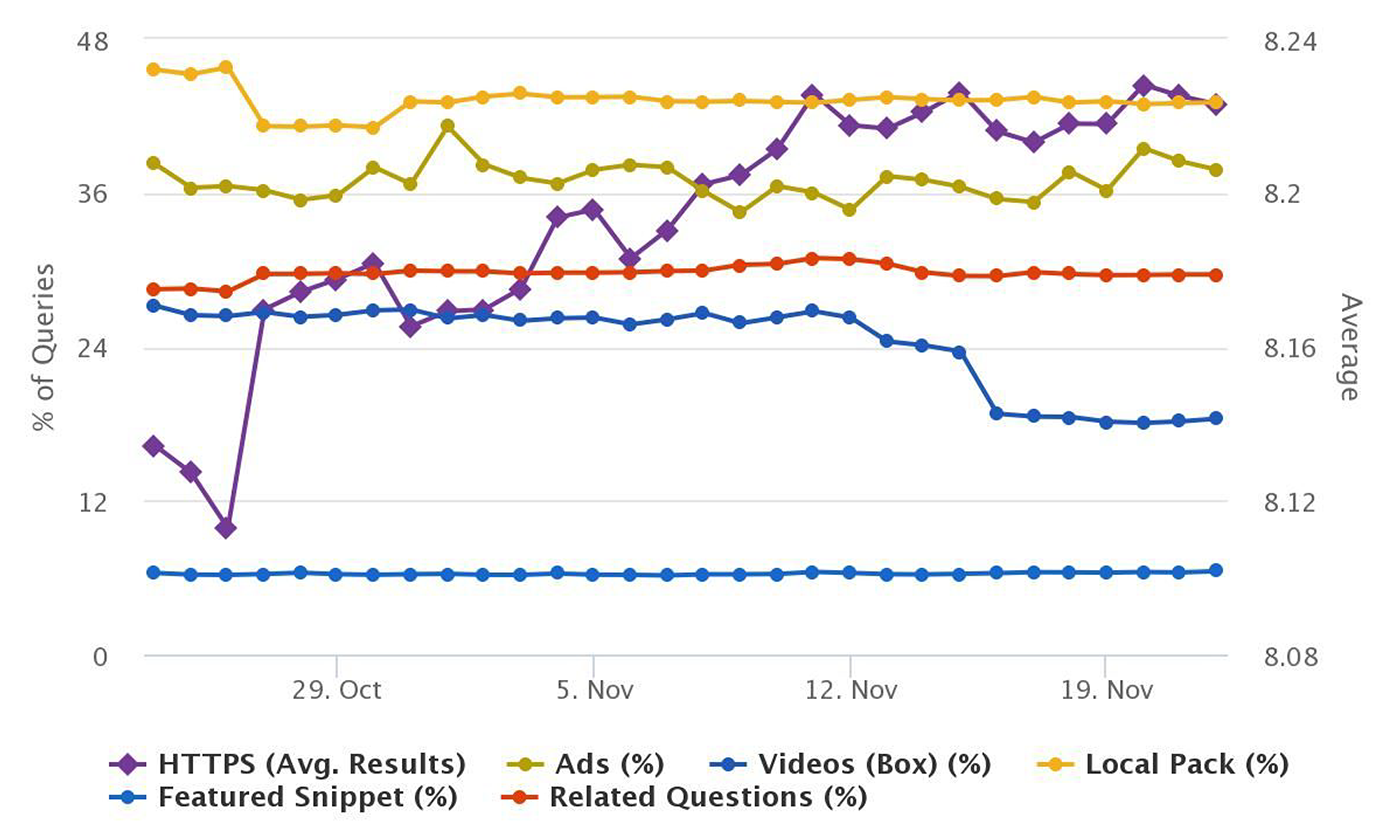
According to Search Engine Land and RankRanger, Google has begun deprioritizing imagery and video search results, lessening the percentage of time that these resources are featured on both mobile and web.

As noted by RankRanger, video carousel results began to drop around November 13th or 14th, 2018 (see dark blue), and have remained consistently low over the past few days.


Source: www.rankranger.com/google-serp-features

At Treefrog, we found this change quite interesting. It also begets the all-important question for us: why are they doing this?

There’s always a data-driven motive behind a decision like this. Here are a few of our theories:

Theory 1: Video and Image Engagement is Declining

Perhaps fewer people are clicking on image and video results.

According to a report by Buffer and BuzzSumo, this is true, at least, for Facebook. In their report, Buffer and BuzzSumo analyzed more than 43 million posts from the top 20,000 brands on Facebook and determined that average engagement per image dropped from 9,370 per post in Q1 2017 to 3,454 per post in Q2 2018.

Although, we haven’t seen any significant data on the types of queries where this is becoming a reality. For example, are images and video being scaled back for informational queries, like “where do I put my brake fluid in a 2011 Hyundai Elantra”? Or are the results affected mostly for commercial-type queries? It’s still rather unclear.

Theory 2: This is a New Strategy to Increase Ad Impressions

Perhaps Google is moving back to having people “dig” for video/image results so it can show more ads when the SERP refreshes.

In other words, instead of showing the thumbnails in universal search, users are expected to click again to specify “Images” or “Videos”. Although this seems uncharacteristic for Google—they’re usually in the habit of lessening clicks rather than adding them.

With recently improved Expanded Text Ads, Google has given us more room to play with as digital marketers (see screenshot) – allowing for extra headlines (^140%) and more descriptive text (^14%). These changes were designed to maximize brand presences on mobile specifically, in response to today’s mobile-first world.

And as our mobile devices have grown in size, we have to ask ourselves, would Google rather replace prime search result real estate with ad space over videos and images? We wouldn’t be at all surprised.

Theory 3: Google Is Refining Video Previews

Perhaps Google is refining the video “preview” feature in SERPs, and they removed the image and video results temporarily to work on them.

We’re not sure if you agree, but the video previews are algorithmically driven at the moment, and not quite ideal. Google is not in the habit of keeping something alive if it isn’t widely adopted. So it could be that they are tinkering with the experience so that people get more use out of the preview feature.

Or, maybe they’re revising it so that it can better determine when to show a video box, when to show an image box, and when to show both (or neither).

Photo sign made by human hands on blurred sunset sky as background

Conclusion

We predict Google will return these results with some enhanced capabilities.

Google is unlikely to remove SERP features completely unless there is indeed a massive decrease in click-throughs from image and video SERP results. It would be strange to do this, given that video and images, especially for informational queries, are still extremely useful.

Another possibility is… maybe they just love messing with people!

A hand touches an illustration of a computer tablet, making lots of icons fly out
Digital Marketing

Online Advertising: How to Use PPC and Social PPC

Raising awareness, increasing conversions, and growing revenues – it’s your strategic goals that determine how and what digital advertising avenues you should travel along

Using pay-per-click (PPC) ads and social media advertising – aka social PPC – to raise your company’s profile and increase revenues can be highly effective strategies. However, knowing which is best for your campaign hinges on what your goals are, who you’re trying to reach, and what actions you want your targeted audience to take by interacting with your campaign.

Although PPC and social PPC advertising can be complementary, they each serve unique purposes. Think of PPC advertising this way: it’s a strategy to deploy to target a particular search term or woo people who are in the Zero Moment of Truth (the way consumers search for information online and ultimately make purchasing decisions on the spur of the moment).

Highly customizable, PPC ads can target Google’s search network, its Display Network, or both. What’s the difference? PPC ads used on Google search are fine-tuned to appear in results from searches users conduct that are tied to a topic or specific keywords. PPC ads placed on Google’s Display Network use text, images, and video and are more likely to appear alongside blogs, news articles, and websites. Each can drive conversion rates.

This short video will help you understand the differences between various Google AdWords campaigns:

PPC ads on Google search can entice someone to click-thru because they may answer the searcher’s query. Display campaigns, meanwhile, can drive conversions provided the messaging and incentives associated with the campaign are attractive to the intended audience.

Advertising on Social Networks

Social PPC is a newer advertising vertical that businesses are increasingly using to promote themselves on social media. And now, social PPC ads created on Facebook’s platform are not confined to the social network—they also appear on websites and apps. Other social channels such as Twitter, Pinterest, and Instagram are also innovating to provide a more targeted experience.

Social PPC ads are effective at generating awareness by reaching large amounts of people in their leisure time – social media is still widely considered to be a recreational activity. But be advised: social PPC ads, like Google PPC ads, are not the “set and forget” variety. They require ongoing analysis and, sometimes, optimization to achieve your aims. Furthermore, social PPC ads do not necessarily require a landing page. Instead, they can link directly to a website or a mobile app. It depends on what your goals are.

Complementary but Different Strategies

Different types of advertising campaigns call for different tactics and channels. Here are four important points to consider when devising your digital advertising campaign:

  • Think mobile. Whatever type of ad you run, and the landing page or website it links to needs to be optimized for a slick experience on a smartphone or any other mobile device. Why? Because more people conduct searches on mobile devices than they do on desktop computers or laptops.
  • Choose the right keywords. For PPC ads earmarked for search results, relevance matters. Be careful you’re selecting the right targeted keywords, and that your ad’s content and the landing page content are unified in their messages. Be honest and transparent. Done well, your ad’s visibility will rise, and the cost-per-click will decrease.
  • Be socially active. To help ensure your social PPC ad campaign is successful, have active and fully completed profiles on the social networks where you intend to deploy the ad. On that note, as Facebook is the most popular social platform, you may wish to advertise using Facebook Ads. Facebook provides lots of options for how ads are created. They can be designed using images, videos, carousels of images, or be immersive using Facebook Canvas. Facebook also offers complimentary stock images for ads.
  • Use video. With each passing year, the importance of using video for digital marketing and advertising grows exponentially. An estimated 51.9% of marketers believe video provides the best ROI. More importantly, in the second half of 2015 mobile devices drove video ad impressions up to 49% from 38% in the first half of the year.

Using Google or social PPC ads or both are worthwhile to amplify your brand’s message, raise awareness of a cause, or promote a product or service as part of your overall marketing strategy. As a general rule for all types of digital content, ensure your message is informative, concise, readable, and interesting. Monitor the results, and be prepared to make changes on-the-fly to ensure you’re reaching your target audience.

Get the best possible ROI you can with your digital advertising campaigns. Talk to us about how our savvy team of marketers can create, manage, and monitor your PPC advertising campaigns.

Scroll to Top