
Author name: admin

Using a mobile phone to take a photo of a forest
Digital Marketing

5 Tips for Instagram Success

Instagram. Odds are you’re using it, your kids are using it, and heck – maybe even your mother is using it. With over 500 million active monthly users, Instagram has grown out of humble beginnings into one of the most popular mobile apps of all time.

According to Forbes, an average of 95 million photos and videos are shared on Instagram per day, and there are now 8 million business profiles and 1 million advertisers leveraging the social platform. These numbers sound impressive, but if you’re a new brand just starting out on Instagram, it might also be a bit intimidating.

Providing your audience with quality content is just the tip of the social media iceberg. Other questions you need to be asking yourself are: How will you stand out and get noticed? And how will you attract new clients to engage with you?

To help you get started on your Instagram journey, check out Treefrog’s five tips for improving your Instagram presence and building a loyal following:

1. Post Regularly

For optimal results, you need to keep your account active. No matter how great your content is, if you are not actively posting on a regular schedule, your followers are likely to lose interest. Try posting at least 2-3 times a week, and no more than 1-2 times a day. Consistency is key.

2. Mentions & Tags

According to a study performed by SproutSocial, Instagram posts with @mentions in their captions earned 56% more engagement. In addition to mentions, you can also tag other users in your photos. However, you should not mention or tag accounts that are completely unrelated to your posts. This action is considered spam and can get you blocked.

3. Hashtags

So, you’ve made a list of accounts to @mention and tag that relate to your content, and you’ve created the perfect schedule to post. Great! But how do you get your content seen by new people? Hashtags. 

PetaPixel words it best: “Think of hashtags as a pipeline to the rest of the world.”

When choosing which hashtags to use in your post, ensure that they relate directly to your content and what you do. Put yourself into the shoes of the people you want to reach and think about what they would most likely search to arrive at your content. Instagram allows you to add a maximum of 30 hashtags per post – chose strategically.

4. Engage

Interact with your followers and the people you are following through comments and likes. If someone leaves a comment on your post, reply to it. Even if it’s just a short thank you or an emoji, your response shows that person that you are paying attention to their comments. Also, keep in mind that people love getting comments. So leave messages on other people’s posts and make them genuine. Find something interesting to say that relates to their post rather than the generic “nice photo” or a thumbs up emoji. Not only will they appreciate your comment, but they might also click through to take a look at your profile, and if they like what they see, you might get a new follower!

5. Instagram Stories

Instagram Stories is a feature that allows you to publish a photo or video that lasts for only 24 hours. It’s a great feature for businesses and brands because it allows you to get personal with your followers. You can use Instagram Stories to make short vlogs, live Q&As, promo videos, behind-the-scenes footage, process footage, show off your office/team/workplace, or simply take a selfie to say ‘hi.’ Your options are endless, and the best part is that it’s gone in 24 hours. So take risks and be creative!

Want to learn more about how your business can leverage the benefits of Instagram and other social media platforms? Give us a call at 905.836.4442 and let our social media specialists strategize your next Instagram campaign.


Two people working and pointing at a laptop.
Digital Marketing

4 Email Marketing Faux Pas

Email marketing is one of the most effective tools when it comes to keeping in direct contact with your customers, business partners, and suppliers. Moreover, professionally crafted and informative emails can generate new and repeat business from happy readers.

Your business can use email broadcasts to share company-related news, provide loyal customers with special offers, inform your audience of new educational or thought-provoking content, and ultimately, drive traffic to your website and increase revenue.

However, there are four major email marketing faux pas that many businesses are unknowingly committing each time they send out their broadcast:

Sending Without Strategy

When it comes to email marketing, creating a pre-launch strategy is essential. In addition to design, knowing your demographic, and creating a targeted email list, it’s also important to investigate all of the factors that make a strategy succeed:

  1. Know the best time to send your email. By understanding your ideal client, you’ll begin to identify the times in which they’re more likely to see, open, and have a moment in their day to read your email. Based on user behaviour, some data collecting systems will even make send-time suggestions for you.
  2. Know the goal and intent of your email. What are you trying to achieve? Leads? Awareness? Sponsorship? Craft an email with that goal consistently in mind.
  3. Be sure to offer plenty of opportunities for people to subscribe to your email list. Add multiple sign-up forms on your website, promote a sign-up sheet at your front desk, and also offer an easy way for people to unsubscribe – if they determine the information isn’t of interest to them after all. The reality is, not everyone will be motivated to interact with your brand, and by allowing people to unsubscribe, you are increasing the quality of the addresses on your targeted email list.
  4. Ensure you’re providing email content that has value to your subscribers. This information could take shape as a helpful blog post (that links back and drives traffic to your site) or you could provide promotional discount codes (encouraging sales). What do your readers want most out of their electronic relationship with you?
  5. Ensure you have a straightforward call to action that invites your readers to take the next step should they be interested in learning more about your offerings. CTA’s allow the reader to connect with you (while it’s fresh in their mind) and can provide you with a potential sales lead.

Lazy Subject Lines

A creative subject line can be the difference between your email being opened/read and being sent straight to the trash box. Think about it – what types of emails are you more likely to open? For the most part, friendly subject lines are much more effective than pushy sales pitches as readers don’t typically respond to anything that feels intense or threatening.

It’s important to also think about the vibe your brand wants to articulate and the ideal audience you want to reach. Is your business of a serious nature? Can you incorporate some humour into your message? What demographic is receiving your emails? What interests your subscribers? Consider these types of questions to ensure your subject line is speaking to the right kind of audience.

Poor Design

A common misconception is that email marketing is too technical and too difficult. Because of this, many companies choose to send out simpler, less organized, and less visually appealing emails. However, email marketing, when done right, can pay off, and therefore requires more attention and a deeper strategy.

High-quality images, a healthy use of brand colour, and template consistency can go a long way. When images are pixelated, or too small, and text is not formatted correctly, your email is more likely to get deleted. Why? Because unprofessional emails can come across as “spam,” even if they aren’t.

The same goes for emails that are too busy and chaotic – they scare your subscribers away! We know you want to catch your reader’s attention, but flashing GIFs and too many calls to action can be overwhelming (and annoying). Professionalism and consistency is key.

Sending Without Permission

Canada’s anti-spam legislation (CASL) has made it mandatory to have permission to send electronic messages to your list of recipients unless you have an existing business relationship with them. The CASL legislation, which came into effect on July 1st, 2014, aims to protect Canadians from spam, electronic threats, and to instill confidence in digital technology.

As a Canadian business that utilizes email marketing, it is your responsibility to ensure your broadcasts are only sent to individuals who have agreed to receive them. Should your email list include those who have not verified consent, it is wise to remove them in preparation for stricter laws and potential lawsuits.

Update: While July 1, 2017, had been scheduled to mark the day Canadian citizens would gain the legal right to sue organizations that committed CASL violations, the Canadian Government, as of June 7th, 2017, has suspended this action, pending review.

“Canadians deserve to be protected from spam and other electronic threats so that they can have confidence in digital technology. At the same time, businesses, charities and other non-profit groups should have reasonable ways to communicate electronically with Canadians. We have listened to the concerns of stakeholders and are committed to striking the right balance.”
– The Honourable Navdeep Bains, Minister of Innovation, Science and Economic Development

Sending an email without intent is never a good idea. By going through the checklist above, and ensuring you have a strategic view of your audience and the mission of your email, your business has a much better shot at securing new subscribers and new business through email marketing.

Have more questions about how to execute a top-notch email marketing campaign? Call Treefrog Inc. today at 905.836.4442.

Close up of a hand holding a mobile phone
Mobile App Development

Driving Your Business Forward With Mobile Apps

Is it just us, or are mobile apps taking over the world? It would certainly seem so.

Gaming apps, dating apps, exercise apps, and more – we’d bet there’s a ton of lifestyle apps cluttering your phone. However, while mobile apps can certainly be entertaining and fun, they can also help with productivity, promotion, and be incredibly beneficial for securing new opportunities for growing companies.

Business-to-Business-to-Consumer Mobile Apps

Here at Treefrog, we’ve noticed a lot of buzz around apps that serve both business-to-business needs and business-to-consumer needs. These dual-focused apps allow companies to manage both their clientele and their business partners/employees – all through the same app!

Why so much buzz? These dual service apps offer innovative solutions to businesses that need fluid communication both internally and with the world. And while most of our clients already have a process for how to manage the two different sides of their business, a customized mobile app can take service and communication from just “good,” to “fantastic”.

Take a mobile app like Foodora for example. Foodora is a food-ordering app that was built to service both restaurants (who need to manage incoming orders, promote their business, and reach new customers), and customers (people wanting to place food orders for quick delivery).

While Foodora could exist exclusively online, fast paced restaurants and on the go customers don’t always have access to their computers. Therefore, a mobile app acts as the perfect custom solution to a previously inconvenient and lengthy food ordering process – all through the click of a few buttons.

Business-to-Employee Mobile Apps

For your business, a customized mobile app can help to ensure your employees have access to the right information, whenever and wherever they require it. An employee-geared mobile app will not only improve workplace satisfaction (as worker mobility is improved and expanded), but with positive user experience, your workers are also destined to become better and quicker at their jobs. This type of app is especially useful for employees who are constantly on the move, such as journalists, recruiters, traveling salespeople, etc. Examples of B-to-E apps include: DocuSign and Evernote.

Business-to-Business Mobile Apps

Business-to-business mobile apps can help to strengthen and build customer relations with industry partners. These apps are especially useful for businesses that want to improve efficiency by tracking analytics, product movement, sales, and project development. Examples of B-to-B apps include the Google Analytics App, the HootSuite app, and Salesforce Mobile.

Business-to-Consumer Mobile Apps

For your clients, a customized mobile app articulates that their satisfaction is a priority. By offering a user-friendly and attractive app to improve their ability to interact with your brand, you’re directly investing in customer loyalty and building the foundation for more business to come your way. With your convenient app downloaded to their phone, we bet they’ll use it again and again! Examples of B-to-C mobile apps include restaurant-specific ordering apps, clothing store apps, and even lifestyle dating apps.

Going Mobile with Your App

The reality is, people are busy, and attention spans are shrinking. Therefore, clients and employees are demanding more comprehensive and efficient ways to consume information and complete tasks that are integral to their jobs and everyday life.

At Treefrog, our Mobile App Development team can design a customized app that solves and addresses your most pressing concerns and process-related issues. By improving user experience and offering better processes that directly help to secure new business, your company will remain competitive in an ever-changing techno-culture.

Call us at 905.836.4442 to learn how we can take your business mobile with a customized Android or native iOS app.

Pen drawing a digital line
Digital Marketing

How To Create An “images_sitemap.xml” File

Part One: What They Are, The Benefits, and Building with Screaming Frog

When having a conversation about XML sitemaps (it’s more exciting than you think), it’s pretty common to think about a style-less page within a website containing all relevant links on it so that search engine robots can more intelligently “crawl” the site, making it easier for them to include you in SERPs. This is an integral part to search engine optimization, as sitemaps serve as a way to communicate directly with search engines, notifying them of new or changed website content to ensure that it is indexed correctly, and timely.

So we know the benefits of having an XML sitemap for web pages, but what about images? Another important part of SEO is optimizing images with appropriate alt text and file names, so shouldn’t we make sure that the same robots that are crawling our website and helping show up in search engines are doing the same for our images in image search engines (ex. Google Images)?

Well, that’s where image XML sitemaps come into play.

What Is an XML Image Sitemap?

Much (exactly) like sitemaps for web pages, sitemaps for images are style-less web pages that live on a site with several links listed on it. However, instead of showing information like a URL, the last modification date, the crawl frequency and priority like on traditional sitemaps, image sitemaps can communicate to robots:

  • The type of image
  • The subject matter
  • Image alt text
  • An image title
  • A geographic location
  • Etc.

Images can be added to an existing sitemap, or you can create a specific sitemap for the images on your site – the choice is entirely up to you. Personally, I prefer to go with the latter because there is an abundance of free third-party software that you can easily use to generate several kinds of sitemaps.

The Benefits of an Image XML Sitemap

Image sitemaps are incredibly useful if you want your images to show up in Google Image search results, and you do want this. Google receives hundreds of millions of image-related search queries every day. Now, if you own a plumbing, construction, or a kind of business where lots of images might not be found on your website, this fact might not mean a lot to you. If on the other hand, you own an e-commerce or other business where images are a key part of your website, I probably just caught your attention.

E-commerce companies are known for having websites that are especially image-rich. If this sounds like you and the images on your website are a) not optimized for organic search and/or b) not included in an XML image sitemap, there is a very good chance that you’re missing out on valuable traffic that you deserve. Not good!

If images make up a large portion of your website, either from product galleries or other resources, I strongly recommend incorporating an image XML sitemap.

Creating An Image XML Sitemap

Here at Treefrog, we use Screaming Frog SEO Spider, a tool provided by Screaming Frog that collects website data and identifies technical issues that could be detrimental to your SEO efforts. To follow along, I recommend you download a free copy of Screaming Frog SEO Spider.

Step One: Getting Comfortable with Screaming Frog

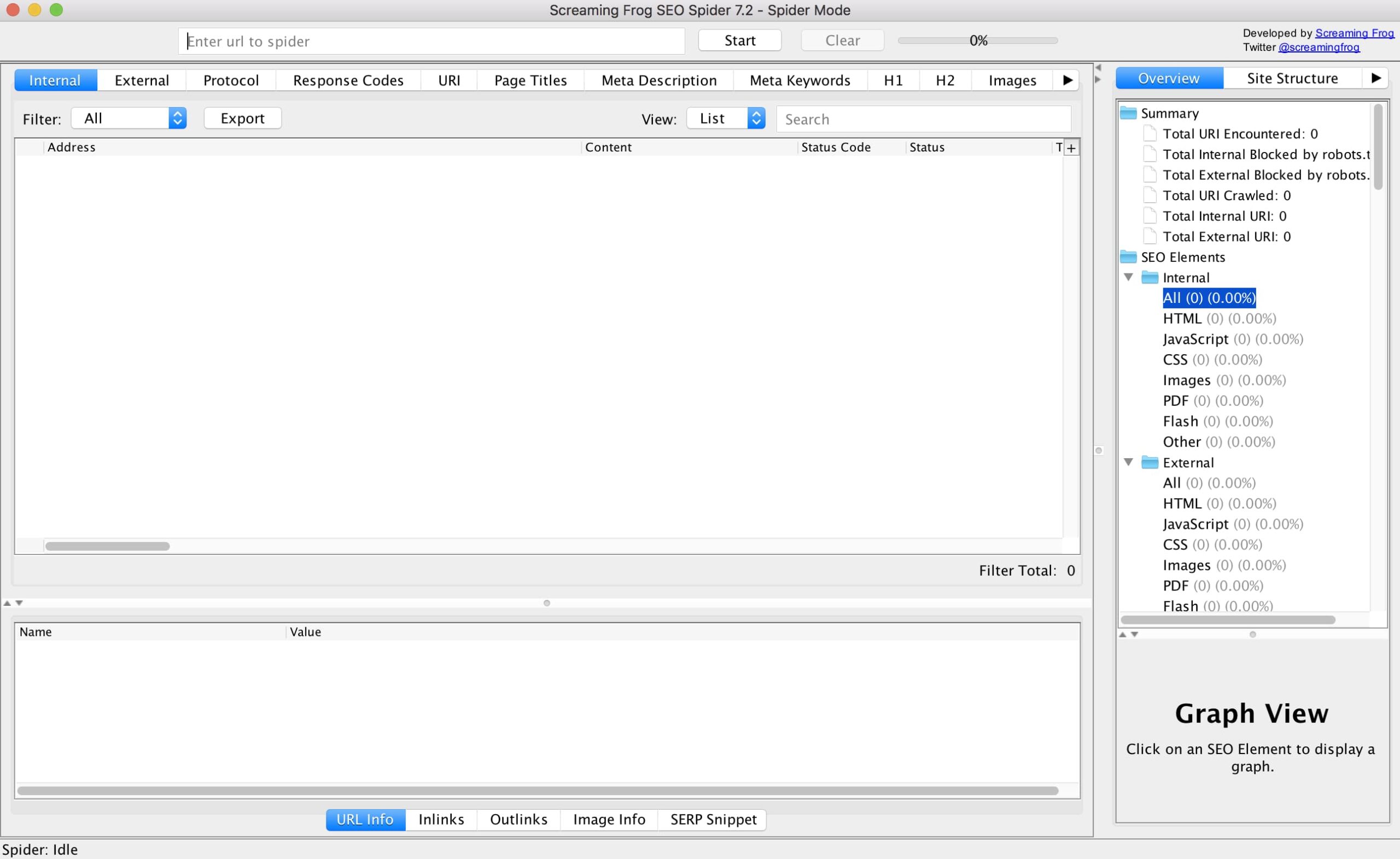
At first glance, the Screaming Frog SEO Spider dashboard can be somewhat intimidating, but not to worry because creating XML sitemaps doesn’t take more than a few clicks of the mouse.

Start getting familiar with the software by doing some exploring. Look at the various aspects of a website that Screaming Frog SEO Spider has access to.

Once you feel comfortable, copy and paste the full URL of the website you would like to crawl into the search bar at the top of the dashboard. As an example, I’ll crawl our company website. Click the “start” button to begin crawling.

Step Two: Creating The Sitemap File

Depending on the size of the website you are trying to crawl, this may take a matter of seconds or minutes. It’s worth mentioning that the free version of Screaming Frog SEO Spider has a 500 URL crawl limit.

Once Screaming Frog SEO Spider has finished crawling the website, make your way to the top menu and look for “Sitemaps”. Hover over it, and then select “create images sitemap”.

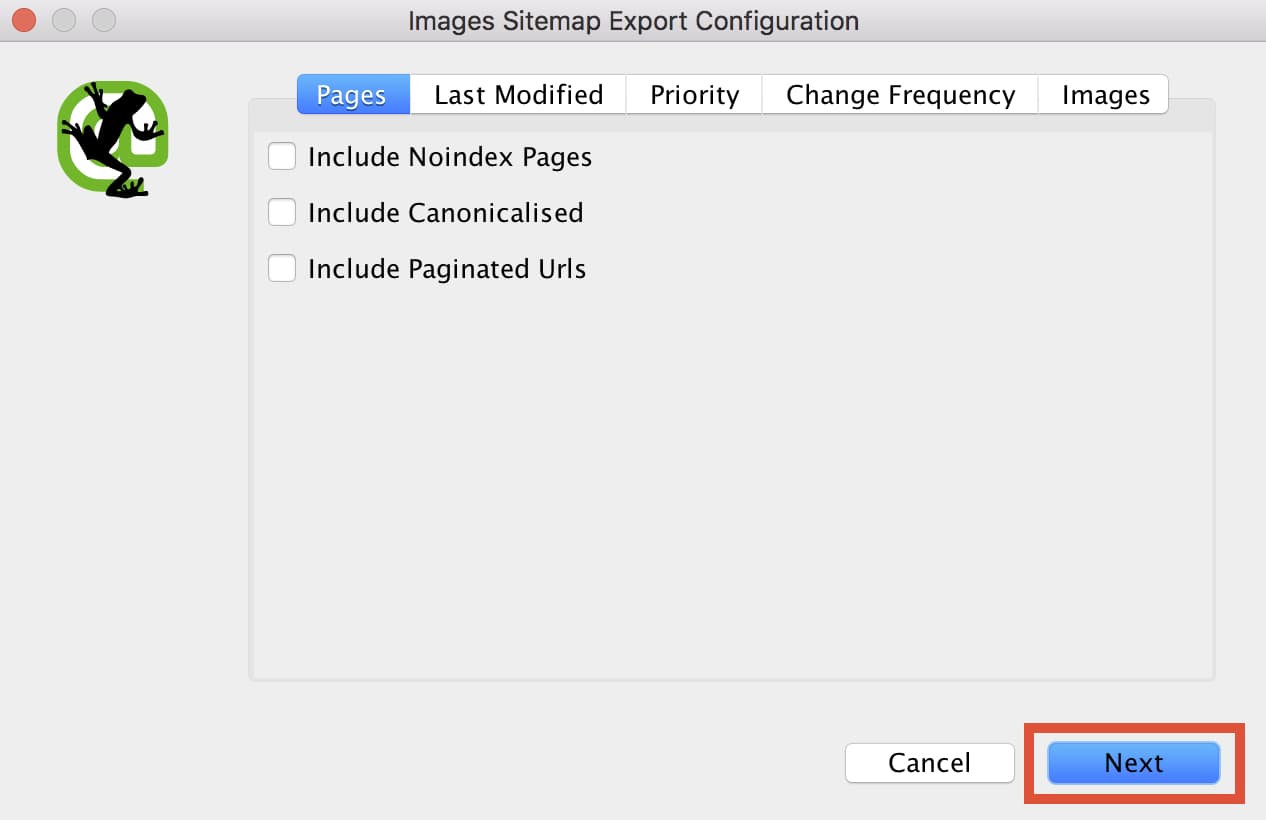
Next, a series of windows labeled “Images Sitemap Export Configuration” will appear. This is to help you set up the sitemap. You will be able to control what pages get included, the priority of the pages, and finally what images to include on the sitemap.XML file. As a default, only internal HTML pages with “200” status codes will be included in the sitemap file. Typically I leave these settings alone, but it’s always good to double check. Once you are happy with the settings, click “next” to generate the sitemap file (Seriously, it’s that easy).

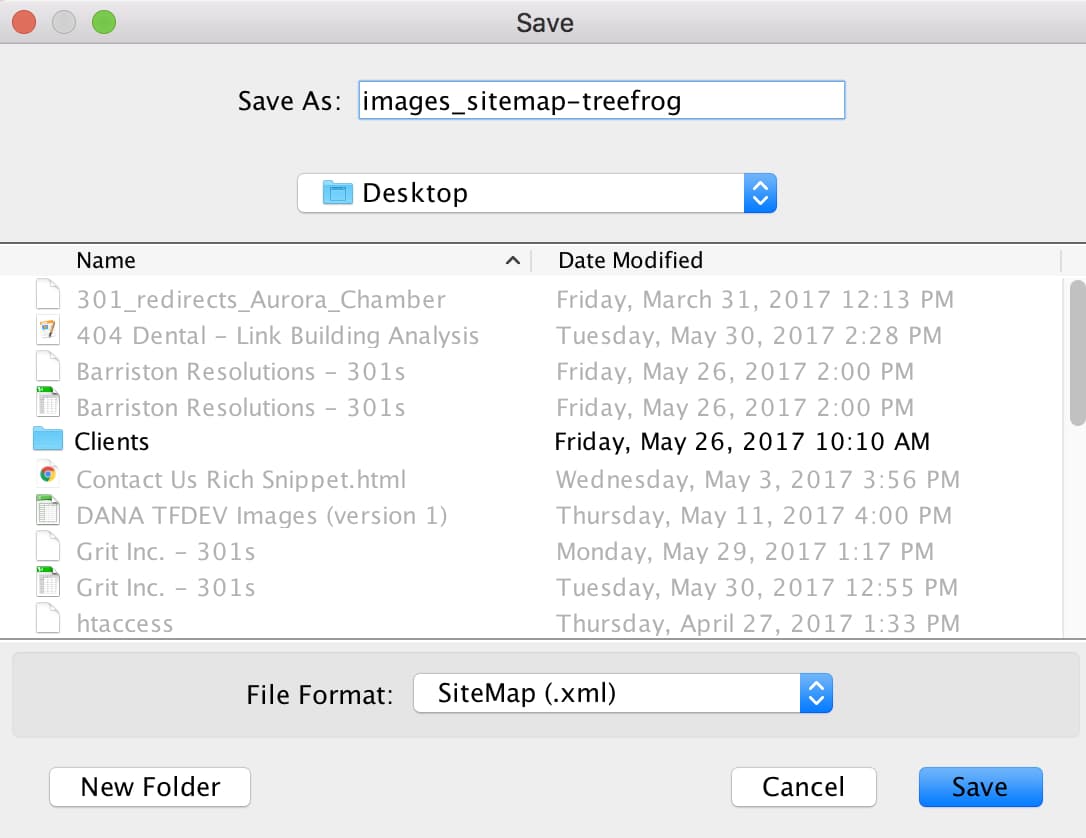
Rename your file to “images_sitemap-(client name).xml and simply save it to your desktop.

… And you’re done! You have just successfully created an images_sitemap.xml file that you can easily upload to your server to get noticed by search engines. In my next post, I’ll go over how to upload your sitemap.xml file to your server using FileZilla, and how to submit it to Google Search Console for proper indexing. If you have any questions about image XML sitemaps or SEO in general, feel free to contact the SEO Team!

A hand holds a credit card, while the other types on a laptop keyboard
Digital Marketing, Web Design & Development

Now’s The Time To Spruce Up Your Ecommerce

Is your online business holiday ready? Now’s the perfect time to spruce up your ecommerce site before the pre-holiday shopping season sneaks up on you!

You may be shaking your head and saying “Are you crazy! It’s only June!”

But trust us. Fixing, updating, and crafting content takes time, and any company using ecommerce to sell products over the holidays needs to start addressing their site’s pain points now.

“But how do you identify pain points?”

We’re glad you asked!

Common pain points for ecommerce sites can range from too little content to too much content, to terrible photo quality, and beyond. So, to help you to identify all the things needing to be addressed within the framework of your ecommerce site, we’ve developed the following checklist of questions that need answering.

Are you using the right platform for your brand?

As the popularity of ecommerce continues to rise, it can be overwhelming to choose which platform will work best to sell your products. That’s why we at Treefrog meet with our clients to understand their goals, the product(s) they’re selling, and then suggest the platform we know will best match their specific needs.

Should a client want to change their online store from one platform to another, we can help with that too!

Have you lost track of the last time you updated your online store?

In competitive markets, it’s essential to refresh and revitalize your retail offerings, especially as the seasons change. Forgetting to update your site could cause you to oversell products (without having enough stock), or cause fans of your brand to get bored, seeing the ‘same old’ each time they come to your site looking for something new.

At Treefrog Inc., we offer training sessions that teach you how to enter your ecommerce site and edit your material quickly and easily. This knowledge allows you to remove products you no longer sell and add new ones that you’d like to feature. We can also provide guidance on what to write in your descriptions, how to position your content messaging, and how to leverage social media to create brand awareness!

Is your content helpful and clear?

Strong and descriptive content can be the push an interested customer needs to follow through with their purchase. Without helpful details about sizes, or materials, or product quality, potential customers may feel they don’t have enough information to commit to their order, especially when having to pay for shipping.

How can we help? Our content marketing team uses their expertise to conduct content audits on websites that need improving. By analyzing each page of your site, including every image and description, we develop a detailed document that provides suggestions for growth, editing, and expansion. Should a client then hire us to work on developing their content, we’ll collaborate with them to apply the suggestions we made, update content that needs to be refreshed, and improve the message they’re articulating.

Are your pictures professional?

If your pictures are outdated and blurry, odds are your user experience is being tainted. The modern customer values professionalism, and to stay competitive, your images need to not only sell your products but also needs to communicate the value of your brand.

Our department of graphic designers and photographers can help. With professional equipment and a key eye for lighting, balance, and detail, our team ensures the images our clients use are consistent and brand appropriate.

Have you thought about SEO?

While the above items are important steps in ensuring your website is ready for the holiday rush, they’re irrelevant unless people are able to find your site! This is where our SEO team comes in.

Our team of Search Engine Optimization Specialists make sure that navigation links are accessible, that webpages have unique titles, URLs, and meta descriptions, that page headings are appropriate (in terms of keyword searching), and more. Each of these additions naturally increases success by enhancing site visibility to new and existing customers online. So, while we know it’s hard to start thinking about the holidays already, we can promise you’ll thank us for giving you this little push to start working on improving and updating your site now. Getting a head start will reduce your holiday stress and will undoubtedly help you to secure more sales from happily returning customers.

Once your site is polished to perfection, it will be time to think about how you want to promote it, via social media, email marketing, and other viable channels.

For more information on how our team can help ensure that your ecommerce site is holiday ready, give us a call today at 905.836.4442!

Woman typing on a laptop that has excel open
Web Application Development

Stop Living in Excel!

Excel. It’s the most popular software application of all time, but is it the best tool for tracking critical information for your business?

It’s staggering to learn that approximately 88% of spreadsheets have errors or 1 in 5 businesses have suffered financial loss from spreadsheet errors.

As Forbes reported in their article, Microsoft’s Excel Might Be The Most Dangerous Software On The Planet, trillions (yes, TRILLIONS) of dollars are dependent on Excel – every day. And while spreadsheets can be helpful for small businesses with limited data to organize, when it comes to high value companies, Excel is starting to seem more and more like an enemy not to cross.

Why? Let’s explore.

Tedious

You’ve heard the groans from people in your office, “Ugh, I hate Excel”, and there’s a reason they do. Aside from being ‘dangerous’, Excel spreadsheets can be difficult, tedious, and frankly annoying to organize. Spreadsheets also require a lot of focus, attention to detail, and a lot of time. These sheets can be effective when organizing small data, but when your spreadsheet quickly fills up, the information can become overwhelming, and you’re likely to lose sight of what data is even important.

Limited

Progress within an Excel document is extremely hard to track. Unfit for growing businesses, Excel spreadsheets are outdated when it comes to organizing big data and collaborating with a team. This is largely because Excel documents cannot be updated live, and important information is bound to be lost as different versions are handed from person to person. In result, Excel limits a company’s ability to plan, budget, and keep track of essential project reporting.

Excel is also limited as the creators of these documents typically set up the spreadsheet according to their own personal needs, and organize the data in a way that makes sense to them and not necessarily to anyone else who may need to access it. This can cause miscommunication, lengthy explaining, and in some cases, cause for double entry during reorganization.

Vulnerable

Excel is also incredibly vulnerable to fraud and manipulation. Should anyone hack into your system, they could delete data, alter values, and as a result, damage the accuracy of your document. What’s worse is that without checking every single row and column to a master copy, you may never detect that any changes were made!

Prone To Human Error

Lastly, and the most alarming reason Excel may be harming your company, is that the system is extremely prone to human error. You may not even realize it, but with the slip of your hand, in a moment of distraction, you could delete or alter critical information in your spreadsheet. Just ask JP Morgan; their 6 billion dollar loss was the result of improper manual entry from copying and pasting from other Excel spreadsheets!

The Solution? Customized Databases

While Excel has served its original purpose; agile companies need to reconsider the ways in which the tool may now be working against them. As technologies advance, it’s time to look ahead and discover new ways to improve efficiency, security, and to expand capabilities. With customized business solutions, designed to cater to your specific needs as a company, each of the above concerns will begin to fade away.

Created to address your pain points and largest vulnerabilities, a custom database provides a system and interface for collaborative entry, support more effective workflow, create easy to follow reporting, improve the security of your system, and reduce the potential for error.

Treefrog has provided a number of local businesses with tailored business solutions for everything from Membership Management Systems and Content Management Systems, to Event Booking, Email Marketing, Internal Training Systems, Product Displays and Online Retail Systems.

Pensive woman looks at floating social media platform icons
Digital Marketing

Picking The Right Social Media Platforms for Your Business

With over 2 billion active users, popular social media platforms have become marketing giants, offering businesses valuable data about their customers. However, with so many options, how do you figure out which social media platforms are right for your business?

Here are a few tips to help you get started:

Facebook

Facebook is the biggest social network on the web, with nearly 2 billion active users! Considering that Facebook has a wealth of options for any organization, it’s a great starting point for your business, regardless of your industry. Facebook can be thought of as the “social hub” of your business, where people can go to leave messages, browse through products and photos, or chat with you online.

Twitter

Twitter averages about 328 million active users worldwide and is an effective channel for marketing your business and handling customer service. With Twitter, you can share short text updates (of 140 characters or fewer), along with videos, images, links, polls and more. As with Facebook, Twitter is more effective when it is a two-way platform in which you respond to and engage with followers.

LinkedIn

LinkedIn is right for you if you are B2B or are in another industry or role in which you can provide useful insights to people who are thinking about their work, looking to make business connections, or who are exploring their next career move. Most users are in work mode on LinkedIn, so it is optimal for peer networking and industry-specific information.

Instagram

Instagram is a mobile-only visual social media platform based entirely on photo and video posts. The Facebook-owned network has more than 700 million active users, many of whom post about food, art, travel, fashion, and similar subjects. More artistic niches tend to excel on Instagram, so it’s important that the person running your account has a good eye for detail and some basic photography skills, so the photos and videos posted to your account are high quality.

Pinterest

Pinterest, another highly visual platform, is popular among women, so it is the place to be if that is your target audience. Every pin includes an image or video, and it is fairly low-maintenance in terms of post frequency. However, keeping your boards organized and search-friendly can be time-consuming. Popular categories on the site are DIY projects, fashion, exercise, beauty, photography, and food.

Macro of purple flower petals
Digital Marketing

Reaching Moms on Social Media

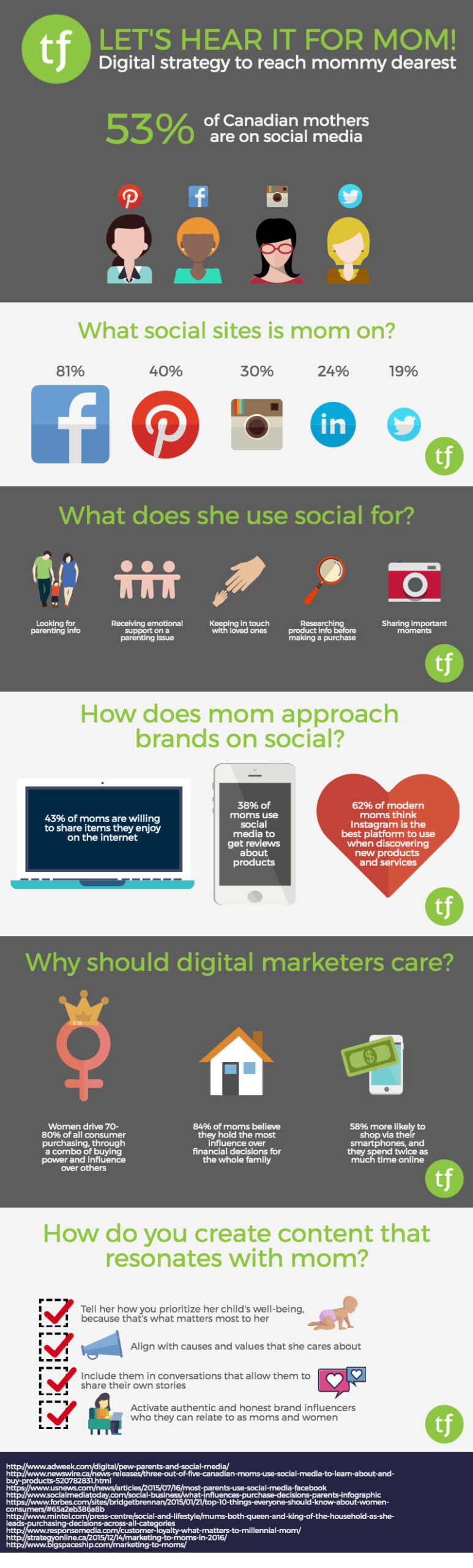
This past Mother’s Day got us thinking about what it means to connect with mom on social media. Much to the dismay of her kids, mom is part of a growing audience of parents on social, proving every day that no one will ever be truly free from the watchful eye of mother. Keeping tabs on her children isn’t the only thing mom is doing online though; social media continues to open up new and exciting opportunities for mom to get on board with brands she likes, and join the online parenting conversations taking place worldwide. Check out our infographic for some highlights on mom as your consumer on social media.

A rocky waterfall
Digital Marketing, Web Design & Development

Increase Your Google PageSpeed Score Part 2: Web Development & Optimization

For the second part of our Google PageSpeed blog post series, we’ll be taking a look at more advanced techniques to adhere to Google’s recommendations. If you haven’t had a chance to read the first part to increasing your Google PageSpeed score, start now! Recalling on the Google PageSpeed insight rules, the speed rules include the following:

  • Avoid Landing Page Redirects
  • Enable Compression
  • Improve Server Response Time
  • Leverage Browser Caching
  • Minify Resources
  • Optimize Images
  • Optimize CSS Delivery
  • Prioritize Visible Content
  • Remove Render-Blocking JavaScript
  • Use Asynchronous Scripts

We’ve already covered avoiding landing page redirects, enabling compression, optimizing CSS delivery and removing render-blocking JavaScript in our first part. In this blog post, we’ll be taking a look at prioritizing visible content, minifying resources and optimizing images.

Note: The following recommendations below assume you fully understand web development best practices as well as server software programming, HTML, JavaScript and CSS programming. If you aren’t too sure of these techniques described, give us a shout and we’ll help you out!

1. Prioritize Visible Content

Putting an emphasis on giving users a high quality mobile experience, Google states “having a mobile-friendly website has become a critical part of having an online presence”. As such, they recommend ensuring that the above-the-fold content of the page is rendered quickly and efficiently.

Above-the-fold is the portion of the webpage that is visible without the need to scroll down. Ensuring the above-the-fold content displays quickly, prevents waiting time for the user. However, if the data exceeds the initial congestion window (a self-imposed variable that limits the amount of data that can be sent), then additional back and forth data transmission between your server and the user’s browsers will occur. This in turn creates a slower and delayed page load for the user.

In other words, if the above-the-fold content isn’t loading quickly enough, users are more likely to leave. The above-the-fold content is the first touch point for most users and they are less likely to stick around for the rest of the webpage to load if the above-the-fold content can’t even load quickly and properly.

What to do:

  • Structure your HTML to load the critical content first:
  1. Identify the critical content of your webpage. For example, if the page is an article, the body text and images are the most critical content. Third-party widgets may fall as secondary items that can be deferred.
  2. Ensure the critical content of your webpage loads first. Structure your HTML such that the critical content is rendered immediately. For example, you may want to inline a portion of the CSS into the HTML file to ensure the styling of the critical content is rendered first, while the rest of the page is styled after the CSS file is rendered later.
  • Reduce the amount of data used by enabling compression and/or minifying resources:
  1. Reduce the size of your HTML, CSS and JavaScript files by enabling compression. As discussed in our previous post, to enable compression you will need to make updates to your .htaccess file.
  2. Minify your HTML, CSS and JavaScript files, which is discussed in detail below

2. Minify Your Resources

Ensure the sizes of your resources are reduced to allow faster transferring of data. Reducing the size of your files will require less data to be transferred from your server to the user’s browser, thereby making the above-the-fold as well as the entire page load much quicker.

What to do:

After writing your HTML, CSS and JavaScript code, you can look at ways to reduce the file size by removing unnecessary or redundant code, unused code and applying shorter variable and function names. Although it may be against code-writing best practices, you can also remove commenting, formatting and removing whitespace altogether. For example, the following CSS code is 953 bytes and has commenting, formatting, whitespace as well as redundant code:

/* ## Headings

——————————————— */

h1 {

      font-size: 36px;

      font-size: 3.6rem;

      color: #333;

      font-family: Lato, sans-serif;

      font-weight: 400;

      line-height: 1.2;

      margin: 0 0 10px;

}

h2 {

      font-size: 30px;

      font-size: 3rem;

      color: #333;

      font-family: Lato, sans-serif;

      font-weight: 400;

      line-height: 1.2;

      margin: 0 0 10px;

}

h3 {

      font-size: 24px;

      font-size: 2.4rem;

      color: #333;

      font-family: Lato, sans-serif;

      font-weight: 400;

      line-height: 1.2;

      margin: 0 0 10px;

}

h4 {

      font-size: 20px;

      font-size: 2rem;

      color: #333;

      font-family: Lato, sans-serif;

      font-weight: 400;

      line-height: 1.2;

      margin: 0 0 10px;

}

h5 {

      font-size: 18px;

      font-size: 1.8rem;

      color: #333;

      font-family: Lato, sans-serif;

      font-weight: 400;

      line-height: 1.2;

      margin: 0 0 10px;

}

h6 {

      font-size: 16px;

      font-size: 1.6rem;

      color: #333;

      font-family: Lato, sans-serif;

      font-weight: 400;

      line-height: 1.2;

      margin: 0 0 10px;

}

This code can be significantly reduced to 311 bytes by removing the redundant code, comments, formatting, and white space:

h1,h2,h3,h4,h5,h6{color:#333;font-family:Lato,sans-serif;font-weight:400;line-height:1.2;margin:0 0 10px}h1{font-size:36px;font-size:3.6rem}h2{font-size:30px;font-size:3rem}h3{font-size:24px;font-size:2.4rem}h4{font-size:20px;font-size:2rem}h5{font-size:18px;font-size:1.8rem}h6{font-size:16px;font-size:1.6rem}

It may become taxing to minify all your resources manually, especially if you have a large website. Luckily, there are free tools available online to minify your resources for you. A simple search for “HTML minify”, “CSS minify” or “JavaScript minify”, will result in various tools you can use. The fall back with using these tools as well as minifying these resources yourself is that the code needs to be minified again whenever you make any updates or changes. As an alternative and depending on the CMS you use, you can automate the process by leveraging plugins. For WordPress and Drupal sites, there are many minify plugins available that can minify HTML, CSS and JavaScript individually or all at once.

As a last alternative, you may also want to use Google’s PageSpeed Module if your server is Apache or Nginx. There are various filters that help optimize your website’s page speed inclusive of reducing resources sizes such as Minify JavaScript. Take a look at their mod_pagespeed documentation for more information.

3. Optimize Images

Ensure the file size of images is reduced without significantly impacting their visual quality. Reducing the size of your image files will require less data to be transferred from your server to the user’s browser, thereby making the above-the-fold as well as the entire page load much quicker.

This may require its own blog post in the future since there are plenty of best practices and image optimization checklists to do. It also really depends on how your website is structured: if your website is highly visual than a much more thorough optimization strategy is required. However, if your website has some images here and there, there are quick and easy things you can do.

What to do:

  • Ensure the images are served at their native dimensions and specify the width and height in the img tag to prevent “popping” when the page is loading
  • Compress your images to reduce file size. Try using PNG files as they are lossless formats and do not make any visual modifications to the image.
  • If you’re using JPEG files and are compressing the images, try to reduce the quality below 85. Past the quality of 85, the file size becomes larger but doesn’t improve visually. Compress the image as low as possible without losing visual quality.

Develop With File Size in Mind or Use Tools To Optimize

These recommendations are best executed during the designing and development stage of building the website. Arranging the structure of the content beforehand can prioritize and serve the critical content to users right from the start. Programming HTML, CSS and JavaScript and optimizing the images with the file size in mind ensures a quicker page load right when the website goes live.

In most cases however, these items may be overlooked or unnoticed during the development stage. To act on these recommendations long after a website has been live, we can leverage: enabling compression, minifying resources and image compression.

As noted in Part 1, every website is different and there are little nuances that make your website unique. It’s very important you test these recommendations first before implementing them.

As always, if you have any questions or comments regarding these recommendations, feel free to comment below. We’d love to hear your thoughts, feedback and/or grievances. Thanks for reading!

Resources

Cityscape with illustrated lines connecting buildings
Digital Marketing

4 SEO Tips For Moving Businesses

So, your business is moving

We bet you’re totally stressed out about boxes, and moving trucks, and how your employees are handling the change.

How do we know?

We’ve been in your shoes. We feel you.

However, more than just our sympathies, we at Treefrog Inc. want to pass on a more valuable ‘moving message’ – a PSA of sorts – to not neglect your online presence during this time.

Trust us, we get it, you’ve got a lot going on. But local profiles don’t optimize themselves when you move, and any change at all creates some risk for your business.

So, to help protect and guide you through this transition, we’ve developed some localized SEO tips you can’t afford to ignore.

1. Build Trust By Providing Detail

In our modern landscape, customers are more likely than ever to search the location, hours, and phone number of a store (from their mobile device) before visiting – especially if it’s for the first time.

If this information is not readily available online, or it is confusing by showing both your old and new locations, customers may choose not to visit the storefront. It becomes a hassle to locate, they’re unable to determine if the store is open, and they’re unsure if the business will serve their needs.

This is especially true for moving businesses that are entering new territory.

If you haven’t already claimed your business and its location on Google Places, (or on other online search engines such as Bing’s Local Listing Center, or Yahoo! Local), it’s crucial that you make this a priority.

However, don’t stop at just providing your address and phone number. If applicable, include as much information as you can. This includes an email, hours of operation, photographs of your new store, your business’ social media accounts, appropriate keywords, and more.

Allow customers to get to know you, and as a result, learn that they can trust you.

2. Collect Reviews & Testimonials

When starting up shop or moving into a new area, it’s critical to build an online persona you can be proud of.

Curious potential customers are likely to not only Google who you are and what you offer, but also what others are saying about you and your service.

This is why it becomes essential to collect positive reviews and testimonials online – whether it be on Facebook, or Glassdoor, or Yelp.

Reviews can be the difference between securing a new client, and not securing a new client, as reviews from real people bring comfort and assurance to other potential customers.

Search engines like Google also rely on reviews to determine the value of your business, website, and online platform. When you receive numerous positive reviews, Google will notice and reward you with better SEO page ranking!

But how do you collect reviews during a transition period?

Capitalize on your big move by launching some creative social media campaigns!  For example, you could invite customers to an open house and offer incentives in exchange for tweets, Facebook posts, and reviews! A little buzz goes a long way!

“Just attended company X’s open house at their new location! The store looks amazing! Be sure to check them out! #CompanyX”

3. Develop Quality Content

If you’re a company that is submitting a local online profile for the first time, creating a well-developed persona will help you to instantly build credibility as a business. A great profile will also showcase your professionalism and dedication to attracting potential customers – and that’s the goal, right?

If you’re a business that is simply moving locations and needs to update their profile, now’s the perfect time to reflect and focus in on the new demographic (and geographic area) you’re serving.

Ask yourself: What’s changed? What’s stayed the same? How can you cater to your new audience?

By incorporating geo-specific keywords into your content, search engines will identify proximity and relevance, bringing your profile forward to those in your area.

For example, if your new location is in Richmond Hill, mentioning Richmond Hill specific services in your blog, and including ‘Richmond Hill’ in your ‘about us’ web page, will naturally boost your relevance in that area.

4. Build Your External Links

Want to build even more credibility in your new local area? Connect with in-town associations, your local chamber of commerce, and residents’ social media pages, to acquire backlinks to your website.

For example, if you own company X, and company Y carries one of your products in-store, you could request that company Y will back-link to your website, or tag your social media handles, when they feature said product on any online platform.

This partnership will then contribute to company X’s quality score, as search engines will recognize that company Y has vouched for company X’s credibility as a resource.

The same goes for customers who willingly post on social media about your products, and then also tag you, and your business, in their posts.

Networking and capitalizing on local partnerships will bring more potential customers to your website, and will also help to spark interest in your community, encouraging people to check out your business, and your new location, in person.

Don’t have time to manage all of these SEO localized changes on your own? We’re here to help.

At Treefrog Inc, we can manage every step of your move online, including producing new advertising content and materials, updating your social media platforms, adding new features to your website design, actively working to improve your conversion rates, and more.

Scroll to Top