
Author name: admin

Cropped close up of graphs on a laptop screen
Digital Marketing

Conversion Rate Optimization & What It Can Do For You

How efficient is your website at turning visitors into customers?

If you could turn more of your website visitors into leads, you’d jump at the chance. Unfortunately this doesn’t just magically happen—there are several factors to consider. That’s why we’ve taken the time to break down the value in conversion rate optimization.

What is Conversion Rate Optimization?

Before we ask this question, let’s first define what a conversion is. A conversion happens when a user performs a desired action on your website.

Common conversions include:

  • Someone clicking your phone number to call you.
  • Someone signing up for your email newsletter.
  • Someone completing a form for a free download or to get in contact.
  • Someone making a purchase on your website.
  • Someone filling out a ‘request a quote’ form.

Conversion Rate Optimization is a strategic approach to digital marketing that seeks to optimize the ratio of traffic to leads on your website.

Obviously everyone wants more leads, and in a perfect world every person that ends up on your website will convert. But the world doesn’t work that way. People are very finicky about whether or not they will commit to a desired action online. What Conversion Rate Optimization (CRO) aims to do is to present a user with a scenario where they will have the highest likelihood of taking that action, whatever it may be.

Normally, CRO is carried out on dedicated landing pages. Often, these landing pages are designed to take all of the external distraction away, so the user is channeled towards the main conversion point, or desired action. It’s kind of like the old velvet rope maze in the bank—it clearly screams “LINE UP HERE!” We don’t want to give users a lot of options with these dedicated landing pages, we want to guide them towards the goal as efficiently as possible.

Again, the world works in mysterious ways, because it’s full of people. And people are funny. No one knows exactly what the right recipe is for conversions, just the same as advertising through one medium does not appeal to all audiences.  What we’re left to work with at that point is data.

In other words, how much traffic is getting to our landing page, and of that traffic, how many people are filling out our request a quote form? Let’s say it’s 1%. Obviously we want that number to improve. So, we need to go through the process of iteratively changing our landing page so that it gets more forms filled out.

The nature of CRO is not to throw the baby out with the bathwater. We don’t want to completely scrap our landing page and start again. We want to make slight changes that we can prove have made a positive effect. Sometimes that can mean changing the colour of an element, like the button people click to submit the form. Maybe we want to try paring down the text on the page, if we feel like there’s too much, and people are seeing it as a distraction. Maybe the form itself has too many fields to fill out and it’s scaring people off. Maybe the main website navigation is leading people off the page and away from our conversion point.

When websites are not architected with these conversion points in mind, and when pathways to conversions are not re-visited and adjusted over time, you run the risk of leaving money on the table. Someone hopping off your website without taking your desired action is the same as someone walking out of a store without buying anything.

How to Test Conversions

Analytics Matter

Many businesses make the mistake of assuming they do not need to use tools like Google Analytics to track their online conversions. We’ve run into several cases where clients aren’t sure what marketing initiative led to what leads. But our thought is: all of this data is trackable! What do you have to lose by tracking it? Collecting and analyzing your website’s data is critical to understanding your business, and in identifying growth areas.

Think about it.

The beauty of digital is that it allows us the ability to accurately track whether our marketing is working or not. As an accompaniment to analytics, CRO allows us the ability to test and tweak specific pages to ensure they are converting (selling) as well as they possibly can.

Make Calculated Changes

CRO also lends into a practice called A/B testing, or multi-variant testing. This means showing one version of a webpage to some visitors, and a variant to others. You can then monitor engagement on both variations. In other words, which one is getting more people to fill out the form? Do people fill out the form more often when it has a big red arrow pointing to it? Yes? Then welcome to our landing page, big red arrow!

Most businesses are unaware that you can conduct these experiments right within Google Analytics. You just need a bit of coding chops to set it up.

While positive analytics are great, negative analytics can be just as informative and helpful.

For example, you may choose to change the main “Get a Quote” button on your home page from red to blue, and track this for four months. If after that time you notice your conversion rate went down, then switch back to blue. Maybe the next test will involve making the button green. The point is, we should always strive to increase our conversion rate through data-driven, incremental optimization.

While these tests take time, the pay off of small-calculated changes can be hugely profitable.

Knowing What To Change

The process of identifying which elements of your site should be tested begins with identifying which parts of your business are under-performing.

You must ask yourself:

  • What are my key performance indicators?
  • What are my defined goals?
  • What are the major problems I am facing?
  • What are the specific needs of each of my web pages?
  • Which pages are most critical?
  • Am I tracking the right data?
  • Is my SEO set-up properly?
  • Is my website easy to navigate and useful to my audience?

Data-driven tests will help you to get into the mind of the customer and truly understand where your website is missing the mark.

In terms of how long you should track an experiment, that depends. Do you get sufficient traffic to the page you want to test? Are there seasonal aspects that will affect your data? How long the CRO experiment runs should be driven by what you’re testing, and whether you can expect to get a large enough data set to make an informed decision.

For example if you plan to track conversions from a landing page for a month, and after the month ends we still don’t have enough data, then perhaps we need to keep the experiment running a while longer.

Be sure to also test only one conversion at a time. Changing multiple aspects of a landing page at one time will really muddy the waters for your data. You need to be able to determine exactly what change led to the increase in conversions at the end of the experiment.

With detailed analytics data, honing in on specific areas of a website has been made substantially easier. However, without the guidance of a professional, who can truly work to unravel and take the time to absorb and understand your specific data, identifying these pain-points, as well as which conversion points to test, can be overwhelming.

To consult with our in-house SEO specialists about evidence base conversion optimization, and what our team can do to test various components of your website, contact Treefrog Inc. today.

A hand uses a stylus to point to a pie graph on a computer screen
Digital Marketing

Finding 404 Errors with Google Search Console

If you’re like me, you lean more to the creative side. I came from a world of content, constantly creating fresh new ideas for the readers of an educational trade publication. In 2013, I was drawn into the world of SEO. That may seem like a drastic shift, but not entirely, when you think about it.

The lines of content and SEO intersect quite frequently. In fact, some bloggers go as far as to say that SEO is only about content, and that everything else is “window dressing”.

Well, I completely disagree and I’ll tell you why. SEO as a skill set is very broad. There’s a lot of overlap when it comes to content and SEO, because after all, content is what’s being optimized for search.

However websites also need to be technically proficient in order to appear consistently in search results for associated keywords and phrases. Google is pretty snobby when it comes to the standard of perfection it expects for technical website optimization. If you’re doing everything right, you get a pass. Do it wrong, and you could have a hard time appearing.

It all comes down to user experience. If your site is full of broken links and slow-to-load elements, no one is going to want to stick around.

As marketers, we need to have at least a fundamental understanding of the technical side of things. If our content is not ranking for the phrase we’re targeting, we need to see the bigger picture—over and above the possibility that the text itself is not adequate. Maybe the blog post or article we wrote is fantastic, but the website is plagued with technical errors. This causes users to lose faith, and that’s a very strong signal to Google that the website in question is low quality.

If any aspects of your site are technically unstable, Google’s assumption is that you have not done your due diligence and obviously you’re not a good answer to the question.

Now, I’m not talking about having to delve too far into overly technical SEO. The extremely technical SEO stuff interests me, but I’m more inclined to leave it to our skilled engineers and programmers.

What I am truly interested in is teaching clients about how they can leverage the data at their fingertips, and turn it into something real.

So in this series of posts I want to show you a few tricks to uncover information about your website that you may not know existed.

We’re going to start basic.

Quick Search Console Trick: Finding 404 Errors

Let’s do a quick tutorial. I’ll assume you have access to Google Search Console and that it’s installed and running properly on your website.

You know what 404 errors are, right? The content is inaccessible because of a few possible reasons:

  • Someone changed the webpage URL, so all links going to it are broken
  • Someone linked something incorrectly on the site and now it’s returning a “page not found” error
  • Someone took down a webpage, and did not forward the old link properly

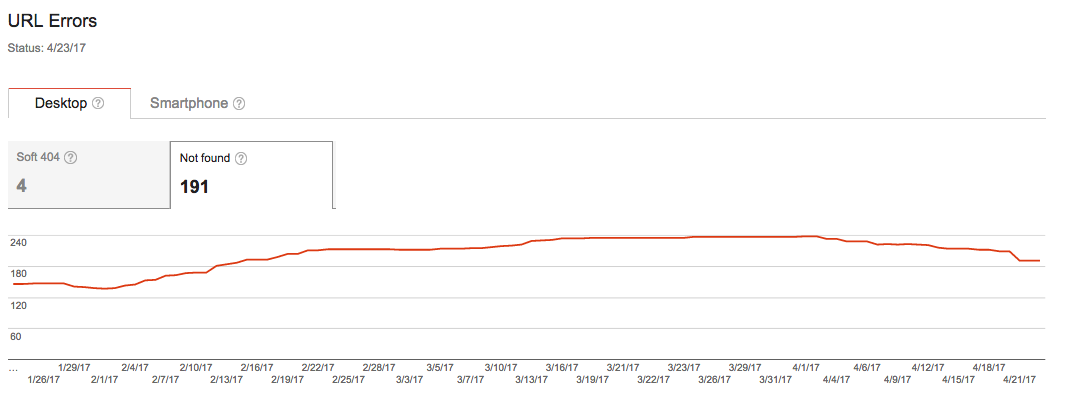
Did you know that Google crawls your site from time to time and has a list of most of the places where 404 errors occur?

How to Find Them:

  • Open Search Console and select your website
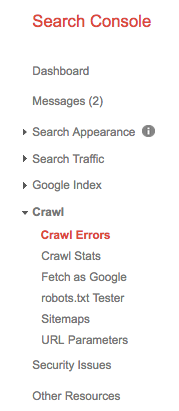
  • Select “Crawl” from the left-hand menu, and select “Crawl Errors”
  • Select the “Not found” tab
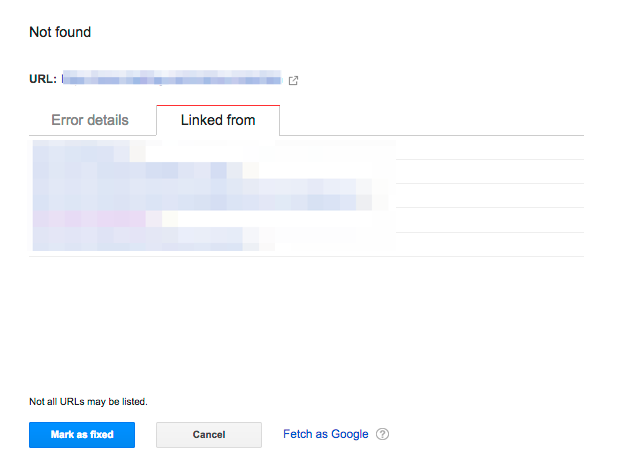
  • Click on one of the links in the found set, and then click on the “Linked from” tab

You now have a list of places on the site where the broken link appears. If the list of pages is massive, it could be that the broken link is part of a menu item or something site-wide.

Now, you need to seek out the place where the link exists and fix it, or remove the link.

Keep in mind that 404 errors on their own are not inherently detrimental to ranking on Google. At least that’s what Google tells us. The caveat to this is user experience. If you have a number of links from search results leading users to inaccessible pages on your website, Google will eventually stop displaying your results. The likelihood of users sticking around the website after they arrive at a 404 error is pretty low. So, the tendency is to “bounce” or “pogo-stick” back to the search result to find a better answer to our question. If enough of this activity is going on, it could be detrimental to your SEO.

The above exercise is a good way to do some spring cleaning on your website. Maybe you’ve been adding webpages over the past few years, changing links, taking pages down. Unless you’ve kept a very detailed record of all this activity, and maintained a process for fixing these things, you may have a bunch of dangling 404 errors haunting you.

Search Console is a good way to keep on top of this. There’s also a ton of other features it offers that most content marketers are unaware of. And the best thing is, it’s a free tool.

If you have questions about anything you’ve come across in Search Console or other SEO tools, let us know!

Woman looking at a laptop in a meeting room
Digital Marketing

Leveraging Reddit for Paid and Organic Advertising

What if I told you that there is a social networking website that could potentially get you 20x the reach of Facebook, Instagram, or Twitter? It sounds too good to be true, right? Wrong! The website I’m talking about is called Reddit.

So what is Reddit?

By definition, Reddit is an “American social news aggregation, web content rating, and discussion website” where members can submit content such as text posts, photos, videos, or direct links into sub-categories of Reddit with specific themes and topics (these are called subreddits). The content posted to these subreddits by members is then voted up (up-votes) or down (down-votes) by other members, determining the position of the post. Posts with more up-votes stay at the top of the subreddit, while posts with less up-votes, or posts with lots of down-votes are pushed down towards the bottom of the subreddit. Essentially, just like any social networking and discussion website, posting high quality content will result in more shares, likes, comments, and maybe even conversions.

Numbers Don’t Lie

So far in 2017, Reddit has been bringing in approximately 542 million monthly visitors, 234 million of them being unique visitors, making it the 7th most visited website in America, and 22nd in the world. If that wasn’t enough, in 2015 Reddit reached 82.54 billion pageviews, 73.15 million submissions, and consisted of 853,824 subreddits.

Now that we know what Reddit is, and why it has such great potential from a marketer’s point of view, I am going to share with you my favourite tactics for leveraging Reddit for organic and paid advertising.

Paying For Targeted Ads

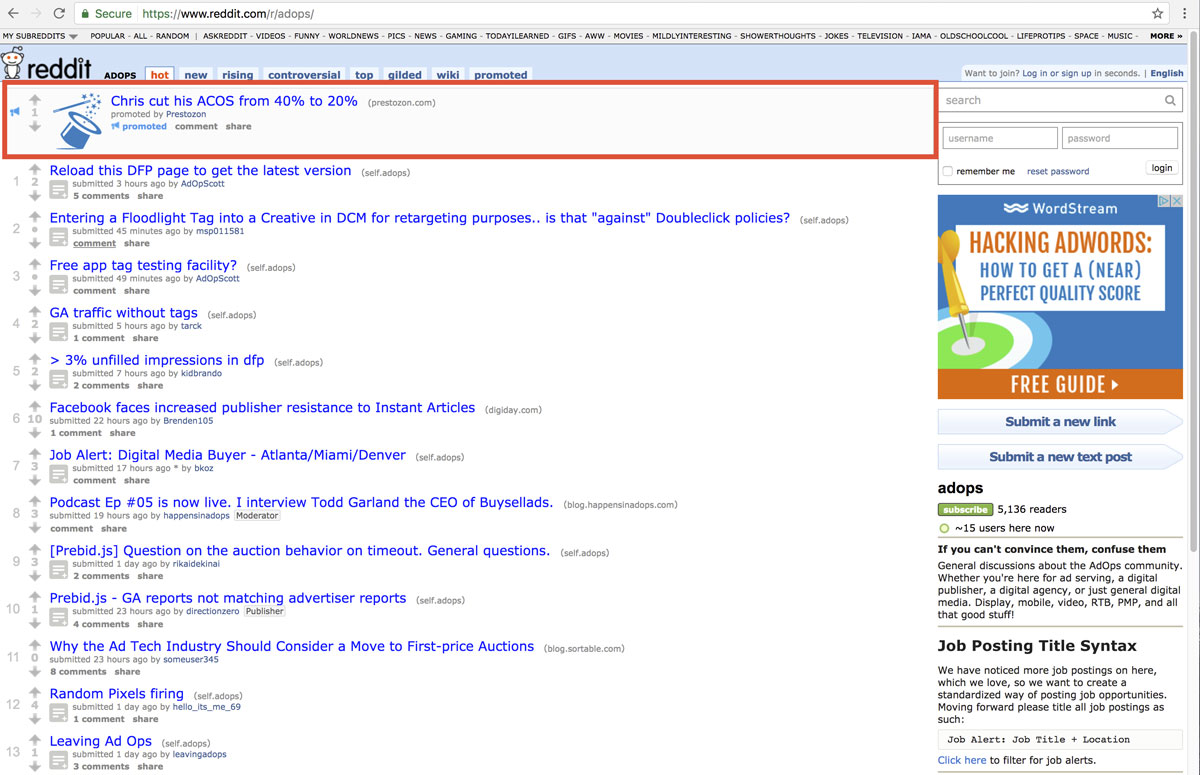
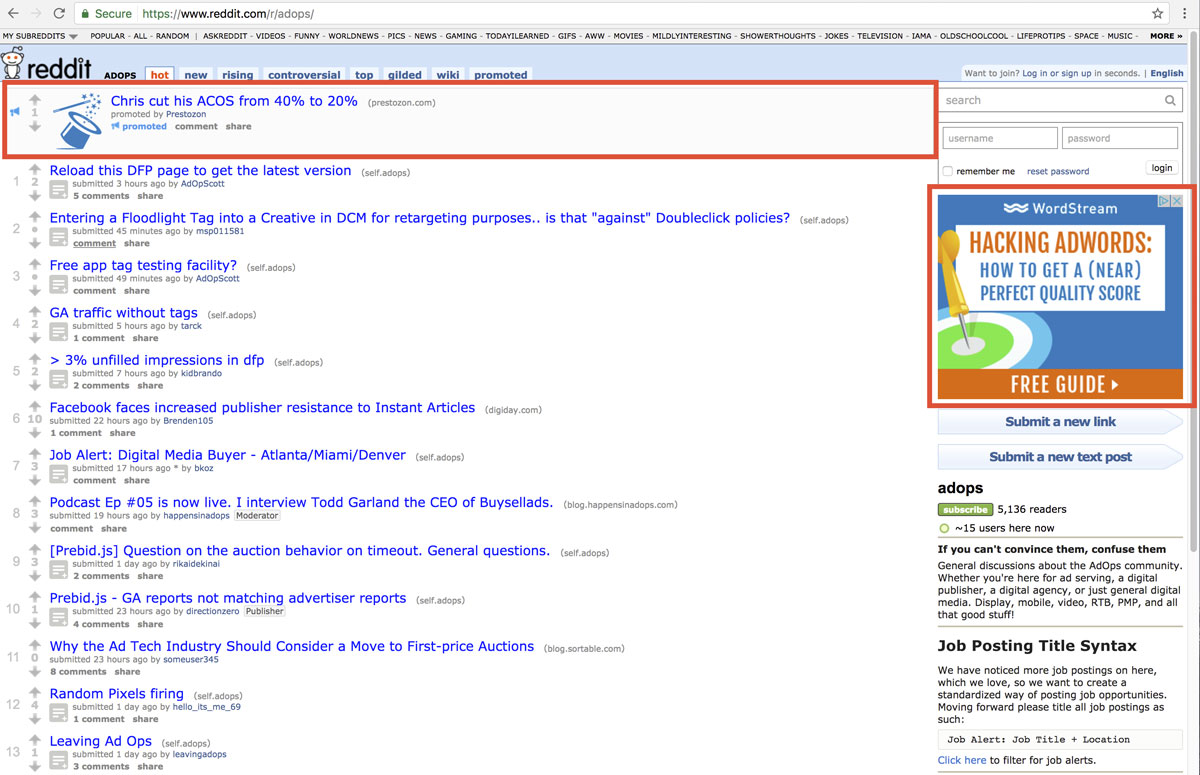
Although I don’t have actual experience with targeted ads on Reddit, I’ve seen them in action and I know they work. Reddit offers advertising options where you can actually advertise in specific subreddits, giving the advertiser an opportunity to target specific users with a super relevant ad. This is great because when a user sees a relevant ad in a relevant place, they are more likely to click through and convert. For example, when I was on the /r/adops/ subreddit earlier today, I found two paid ads that would be very relevant to the /r/adops/ community.

The first is a native looking ad at the top of the subreddit, disguising itself as a normal post:

The second ad, featured on the right side of the webpage is not a native ad. It is still however a high quality ad that is very relevant to just about anyone visiting the /r/adops/ subreddit:

How Much Does It Cost?

In order to advertise on Reddit, advertisers must be willing to spend a minimum of $5 per campaign, and a $0.75 charge per thousand pageviews. Currently, Reddit only offers CPM (cost per thousand impressions) as a cost model, and like Adwords, the CPM price you pay depends on a variety of factors, like targeting, bid, and competing ads. Reddit also allows advertisers to purchase up to 3 months prior to a campaign, so plan ahead!

Organic Marketing

Another form of advertising that I like on Reddit, and one that I have personal experience with, is organic marketing. One tactic that is arguably the easiest is to position yourself as a thought leader within the subreddit you are trying to advertise on. Let’s say that you are working for a landing page optimization company, and come across a user in the ad operations subreddit looking for information on landing page optimization. You could answer the user’s question and also provide a backlink to the company you work for. Doing this (well) would provide you with authority within the subreddit, which will benefit you should you decide to keep posting, and will drive traffic back to the website you have just linked to.

Organic marketing is trickier to pull off successfully than paid advertising, because like most people on social networking websites, people on Reddit hate ads, even more so when the ads are low quality, intrusive, aren’t relevant, or are ads disguised as regular posts. Failing to follow the rules, or “reddiquette”, you may find your content getting downvoted, and you getting banned. Having said that, there are a number of ways to organically market on Reddit without pissing off all of the people who could be potentially clicking on your ad.

Things To Avoid

As I mentioned above, Reddit users hate ads and being deceived into clicking on them. There are some things that every company should avoid doing, whether you’re marketing for Starbucks or a local coffee shop.

The big no-no is posting memes. Just don’t do it. If this is the only take away you have from this article, you’ll have still learned something valuable. It’s a risky move that few brands (if any) have managed to pull off without looking incredibly desperate.

One cringe-worthy example that demands a discussion is when Pilot posted a series of memes to various social networking sites in an effort to try to promote their new line of pens. The memes featured slogans like “The only pen that matters” and “I will not lose any of these” that make you want to put your head in your hands. Once they found their way to Reddit, users weren’t happy, and felt betrayed by the user who originally posted the memes, and maybe even by Reddit as a whole. One user even went on to say “Even if he’s [the poster] not paid by the company or an advertising agency, I don’t really want people who are just fans of some brand making accounts just to post about that product. What would Reddit be then?”

I’ve managed to track down a few of the original memes, and have attached my personal favourites. I truly hope you find them as horrible as I did.

In conclusion, marketing on Reddit is not easy or for the faint at heart. It’s a lively community that offers a huge potential for marketing. If you aren’t afraid of criticism, and are targeting certain niches – there’s really no better place to be. If done correctly, you could be on your way to tapping into a valuable goldmine of targeted traffic directly to your website, while increasing brand awareness at the same time.

Resources

A rocky waterfall
Digital Marketing, Web Design & Development

Increase Your Google Page Speed Score Part 1: Start With The Basics!

With Google putting an emphasis on high quality content for users in the last few years, there’s been a big push to focus strictly on content marketing. Where the first optimizers started off by taking advantage of search engine algorithms through pure coding, nowadays, producing high quality content has been the primary goal.

And absolutely…content really is important. A website without high quality content is just an empty shell with no pearls. However, as search engine optimizers, it is essential that we don’t lose focus on the technical aspects either and that we also give this side of SEO the attention it deserves.

…which brings us to PageSpeed.

Speedy Content

Part of producing high quality content includes delivering it to users with lightning speed. No one likes clicking on a link only to wait for more than 5 to 10 seconds for the page to load in full. By then, they would probably have left your site: increasing your bounce rate, reducing time on site and affecting your overall user engagement. All these things can impact your keyword ranking.

With more “Google searches taking place on mobile devices”, ensuring your website operates with lightning speed is essential.

Google PageSpeed Insights

There are many page speed test tools out there that can help ensure your website performs optimally in speed. Tools such as KeyCDN, pingdom and GTmetrix are great for really analyzing and optimizing your website. But for the purposes of this blog post, we’ll be taking a look at Google PageSpeed Insights.

There are various differences to how Google PageSpeed Insights work versus other page speed tools. For one, it doesn’t actually measure loading time. Rather Google PageSpeed analyzes several different components of your page and gives recommendation on how to improve its performance based on time to above-the-fold load and time to full page load.

As such, there is much debate within the SEO community on whether or not it’s even worth achieving a high PageSpeed score. Some trade offs may occur when trying to achieve a high score (i.e. certain techniques to decrease render time can actually decrease your PageSpeed score). We’ll save the usability and reliability of Google PageSpeed Insights for a later post as this topic requires a much more thorough discussion.

Having said that, Google has the largest market share in search engines. It’s still a good idea to consider these recommendations in conjunction with using other speed tools to compare loading/rending and server response time measurements.

Google PageSpeed Insights Rules

Google PageSpeed Insights is split into two rules: speed rules and usability rules. Since our focus is on speed, we’ll take a look at the speed rules exclusively. The speed rules include the following:

  • Avoid Landing Page Redirects
  • Enable Compression
  • Improve Server Response Time
  • Leverage Browser Caching
  • Minify Resources
  • Optimize Images
  • Optimize CSS Delivery
  • Prioritize Visible Content
  • Remove Render-Blocking JavaScript
  • Use Asynchronous Scripts

Some of these recommendations will require their own blog post as there are many factors to consider before implementing. For example, improving server response time requires a much more thorough thought process. So we’ll be highlighting the items that are fairly simple to complete.

1. Avoid Landing Page Redirects

Ensure your landing page is not a redirected page. Landing page redirects can hamper the user experience if its takes too much time redirecting to multiple pages. This is especially important for ads, links, and social links pointing to a specific landing page.

What to do:

The best and easiest thing to do in this case is to update all your ads, links and social links so that they are pointed to the correct landing page (i.e. their final destination).


Note: The following recommendations below assume you fully understand server software programming, HTML, JavaScript and CSS programming. If you aren’t too sure of these techniques described, give us a shout and we’ll help you out!


2. Enable Compression

Ensure your compressible resources are served with gzip compression. “This can reduce the size of the transferred response by up to 90%”, reducing the download time for users when they visit your page.

What to do:

Most web servers in the world use Apache as their server software. There are others such as nginx and IIS. I personally have only had to deal with Apache servers so far and you are likely dealing with it too. (Tip: One way to check is to use Google Search Console’s Fetch as Google tool and look at the fetch details)

Assuming your server uses Apache, to enable gzip compression, you’ll need to use the Apache Module mod_deflate. Depending on the file types you want to compress, insert the following into your .htaccess file:

3. Remove Render Blocking JavaScript

Ensure there are no HTML references to external JavaScript files in the above-the-fold portion of your page. When your browser sees a script in the document, it pauses DOM construction and executes the script before proceeding. Therefore, your above-the-fold content can not be rendered without waiting for the JavaScript resources to load. In other words, avoid placing any JavaScript in the header as it may cause a delay in rendering your page.

What to do:

  • If the JavaScript resource is fairly small in code, you can inline the script contents into the HTML document. The drawback however is that you are now making the HTML document larger in size with extra JavaScript code.
  • You can apply asynchronous JavaScript to avoid parse blocking the DOM construction. To achieve this, mark your JavaScript with async

You can also avoid the JavaScript from running altogether until the DOM construction is complete by deferring the script. To achieve this, mark you JavaScript with defer.

Another way to defer, is to simply put your JavaScript in the footer of the HTML

4. Optimize CSS Delivery

In the same manner as removing render-blocking JavaScript, ensure there are no HTML references to external stylesheet files in the above-the-fold portion of your page. Similar to JavaScript, CSS are render-blocking resources. Therefore, your above-the-fold content cannot be rendered without waiting for the CSS resources to load.

Unlike JavaScript, defer and async do not work on CSS files.

What to do:

  • If the CSS resource is fairly small in code, you can inline the script contents into the HTML document. The drawback however is that you are now making the HTML document larger in size with extra JavaScript code.
  • The one solution that’s worked for me so far is using JavaScript to defer CSS from loading. Courtesy of www.giftofspeed.com, insert the following code into your HTML footer (replace yourcssfile.css with your actual CSS file).

Place the following snippet within your HTML header. This ensures browsers that don’t support JavaScript can still load CSS files.

What Are You Waiting For? Get Started!

I’ll be saving the rest of the recommendations for a next blog, since they require a little more context and discussion. But these four recommendations are a good place to start optimizing for Google’s PageSpeed Score …assuming you have a good understanding of servers, HTML, CSS and JavaScript.

In the tests we’ve conducted, enabling compression alone increased our PageSpeed Score by 22 points for mobile and 24 for desktop – quite a big jump. Even with trying out these four recommendations, you could significantly increase your PageSpeed score right now.

As a last note, every website is different and there are little nuances that make your website unique, so its very important to test these recommendations first before implementing them right away. With that being said, try testing these recommendations and let us know how it worked out for you!

Thanks for reading! If you have any questions or comments, feel free to comment below! We’d love to hear your thoughts, feedback and/or grievances!

Resources

Wet round rocks covered by mist
Digital Marketing

Dispelling the myth of the magic social media button

“I made a post on Facebook. Why don’t I have 1000 Likes?”

Have you ever walked into a room full of people and whispered your name, hoping for everyone to turn and flock to you? It seems that many business owners believe that, because their business is unique, it will auto-magically stand out in the crowded sea of social media ships. The timeline goes as such: they register their social media profiles, make a few posts, and sit back and wonder why no one is following, liking or otherwise engaging with them.

3 Key Misconceptions

There are three key misconceptions many businesses are making when they realize they should be leveraging social media to grow their business.

We’ll call the first misconception the “illusion of presence”.

There is a widely held misconception that being present on social media is enough. As this misconception goes, the assumption is that businesses get points just for showing up (on social media). Not to be platitudinous, but being successful as a business takes commitment and hard work; social media, like any digital marketing, also takes planning, creativity, and dedication. Showing up is not good enough.

The second misconception is that businesses often feel that when they do start to build an audience, they should talk only about themselves and how great they are.

Have you ever known someone like that? At first it’s fine, but after a while it becomes intolerable and alienating when they appear uninterested in what you like, want, feel, or care about. On social media, this manifests as businesses posting only about what they are doing, selling, or interested in without the understanding that social media, like walking into a crowed room, requires that they engage, talk, query, and generally appear interested in others. This two-way communication is the distinction between being social, rather than doing social (media).

The third misconception is the most pernicious. Some people believe that social media influencers are quietly guarding the secret social media button that once pushed causes likes and followers to fall from the sky. For most industries, the social media landscape is crowded. You are not a unique snowflake, until you can provide value to your audience. Moreover, and more importantly, these platforms (Facebook, Twitter, LinkedIn, Instagram) are advertising platforms. They are a means to reach greater numbers of people in a more cost effective manner than traditional advertising. Just because it is free to create an account does not mean it’s not pay-to-play for (most) businesses.

There is no magic button, no single recipe that defines success; there is no mysterious formula that social media influencers have cooked up and are unwilling to share. Doesn’t exist. Research, dedication, monitoring, planning, and experimentation are the answer.

These misconceptions are the albatross hanging around the neck of your social media success. But, you ask, how can I be successful on social?

Top three recommendations


1. Provide value

Give your audience something engaging, interesting, and relevant to them. How can you tell which types of content resonate with your audience? Check out your analytics and monitor the engagement (Likes, Comments, Shares) on your content to discern potential new content development opportunities.

2. Distinguish yourself from your competitors

Try video, be creative, and experiment. Have you ever tried Instagram Memories or Facebook Live? If not, maybe you should. They are a great way to generate live content and provide a look “behind-the-scenes”. If you are not sure what Memories or Facebook Live are or how to use them, we can help.

3. Increase your reach and presence using ads

Using Facebook, Instagram, or Twitter ads can accelerate your profile growth and visibility. They can draw users back to your website or lead them to your profile. They are highly customizable, trackable, and editable, on-the-fly.

Want to learn more about how social media can help your business grow? Let’s chat!

Close up of a hand holding a mobile phone
Digital Marketing

Fall in love with the Rule of Thirds

Social Media

As part of the social media team here at Treefrog, conducting social media analyses when receiving a new client has become second nature to me. What’s a social media analysis, you ask? Well, truth be told, you’ve probably conducted a few yourself. That time you found the Instagram account of that cute Starbucks barista and spent a few more minutes than you’d like to admit scrolling down their feed, creeping their photos, and praying to the thumb gods for no accidental double-tap…you were kind-of conducting a social media analysis.

Social media competitive analyses are a great way to get information. Questions like, “What is this brand’s personality?”, “Who is their target audience?”, and “Is cute Barista Alex single?” can be answered through each post, each photo, and each comment.

After having done a number of these analyses, something very disturbing has become clear to me: many companies seem to think it’s okay to talk only about themselves on social. Post after post it’s “Hey, check out OUR website!”, or, “This is what WE sell! Buy it now!”, or, “Here’s OUR phone number to learn more about US!”

To put this into perspective, imagine stumbling on Cute Barista Alex’s Facebook page and finding the only thing Alex shares are selfies and statuses about what he’s currently doing. In your eyes, Alex might start looking a little self-absorbed and a lot less cute. In contrast, imagine finding Alex’s Facebook page and seeing he’s shared information about upcoming local volunteer opportunities, posted links for “Study Time” playlists for fellow students during exam week, and has commented on every “Happy Birthday!” post he received to say thank you and wish each person well. Suddenly your interest is further peaked; he’s into music, he’s involved in a  great community, he has plenty of meaningful relationships in his life…and you already know your wedding photos are going to be SO Pinterest-worthy. Companies need to be the Alex we want to marry! They need to show us they care about more than just themselves. So if you’re a brand reading this and wondering how you can make sure your audience falls in love with you, this is what we tell all our clients during social media training: Follow the Rule of Thirds.

The Rule of Thirds states that the content you share on your company’s social channels should be evenly divided as such: 1/3 of it should be promotional, 1/3 should be valuable, and 1/3 should be engaging.

Promotional

This is the one that most companies already have a firm grasp on. This is the content that overtly pushes your goal, such as selling your newest product, or getting people to attend your upcoming event. This content is important because, first and foremost, you are a business and conversions are what keep you up and running. Sharing links to your website’s products and services page or e-flyers for in-store promotion helps your audience find out vital information they need to make a transaction (e.g. Where? How?).

Something to keep in mind is that this content, if done excessively, can come off as too pushy, too self-motivating, and too corporate (something consumers are turning their noses up at nowadays).

Valuable

This content will help balance out your promotional content and ensure your company doesn’t look too “Me, me, me!” That’s because this content revolves around your viewer and what’s important and meaningful to them, whether it’s a news article that they might be interested in, or links to exciting events in their city. A clever way to still tie this kind of content to your brand so it doesn’t seem random and out-of-place is to think about themes around your brand and share content with similar themes. For example, an auto shop in a suburban area populated with new families could share a magazine article about road trip tips for parents with young children.

Engaging

This content will also help to make sure your feed doesn’t come off as too promotional. Similar to valuable content, engaging content takes a step back from “Me, me, me!” and instead says, “We”. Through this type of content, you create an opportunity for two-way interaction between your viewer and your brand. A fashion brand might tweet, “Seems like suede pants are making a comeback. Is this a fashion YAY or NAY to you?”, inviting their followers to tweet back at them and participate in discussion on the topic. It’s a great way to show your audience that you care about what they have to say, solidify meaningful relationships, and gain loyal fans.

So, next time you’re trying to decide what to post on your company’s social media page, scroll down and see what type of content you could use some more of. Use the Rule of Thirds to even things out and make your audience swoon…we hear the cash registers dinging and the wedding bells ringing already.

Want to learn more? We’d love to chat!

The word "brand" decoratively drawn in a notebook
Branding & Design

Is your brand compelling others to act?

A good brand can be the difference between having a product and selling a product.

A great brand can be the difference between selling a product and creating a business.

Your brand is more than your logo. It’s the core of your identity – culture, mission, ethics, competitive advantages – that your customers will identify with when they interact with your organization. When a brand is strategized and executed properly, it will not only increase a company’s popularity and visibility, but it will also compel others to act.

How do you accomplish this? Let’s look at the importance of effective target marketing, staying competitive, and brand development – in regard to both graphic design and content.

Target Audience

A brand is only as effective as the market it targets. In advertising practices, a target is a clear and focused description of the demographic a company would like to reach. While some companies will target many different markets, depending on the product or service they provide, other companies will consistently target the same market.

A successful target audience is one in which a company has been able to narrow their focus, taking the time to study and understand their wants and needs. It is then the mission of a company to attract these people and satisfy these desires through effective and consistent brand advertising.

Market Context

While it is important to understand the target market of your brand, it is also just as important to understand your competition and how you plan to remain competitive against them.

How do you do this? Research and strategic brand execution.

To understand the advantages of your competitors, you must work to understand what their product or service offers, fully. Then, to get ahead, you must look to develop and advertise new features that will make customers chose your brand instead. These features can be as complex as offering an entirely innovative new service, or as simple as integrating more colour variations in a new logo design.

How else can you remain competitive?

Through creatively marketing your uniqueness and strengths:

Unique Benefits

It is critical to identify all the unique benefits your company, service, or product offers to customers. If you can’t identify a clear advantage in your business, get creative and think outside the box.

Is your product essentially the same as that offered by your competitors? You may still have an advantage over them in the quality of your customer service or your warranty. Think about the customers you already have – why do they choose to deal with you rather than your competitor? Leverage those advantages to speak to new prospects with an authenticity they will relate to and want to experience.

Culture

People like to do business with people they know, like, and trust. You may think your culture matters only for internal recruitment and retention, but sharing the philosophy of your company with customers and prospects can help to engage them in your brand.

For example, if your employees regularly go on fun camping weekends together, why not use pictures and content from these excursions as a way to promote your company on social media? You may not see the direct link between camping excursions and insurance brokerage, but this fun and interactive material may be the reason a customer connects with you and wants to hire your company over another.

You may then even be able to integrate this theme into your logo, website design, and beyond! When an organization positions themselves as on-trend, relatable, and fun, customers are more likely to engage with them on social media sites like Facebook and Twitter, and to then also remember and hire them in the future.

Reason to Believe

A brand must also convey trust. In a society filled with “fake news”, what will make someone truly believe that your company provides the best service or wants to help the community by participating in charity events? It’s one thing to claim it, but it’s another thing to show it.

Effective brands practice what they preach. If your company claims to support Charity X every year, why not include a page on your website that includes a pictures collage of your team at various Charity X events and content about why your company is passionate about that charity. You can also use infographics to show how much money you’ve raised for them.

Customers need proof that you are who you say you are. So give it to them.

Brand Slogans & Logos

Effective brand slogans typically include “we” language rather than “I” language, evoking a sense of collaboration and inclusivity. Great slogans also put forward a call to action, creating a mission that will actively push for and drive success. These slogans do not ‘beat around the bush’; they are instead direct, powerful, and concise, leaving no room for misunderstandings.

Example: Barrack Obama’s, “Yes we can” instead of “I can do it” or, Nike’s “Just Do It” instead of “Try it”.

Even more effective than a slogan, a brand logo will push a sale. These icons register with people when they are simple and say something about the brand – without saying anything at all. In other words, great logos are distinctive, appropriate, “cool”, and visually appealing.

Have you ever purchased a Coach purse? How about a Nike hat? In some cases, people may even buy a product simply because the product features an attractive and popular brand logo that they want to associate with their own personal brand.

How Treefrog Can Help

Through the effective implementation of content, graphic design, and social media, your brand will attract its target market and compel that group to engage and buy.

Together, we can strategize, create, and execute your brand. We can design your logo, your website, your product packaging, your business cards, and beyond! We can also help to develop your brand messaging, developing content that will reach all the right people, in all the right channels.

We’ll work to make sure your brand is not only effective, appealing, and directed at the right target market, but that it is also consistent across all platforms.

Let’s talk!

Water drops on a long leaf
Digital Marketing

The Duplicate Content Penalty

Be warned: if Google finds duplicate content, a spike will come out of the internet and impale your website horribly.

Frightened? Many are. But they shouldn’t be.

Duplicate Content Is Necessary

Let’s consider for a moment that Google, or at least some of the higher ups that hold sway at Google such as this guy, state that every website in the universe has some form of duplicate content on it. Think of press releases, blog quoting, product descriptions between manufacturers and dealers… some duplicate content is just natural. If Google were to drop the hammer on all of this content—i.e. implement a “duplicate content penalty” for any duplicate content it came across—it would make a whole lot of content syndicators really grumpy. Google often doesn’t care about making people grumpy—what it does care about is user experience, because users are the ones who click on ads.

On that note, it’s frustrating for a user to see a bunch of webpages in a search result with exactly the same content. Users like to see diverse angles and opinions on a given topic.

It comes back to user experience. We have to think of why the content is duplicated. Is there a logical and justifiable reason? If so, Google will most likely understand. Google has also given us a number of tools to use to properly outline why the content is duplicated.

The Duplicate Content Penalty

A myth that needs to be cleared up is this: there is no “duplicate content penalty”. Although in extreme situations, websites with a ton of duplicate content (hundreds of pages) have been the victim of a manual action. If Google thinks your site is trying to hone in on ranking by posting myriad pages all about the same topic, with identical content, then the skies may open up and Google will smite thee.

If you have content on your website that is the same as other pages on the same site—a paragraph or two let’s say—then you needn’t worry. As long as there is a clear and logical reason for that content to exist, you’ll be fine.

That being said, Google provides us with the necessary tools to identify and categorize our content so there’s no question about why it exists. I’ve listed some examples of these tools below.

Where Canonicalization Fits In

What the blue hell is “canonicalization”? Well, let’s say you have a product that comes in various colours. Your website may have a different webpage for that product in each colour available, which would make for several pages with the same text (describing the product) with minor differences. To keep this organized, it makes sense to define one solitary page that you wish to show up in a Google search for that product. In this case, it is best to use a practice that no one can pronounce, called “canonicalization”. N.B. I’ve actually heard this term referred to as “chocolization”, and I didn’t have the heart to correct the client.

Canonicalization basically means picking a leader. Consider a clone army. You have a bunch of clones (webpages with the same content, only minor differences, like colour red versus blue) and you only want one to step up to the plate and represent. So, you’d canonicalize all those other peon clones towards the leader. The leader will get all the authority, and she’ll be the one putting herself out there in a search result for the world to see. You’ll need to go through the leader in order to get to all of the other clones. If Google has to choose between too many webpages as the authority, it will just get bored and go acquire another company.

Point being, canonicalization will help define for Google the reason for the duplication. You have a better shot of ranking with the one authoritative leader than with several identical pages all competing for the same keywords.

Canonicalization for Pagination

Let’s say you have an article on your website that spans multiple pages. There’s a tag you can implement to tell Google that you want the first page of the article to rank, not all of the subsequent pages.

The tag is used to signal to Google that there’s a logical sequence to the order of the content.

Users wouldn’t benefit from seeing all the internal pages of an article in a search result; why would you want to start reading an article on page 3? The pagination tag allows you to indicate to Google that you’re aware the article has multiple pages, but you only need page one (the leader) to show up in a search result.

301 Redirects?

We’re not going to get into explaining 301 redirects here, but I mention them simply to point out that canonicalization and redirects are two very different things.

Put simply, you use a redirect if you want to route users and search engines to a new location for the content (a change of address). You use canonicalization when you need all the pages to still be accessible by users. The canonical tag is meant to indicate to search engines that you’re aware the content is very similar across those pages, and you only want the “leader” to show up in a search result.

Key things to remember

We need to keep in mind that canonical tags are a recommendation to Google. Whether Google actually follows this recommendation or not is another story. In other words, I can recommend that a train not hit me if I’m standing in the middle of the tracks, but there’s no guarantee it will listen. In Google’s own words, these tags are used as “hints”, not absolute directives.

Is there a good reason for the duplication? If you’re asking whether something will be perceived as duplicate content, put yourself in the mind of the user. Would someone expect the content to be there? If there’s a good reason for the duplicate content to exist, then we should be in good shape. Where we can apply one of the above tags as a hint to Google, then let’s do that.

There is no duplicate content penalty. Google will not shoot your website in the face if it crawls duplicate content. Will SEO tools pick up on duplicate content as a potential negative ranking signal? Sure. But again, let’s think of why the content is duplicated in the first place. If there’s a perfectly good reason for it to be there, then we should be good.

Unique, original content is always best. There are some cases where you may feel compelled to duplicate content. I’ve seen some clients copy and paste text from a source and use it on their own site. I would not ever recommend you do this. Best case scenario is to write your own version of that content so it’s original. Cite the original source of the content with a genuine link. That’s far more natural than simply copying the content.

Thanks for reading! Let me know if you have any questions.

More quality reading about canonicalization

More about duplicate content:


More about chocolization:

Close up of a microphone with a stage and audience out of focus in the background
Digital Marketing

How to Become a Key Opinion Leader in the Digital World

A Key Opinion Leader.

“What’s that?” you ask.

“A Key Opinion Leader is a person who successfully combines expertise and passion, both online and off”
– Sean Stephens

A mainstay in the pharmaceutical and life sciences fields, the concept of Key Opinion Leader, or ‘KOL’, has infiltrated digital spaces as an adjunct to the popular, and perhaps cliché, concept of ‘Thought Leader’.

What makes a Key Opinion Leader? In the medical field, a Key Opinion Leader is a person with long-standing respect, who builds their influence and reputation by speaking at conferences, developing new theories, being published and re-quoted in journals, popular press, and by others who possess considerable influence. A KOL is a person who other professionals look to for answers and guidance because they have distinguished themselves by pushing the boundaries of their field.

Pharmaceutical marketing teams look for KOL’s to act as product advocates – someone who will give their ‘stamp of approval’ on the efficacy and effectiveness of the product. As advocates for the drug brand, KOLs are used to generate increased revenue by capitalizing on their popularity.

Within the realm of digital media and marketing, a KOL possesses social, rather than purely academic, influence. This social variant of a KOL is open to regular, everyday people who can become influential to their peers or “following”.

Out of our discussion with two real-life Key Opinion Leaders in the digital world, Treefrog Inc. CEO Sean Stephens, and Perfect Community Manager and local entrepreneur Lucas Chang, we’ve assessed how both content and social media can help launch and support your KOL career.

Get Social

“It’s critical to be involved and accessible.”

Sean Stephens and Lucas Chang both agreed that Key Opinion Leaders don’t necessarily need to be high profile, but they do need to get out there and be social.

If you are interested in becoming a KOL, it is critical that you make yourself accessible to your community, both in person and online. It is also important that you ensure to leave a positive impact on those you encounter, making your followers feel valued, heard, and more informed after speaking to or hearing from you.

To accomplish this, take advantage of various speaking opportunities and attend conferences in your field of expertise. Afterward, make time to shake hands, exchange contact information with those who may present further opportunities to you, and join in for pictures. The more you are seen, the more you will become recognizable and established.

Another key tip is to be engaging and active on various social media platforms. Social media will allow you to access a wider audience, as well as to spread your message instantly. By leveraging social media, your material has greater potential to be shared, liked, and commented on.

You should also consider pitching interview topics with both local and national media, increasing your platform’s visibility. Not only will producing this material build your resume, but it will also provide documented proof of your ability to lead and educate, establishing a more concrete reputation.

Make Strategic Connections

“In order to develop an opinion that isn’t just fluff, you have to surround yourself with people who are also equally engaged in the same material as you.” 

Using the analogy of iron sharpening iron, Sean Stephens stressed the importance of surrounding yourself with people who are passionate about the same material as you; yet don’t necessarily share your same exact opinion. Stephens went on to explain that Key Opinion Leaders gain credibility when they engage with other leaders and not only express their personal opinions, but also actively listen and learn.

Social media can significantly support these types of connections as social websites like Facebook contain customizable group and event pages where meetings can be set up, conferences can be advertised, and discussions can be had.

While Lucas Chang reminded us that there is still a lot of value in face-to-face interaction, social media now plays a huge role in guiding people to an actual in-person meet. Think about it. When you read a book or article that genuinely interests you, you are more likely to reach out to the author, through either social media or email. Once an online relationship is fostered, you are then more apt, (and likely more comfortable) to meet and interact with that person in real life.

Using social media as a tool, there are limited boundaries with whom you can connect with online and in person. Why not give it a try?

Become A Specialized Expert

“A KOL is a person who successfully combines expertise and passion.” 

By attending local events and networking, you can begin to build your personal brand and reputation. However, Sean Stephens reminded us that the social persona of a true Key Opinion Leader is only valuable if based on validated expertise.

KOL’s must responsibly invest in themselves, as well as their area of interest, consistently working to develop their opinion by further investigating the subject. KOL’s can become experts through online research, meeting with others who are interested in their same field, and through receiving accreditation.

Above all, creating quality publishable content will position your brand as reputable. Experts become known when their novels, theories, and opinions are published on websites or in credible magazines, newspapers, and journals. Without a foundation of content, your ‘expertise’ will be seen as just talk.

Be Consistent & Present

“Always go to the things you say you’re going to go to.” 

Sean Stephens expressed that one of the most valuable things a KOL can be is consistent and therefore reliable. He stressed that absence and lateness do not go unnoticed and that being considered inconsistent can ruin a reputation. Stephens also claims that there’s a notable difference between being present and truly having a presence both in person and online.

In a digital era, online presences can either make or break a Key Opinion Leader. When a person chooses to support a social media account by following and engaging with it, that person is essentially saying, “I like what this page has to offer me” and “I’d like to see more”. However, when media platforms are neglected, or if the posts do not reflect the messaging a follower initially followed that page for, that person is likely to un-follow and disengage with the account.

If you commit to having a social media page, be sure that you are able to set ample time aside to support that page, making frequent, appropriate, and applicable updates, which will keep your audience interested.

When strategized correctly, social media can launch your brand towards success, but when not executed well, these failed campaigns can damage your reputation.

Be Passionate

“When you can tell that someone is passionate, whether it be quietly passionate, or overtly passionate, you want to hear more about what they have to say.” 

While anyone can educate themselves on any topic, especially in a digital era, both Sean Stephens and Lucas Chang believe that passion is what sets regular experts and Key Opinion Leaders apart. When a speaker is truly passionate, their level of excitement will naturally transfer to their spectators, leaving a lasting impact.

To build one’s passion into a credible opinion, you must allow yourself to continuously learn and rediscover the meaning behind your passion as it grows. In a technology-obsessed world that is constantly changing, a KOL must be adaptable, finding new ways to keep their message interesting, informative, and up-to-date.

One of the most powerful ways to express passion is through open, genuine, and relatable online posts. Key Opinion Leaders can demonstrate love for their specialty by writing exciting articles about new finds in their field, sharing promotional material for related events on Facebook, posting pictures of themselves in action on Instagram, and more. When audiences physically can see that a Key Opinion Leader is consistently engaging with their area of interest, that person’s passion becomes believable.

Be Practical

“Any person can come up with an idea, but a majority of people never execute those ideas.”

Lucas Chang explained that aspiring KOL’s must pick a specialty that they are naturally passionate about, and then must find a way to make their dream practical. Chang claimed that most people fail in becoming a KOL when they are full of ideas and yet are unable to make their dream a tangible reality.

However, with incredible advances in technology, becoming a Key Opinion Leader has never more achievable. Social media sites are built with the intent to connect people to the things and people they find interesting, expediting one’s ability to gain momentum and success.

In the past, Key Opinion Leaders relied on content alone, to build a reputation of expertise. However, the value of printing words in a book is fading. Content now needs to be supported by the internet, making the sharing of content practical and accessible to more people.

It is then opportune for potential Key Opinion Leaders to leverage social media to support their written work, preventing incredible ideas from just being stored and ignored on a dusty bookshelf. You never know, your message might even go viral.

It is not enough to simply want to become a known expert; you must also be willing to put in the work to make it happen.

Too busy to do it alone?

Through expertise in the development of engaging social media campaigns, as well as content writing, Treefrog Inc. can help establish your Key Opinion Leadership.

By managing your social media profiles, building your website, developing blog topics, and more, the Frogs at Treefrog Inc. can customize your path to success, helping to relay your message to the right audience.

Hand on a laptop keyboard
Digital Marketing

Search Engine Changes and How They Affect Your Content

Updates in Search Engine Optimization have brought content marketing full circle. Nowadays, Google actively abolishes websites that include keyword stuffing, multiple thin pages, misleading information—in essence, Google is encouraging us to be better writers.

But isn’t this the way it should have always been?

When you are able to develop content that is genuinely useful and interesting to your audience, that same audience is more likely to engage with your material, increasing the success of your website and business. This type of content will then also naturally improve your websites SEO results, as well as improve the quality of your online presence.

Below we explore this, as well as some other major search engine shifts, which directly affect how you should be approaching your website content. Understanding where search engines are headed will not only help to keep your website competitive, but will also ensure your message is reaching the audience it is intended for.

So with that, let’s dive in!

A Mobile-Friendly Shift

Is your website mobile-friendly? You’ve likely already run into this question many times.

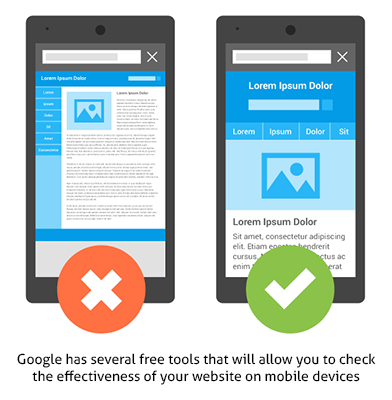
Updating their Search Quality Ratings Guidelines, Google has recently given extra emphasis on the importance of having a mobile-friendly website. As users are more frequently using their mobile phones and tablets (over laptops and desktop screens) to search for information, websites that are not mobile-friendly may fall behind. When people are unable to access, navigate, and read all of the information on your webpage with ease, they are likely to lose interest and abandon the site.

To have a mobile-friendly site means that when a person accesses your web content on their handheld device, they aren’t forced to “pinch and zoom” to get at the content. Google also recommends having a design that is responsive to the size of various screens, which is the preferred route to having a separate site for mobile devices and a separate website for desktop.

Google’s shift to mobile-friendliness affects content by forcing us to think about how someone is consuming content via the medium. After all, mobile devices have smaller reading screens, and people consuming content on mobile are often opting for a quick ‘snack’ rather than a full course meal. While content developers could still write the same detailed content as they always have, mobile users are not likely to keep scrolling and scrolling down, committing to read a long post in its entirety. When most people go looking of for an answer on their phone, they want a quick and tightly packaged response. So – while large-screen webpages have much more physical room for the development of information, writers have had to adjust to the idea of keeping marketable content as concise as possible. Content writers have also been forced to articulate an answer within the first paragraph of content – ensuring a reader receives what they’re looking for before losing interest and leaving the page to look somewhere else.

Long-form content still has a place on mobile, there’s no doubt. If it didn’t, there would not be such wide adoption of e-books on mobile. However, the medium encourages us to focus heavily on our target audience. Are they likely to consume this piece of content on a smartphone? If so, then perhaps we should consider length, the images we opt to use, our desired calls to action, etc. We not only need to think about the reader, but also consider how the reader will best engage with the content we’re putting in front of them.

Link building as PR

It’s no longer common practice, nor is it particularly effective, to purchase or incentivize links that deliver a user to content. Even asking for links is often now considered outdated. It’s far more applicable to acquire links organically; in other words, have people come across or land on your page because they want to, not because you’re asking or positioning them to.

So – how do you receive these organic engagements? Hard work. Link building isn’t what it once was—it’s now essentially a Public Relations strategy. This practice involves reaching out to bloggers and industry publication editors as an expert in a specific field, providing links to applicable sources that may benefit that organization’s developing stories. Positioning your webpage as a reliable resource validates your page as useful, and drives traffic to your site. By acquiring links from media sources naturally—because they were genuinely interested in linking to your article—the next time Google crawls from those outlets to your content, it will give your website that much more credibility, and thus improve SEO.

Engagement VS. Keywords

Traditionally, the importance of populating a webpage with keywords for search engine ranking took precedence over user happiness. SEO departments worked vigorously to compile data concerning which words, when optimized, would lure the most users to a page. SEO would pass this data on to content writers for keyword-focused content to develop.

However, a major shift has occurred. No longer are SEO specialists identifying keywords for the use of content developers – the value of content itself, is now taking priority.

Web developers realized that keywords were getting traffic to a webpage, but that content, which was created only for the purpose of including a keyword, was not providing customer-focused information. Without creating content with user intent in mind, people would stray from these pages quickly – damaging the website’s SEO performance.

Searchers normally have one of three main reasons to conduct a search online: transactional (want to buy), navigational (want to go to), and informational (want to learn). Businesses must now think of content not only in terms of the audience that they’re trying to reach, but also in terms of matching that audiences’ intent. The more you are able to focus your content on what the searcher wants, the more effective you will become at solving both reader and customer problems.

Voice Search Is on the Rise

Siri. Love her or hate her, there’s a lot to be said about what she can do. Siri, Apple’s on-board automated assistant, can help with tasks such as remembering a date, booking an appointment and sending a text message to a friend.

What is of increasing interest is how people are using automated assistants like Siri to search the web. If you ask Siri a question she can’t answer, she’ll take to a search engine (Siri uses Bing)—and that query data gets tracked. Similarly, Google Now will track voice searches from Android device users in the same way as text-based queries are tracked.

The main difference is in the way that people search via voice. They are more inclined to use natural language—including stop words like “and”, “if”, even “please” in their query. This has necessitated a search engine to decipher the true meaning of a query, while sifting through far more specific information. For example, we’re not typing “cheetah running speed”, we’re asking a search engine: “OK Google, how fast can a cheetah actually run, in kilometers per hour?”

These spoken questions are very specific, “long tail” queries. The issue is that they don’t hold enough search volume to gather trend data from. You’d be far more likely to get search query volume for something like “cheetah running speed” rather than the longer variation.

The beauty of the long tail query is that it is so specific that you have a great chance of ranking highly for it. For example, if you were to create a piece of content called “How Fast A Cheetah Can Run In Kilometers per Hour”, and you optimized the heck out of it, your chances of your content ranking when someone searched for that query would be very high.

How does this effect content? Google is pushing a shift for content to adapt to the: who, what, where, why, and how questions that audiences are asking – providing more user-friendly and immediate answers. This then challenges content writers to use alternative methods of communicating information, such as blogging, as a way to specifically target searcher intent – developing content based on common user interests and concerns.

Source: http://www.huffingtonpost.com/michael-peggs/how-voice-search-is-changing-seo_b_8926708.html

Search Ads Disguised

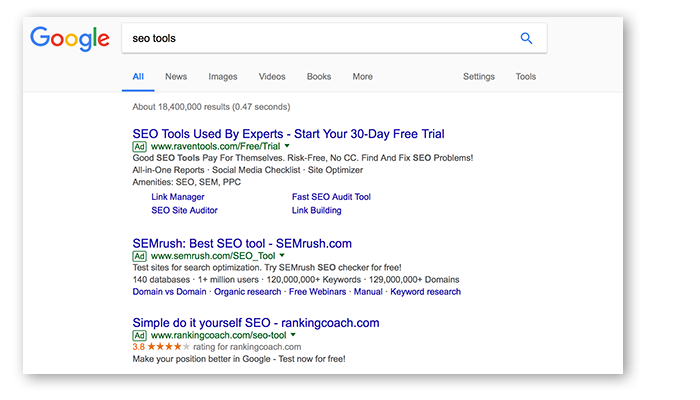
You may not have noticed, but Google has been transforming their small search result “Ad” indicator.

Over the course of AdWords history, Google got rid of the yellow backdrop (sometimes called the sandbox), introduced the small “Ad” icon, changed the icon from yellow to green, and most recently changed the icon again to be an outline; arguably even more indiscernible.

While these new design shifts may seem small, the change holds great significance. Basically, Google is trying to blur the lines between what is a paid and what is an organic search result.

It would seem that Google has done this to intentionally blend and disguise paid ad results with organically listed results, making the difference between the two less obvious. This is likely to increase visits to paid-for ad sites, as many users previously became accustomed to skipping past advertisements – noting the yellow indicator and moving to the organic green results instead.

It is then more important than ever to have engaging content on your web pages, increasing the flow of natural traffic to your site, as well as positioning your brand in a competitive place on Google’s result list.

With great content, organic users will spend more time on your site, increasing your popularity. It is also becoming critical to invest in SEO research, understanding how to make your website competitive with other paid-for advertisements.

As Google continues to improve its algorithms, it is important to keep your website’s content up to date and on trend. More than ever before, businesses must work to understand their customer demographics through detailed analysis, to get a clearer sense of what these users might be searching for. Our web content needs to be informative, helpful, and engaging for our audience, otherwise people just won’t bother reading it.

While it may seem hard to keep up, the team at Treefrog is passionate about keeping on top of industry shifts. Should you need us to help navigate your business through these changes, we’d be happy to help.

Scroll to Top