
Author name: admin

Coworkers sit and stand, looking at a paper held by a woman.
Branding & Design, Digital Marketing, Web Design & Development

How To Strategically Plan Your 2018 Marketing Budget

Marketing budgets vary per company and industry, but what’s true about all businesses, is that having a marketing budget, no matter what size, is necessary.

In this article, we discuss what should be included in your marketing plan, and provide an overview of the below checklist – which covers the action items you’ll need to complete as you head into 2018:

  1. Organize your finances
  2. Identify your needs and goals
  3. Determine your spend
  4. Develop a marketing plan
  5. Decide how to allocate your budget
  6. Action your plan

Organize Your Finances To Identify Your Needs

Before creating your marketing budget for 2018, you need to strategically organize and collect social and financial data that will allow you to:

  • Identify holes or ‘misses’ in past marketing campaigns
  • Identify 2017 gross revenue to predict 2018 gains
  • Reflect upon which areas (social, content, SEO) you are struggling in
  • Identify which areas of your business need attention and larger investment

Identifying Your Needs & Goals

Once your financial plan is in order, you will be in a better position to consider the state of your business and how much focus you will need to give social media, website building, design, SEO, or content marketing in the upcoming year. Having a clear understanding of this data will help you to identify your actionable needs and goals for 2018, such as:

  • Developing a social media campaign around a new fundraiser you’re hosting
  • Increasing SEO to rank higher on search engine results pages (SERPs)
  • Updating out-dated content on your website
  • Designing new marketing material to hand out at a tradeshow you’ll be attending
  • Starting fresh with a new website

What is your biggest priority for 2018?

Determining Your Spend & Plan

Brand New Companies

Companies that are less than a year old are likely limited to a very small marketing budget. They should, therefore, leverage predominantly free social media platforms (Ex. Facebook, Instagram, etc.) and consider attending a comprehensive Social Media Training session to begin generating buzz around their brand. By learning how to strategically publish yourself, you’ll reduce costs.

New Companies

Businesses that have been established for one to five years should consider using a healthy percentage of their gross revenue on print (Ex. brochures at tradeshows) and digital marketing (Ex. website enhancements and blog development). A larger marketing budget will help to launch awareness and boost familiarity amongst new and returning customers.

Established Companies

Companies that have been in business more than five years, and have a secure budget for marketing, should allocate a substantial amount of their gross income to brand marketing (Ex. Email marketing, PPC, and social media/content campaigns). For companies who exist in extremely competitive markets, are in need of brand reputation management, or who are promoting a new service or product, this budget should only continue to increase.

Allocating Your Budget

Branding

Graphic design can transform a boring and stagnant brand into something refreshed, relevant, and captivating. Although branding feeds into SEO, social media, content, and website integration, most branding begins in the design studio – where talented teams research and draft branding materials that reflect the vibe and intent of the company’s messaging.

If your business relies on brochure material, tradeshow booth design, or needs a complete logo and brand overhaul, your marketing budget should be catered towards branded design elements, as well as the integration of those designs – into your social media platforms, web copy, and website.

SEO Management

Companies that find they are in need of more quality leads, improved recognition, and higher visibility within search engines like Google, are in need of quality and consistent SEO management, as well as PPC advertising.

However, SEO relies heavily on quality content to rank and perform ideally. Therefore, if your business is in need of SEO, you’re also in need of new and better content – audited, identified, and strategically improved throughout your website.

61% of marketers say improving SEO and growing their organic presence is their top inbound marketing priority.

Local searches lead 50% of mobile visitors to visit stores within one day. (Google, 2014

78% of local-mobile searches result in offline purchases. (Search Engine Land, 2014

Content Marketing

Web content articulates your visual brand messaging in text. In other words, content backs the intent and messaging that your branding portrays. Content also goes a step further – to provide context, drive actions, present valuable information, help your company to rank well in search engines, and, in most cases, helps users make an informed consumer decision.

While writing words for a webpage may seem easy, content marketing does more than just list details about a product and tell you why it’s great. Content marketing strategically develops copy that will speak directly to a targeted market, tap into their concerns and interests, support SEO, and drive specific conversion goals. This targeted marketing is also effective for email marketing broadcasts.

53% of marketers say blog content creation is their top inbound marketing priority. (HubSpot, 2017

On average, B2B marketers allocate 28% of their total marketing budget to content marketing. (Content Marketing Institute, 2015

Social Media Marketing

For businesses looking to improve brand recognition and to interact with their customers and clients, a new marketing budget should shift primarily to social media engagement, management, and development. With SSPC on the rise, companies need to consider investing money in social media advertising – to convert social media engagement into a potential sale of a product or service. By allocating the rest of your budget towards content development and SEO management, your online profile will continue to flourish.

83% of all marketers actively pursue social media marketing initiatives. (Aberdeen, 2016

Nearly one-third of the world uses social networks regularly. (eMarketer, 2016

Website Design

If your website is out-dated, hard to navigate, and is not serving the purpose it should – it’s time to dig deep and invest in SEO, content, social media, and web design. Working together to achieve the succinct goal of driving brand recognition, leads, and success for your company, each of these marketing sectors can deliver a complete overhaul for your public and online persona.

While a full website build is a major investment, the payoff of refreshing your entire brand at once will ensure the future of your business is on-trend and prosperous.

Investing In End of Year Marketing

Is your online business holiday ready? If your company relies on online sales during the end of year season, your marketing budget should allow for an increase in spend during these months. That means more social media campaigns, a stronger PPC play, content development to drive interest, and graphics to support your initiative.

For more information on re-visiting your end-of-year ecommerce marketing budget, check out our article ‘Now’s The Time To Spruce Up Your Ecommerce’.

81% of shoppers conduct online research before making big purchases.

Actioning Your Plan

With so many options of where to begin, it can be hard to identify which marketing venture your company should be focused on and participating in. That’s where we come in.

Treefrog Inc. – Your Digital Marketing Solutions Specialists

At Treefrog Inc., we understand that the needs of B2B and B2C clients are sometimes different, and our Client Care Advocates are well versed in identifying client needs based on their pain points and industry sector. If you’re not sure where to begin, we can help:

  • Social Media Training
  • Content Development Workshops
  • SEO Training
  • Email Marketing
  • Website Programming
  • Graphic Design
  • Content Marketing
  • Social Media Management
  • SEO

As one of Treefrog’s Marketing Partner’s (MP’s), your business will receive monthly project management, support, strategizing, development, and reporting – across content, SEO, and social media departments (if required).

To learn more about planning your upcoming marketing budget, contact us today or give us a call at 905.836.4442


Illustration of interconnecting points
Digital Marketing, Web Design & Development

Why Your Business Should Always Renew Your Domain Name With a Reputable Company

A cautionary tale in domains

You wake up in the middle of the night with a fabulous new business idea. You now need a website! First things first, you look for a domain name. The domain name is an essential piece of your brand and may involve your keywords, your company’s name or is possibly is just memorable by the name itself.

As the months pass and your website is live, your business is running and you are now working 18-hour days running your business. The small little thing, like a domain name, is farthest from your mind now thinking of what’s it’s doing or how it’s working for you. Until it happens…the renewal!

Have you ever thought of what happens if you don’t renew you domain name?

If you own a domain (unless you have purchased it for 5 or 10 year increments) you will receive an annual renewal notice, they are typically sent out at 90 days, 60 days, and 30 days, depending on your registrar. The desire is that this will prompt you to renew with adequate notice. But should you miss the renew date it does expire and enters a grace period.

For 0 – 40 days, depending on the kind of domain name you have (.com, .ca, .uk etc.), past that expiry date your domain name sits waiting for you to change your mind. All in the hopes that it was possibly a mistake and you will pay the fee and return it to its former glory, housing your website!

During this grace period all services associated with your domain name stop working. That means, all of your email addresses associated with that domain name will no longer receive email, and your website on that domain name will be inaccessible.

After the grace period has come and gone the domain name finally does one of two things. It either enters a redemption period where you can still get your domain name back one more time (for an additional fee on top of the renewal), or it fully expires. Finally, it’s then publicly listed with other “to be released” domains and sold to the highest bidder. There are a lot of people out there reading those lists of domains in search of domains to purchase, but that’s a whole other subject for another time.

Can you imagine if your domain name was sold off to the highest bidder?

For an example, let’s take the current mayor of Toronto who owned robford.ca. This domain housed the website which was home of everything Rob Ford when he was city councillor before becoming mayor. He would update it with council votes, council expenses and the site held information for you to contact him. But since becoming mayor, someone along the way either forgot to renew it  (possibly wherever he was hosting the domain, or they never let him know?). Or possibly just deemed robford.ca not necessary anymore and let it completely, totally expire.

It sat for the 0 – 40 day grace period and was then released back into the pool and sold off to the highest bidder. Now Mr Mayor Rob Ford’s domain name is in the hands of someone else, who’s having it re-direct to the Toronto Star, or posting “Rob Ford (January 31, 1862 – June 8, 1892) was an American outlaw best known for killing his own gang leader Jesse James in 1882” and now taking suggestions on what to do next. Who knows the eventual fate now of robford.ca, but whatever happens now isn’t controlled by Rob Ford.

The Mayor Rob Ford now uses http://www.robfordformayor.ca and http://www.toronto.ca/mayor_ford, but to let a domain he was using for years lapse is a costly move for him, and would be a costly move for any business.

If your business is online, then you have a domain name! It’s connected to your website and possibly your email. It’s how you tell prospective clients and current clients where you are, how they get in contact with you and is part of your brand. Your business is important and your domain is the most important piece to that online identity.

Ensure your domain name is renewed yearly or better yet purchase it for 10-years, show stability to the search engines and put your mind at ease.

One of the best practices at Treefrog is that we renew every domain in our account for our clients and each domain is checked over by trained staff who know the value of keeping that domain. Even if you do finally choose to let your domain go, we follow up with you personally to ensure this is what you want. So make sure your domains are with a reputable company and are renewed so, unlike Rob Ford, you will control your  domain for many years to come.

Decorative illustration of "#Hashtag"
Digital Marketing

Instagram Hashtags 101

Is your brand on Instagram? Your answer should be a big ‘Yes!’ Otherwise, you’re missing out on the chance to potentially reach up to 700 million monthly users!

Instagram is a photo-sharing mobile platform that allows users to share photos and videos, individually or as a set. Getting ahead on Instagram involves following some common best-practices which include posting high-quality visual content, making a list of accounts to @mention and tag that relate to your content, and creating the perfect schedule to post.

However, one aspect of Instagram that arguably isn’t being used to its full potential is hashtags.

Instagram hashtags are one of the best ways to grow your account. Did you know that posts with at least one hashtag average 12.6% more engagement than posts without any hashtags.

PetaPixel words it best: “Think of hashtags as a pipeline to the rest of the world.”

Using the right combination of hashtags in the captions of your Instagram posts (and Instagram Stories) can help you expose your brand to large and targeted audiences. In fact, your chances of attracting new followers, gaining more likes, and increasing engagement are massively improved by the use of hashtags! However, if you’re not choosing your hashtags strategically, your posts will not get in front of the right people.

How Instagram Hashtags Work

Every Instagram post can be accompanied by a caption and up to 30 hashtags. These hashtags help categorize photos and videos, which supports the process of content discovery and optimization.

For example, Luxy Hair, a hair extensions brand, posts images of intricate hairstyles with hashtags like #hairideas, #hairgoals, #hairtutorial, etc.

Due to these hashtags, any user searching for hashtags about #hairideas, #hairgoals, or any of the other hashtags used, may come across this post.

Branded Vs. Community Hashtags

There are two types of hashtags that are commonly used in conjunction with regular content-related hashtags: Branded Hashtags and Community Hashtags.

Having a general understanding of the different types of hashtags (and their corresponding audiences) can help you develop a more effective Instagram strategy.

Branded Hashtags

Branded hashtags are unique to a brand or campaign. It could be as simple as your company’s name, tagline, or the name of one of your products or campaign. These hashtags can also communicate your brand identity or lifestyle messaging.

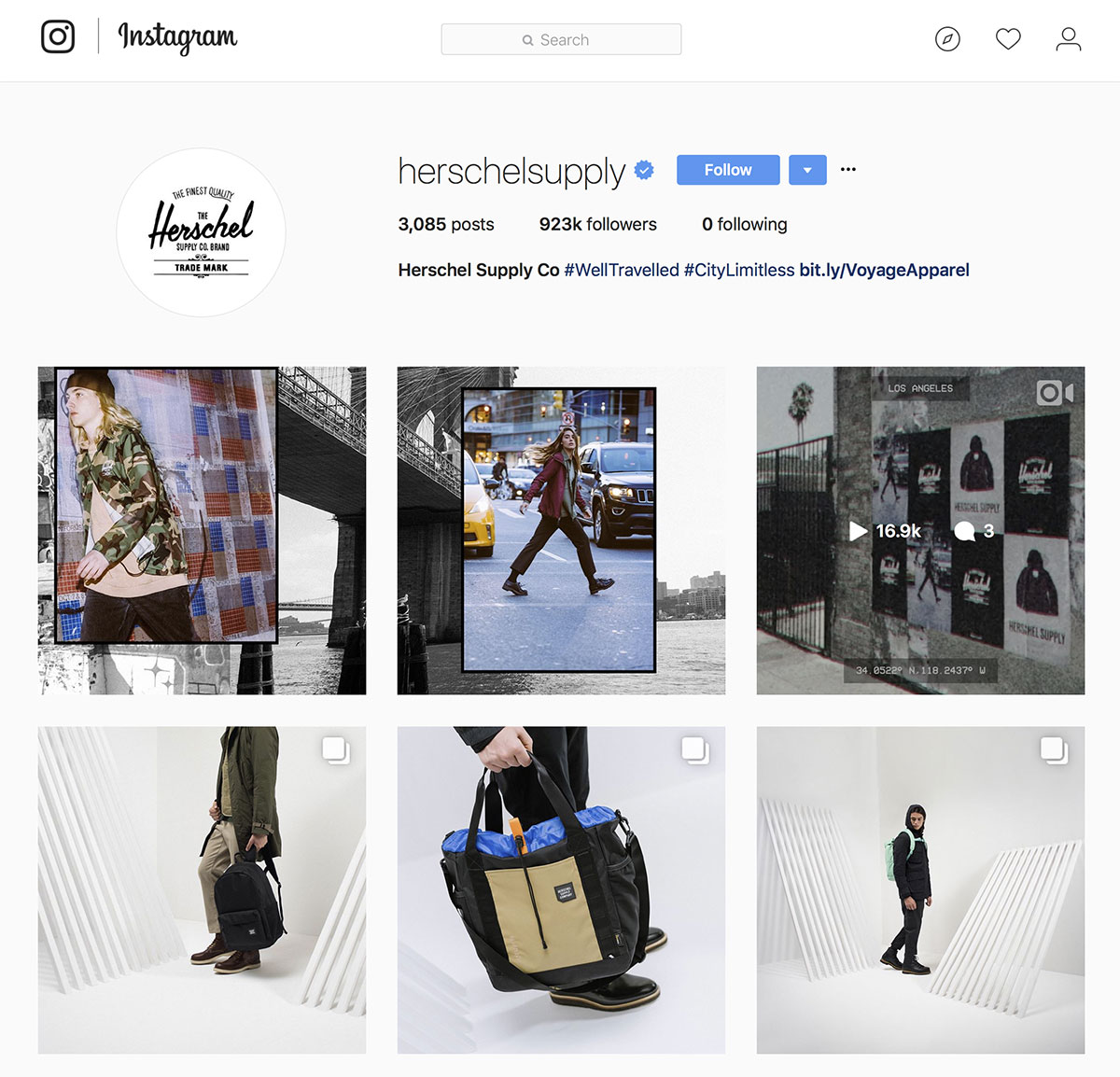
For example, Herschel Supply Co. uses a few branded hashtags, including #HerschelSupply, #WellTravelled and #CityLimitless. The hashtag #WellTravelled was created for a campaign to encourage customers to share travel photos featuring Herschel products. Now tagged in more than 2.57 million posts, it is often cited as one of the most popular travel hashtags on Instagram.

Like Herschel, you can create a branded hashtag for a specific campaign, contest, or to simply showcase your company’s culture, products, or services.

If you’re running an Instagram campaign or contest, having a brand hashtag will help drive participation and engagement. It will also organize all the posts that are tagged with it on a hashtag page. This is helpful if you’re using the hashtag to collect entries for a promotion or contest submissions, or looking for content to ‘re-post’ onto your brand’s account.

Use branded hashtags to get your most loyal followers and customers to engage, and to improve your overall online brand awareness.

Community Hashtags

Community hashtags connect like-minded users around a specific topic. These hashtags are more general and don’t necessarily have anything to do with your company or brand.

Some examples include #instafood or #dogsofinstagram. These hashtags are widely used and aren’t specific to any one person or brand.

For example, the photo above from @white_coffee_cat_ uses multiple community hashtags including #catsofinstagram, #catstagram and #weeklyfluff.

The benefit of community hashtags is that people actively search for these common word sets, so, if your brand’s photos and videos show up in the search results, you’ll get instant exposure to a new audience.

However, you need to make sure the community hashtags are relevant to the content you’re posting. If @white_coffee_cat had used hashtags like #instafood or #ootd in the photo, it wouldn’t have made sense.

The best way to figure out which community-oriented hashtags are right for your brand is by researching which hashtags your audience or competitors are already using.

How to Find The Best Hashtags For Your Account

If you are not being strategic with which hashtags you are using, your posts will not get in front of the right people. The first step to figuring out which hashtags are best for your brand is to put yourself into the shoes of your ideal audience.

For example, if you are a real estate agent serving the city of Hamilton, you ideally want to target potential homebuyers looking to move into a house in the Hamilton area. Logically, some keywords that the target group may search for include #HamiltonHomes and #HamiltonLiving. It is then important to further develop this list and to investigate what else the target market may be interested in.

Next, create a list or home buying hashtags that are directly relevant to your company, brand, and include the location that you serve. For example, if your company is called ‘Hamilton House Hunters’, one of your hashtags could be #HamiltonHouseHunter.

As a real estate agent, the obvious industry hashtag is #RealEstate, but you can narrow it down further to the specific location that you are serving: #HamiltonRealEstate. Some other hashtags could include #RentalProperties, #Hamilton, #GTAHomes, and #HouseHunter.

Finally, make a list of the hashtags that your top competitors and ideal audiences are using. This involves some research, but it is well worth it if it means you’ll be attracting potential clients to your business.

Once you have your list of hashtags, do a search of each hashtag on your list to ensure that the content that pops up is relevant to your brand, is appropriate, and has a good amount of users using the hashtag.

Additional Tips

  • Instagram currently limits the number of hashtags you can use per post to 30. Many users avoid using more than 5-10 hashtags simply because it looks like spam. One way to avoid the unprofessional, ‘spammy’ look of using many hashtags is to post your main brand hashtags in your main caption, and the rest of the hashtags as a comment. This will ensure that your post still falls under each of your hashtags, but avoids viewers from seeing all the hashtags at first glance.
  • Keep your main hashtags typed out in a note on your phone, which you can easily copy and paste into your Instagram posts without having to re-type them each time. This will save you a ton of time!
  • Make sure you update your hashtags every 3-6 months! Hashtag trends are always changing, and some may become blocked by Instagram due to inappropriate content.

Using the tips and strategies you’ve learned here, you’ll be well on your way to growing your audience on Instagram.

Want to learn more about how your business can leverage the benefits of Instagram and other social media platforms? Give us a call at 905.836.4442 and let our social media specialists strategize your next Instagram campaign!

An open sketch book on a table with social media related illustrations.
Digital Marketing

Why Social Media Works

Many business owners enter the world of social media marketing believing that it will immediately take their business from zero to 100 in just a few clicks. However, this expectation isn’t realistic. Social media marketing takes time, effort, and a well-developed strategy. Enough momentum also needs to be kick-started and maintained to start seeing a notable increase in ROI.

So, if you’re wondering if you should be leveraging social media marketing for your business, the short answer is ‘yes’. No matter what industry your business is a part of; here are five reasons why social media will work for you:

1. Sophisticated Targeting

The biggest advantage to social media marketing is the ability to target your ideal audience – much more accurately when compared to traditional marketing tactics.

Through Facebook Ad Campaigns, you can target individuals based on age, gender, location, household income, interests, education, workplaces, languages, relationship status, parenting status, and so much more! Sophisticated targeting has proven to be an incredibly valuable tool for getting your ads in front of the right people. Almost 90% of marketers say their social marketing efforts have increased exposure for their business, and over 50% of marketers who have been implementing social media marketing tactics for two years have reported improved sales.

2. Real-Time Feedback

Social media marketing allows businesses to receive feedback on their products and services in real-time.

When you put out a new product or service, you can immediately start tracking how well it’s doing based on how many people are talking about it, what is being said, and what comments and concerns people are leaving. This provides a great foundation for businesses to decide what changes or improvements to make.

In addition, real-time feedback provides great insight into ad campaigns. In traditional marketing, once you put out an ad in a newspaper, there is no way for you to stop the ad from running or to make any changes. However, with social media marketing, you can pause or completely stop the ad campaign if you notice that it is not doing as well as you hoped. You can then make changes to the ad or create a new ad campaign. Being able to edit your posts will save you a ton of money and will ensure that your marketing dollars are being spent wisely.

3. Build Relationships with Customers

Social media has the power to transform big companies into organizations of everyday people through humanization.

Through social media, you are able to share the ‘real’ side of your company, from photos and videos of company events or employee milestones, to simply having a conversation with a customer in the comment section of a Facebook post. Not only will this make your brand more relatable, it will also improve customer loyalty.

Loyal customers who feel valued, listened to, and appreciated are typically more willing to share what they love about your company online. Loyal customers are also more likely to try out new products or services (when you release them) and leave a positive review – which will help to build your brand awareness.

4. Brand Awareness

Brand awareness refers to the extent of which customers are able to recognize a brand – which is central to purchasing decision-making.

Creating brand awareness is one of the key steps in promoting a product, and social media gives your business the perfect opportunity to show off your brand to the right people. Through sophisticated targeting and real-time feedback, you’ll get an idea of what type of content works best for your target audience. By building brand awareness using this knowledge, you are also able to increase brand loyalty and build better relationships with your customers.

5. Know Your Competitors

If you analyze the social media efforts of other businesses, you’ll find insights to improve your own social media marketing.

Chances are, your competitors are on social media. This is your opportunity to directly see what types of content they are posting and what’s working and not working for them. You can search the interests of people who like your competitors Facebook pages, analyze their twitter audiences, monitor keywords, identify industry influencers that your competitors are taking advantage of, and discover the best hashtags to use with your posts.

Are you ready to use social media to your advantage?

Request a free quote or give us a call at 905.836.4442 today!

Man's hand circling several floating icons with a red marker
Digital Marketing

It’s Time To Get On Board With Facebook Advertising

With 40% of users actively deciding what to buy based on what they have seen on social media platforms, Social Pay-Per-Click (S-PPC) advertising is now more important than ever!

Get a Free Social Pay-Per-Click Quote

Ever researched something on Google and then, while using Facebook or Instagram, you suddenly see advertisements for the exact thing you had been searching for prior?

Ahhhh… the power of social media advertising. It seems to just follow you everywhere, doesn’t it?

Facebook and Google are the two key players in marketing and advertising today, and as Social Media Manger Laurie Baker puts it, “Anyone that’s doing PPC, should also be doing SPPC”.

Social Pay-Per-Click Facts

  • Facebook advertising grew by 50% between 2015-2016.
  • Facebook has more than 3 million active advertisers and over 50 million business pages.
  • Social network ad spending is expected to reach $36 billion in 2017.
  • Social advertising represents 16% of total digital ad spending worldwide.

“40% of users are actively deciding what to buy based on what they have seen on social media platforms, including reviews and recommendations, and this is only set to grow”.Stuart Kerr

It may seem overwhelming to wrap your mind around how this new wave of advertising is designed and implemented, but in the ever-changing landscape of social media and SEO, it’s time to get on board with social advertising.

What is SPPC?

PPC stands for pay-per-click, an advertising model in which marketers use the Internet to get the word out about a service or product. What’s different about PPC advertising is that marketers must pay a fee each time one of their ads is clicked on by a potential online customer. In other words, you’re paying for successful leads.

S-PPC stands for social pay-per-click; pay-per-click with a focus on placing ads through social media platforms like Facebook and Instagram. The ‘S’ is for social – get it?

To break down the reasons why it’s time for your business to start investigating options for Facebook and social advertising, we sat down with our very own Social Media Anthropologist, Dr. Laurie Baker, to get the full SPPC scoop.

What We Learned About Social Pay-Per-Click Advertising

Leveraging The Personal

Facebook is unlike any other advertising platform in that the advertising you produce leverages your friends and personal Facebook connections for dissemination and visibility. Facebook also uniquely receives different types of queries than Google.

For example, someone on Facebook is more like to search specific products they’ve heard about and then engage with the company by liking or following them – an action that cannot be performed on a basic website.

These actions generate a following and help to build your social brand awareness as your connections can “share”, “like”, and help to promote your brand to their own friends.

Social Proofing Is On The Rise

More than ever before, having a lively social profile is extremely important when securing a lead. No longer do consumers just Google a company to find their website or location. Consumers now also want to check out brands on Facebook, Instagram, and Twitter – to see if their own interests and values align with a product they’re interested in. If potential customers like what they see, they’re more like to make a purchase, follow your accounts, and interact with you across multiple social platforms.

Online Marketing Is Editable

Unlike print advertising, online marketing is editable on-the-fly. Should you place a Facebook ad online and not receive the results you were hoping for, you can simply alter the message and re-visit your strategy, or just turn it off. Designed with business success in mind, SPPC marketing allows for seasonality, flexibility, adaptability, and peace of mind (that you can fix your message or adjust your budget) – just in case!

Advanced Target Marketing

Social advertising surpasses all other forms of advertising in its advanced targeting capabilities. For example, Facebook allows marketers to target their ads to extreme specifics in the following categories:

  • Gender
  • Marital Status
  • Age
  • Political Leanings (specific regions)
  • Location
  • Occupation
  • Income (specific regions)
  • Interests
  • Upcoming Celebrations

An example of how specific you can really get with Social Media Advertising:

Newly married parents, between the ages of 30-35, who have a newborn child, both work in IT, make a combined salary of $120,000, live on Davis Drive, like French bulldogs, shop at Walmart, and have a relative or friend with an upcoming birthday.

Crazy, huh?

Advanced targeting is also cost effective, as these ads don’t just show up on Facebook; they can be seen on various apps (such as Instagram), and on websites!

Consult The Social Advertising Experts

Lost? Our specialized Treefrog Social Media team has strategized and executed countless successful social media ad campaigns for businesses just like yours. By completing a full competitive analysis and identifying what other key players in your industry are doing, our team can design an SPPC strategy that can take your online social presence to the next level.

Ready to get started with Social Pay-Per-Click Advertising? Request a free quote or give us a call at 905.836.4442 today!

Woman pointing a camera at the viewer
Branding & Design, Digital Marketing

8 Tips for Improving Your Photos

Improve your Photos!

In today’s digital world, everyone’s head seems buried in their devices, scrolling through Facebook and double tapping on Instagram. Naturally, you would then expect that your content would get in front of many eyes and be liked and shared by your followers. Unfortunately, this doesn’t happen often. People end up scrolling right past your content without a second glance. In fact, the average attention span is now only around 8 seconds! So how do you get someone to stop and pay attention to your posts? Eye-catching visual content.

With today’s technology, you can take impressive photos without spending a fortune on fancy equipment. Whether you have a high-end full-frame DSLR, a standard point-and-shoot, or a smartphone, these tips will help you get more creative with your photography and create visual content that speaks to your viewers:

1. Try New Angles/Perspectives

The average person takes a photo by standing directly in front of their subject and by taking the photo from eye-level. Now, there is nothing necessarily wrong with taking a picture this way, but it’s become extremely commonplace – there’s nothing unique or interesting about this angle unless the subject itself is interesting or unique.

The next time you pick up your camera, force yourself to shoot from a different angle. Get low to the ground and aim your camera upwards, or stand above your subject and aim your camera down. Shoot from the side, shoot from below, or find interesting perspectives upside down! Giving your viewers a new perspective will immediately draw some interest.

TIP: When shooting children or animals, get down to their eye-level rather than shooting from above. This can create a sense of intimacy in the picture – making the image feel more personal.

2. Follow the Light

The word ‘photography’ literally means ‘drawing with light’! Lighting makes a huge difference in the quality of your images, especially if you’re shooting with a smartphone. Before you raise your camera, look around you and notice where the light is coming from, as well as what type of light it is. If you’re shooting outdoors, acknowledge the position of the sun and the direction of the shadows that it casts. Shooting against the sun can create amazing sun flares and a warm, soft glow on your subject. Shooting in the direction of sunlight can create a bold look with harsh contrasts. You can position your subject so that the light only hits one side, or you can look for trees and buildings that create interesting shadows. If you’re working with artificial light, try positioning the lights in different places and see what kind of effect it gives you. The possibilities are endless!

3. Colours

Colours are often associated with different emotions: oranges are warm and inviting, while greens and blues tend to be calm. You can play around with different colours to get the mood that you are looking for in your image. You can also add that extra ‘pop’ to your pictures by looking for contrasting colours such as a green leaf against a red brick wall, or a white sail boat on blue waters. You can choose to look for strong, bold colours, subtle, pastel colours, or you can avoid colour all together and shoot monochrome images in black and white or sepia. Each of these options has its own way of bringing out different elements of an image. It’s up to you to decide what you think portrays your picture, and your message, in the best way. If you need some inspiration, take a look at the works of Ernst Haas, a master of colour photography.

4. Leading Lines

A great way to improve your photo composition is with leading lines. Lines create a path for the eye to follow along your picture and can have different effects depending on their orientation and direction. Horizontal lines invoke a sense of restfulness and peace, whereas vertical lines create a sense of power, and diagonal lines suggest movement.

Before you shoot, take a moment to look at the scene in front of you and identify if there are any prominent lines that your eyes are naturally drawn to, such as roads, fences, buildings, rivers, or rows of trees. Once you identify your strongest lines, think about how you can use it to your advantage. You can create depth by positioning a strong line that leads from the foreground to the background, or you can place your subject at a point where several lines converge, giving your subject more importance in the frame and causing the viewer’s eyes to be naturally drawn there.

Leading lines can be used to tell a story, to place emphasis, or to draw a connection between two objects. Use them creatively!

5. Patterns

The world is filled with patterns, but many of them are overlooked in our day-to-day lives. And while patterns may seem boring, capturing them in a picture can create an image with real impact.

Look for repeating patterns or interesting textures when you are composing your next image. Patterns can be found everywhere – in nature and man-made constructions. You can use a pattern as the focal point of your picture, or you can use it as a backdrop. A great way to add interest to a picture is to break a pattern, such as a row of blue flowers with one red flower. This pop of inconsistent colour will immediately draw eyes to the object that doesn’t belong and this method can be quite impactful if used creatively.

6. Rule of Thirds

The Rule of Thirds is a composition technique that helps you to position your subject in the best spot when taking a picture. When you are taking your picture, imagine the frame as being split up into a grid of four lines as shown below.

The points where the lines intersect identify the four important points of your frame. According to the rule of thirds, you will want to position your main subject at one of these points so that the image becomes more balanced and easier for the eye to roll over naturally. Studies have shown that your eyes tend to naturally go towards one of the four points when looking at an image, rather than the centre.

 7. Show Depth

A picture that shows a sense of depth is much more interesting and engages the viewer, inviting them to explore the scene rather than just to observe.

There are a number of different ways that you can add depth to your shots. You can add foreground interest by adding an object closer to the camera and a secondary object farther away. You can also use foreground objects to create a natural frame around your main subject. Photographing with a wider angle also creates a sense of depth by naturally exaggerating the perspective of a scene.

Another great way of showing depth is by layering objects in the frame. By overlapping objects, you help the viewer reconstruct the 3-D view in their mind, allowing them to mentally be ‘in’ the scene, rather than just seeing a photo of it.

8. Negative Space

Negative space is the ‘emptiness’ that surrounds the subject of interest, and making use of this space is a great way to add more emphasis on a subject and to evoke different moods. Negative space can provide context, it can create a sense of lightness or airiness, or it can emphasize the emotions of your subject.

Negative space is also important if you are planning on adding text to your image before posting it. You should always have a general idea of what you want your final post to look like before taking the image. Prepare ahead of time and be sure to leave enough space around your subject for texts and other graphic elements.

A couple takes a selfie in front of mountains
Digital Marketing

Dear Snapchat, You’re Losing Influencers

Dear Snapchat,

You’re losing influencers.

Fostering long-lasting relationships is an important aspect of any brand or business’ long-term success. This is especially true for mobile apps, which rely on consumers to keep using their product.

When it comes to social media, many brands and businesses have turned to leveraging ‘influencers’ for their marketing, rather than traditional ads. They’ve also turned to social media platforms such as YouTube and Instagram to reward their top influencers with special features and assistance to further their careers. These popular platforms thoroughly understand that interesting individuals with large followings and content creation skills can attract more consumers and keep them on the network longer.

Unfortunately, the same cannot be said for Snapchat.

When Instagram released their stories feature, the social media realm was filled with memes and articles ridiculing the fact that the platform had copied Snapchat. Yet, according to TechCrunch, Snapchat Story views dipped by 15-40% after Instagram Stories launched.

To add to the fire, Snapchat did nothing to foster relationships with their influencers. In fact, many influencers expressed feeling like they had received a cold shoulder when attempting to reach out. Instagram on the other hand, invited influencers in with open arms and enthusiastically helped them out with whatever they needed.

Snapchat’s disregard of influencers may stem from a business decision that aims to maintain control over advertising by having companies pay them directly, rather than paying influencers. Unfortunately, this technique may not be doing Snapchat a favour. It’s no surprise that influencers began moving their audiences to other platforms like YouTube and Instagram. And where influencers go, brands may follow.

In fact, MediaKix, an influencer agency, tracked Snapchat’s top 12 influencers (all of whom have close to 100 million followers), for 30 days, to see how often they posted on various platforms. The agency found that the top Snapchat influencers posted 25% more on Instagram Stories than on Snapchat, an intriguing result.

So why are influencers leaving Snapchat?

  1. An influencer’s primary goal is to grow their audience. This requires them to be able to be found. Unfortunately, Snapchat’s search function makes it much harder to find and follow someone when compared with Instagram.
  2. Another advantage that Instagram has over Snapchat is the ability to share links, use searchable hashtags, and tag people in their stories. The ability to link viewers to their YouTube channel, website, or store is a MUST for influencers!
  3. With more than 700 million monthly active Instagram users, the potential reach on Instagram is much higher than on Snapchat, which only has around 300 million monthly active users. Snapchat also lacks the robust analytics features that Instagram and other networks offer, which has proved to be an incredibly useful tool for influencer marketing.

So, the question is:

Will we see Snapchat wither away like Vine?

Or will we see them make a comeback in the tech world with new and exciting products?

Only time will tell.

Out of focus photo of a tradeshow floor
Branding & Design

Get Tradeshow Ready In 6 Steps

When executed with professionalism and flair, having a company booth at an industry-related tradeshow can take your brand presence to the next level. Tradeshows are the ideal venue to learn about new trends, scope out the competition, launch a new campaign or product, or to simply throw your name in the mix, as an industry player to watch.

However, no matter your presence, a poorly thought-out or lazy-looking booth will do harm to your brand. How? An uninteresting display makes you invisible in a sea of other more captivating booths, will cause people to go out of their way to avoid engaging with you, and in result, your participation will become a waste of time and money.

To avoid these horrors, we’ve outlined the six steps for tradeshow success:

1. Do Your Research

If your industry is big enough, odds are there’s a tradeshow out there that’s featuring your fellow competitors. Search online to determine which tradeshows are being held in your field, your geographical area, and in other areas you may want to expand your reach. Once you have determined which tradeshows you’re interested in attending, be sure to research which other brands and companies will be present, as well as what types of booths have been successful for your industry the past. Knowledge is power!

2. Determine Your Marketing Budget

Professional and engaging tradeshow booths can cost upwards of $5,000 to construct and design. And with tradeshows being all about drawing people in and putting your best foot forward (to secure a potential lead), you don’t want to cheap out. Be sure to fully understand and even readjust your marketing budget to accommodate your attendance in a tradeshow. It’s also important to research what types of costs you’ll face – by not only purchasing a spot in the show and designing your booth, but also your travel, hotel, and food costs, and more. It all adds up. Know what your marketing budget allows for before you get in too deep.

3. Identify Attendees & Connect Online

Once you’ve registered for the show, crack down on your demographics and determine what type of customers you may interact with while there. By identifying attendees, you’ll be able to begin targeting them online – through social media engagement and by sending e-broadcasts, inviting your email list to find and engage with you at the tradeshow.

4. Consult The Professionals

When in doubt, contacting a professional digital marketing agency is always your best move. The advantage of getting input from experts is that you’ll be able to express your vision, receive unique and creative feedback, and then receive guidance on the execution of a unified brand strategy. In addition to strategy and brand messaging, a digital marketing agency can also develop print materials, banners, posters, and whatever else you may need – all in one place. By outsourcing the design of your booth, you’ll ensure that you have an outsider’s opinion of what works and what doesn’t.

5. Invest Time In Your Pitch, Set-Up, & Demo

Don’t head into a tradeshow having never assembled your booth, pitched your brand to someone, or practiced your demo. The less prepared you are, the more likely something is to go wrong. The last thing you need is to forget adhesive to mount your poster, to fumble with your words while trying to explain what your company does, or to have a glitch while showing your product capabilities.

To bump up your presence, think about:

  • Dressing your team in bright and unified colours.
  • Distributing memorable marketing materials.
  • Putting enthusiastic people out front.
  • Designing a visually appealing video or PowerPoint.
  • Providing free giveaway merchandise (or food).
  • Drawing people in with interactive games and raffle prizes.

Example: Fill out a ballot with your name and email to WIN!
This will get potential clients excited, keep them at your booth longer, and help you to build your email list!

6. Capture & Pursue Leads

It’s not enough to just talk to passers-by and bring awareness to who you are and what you do. As a business, you need to capture and secure leads that can result in a sale. Be sure to offer a sign-up sheet for your newsletter and to provide a direct contact number on takeaway materials for those who are undecided. Once you’ve gained a person’s email address, be sure to follow up within 24 hours. By touching base while your brand is still fresh in someone’s mind, they’re more like to commit to purchasing.

If you need help with your tradeshow booth strategy and design, our content, social, and graphic design departments can help! Contact Treefrog today at 905.836.4442 to learn more.

Top down view of designers brainstorming a brand around a wooden table
Branding & Design

4 Signs You Need A Brand Overhaul

Great brands resonate with customers through the strategic execution of look and feel, reputation management, and by telling a great story. And while some brands like Pepsi and Instagram can take things to the next level by making small adjustments to their brand, other companies may require a full brand overhaul to revitalize their presence.

How do they do it?

They hire professionals who can help to identify when their brand identity is becoming stagnant and mature their logo, website, packaging, and messaging – seamlessly and according to trends identified in the marketplace.

How do you know when it’s time to contact the professionals?

1. You’re Making Too Many Excuses

Are you at the point where you’re making up excuses for updating your branding? You know, saying things like, “We’ve just been too busy,” “It’s not that bad,” and, “Maybe next year”?

If this sounds like you, it’s time to take the necessary steps towards a brand overhaul. Think about it, if you, (a person who is biased towards your brand) is noticing that you’re falling behind, imagine what your potential customers and clients are thinking.

We know your brand may have sentimental value, but it’s important that over time, it still appeals to your audience. Revitalize your business by contacting a digital marketing agency that can begin to strategize and action your creative and innovative comeback.

2. You’re In Need Of Reputation Management

If your business is looking for ways to overcome a series of bad reviews or some sort of scandal; a brand overhaul and reputation management may be able to save your company from losing momentum. Re-branding is the perfect way to articulate that improvement and change are being made to rectify the concerns of your customers.

Creative re-branding is also helpful in distracting customers from the ‘bad’ and getting people excited about the ‘good’ that’s to come as you turn a new leaf. Take fast food giant McDonald’s for example:

When American filmmaker Morgan Spurlock released his documentary Supersize Me, McDonald’s, unsurprisingly, panicked. While customers knew that McDonald’s wasn’t necessarily healthy, the negative press and shocking results of the documentary turned into a massive scandal for the brand.

To minimize the hit, McDonald’s quickly went to the drawing board to try to change the way people were thinking about their food. Since then, McDonald’s has re-designed their restaurants, ordering experience, and promotes sophisticated McCafe coffee and smoothies, Happy Meal apple slices, salads, snack wraps, Angus burgers, and shows no signs of slowing down – a brand overhaul well done.

3. Your Business Is Growing Rapidly

Start-ups typically launch with one service or product, but as they develop a following and identify consumer interests and needs, they are likely to expand their offerings – potentially changing their target market and brand messaging. Therefore, when growth develops outside of the scope of an original business plan, a brand overhaul may be necessary – to target and appeal to a wider audience.

In the beginning days of a start-up, it’s also not uncommon to try to save money by building your own basic website, designing your own print materials, and crafting your own logo. However, as your business begins to grow, you may want to consider consulting print, web, design, and content professionals who can mature the logo and promotional materials you started with, making them more sophisticated, versatile, and professional.

4. Your Brand Is Losing Interest & Customers

Over time, audience preferences change, and it’s your responsibility to keep up. This is especially true for brands that have been around for decades and must launch new campaigns to remain fresh and relevant with changing trends and target markets. Take men’s deodorant brand Old Spice for example:

Before launching their 2010 campaign featuring athlete Isaiah Mustafa, Old Spice had become stagnant, dated, and boring. However, through their successful commercial campaign, Old Spice rebranded with humour, connected with a younger demographic, and became a key creative player in the marketplace. They even went viral with ‘The Man Your Man Could Smell Like’.

Other successful re-brands include Keds partnership with Taylor Swift, Burberry’s innovative use of technology and personalization, and The Bay’s shift back to their original name, ‘Hudson’s Bay’.

How Treefrog Can Help

Need professional guidance on how to execute your brand overhaul or logo maturation? That’s our specialty. Our Treefrog team of content marketers, social media gurus, kick ass designers, and programmers, can help to deliver a brand refresh that will keep your business moving forward.

Contact us today at 905.836.4442 to learn more.

Colour swatches
Branding & Design

Trade Show Booth: Get Results!

From concept to print and everything in between

Trade shows are an engaging opportunity to build your brand, meet with new prospects and strengthen your relationships with established clients. Often it is not taken into consideration the amount of time it takes to complete the process of conceptualizing, designing and printing of trade shows booths.

Because most industry trade shows are just that: a gathering of the industry, it is important to consider the competition and how to distinguish your business from them in such close quarters. Trade shows can play an extremely pivotal role in your business’ networking if you are able to make the right connections.

Remember it is imperative to think about your target audience and ask yourself if you are effectively communicating with them.

  • How can you best reach your target market?
  • What is the desired action of your target market?
  • How is your presence at the trade show going to affect your target market?
  • Does your booth coordinate with your branding & other marketing efforts?

A compelling, custom booth is a sure-fire way to stand out on the floor and increase foot traffic at a crowded trade show.

In order to achieve this goal, it all has to start weeks earlier in the planning stage. Better yet, let’s say plan months earlier, or as early as you can. This way you will be able to handle any unexpected hiccups or hurdles that are all too common on projects like this.

It all begins with a deadline. When is the booth needed? From there you begin communication with a printer to determine their requirements. Accordingly your design or marketing team work backwards from this date, if left too late and they only have a week, you are likely to be limited in our options. However if you have planned appropriately, there are a variety of innovative alternatives to explore, and you are able to create the right message and invest wisely.

Put simply; people are attracted to booths that look good. Investing some time and money into an appealing design will serve you well when you arrive at the show. You need to communicate visually to any potential visitors what your brand stands for and the message you are expressing. This result is not created plainly with a slogan printed on a 7-foot piece of vinyl but communicated through engaging colour, composition and typography in tandem with a solid marketing message.

There is a multitude of options and booth alternatives to explore and consider, including:

  • iPad stands
  • Video/TV displays
  • Presentation equipment
  • Furniture

How will visitors interact with you and the space?

This interaction is another important component to consider, as you want to make an impression not only immediately in person, but also when everybody returns home from the trade show and has time to reflect on the many choices they have to digest.

To ensure a lasting impact you may want to examine something tangible to send back with all of your new connections, such as:

  • Takeaway pieces
  • Business cards
  • Brochures
  • Giveaways

Even once you have your artwork finalized, the project is not complete.

It is then time to return to the printer in order to turn these digital files to a functioning exhibit. But this too, is not an overnight process. Just how long does it take to get a booth printed? This information varies from printer to printer, as well as depending on the time of the year. However, you could be looking at anywhere from one week to four weeks depending on the size and complexity of the booth as well as shipping times. Remember if you are looking to get a booth printed, it is likely that many other businesses in your industry are as well. You wouldn’t want to miss out on an effective booth because the printer couldn’t find the time to complete your job!

When time and finances are budgeted appropriately, an appearance at a trade show can often be a momentous networking opportunity, and exhibit a great return on your investment.

Need a hand determining a strategy for success at your upcoming trade show?

Treefrog is in the business of helping your business in situations just like this. Contact us today; we’re here to help!

Scroll to Top