Analytics

A couple takes a selfie in front of mountains
Digital Marketing

Dear Snapchat, You’re Losing Influencers

Dear Snapchat,

You’re losing influencers.

Fostering long-lasting relationships is an important aspect of any brand or business’ long-term success. This is especially true for mobile apps, which rely on consumers to keep using their product.

When it comes to social media, many brands and businesses have turned to leveraging ‘influencers’ for their marketing, rather than traditional ads. They’ve also turned to social media platforms such as YouTube and Instagram to reward their top influencers with special features and assistance to further their careers. These popular platforms thoroughly understand that interesting individuals with large followings and content creation skills can attract more consumers and keep them on the network longer.

Unfortunately, the same cannot be said for Snapchat.

When Instagram released their stories feature, the social media realm was filled with memes and articles ridiculing the fact that the platform had copied Snapchat. Yet, according to TechCrunch, Snapchat Story views dipped by 15-40% after Instagram Stories launched.

To add to the fire, Snapchat did nothing to foster relationships with their influencers. In fact, many influencers expressed feeling like they had received a cold shoulder when attempting to reach out. Instagram on the other hand, invited influencers in with open arms and enthusiastically helped them out with whatever they needed.

Snapchat’s disregard of influencers may stem from a business decision that aims to maintain control over advertising by having companies pay them directly, rather than paying influencers. Unfortunately, this technique may not be doing Snapchat a favour. It’s no surprise that influencers began moving their audiences to other platforms like YouTube and Instagram. And where influencers go, brands may follow.

In fact, MediaKix, an influencer agency, tracked Snapchat’s top 12 influencers (all of whom have close to 100 million followers), for 30 days, to see how often they posted on various platforms. The agency found that the top Snapchat influencers posted 25% more on Instagram Stories than on Snapchat, an intriguing result.

So why are influencers leaving Snapchat?

  1. An influencer’s primary goal is to grow their audience. This requires them to be able to be found. Unfortunately, Snapchat’s search function makes it much harder to find and follow someone when compared with Instagram.
  2. Another advantage that Instagram has over Snapchat is the ability to share links, use searchable hashtags, and tag people in their stories. The ability to link viewers to their YouTube channel, website, or store is a MUST for influencers!
  3. With more than 700 million monthly active Instagram users, the potential reach on Instagram is much higher than on Snapchat, which only has around 300 million monthly active users. Snapchat also lacks the robust analytics features that Instagram and other networks offer, which has proved to be an incredibly useful tool for influencer marketing.

So, the question is:

Will we see Snapchat wither away like Vine?

Or will we see them make a comeback in the tech world with new and exciting products?

Only time will tell.

Out of focus photo of a tradeshow floor
Branding & Design

Get Tradeshow Ready In 6 Steps

When executed with professionalism and flair, having a company booth at an industry-related tradeshow can take your brand presence to the next level. Tradeshows are the ideal venue to learn about new trends, scope out the competition, launch a new campaign or product, or to simply throw your name in the mix, as an industry player to watch.

However, no matter your presence, a poorly thought-out or lazy-looking booth will do harm to your brand. How? An uninteresting display makes you invisible in a sea of other more captivating booths, will cause people to go out of their way to avoid engaging with you, and in result, your participation will become a waste of time and money.

To avoid these horrors, we’ve outlined the six steps for tradeshow success:

1. Do Your Research

If your industry is big enough, odds are there’s a tradeshow out there that’s featuring your fellow competitors. Search online to determine which tradeshows are being held in your field, your geographical area, and in other areas you may want to expand your reach. Once you have determined which tradeshows you’re interested in attending, be sure to research which other brands and companies will be present, as well as what types of booths have been successful for your industry the past. Knowledge is power!

2. Determine Your Marketing Budget

Professional and engaging tradeshow booths can cost upwards of $5,000 to construct and design. And with tradeshows being all about drawing people in and putting your best foot forward (to secure a potential lead), you don’t want to cheap out. Be sure to fully understand and even readjust your marketing budget to accommodate your attendance in a tradeshow. It’s also important to research what types of costs you’ll face – by not only purchasing a spot in the show and designing your booth, but also your travel, hotel, and food costs, and more. It all adds up. Know what your marketing budget allows for before you get in too deep.

3. Identify Attendees & Connect Online

Once you’ve registered for the show, crack down on your demographics and determine what type of customers you may interact with while there. By identifying attendees, you’ll be able to begin targeting them online – through social media engagement and by sending e-broadcasts, inviting your email list to find and engage with you at the tradeshow.

4. Consult The Professionals

When in doubt, contacting a professional digital marketing agency is always your best move. The advantage of getting input from experts is that you’ll be able to express your vision, receive unique and creative feedback, and then receive guidance on the execution of a unified brand strategy. In addition to strategy and brand messaging, a digital marketing agency can also develop print materials, banners, posters, and whatever else you may need – all in one place. By outsourcing the design of your booth, you’ll ensure that you have an outsider’s opinion of what works and what doesn’t.

5. Invest Time In Your Pitch, Set-Up, & Demo

Don’t head into a tradeshow having never assembled your booth, pitched your brand to someone, or practiced your demo. The less prepared you are, the more likely something is to go wrong. The last thing you need is to forget adhesive to mount your poster, to fumble with your words while trying to explain what your company does, or to have a glitch while showing your product capabilities.

To bump up your presence, think about:

  • Dressing your team in bright and unified colours.
  • Distributing memorable marketing materials.
  • Putting enthusiastic people out front.
  • Designing a visually appealing video or PowerPoint.
  • Providing free giveaway merchandise (or food).
  • Drawing people in with interactive games and raffle prizes.

Example: Fill out a ballot with your name and email to WIN!
This will get potential clients excited, keep them at your booth longer, and help you to build your email list!

6. Capture & Pursue Leads

It’s not enough to just talk to passers-by and bring awareness to who you are and what you do. As a business, you need to capture and secure leads that can result in a sale. Be sure to offer a sign-up sheet for your newsletter and to provide a direct contact number on takeaway materials for those who are undecided. Once you’ve gained a person’s email address, be sure to follow up within 24 hours. By touching base while your brand is still fresh in someone’s mind, they’re more like to commit to purchasing.

If you need help with your tradeshow booth strategy and design, our content, social, and graphic design departments can help! Contact Treefrog today at 905.836.4442 to learn more.

Two people working and pointing at a laptop.
Digital Marketing

4 Email Marketing Faux Pas

Email marketing is one of the most effective tools when it comes to keeping in direct contact with your customers, business partners, and suppliers. Moreover, professionally crafted and informative emails can generate new and repeat business from happy readers.

Your business can use email broadcasts to share company-related news, provide loyal customers with special offers, inform your audience of new educational or thought-provoking content, and ultimately, drive traffic to your website and increase revenue.

However, there are four major email marketing faux pas that many businesses are unknowingly committing each time they send out their broadcast:

Sending Without Strategy

When it comes to email marketing, creating a pre-launch strategy is essential. In addition to design, knowing your demographic, and creating a targeted email list, it’s also important to investigate all of the factors that make a strategy succeed:

  1. Know the best time to send your email. By understanding your ideal client, you’ll begin to identify the times in which they’re more likely to see, open, and have a moment in their day to read your email. Based on user behaviour, some data collecting systems will even make send-time suggestions for you.
  2. Know the goal and intent of your email. What are you trying to achieve? Leads? Awareness? Sponsorship? Craft an email with that goal consistently in mind.
  3. Be sure to offer plenty of opportunities for people to subscribe to your email list. Add multiple sign-up forms on your website, promote a sign-up sheet at your front desk, and also offer an easy way for people to unsubscribe – if they determine the information isn’t of interest to them after all. The reality is, not everyone will be motivated to interact with your brand, and by allowing people to unsubscribe, you are increasing the quality of the addresses on your targeted email list.
  4. Ensure you’re providing email content that has value to your subscribers. This information could take shape as a helpful blog post (that links back and drives traffic to your site) or you could provide promotional discount codes (encouraging sales). What do your readers want most out of their electronic relationship with you?
  5. Ensure you have a straightforward call to action that invites your readers to take the next step should they be interested in learning more about your offerings. CTA’s allow the reader to connect with you (while it’s fresh in their mind) and can provide you with a potential sales lead.

Lazy Subject Lines

A creative subject line can be the difference between your email being opened/read and being sent straight to the trash box. Think about it – what types of emails are you more likely to open? For the most part, friendly subject lines are much more effective than pushy sales pitches as readers don’t typically respond to anything that feels intense or threatening.

It’s important to also think about the vibe your brand wants to articulate and the ideal audience you want to reach. Is your business of a serious nature? Can you incorporate some humour into your message? What demographic is receiving your emails? What interests your subscribers? Consider these types of questions to ensure your subject line is speaking to the right kind of audience.

Poor Design

A common misconception is that email marketing is too technical and too difficult. Because of this, many companies choose to send out simpler, less organized, and less visually appealing emails. However, email marketing, when done right, can pay off, and therefore requires more attention and a deeper strategy.

High-quality images, a healthy use of brand colour, and template consistency can go a long way. When images are pixelated, or too small, and text is not formatted correctly, your email is more likely to get deleted. Why? Because unprofessional emails can come across as “spam,” even if they aren’t.

The same goes for emails that are too busy and chaotic – they scare your subscribers away! We know you want to catch your reader’s attention, but flashing GIFs and too many calls to action can be overwhelming (and annoying). Professionalism and consistency is key.

Sending Without Permission

Canada’s anti-spam legislation (CASL) has made it mandatory to have permission to send electronic messages to your list of recipients unless you have an existing business relationship with them. The CASL legislation, which came into effect on July 1st, 2014, aims to protect Canadians from spam, electronic threats, and to instill confidence in digital technology.

As a Canadian business that utilizes email marketing, it is your responsibility to ensure your broadcasts are only sent to individuals who have agreed to receive them. Should your email list include those who have not verified consent, it is wise to remove them in preparation for stricter laws and potential lawsuits.

Update: While July 1, 2017, had been scheduled to mark the day Canadian citizens would gain the legal right to sue organizations that committed CASL violations, the Canadian Government, as of June 7th, 2017, has suspended this action, pending review.

“Canadians deserve to be protected from spam and other electronic threats so that they can have confidence in digital technology. At the same time, businesses, charities and other non-profit groups should have reasonable ways to communicate electronically with Canadians. We have listened to the concerns of stakeholders and are committed to striking the right balance.”
– The Honourable Navdeep Bains, Minister of Innovation, Science and Economic Development

Sending an email without intent is never a good idea. By going through the checklist above, and ensuring you have a strategic view of your audience and the mission of your email, your business has a much better shot at securing new subscribers and new business through email marketing.

Have more questions about how to execute a top-notch email marketing campaign? Call Treefrog Inc. today at 905.836.4442.

Woman typing on a laptop that has excel open
Web Application Development

Stop Living in Excel!

Excel. It’s the most popular software application of all time, but is it the best tool for tracking critical information for your business?

It’s staggering to learn that approximately 88% of spreadsheets have errors or 1 in 5 businesses have suffered financial loss from spreadsheet errors.

As Forbes reported in their article, Microsoft’s Excel Might Be The Most Dangerous Software On The Planet, trillions (yes, TRILLIONS) of dollars are dependent on Excel – every day. And while spreadsheets can be helpful for small businesses with limited data to organize, when it comes to high value companies, Excel is starting to seem more and more like an enemy not to cross.

Why? Let’s explore.

Tedious

You’ve heard the groans from people in your office, “Ugh, I hate Excel”, and there’s a reason they do. Aside from being ‘dangerous’, Excel spreadsheets can be difficult, tedious, and frankly annoying to organize. Spreadsheets also require a lot of focus, attention to detail, and a lot of time. These sheets can be effective when organizing small data, but when your spreadsheet quickly fills up, the information can become overwhelming, and you’re likely to lose sight of what data is even important.

Limited

Progress within an Excel document is extremely hard to track. Unfit for growing businesses, Excel spreadsheets are outdated when it comes to organizing big data and collaborating with a team. This is largely because Excel documents cannot be updated live, and important information is bound to be lost as different versions are handed from person to person. In result, Excel limits a company’s ability to plan, budget, and keep track of essential project reporting.

Excel is also limited as the creators of these documents typically set up the spreadsheet according to their own personal needs, and organize the data in a way that makes sense to them and not necessarily to anyone else who may need to access it. This can cause miscommunication, lengthy explaining, and in some cases, cause for double entry during reorganization.

Vulnerable

Excel is also incredibly vulnerable to fraud and manipulation. Should anyone hack into your system, they could delete data, alter values, and as a result, damage the accuracy of your document. What’s worse is that without checking every single row and column to a master copy, you may never detect that any changes were made!

Prone To Human Error

Lastly, and the most alarming reason Excel may be harming your company, is that the system is extremely prone to human error. You may not even realize it, but with the slip of your hand, in a moment of distraction, you could delete or alter critical information in your spreadsheet. Just ask JP Morgan; their 6 billion dollar loss was the result of improper manual entry from copying and pasting from other Excel spreadsheets!

The Solution? Customized Databases

While Excel has served its original purpose; agile companies need to reconsider the ways in which the tool may now be working against them. As technologies advance, it’s time to look ahead and discover new ways to improve efficiency, security, and to expand capabilities. With customized business solutions, designed to cater to your specific needs as a company, each of the above concerns will begin to fade away.

Created to address your pain points and largest vulnerabilities, a custom database provides a system and interface for collaborative entry, support more effective workflow, create easy to follow reporting, improve the security of your system, and reduce the potential for error.

Treefrog has provided a number of local businesses with tailored business solutions for everything from Membership Management Systems and Content Management Systems, to Event Booking, Email Marketing, Internal Training Systems, Product Displays and Online Retail Systems.

Macro of purple flower petals
Digital Marketing

Reaching Moms on Social Media

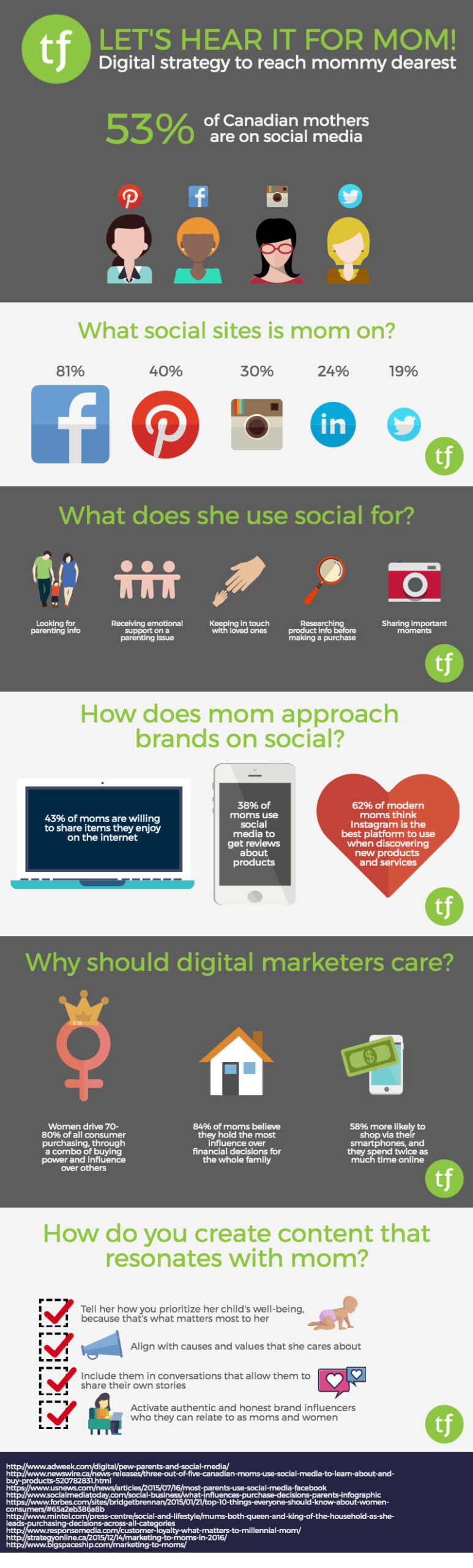
This past Mother’s Day got us thinking about what it means to connect with mom on social media. Much to the dismay of her kids, mom is part of a growing audience of parents on social, proving every day that no one will ever be truly free from the watchful eye of mother. Keeping tabs on her children isn’t the only thing mom is doing online though; social media continues to open up new and exciting opportunities for mom to get on board with brands she likes, and join the online parenting conversations taking place worldwide. Check out our infographic for some highlights on mom as your consumer on social media.

Cropped close up of graphs on a laptop screen
Digital Marketing

Conversion Rate Optimization & What It Can Do For You

How efficient is your website at turning visitors into customers?

If you could turn more of your website visitors into leads, you’d jump at the chance. Unfortunately this doesn’t just magically happen—there are several factors to consider. That’s why we’ve taken the time to break down the value in conversion rate optimization.

What is Conversion Rate Optimization?

Before we ask this question, let’s first define what a conversion is. A conversion happens when a user performs a desired action on your website.

Common conversions include:

  • Someone clicking your phone number to call you.
  • Someone signing up for your email newsletter.
  • Someone completing a form for a free download or to get in contact.
  • Someone making a purchase on your website.
  • Someone filling out a ‘request a quote’ form.

Conversion Rate Optimization is a strategic approach to digital marketing that seeks to optimize the ratio of traffic to leads on your website.

Obviously everyone wants more leads, and in a perfect world every person that ends up on your website will convert. But the world doesn’t work that way. People are very finicky about whether or not they will commit to a desired action online. What Conversion Rate Optimization (CRO) aims to do is to present a user with a scenario where they will have the highest likelihood of taking that action, whatever it may be.

Normally, CRO is carried out on dedicated landing pages. Often, these landing pages are designed to take all of the external distraction away, so the user is channeled towards the main conversion point, or desired action. It’s kind of like the old velvet rope maze in the bank—it clearly screams “LINE UP HERE!” We don’t want to give users a lot of options with these dedicated landing pages, we want to guide them towards the goal as efficiently as possible.

Again, the world works in mysterious ways, because it’s full of people. And people are funny. No one knows exactly what the right recipe is for conversions, just the same as advertising through one medium does not appeal to all audiences.  What we’re left to work with at that point is data.

In other words, how much traffic is getting to our landing page, and of that traffic, how many people are filling out our request a quote form? Let’s say it’s 1%. Obviously we want that number to improve. So, we need to go through the process of iteratively changing our landing page so that it gets more forms filled out.

The nature of CRO is not to throw the baby out with the bathwater. We don’t want to completely scrap our landing page and start again. We want to make slight changes that we can prove have made a positive effect. Sometimes that can mean changing the colour of an element, like the button people click to submit the form. Maybe we want to try paring down the text on the page, if we feel like there’s too much, and people are seeing it as a distraction. Maybe the form itself has too many fields to fill out and it’s scaring people off. Maybe the main website navigation is leading people off the page and away from our conversion point.

When websites are not architected with these conversion points in mind, and when pathways to conversions are not re-visited and adjusted over time, you run the risk of leaving money on the table. Someone hopping off your website without taking your desired action is the same as someone walking out of a store without buying anything.

How to Test Conversions

Analytics Matter

Many businesses make the mistake of assuming they do not need to use tools like Google Analytics to track their online conversions. We’ve run into several cases where clients aren’t sure what marketing initiative led to what leads. But our thought is: all of this data is trackable! What do you have to lose by tracking it? Collecting and analyzing your website’s data is critical to understanding your business, and in identifying growth areas.

Think about it.

The beauty of digital is that it allows us the ability to accurately track whether our marketing is working or not. As an accompaniment to analytics, CRO allows us the ability to test and tweak specific pages to ensure they are converting (selling) as well as they possibly can.

Make Calculated Changes

CRO also lends into a practice called A/B testing, or multi-variant testing. This means showing one version of a webpage to some visitors, and a variant to others. You can then monitor engagement on both variations. In other words, which one is getting more people to fill out the form? Do people fill out the form more often when it has a big red arrow pointing to it? Yes? Then welcome to our landing page, big red arrow!

Most businesses are unaware that you can conduct these experiments right within Google Analytics. You just need a bit of coding chops to set it up.

While positive analytics are great, negative analytics can be just as informative and helpful.

For example, you may choose to change the main “Get a Quote” button on your home page from red to blue, and track this for four months. If after that time you notice your conversion rate went down, then switch back to blue. Maybe the next test will involve making the button green. The point is, we should always strive to increase our conversion rate through data-driven, incremental optimization.

While these tests take time, the pay off of small-calculated changes can be hugely profitable.

Knowing What To Change

The process of identifying which elements of your site should be tested begins with identifying which parts of your business are under-performing.

You must ask yourself:

  • What are my key performance indicators?
  • What are my defined goals?
  • What are the major problems I am facing?
  • What are the specific needs of each of my web pages?
  • Which pages are most critical?
  • Am I tracking the right data?
  • Is my SEO set-up properly?
  • Is my website easy to navigate and useful to my audience?

Data-driven tests will help you to get into the mind of the customer and truly understand where your website is missing the mark.

In terms of how long you should track an experiment, that depends. Do you get sufficient traffic to the page you want to test? Are there seasonal aspects that will affect your data? How long the CRO experiment runs should be driven by what you’re testing, and whether you can expect to get a large enough data set to make an informed decision.

For example if you plan to track conversions from a landing page for a month, and after the month ends we still don’t have enough data, then perhaps we need to keep the experiment running a while longer.

Be sure to also test only one conversion at a time. Changing multiple aspects of a landing page at one time will really muddy the waters for your data. You need to be able to determine exactly what change led to the increase in conversions at the end of the experiment.

With detailed analytics data, honing in on specific areas of a website has been made substantially easier. However, without the guidance of a professional, who can truly work to unravel and take the time to absorb and understand your specific data, identifying these pain-points, as well as which conversion points to test, can be overwhelming.

To consult with our in-house SEO specialists about evidence base conversion optimization, and what our team can do to test various components of your website, contact Treefrog Inc. today.

Woman looking at a laptop in a meeting room
Digital Marketing

Leveraging Reddit for Paid and Organic Advertising

What if I told you that there is a social networking website that could potentially get you 20x the reach of Facebook, Instagram, or Twitter? It sounds too good to be true, right? Wrong! The website I’m talking about is called Reddit.

So what is Reddit?

By definition, Reddit is an “American social news aggregation, web content rating, and discussion website” where members can submit content such as text posts, photos, videos, or direct links into sub-categories of Reddit with specific themes and topics (these are called subreddits). The content posted to these subreddits by members is then voted up (up-votes) or down (down-votes) by other members, determining the position of the post. Posts with more up-votes stay at the top of the subreddit, while posts with less up-votes, or posts with lots of down-votes are pushed down towards the bottom of the subreddit. Essentially, just like any social networking and discussion website, posting high quality content will result in more shares, likes, comments, and maybe even conversions.

Numbers Don’t Lie

So far in 2017, Reddit has been bringing in approximately 542 million monthly visitors, 234 million of them being unique visitors, making it the 7th most visited website in America, and 22nd in the world. If that wasn’t enough, in 2015 Reddit reached 82.54 billion pageviews, 73.15 million submissions, and consisted of 853,824 subreddits.

Now that we know what Reddit is, and why it has such great potential from a marketer’s point of view, I am going to share with you my favourite tactics for leveraging Reddit for organic and paid advertising.

Paying For Targeted Ads

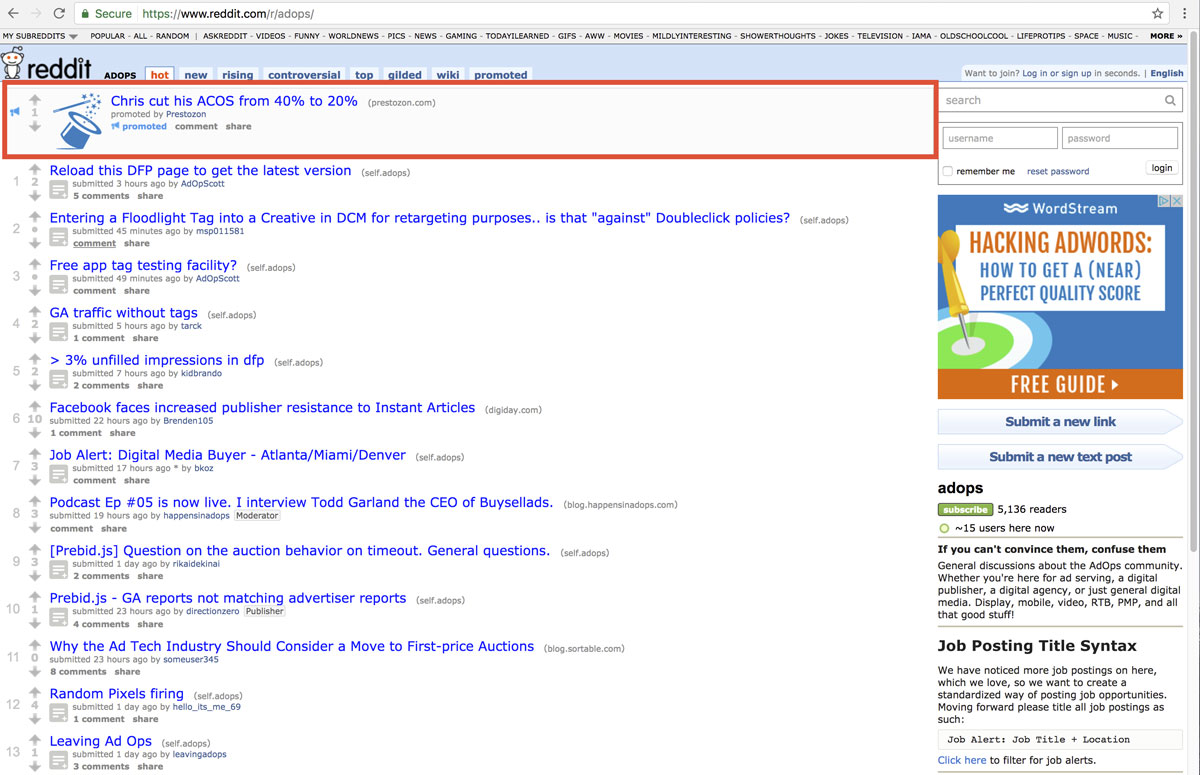
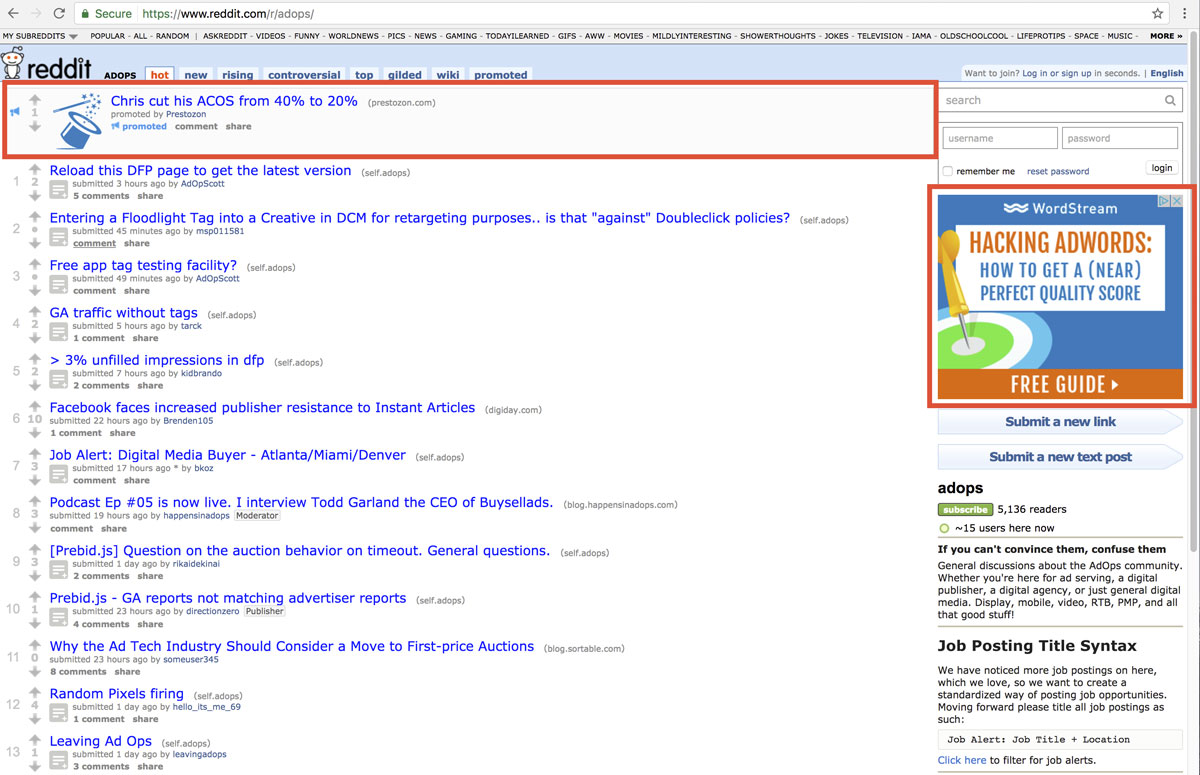
Although I don’t have actual experience with targeted ads on Reddit, I’ve seen them in action and I know they work. Reddit offers advertising options where you can actually advertise in specific subreddits, giving the advertiser an opportunity to target specific users with a super relevant ad. This is great because when a user sees a relevant ad in a relevant place, they are more likely to click through and convert. For example, when I was on the /r/adops/ subreddit earlier today, I found two paid ads that would be very relevant to the /r/adops/ community.

The first is a native looking ad at the top of the subreddit, disguising itself as a normal post:

The second ad, featured on the right side of the webpage is not a native ad. It is still however a high quality ad that is very relevant to just about anyone visiting the /r/adops/ subreddit:

How Much Does It Cost?

In order to advertise on Reddit, advertisers must be willing to spend a minimum of $5 per campaign, and a $0.75 charge per thousand pageviews. Currently, Reddit only offers CPM (cost per thousand impressions) as a cost model, and like Adwords, the CPM price you pay depends on a variety of factors, like targeting, bid, and competing ads. Reddit also allows advertisers to purchase up to 3 months prior to a campaign, so plan ahead!

Organic Marketing

Another form of advertising that I like on Reddit, and one that I have personal experience with, is organic marketing. One tactic that is arguably the easiest is to position yourself as a thought leader within the subreddit you are trying to advertise on. Let’s say that you are working for a landing page optimization company, and come across a user in the ad operations subreddit looking for information on landing page optimization. You could answer the user’s question and also provide a backlink to the company you work for. Doing this (well) would provide you with authority within the subreddit, which will benefit you should you decide to keep posting, and will drive traffic back to the website you have just linked to.

Organic marketing is trickier to pull off successfully than paid advertising, because like most people on social networking websites, people on Reddit hate ads, even more so when the ads are low quality, intrusive, aren’t relevant, or are ads disguised as regular posts. Failing to follow the rules, or “reddiquette”, you may find your content getting downvoted, and you getting banned. Having said that, there are a number of ways to organically market on Reddit without pissing off all of the people who could be potentially clicking on your ad.

Things To Avoid

As I mentioned above, Reddit users hate ads and being deceived into clicking on them. There are some things that every company should avoid doing, whether you’re marketing for Starbucks or a local coffee shop.

The big no-no is posting memes. Just don’t do it. If this is the only take away you have from this article, you’ll have still learned something valuable. It’s a risky move that few brands (if any) have managed to pull off without looking incredibly desperate.

One cringe-worthy example that demands a discussion is when Pilot posted a series of memes to various social networking sites in an effort to try to promote their new line of pens. The memes featured slogans like “The only pen that matters” and “I will not lose any of these” that make you want to put your head in your hands. Once they found their way to Reddit, users weren’t happy, and felt betrayed by the user who originally posted the memes, and maybe even by Reddit as a whole. One user even went on to say “Even if he’s [the poster] not paid by the company or an advertising agency, I don’t really want people who are just fans of some brand making accounts just to post about that product. What would Reddit be then?”

I’ve managed to track down a few of the original memes, and have attached my personal favourites. I truly hope you find them as horrible as I did.

In conclusion, marketing on Reddit is not easy or for the faint at heart. It’s a lively community that offers a huge potential for marketing. If you aren’t afraid of criticism, and are targeting certain niches – there’s really no better place to be. If done correctly, you could be on your way to tapping into a valuable goldmine of targeted traffic directly to your website, while increasing brand awareness at the same time.

Resources

A rocky waterfall
Digital Marketing, Web Design & Development

Increase Your Google Page Speed Score Part 1: Start With The Basics!

With Google putting an emphasis on high quality content for users in the last few years, there’s been a big push to focus strictly on content marketing. Where the first optimizers started off by taking advantage of search engine algorithms through pure coding, nowadays, producing high quality content has been the primary goal.

And absolutely…content really is important. A website without high quality content is just an empty shell with no pearls. However, as search engine optimizers, it is essential that we don’t lose focus on the technical aspects either and that we also give this side of SEO the attention it deserves.

…which brings us to PageSpeed.

Speedy Content

Part of producing high quality content includes delivering it to users with lightning speed. No one likes clicking on a link only to wait for more than 5 to 10 seconds for the page to load in full. By then, they would probably have left your site: increasing your bounce rate, reducing time on site and affecting your overall user engagement. All these things can impact your keyword ranking.

With more “Google searches taking place on mobile devices”, ensuring your website operates with lightning speed is essential.

Google PageSpeed Insights

There are many page speed test tools out there that can help ensure your website performs optimally in speed. Tools such as KeyCDN, pingdom and GTmetrix are great for really analyzing and optimizing your website. But for the purposes of this blog post, we’ll be taking a look at Google PageSpeed Insights.

There are various differences to how Google PageSpeed Insights work versus other page speed tools. For one, it doesn’t actually measure loading time. Rather Google PageSpeed analyzes several different components of your page and gives recommendation on how to improve its performance based on time to above-the-fold load and time to full page load.

As such, there is much debate within the SEO community on whether or not it’s even worth achieving a high PageSpeed score. Some trade offs may occur when trying to achieve a high score (i.e. certain techniques to decrease render time can actually decrease your PageSpeed score). We’ll save the usability and reliability of Google PageSpeed Insights for a later post as this topic requires a much more thorough discussion.

Having said that, Google has the largest market share in search engines. It’s still a good idea to consider these recommendations in conjunction with using other speed tools to compare loading/rending and server response time measurements.

Google PageSpeed Insights Rules

Google PageSpeed Insights is split into two rules: speed rules and usability rules. Since our focus is on speed, we’ll take a look at the speed rules exclusively. The speed rules include the following:

  • Avoid Landing Page Redirects
  • Enable Compression
  • Improve Server Response Time
  • Leverage Browser Caching
  • Minify Resources
  • Optimize Images
  • Optimize CSS Delivery
  • Prioritize Visible Content
  • Remove Render-Blocking JavaScript
  • Use Asynchronous Scripts

Some of these recommendations will require their own blog post as there are many factors to consider before implementing. For example, improving server response time requires a much more thorough thought process. So we’ll be highlighting the items that are fairly simple to complete.

1. Avoid Landing Page Redirects

Ensure your landing page is not a redirected page. Landing page redirects can hamper the user experience if its takes too much time redirecting to multiple pages. This is especially important for ads, links, and social links pointing to a specific landing page.

What to do:

The best and easiest thing to do in this case is to update all your ads, links and social links so that they are pointed to the correct landing page (i.e. their final destination).


Note: The following recommendations below assume you fully understand server software programming, HTML, JavaScript and CSS programming. If you aren’t too sure of these techniques described, give us a shout and we’ll help you out!


2. Enable Compression

Ensure your compressible resources are served with gzip compression. “This can reduce the size of the transferred response by up to 90%”, reducing the download time for users when they visit your page.

What to do:

Most web servers in the world use Apache as their server software. There are others such as nginx and IIS. I personally have only had to deal with Apache servers so far and you are likely dealing with it too. (Tip: One way to check is to use Google Search Console’s Fetch as Google tool and look at the fetch details)

Assuming your server uses Apache, to enable gzip compression, you’ll need to use the Apache Module mod_deflate. Depending on the file types you want to compress, insert the following into your .htaccess file:

3. Remove Render Blocking JavaScript

Ensure there are no HTML references to external JavaScript files in the above-the-fold portion of your page. When your browser sees a script in the document, it pauses DOM construction and executes the script before proceeding. Therefore, your above-the-fold content can not be rendered without waiting for the JavaScript resources to load. In other words, avoid placing any JavaScript in the header as it may cause a delay in rendering your page.

What to do:

  • If the JavaScript resource is fairly small in code, you can inline the script contents into the HTML document. The drawback however is that you are now making the HTML document larger in size with extra JavaScript code.
  • You can apply asynchronous JavaScript to avoid parse blocking the DOM construction. To achieve this, mark your JavaScript with async

You can also avoid the JavaScript from running altogether until the DOM construction is complete by deferring the script. To achieve this, mark you JavaScript with defer.

Another way to defer, is to simply put your JavaScript in the footer of the HTML

4. Optimize CSS Delivery

In the same manner as removing render-blocking JavaScript, ensure there are no HTML references to external stylesheet files in the above-the-fold portion of your page. Similar to JavaScript, CSS are render-blocking resources. Therefore, your above-the-fold content cannot be rendered without waiting for the CSS resources to load.

Unlike JavaScript, defer and async do not work on CSS files.

What to do:

  • If the CSS resource is fairly small in code, you can inline the script contents into the HTML document. The drawback however is that you are now making the HTML document larger in size with extra JavaScript code.
  • The one solution that’s worked for me so far is using JavaScript to defer CSS from loading. Courtesy of www.giftofspeed.com, insert the following code into your HTML footer (replace yourcssfile.css with your actual CSS file).

Place the following snippet within your HTML header. This ensures browsers that don’t support JavaScript can still load CSS files.

What Are You Waiting For? Get Started!

I’ll be saving the rest of the recommendations for a next blog, since they require a little more context and discussion. But these four recommendations are a good place to start optimizing for Google’s PageSpeed Score …assuming you have a good understanding of servers, HTML, CSS and JavaScript.

In the tests we’ve conducted, enabling compression alone increased our PageSpeed Score by 22 points for mobile and 24 for desktop – quite a big jump. Even with trying out these four recommendations, you could significantly increase your PageSpeed score right now.

As a last note, every website is different and there are little nuances that make your website unique, so its very important to test these recommendations first before implementing them right away. With that being said, try testing these recommendations and let us know how it worked out for you!

Thanks for reading! If you have any questions or comments, feel free to comment below! We’d love to hear your thoughts, feedback and/or grievances!

Resources

The word "brand" decoratively drawn in a notebook
Branding & Design

Is your brand compelling others to act?

A good brand can be the difference between having a product and selling a product.

A great brand can be the difference between selling a product and creating a business.

Your brand is more than your logo. It’s the core of your identity – culture, mission, ethics, competitive advantages – that your customers will identify with when they interact with your organization. When a brand is strategized and executed properly, it will not only increase a company’s popularity and visibility, but it will also compel others to act.

How do you accomplish this? Let’s look at the importance of effective target marketing, staying competitive, and brand development – in regard to both graphic design and content.

Target Audience

A brand is only as effective as the market it targets. In advertising practices, a target is a clear and focused description of the demographic a company would like to reach. While some companies will target many different markets, depending on the product or service they provide, other companies will consistently target the same market.

A successful target audience is one in which a company has been able to narrow their focus, taking the time to study and understand their wants and needs. It is then the mission of a company to attract these people and satisfy these desires through effective and consistent brand advertising.

Market Context

While it is important to understand the target market of your brand, it is also just as important to understand your competition and how you plan to remain competitive against them.

How do you do this? Research and strategic brand execution.

To understand the advantages of your competitors, you must work to understand what their product or service offers, fully. Then, to get ahead, you must look to develop and advertise new features that will make customers chose your brand instead. These features can be as complex as offering an entirely innovative new service, or as simple as integrating more colour variations in a new logo design.

How else can you remain competitive?

Through creatively marketing your uniqueness and strengths:

Unique Benefits

It is critical to identify all the unique benefits your company, service, or product offers to customers. If you can’t identify a clear advantage in your business, get creative and think outside the box.

Is your product essentially the same as that offered by your competitors? You may still have an advantage over them in the quality of your customer service or your warranty. Think about the customers you already have – why do they choose to deal with you rather than your competitor? Leverage those advantages to speak to new prospects with an authenticity they will relate to and want to experience.

Culture

People like to do business with people they know, like, and trust. You may think your culture matters only for internal recruitment and retention, but sharing the philosophy of your company with customers and prospects can help to engage them in your brand.

For example, if your employees regularly go on fun camping weekends together, why not use pictures and content from these excursions as a way to promote your company on social media? You may not see the direct link between camping excursions and insurance brokerage, but this fun and interactive material may be the reason a customer connects with you and wants to hire your company over another.

You may then even be able to integrate this theme into your logo, website design, and beyond! When an organization positions themselves as on-trend, relatable, and fun, customers are more likely to engage with them on social media sites like Facebook and Twitter, and to then also remember and hire them in the future.

Reason to Believe

A brand must also convey trust. In a society filled with “fake news”, what will make someone truly believe that your company provides the best service or wants to help the community by participating in charity events? It’s one thing to claim it, but it’s another thing to show it.

Effective brands practice what they preach. If your company claims to support Charity X every year, why not include a page on your website that includes a pictures collage of your team at various Charity X events and content about why your company is passionate about that charity. You can also use infographics to show how much money you’ve raised for them.

Customers need proof that you are who you say you are. So give it to them.

Brand Slogans & Logos

Effective brand slogans typically include “we” language rather than “I” language, evoking a sense of collaboration and inclusivity. Great slogans also put forward a call to action, creating a mission that will actively push for and drive success. These slogans do not ‘beat around the bush’; they are instead direct, powerful, and concise, leaving no room for misunderstandings.

Example: Barrack Obama’s, “Yes we can” instead of “I can do it” or, Nike’s “Just Do It” instead of “Try it”.

Even more effective than a slogan, a brand logo will push a sale. These icons register with people when they are simple and say something about the brand – without saying anything at all. In other words, great logos are distinctive, appropriate, “cool”, and visually appealing.

Have you ever purchased a Coach purse? How about a Nike hat? In some cases, people may even buy a product simply because the product features an attractive and popular brand logo that they want to associate with their own personal brand.

How Treefrog Can Help

Through the effective implementation of content, graphic design, and social media, your brand will attract its target market and compel that group to engage and buy.

Together, we can strategize, create, and execute your brand. We can design your logo, your website, your product packaging, your business cards, and beyond! We can also help to develop your brand messaging, developing content that will reach all the right people, in all the right channels.

We’ll work to make sure your brand is not only effective, appealing, and directed at the right target market, but that it is also consistent across all platforms.

Let’s talk!

Man holding a computer tablet. There is a coffee mug in the foreground.
Digital Marketing

To Be or Not to Be – Social!

Content is arguably one of the most valuable marketing tools for any company. When you produce relevant and shareable content, you engage readers, build trust for our brand, products, and services while informing and inspiring people to new ways of thinking.

Investing in content marketing creates an opportunity to directly and articulately connect with customers and show them why they should choose to work with you over your competitors.

Once you’ve created that content, you need to get it out into the world. That’s where social media comes into play.

Sure, your product or mission may be cool and trendy, innovative and progressive, but what do you have to say as a company or organization? Why should people “like” your Facebook page or follow you on Instagram and Twitter? What makes engaging with your online presence worth their time?

Why Great Social Content Matters

1. Establishing Target Markets Drives Profitability

A good social marketing team will work with you to pinpoint your target market. When it comes to content, it is important to understand the difference between, “who would be interested in this?” and “who do I want to be interested in this?”. When your desired market doesn’t match with the content you are creating, innovation is key.

With an ever-changing marketing landscape, companies must actively look for new ways to reach their demographic. Establishing a true target market, along with collecting data on what those potential clients are drawn to drive profitability and ensures your content is reaching the people who are most likely to use your service or product and creating a connection with them.

2. A Concise Message Is A Message Well Received

Imagine you enter an elevator with the CEO of a potential investor in your start-up business. This is your shot! You’ve got two minutes to explain why your product or business is valuable and worth their interest. What do you say?

This exercise is understandably difficult. It is not an easy task to rein in all of your many creative ideas into one neat package.  However, in the realm of social media, this practice is important. When creating a company biography for Facebook, or writing an “About Us” section on your website, your message needs to be clear and accurate. When these sections are too long, or too vague, people get bored and stop reading! This practice is especially important for use on social media sites like Twitter – where your post-able word count is limited.

Filling your Tweets and Facebook ads with either unimportant or data-intense information can make customers hesitant and less likely to engage. Articulating a healthy balance of informative and interesting content is no easy task, but it is key to your social media success.

3. When Your Clients Feel Important, They Return

Do your content ideas consider the perceptions of your customers? As an owner or manager it can become difficult to detach yourself, seeing your product or business from the outside looking in. It is important to seek a new set of eyes, playing devil’s advocate with any points of disconnect between your company’s mission and what is really being conveyed to potential customers.

It is also important to consider how you can become not only a product provider, but a “friend” to your users. People are more likely to use a product or consult with a company (and people) that makes them feel happy, valued, and secure.

A great way to do this through retweeting or replying to user questions and concerns on your social media pages. Instead of just stating dry information, ask them questions, add some personality to your messages, and show your appreciation for their business. Clients are more likely to engage and be returning customers if they feel important and recognized.

“People want to do business with you because you help them get what they want. They don’t do business with you to help you get what you want.”
– DON CROWTHER (@DON_CROWTHER)

4. Keywords Make A Difference.

Social content cannot rely on creative ideas alone. It is necessary to also compile search engine research data – identifying rich and attractive keywords that will set your business’ content above the rest.

For example, popular hashtags help to link your specific postings to all other posts made under that same hashtag umbrella. If someone is looking for #GreenSocks and you happen to be a company that specifically sells #GreenSocks, you can locate this customer and reach out to them.

Identifying these keywords is essential to your success as they help to increase your online presence, allow users to more effortlessly locate you through search engines like Google, and it helps your customers to see the true value you bring to their specific needs!

5. Advertising Is Changing. It’s Time To Adapt.

Every day we are bombarded by billboards, commercials, and print advertising messages. Due to this over-sell, these types of advertising methods have become less and less effective. This is because customers have become bitter and annoyed by the repetition, and have therefore found ways to avoid them (such as recording their favourite show and fast forwarding over the commercials or by using ad blockers). It is then necessary that companies work towards developing new and intriguing ways to reach customers without unsettling or bothering them, and instead interacting and connecting with them.

One of the ways companies can draw business, without a forward in-your-face sell, is through (you guessed it) – social content marketing! People are more likely to read and share a blog article that they find value in and believe others will as well.

For example: Instead of reading why she should buy shampoo from XYZ company, Sally is more interested to read about,  “The 7 Benefits of Shampoos that contain Coconut Oil” – something that XYZ company specifically includes in their product! Then, when XYZ company shares this blog article, customers read about the benefits of this same shampoo, without feeling like they’re reading a direct advertisement.

“Think like a publisher, not a marketer.”
David Meerman Scott (@dmscott)

6. Consistency & Tone Create A Lasting Effect

Setting the tone for your social media plan is critical. If your brand is funky and hipster, then the lingo you use in your online posts need to mesh with this pre-established foundation. However, if your company is of a more serious or traditional nature, don’t be timid about fostering new ideas that will change up those potentially “dry” stereotypes people may have about you. Yes, your website may be full of important data and statistics, but your social media accounts allow for you to communicate important things with a bit more flare and edge – that’s what they’re there for.

Let’s dive deeper. Static website content is not always great social media content because readers often look past it as “boring”. This is because website and social content often speak to different audiences and have different goals – information vs. engagement. Social media is built to encourage and sustain interaction (and get new leads!), so be mindful of how these helpful tools need to be approached in different ways.

What exactly makes social media content different, you ask? Its tone is consistently creative, often fun, “digestible” (straightforward and not jargon-heavy), and can include an image, infographic, video, or other media component. This type of engaging and creative work takes time, but this is time very well spent. When people see this type of interesting content being produced regularly, they are more likely to engage with the posts and return to see more because they enjoy keeping up to date with a brand that speaks to them.

7. Monitoring Results Increases Customer Satisfaction.

So, here’s where things get tricky. More important than having people engage with your social media accounts, you need to drive referral traffic back to your website – the centre of your digital presence.

Through website analytics you will be able to track how many new people have found your website, as well as how long they have stayed on the page, reading more detailed content and navigating the site to additional pages. Effective social media convinces the engager that you are a company worthy of their time and money and helps to lead them to your website in order to learn more.

“If you make customers unhappy in the physical world, they might each tell 6 friends. If you make customers unhappy on the Internet, they can each tell 6,000 friends.”
– JEFF BEZOS

It is important to monitor your social media engagement results, both the good and the bad. When your company receives a great review on social media, this information can be shared and celebrated across your different sites. When your company receives a bad review, social media gives you a voice to be able to communicate with the unhappy customer and to try to repair the relationship. Opening the dialogue and ensuring that a customers care is of the utmost importance shows great initiative and ownership to other potential clients. This response also tells the client that their opinion matters and that issue will be rectified in some way.

Engaging content is the foundation of any social media engagement strategy. “This is all great knowledge”, you say. “But I don’t have time to write it and I don’t know where to start!”. That’s where we come in. We can help source, write, and curate your content for social media sharing. If you are in need of new content for your websites and social media platforms, contact us today.

“Content is fire, social media is gasoline”
– Ryan Kahn

Scroll to Top