Author name: admin

Dandelion puffs being blown away
Digital Marketing

Do Keywords Still Matter?

Anyone who’s been following developments in the SEO world may be quick to say things like “keywords are dead.” Well, that’s just ludicrous. How can content be king and keywords not matter? Keywords  are, in fact, words.  Is content not made from words?

You know what is dead? Keyword stuffing and gaming search engines. Search engines surpassed human intelligence like… two years ago. SEO’s don’t game the system anymore. Those that do are beheaded by Google. And then Bing comes along afterwards and gives their beheaded corpses a kick in the bum.

There’s a fundamental difference between keywords for search engines’ sake, and keywords for users’ sake. But there shouldn’t be. Content should be created for users first, there’s no doubt. But there’s also no reason that content can’t also perform well from a search engine ranking standpoint.

Keyword Optimization: The Modern Filing System

Here’s an extremely basic explanation.  Think of  a search engine as a database, and your  website as a file within that database. If your website doesn’t contain the words that someone is searching for, how will it ever be found?

Even more basic: what do you do when you file papers into folders and put them in a filing cabinet? You’d organize the papers by topic, and then label the folders with that topic, right?  Think of including keywords and optimizing your webpage somewhat like labeling the topic so that it’s easier to find. On the other hand, if you’re like me you just stack everything together and dump it into the filing cabinet in a huge papery mass. If I need that piece of paper later, I simply try to forget the reason I needed it in the first place, and then move on with my life.

Don’t be Stuffy: Write for User’s Sake

Back in the day, SEOs used to beat the keyword/labeling concept to death. They’d repeat a select keyword numerous times on a page — to the point of annoyance — rendering the page text unreadable. Well, this doesn’t cut it anymore. Actually, it didn’t cut it in 2011.

So what can you do?  Luckily, there are still some tried and true tactics to content building that you can employ to help with search engine visibility. Search engines still pay attention to your META page title. They still pay attention to headings and on-page content that is relevant to your topic. They still pay attention to the intended visibility of your webpage; that is, whether you have it  prominently  displayed and/or linked from a site-wide menu. They  pay attention to whether that page is distributed on social media, and whether people click on it and read it. They care about how many other websites are linked to your content, and whether those websites are relevant to the topic.  Search engines also  care about relevance, and user engagement. Actually they care about this last one most of all.

You need to also keep  competition in mind. For example, do your competitors have a page on their website that is ranking well for the topic you’re planning to write? Are those competitor pages written well? Do your competitors have a large social media presence? If so, then it will be much more difficult for your content to rank. It’s not that your content isn’t as good or better, it’s just that your competitors may have been at the game longer.

“Play the Long Game: Think Like the Mighty Tortoise”

Will your new webpage take a long time to start performing well? Sure it will. In some cases, it will take six months or longer. You can jump-start the page’s visibility by sharing it on social media. If you have a  client  e-mail list (people who have opted-in, of course!) then throw a teaser blurb about your content in there and link to it. Link to it from other pages on your website, and make the anchor text in-line with the topic heading.

All of the above tactics can be factored into your content, and you’ve not had to stuff one keyword. You’ve simply selected a relevant topic to write about, and you’ve done all the right things to make sure it will eventually rank well when someone researches that topic. The fact that the topic contains what could be defined as a “keyword” is merely coincidental.

So, do keywords still matter? They certainly do, if they are used for the right reason. Keep in mind: users first. Organizing the keywords and optimizing the page is really only making the job of the search engine less difficult. But the whole reason you’re doing this is to get more eyes on your content, and then get those eyes to convert into sales.

Actually, you want the people to convert into sales. Actually,  you want the people to remain people, and buy stuff from you willingly.  You get the idea.

Need help? It just so happens that  Treefrog is in the business of getting your users to convert  into sales.  We’re here for you!

A man's hands hold drawn mock ups of a website design
Branding & Design

What is Graphic Design?

101 Information

Graphic design is art with a purpose. It involves a creative and systematic plan to solve a problem or achieve certain objectives, with the use of images, symbols or even words. It is visual communication and the aesthetic expression of concepts and ideas using various graphic elements and tools.

Elements of Graphic Design

Graphic design can use image-based designs involving photos, illustrations, logos and symbols, type-based designs, or a combination of both techniques. These designs can include various combinations of the following elements.

Lines: Straight, curved, wavy, thick, thin – when it comes to lines, the possibilities are limitless. Lines allow designers to divide a space or separate content in a layout. They can also be used to guide the eyes of the viewer, or make other elements follow a strategic path for added findability, to get the viewer easily from point A to point B.

Shapes: Shapes offer a variety of ways to fill spaces creatively, to support text and other forms of content, and to balance a design. Shapes can be created out of nothing, using white space to give a design structure and clarity.

Colour: Colour, or the absence of colour, is an important element of any visual design. With a solid understanding of colour theory, designers can amazingly influence a design and a brand, seamlessly integrating colour boldly or with brilliant subtlety.

Type: Type can transform a message from mere text to a work of art. Different fonts, combined with customized alignments, spacing, size, and colour, can add power to the point you are communicating to the world.

Texture: Even a smooth and glossy advertisement can seem tangible with texture. It gives a sense of a tactile surface through its visual appearance and adds a sense of depth, enhanced by selection of appropriate paper and material.

Tools of Graphic Design

Professional designers possess a creative mind with an artistic inclination, and so much more. Keen observation skills and analytical thinking are essential tools for graphic designers, before they dig into their physical tool kit and touch pen to paper or stylus to tablet. Designers employ a variety of methods to combine art and technology to communicate a particular message and create an impressive visual.

Sketchpads: A traditional tool used to sketch out ideas; it is the quickest way to jot down the rough designs, which designers can develop further using other tools and technologies.

Computers: Computers now occupy an essential place in every designer’s tool kit. Hardware such as tablets allow designers to expand their creative freedom and maintain that sketchpad feel while creating a digital design.

Software: Technology has opened new doors for realizing creative vision. Specialized software such as Illustrator and Photoshop can help to create illustrations, enhance photographs, stylize text, and synergize all of the pieces in incredible layouts.

Graphic Design communicates your brand and message visually with impressive business logos, enchanting brochures, newsletters with impact, and stunning posters.

Let the professional graphic designers at Treefrog Inc. turn your dreams and ideas into realistic revelations.

We have provided countless clients with beautiful, eye-catching graphic design work, but don’t just take our word for it! Let’s Talk.

The word "brand" decoratively drawn in a notebook
Branding & Design, Digital Marketing

What is Corporate Identity?

…and Why is it Important?

The concept of corporate identity is akin to what we refer to when we talk about our own identity, the specifics that differentiate us from others. It is our personality and character that maintains our individuality, which we express through how we behave, speak, and even what we wear.

Similarly, a business makes itself distinct through the image that it presents to the world, through collateral like business cards, letterheads, brochures and other options. It is a physical expression of the company’s brand, an extension of the culture that is already expressed through communication style and behaviour exhibited to maintain the image of the business.

Corporate Identity expresses your business’s brand personality and sets you apart from the competition.

The Importance of Corporate Identity

In a fast-paced and competitive world where the consumer has innumerable options available to them, a company needs a strategy to establish a solid presence in the marketplace. There are strong reasons to believe that the right corporate identity helps achieve this business objective.

Building Corporate Persona: When we meet a person, it is the first impression that has the most impact. We tend to gather cues from what we see and feel, interpreting our observations to form our opinion about the person. This is also how we treat products and companies. To stand out from their competitors, every company needs to have a good brand image, to create a niche in the client’s mind by having a unique, pleasing appearance and identity.

Consumer Loyalty: The consistent design of a corporate identity, in accordance with objectives set for the business, uphold and reflect the ethos, culture, principles, future ambitions, or visionary goals of the business. Customers who find this to be in accordance with their philosophy and liking feel connected to this image and are more likely to develop loyalty to the business.

Business Enhancement: Personal experiences with a corporate identity influence consumers and their purchasing decisions. A corporate identity with a strong and positive impact creates a favorable mental image of the business in a consumer’s mind. A strategically planned identity gives a good return in terms of referrals and repeat business.

Businesses may occasionally need to update their corporate identity, if there is an ideological change in the target audience over time and as the world changes. Design professionals can help with attention grabbing logos, impressive business cards, elegant letterheads, inviting envelopes, stunning brochures and other identity elements. Invest in your corporate identity to develop trust, a sense of value, and a lasting connection with your customer base.

Close up of a zebra's eye
Branding & Design

The Power of Print

Pack a Punch with Professional Print Design

If the web is a superhero in today’s marketing strategies, then print design is a trusty sidekick with its own unique set of talents and strengths. Often lost in the shadow of the ever-available Internet, it’s time to rediscover that sometimes the sidekick can be the one who saves the day.

Let Print Design Reveal Your Website’s Secret Identity

Your website might be the most powerful marketing tool Metropolis can ever hope to see, but unlike most superheroes, it can’t have a secret identity. You want the world to know exactly where to find your site so you can solve the problem by providing the products or services that are needed. Print materials unmask your website by driving traffic to it. From business cards to billboards, you can use print materials to maximize your investment in your website, creating an unbeatable dynamic duo for your marketing plan.

The Boy Wonder of Branding

Superheroes know branding. Whether they are famous for the bat signal in the sky, the letter “S” on their costume, or maybe for a “Holy Classic Catchphrase”, their trademarks are recognized for generations. Print design can make your logo and tagline, the personality of your brand, just as pervasive. Get instant recognition in your target audience and infuse the marketplace with your message and your mark using posters, postcards, brochures, trade show displays and signage.

Print Takes Your Marketing Strategy “To Infinity and Beyond!”

Print design may be seen as a sidekick in our digital world, but its power and effectiveness also stand strong alone. Print materials are tangible and tactile. Who can resist turning the glossy pages of a magazine or catalogue? These temptations are marketing kryptonite to consumers everywhere. Get their spidey senses tingling for your product with strategically placed ads in newspapers and magazines to promote special offers and send seasonal reminders.

If you have been dazed by digital, try putting the power of print to work for your business and “Pow!” “Blam!” your business will become a super power to beat all the competition.

Country road going into the mountains
Digital Marketing, Web Design & Development

Site Architecture as a Writing Road Map

Find your way to writing brilliant website content

Think of building your website like heading out on the highway for an exciting road trip to new business heights. You have web design experts to help you develop an architecture and design and to manage the programming. Now you need to fill it with content.

Content Writing Road Blocks

Content writing is a massive road block for many a new website owner. If you’ve been procrastinating, you’re not alone. In Treefrog’s experience, this is the number one stage of a web design project where clients get stuck at the side of the road, completely out of gas.

It surprises many – after all, who is more of an expert on your business than you? So why does it happen?

  • You’re so close to your own business, sometimes it’s hard to step back and see things from your client’s perspective.
  • You invest your time in running your business, you don’t have time to write about it.
  • You’re great at running your business. You don’t also have to be great at writing about it.

Site Architecture to the Rescue

There is a way out of the content writing wilderness. You just need the right directions, and you already have them.

Remember that site architecture and wireframe you approved at the beginning of your project? No? You’re not alone there either. The site architecture is not just for designers and programmers. It’s for YOU.

Your site architecture is a list of the pages you want and/or need on your website when it goes live. Like the step by step directions from your GPS navigator, the architecture is a checklist that will take you through your content writing journey.

“Like any map, your site architecture is a guideline. It offers a route to website success through a user friendly structure.”

Changing Content Directions

Like any map, your site architecture is a guideline. It offers a route to website success through a user friendly structure. There are some aspects that need to be followed, but you might find shortcuts or detours along the way that will improve it, as you see how your design and writing come together.

If you proposed a page at the beginning of your project that you no longer need, you have the power to take it out. If you realize you missed something, you have the power to add it in.

Stop and Ask for Directions

If all else fails, trust the experts. Content writers in web agencies not only understand your architecture, they understand how to write for the web so that Google and other search engines will find you. They will work with you to refine your message and guide you through the twists and turns of your website content.

Red eyed tree frog on a leaf
Uncategorized

About Tree Frogs

There are actually several varieties of tree frogs in the world

You may find this surprising, but there are actually several varieties of tree frogs in the world. The most digitally relevant are, of course, the group of designers, programmers and website engineers who have somehow landed themselves with the name The Frogs. However, in a spirit of transparency and honesty, we would like to formally admit to the existence of a second type of frog: the amphibian.

Now, an amphibian is not a reptile, but a member of the zoological class called Amphibia. They are cold-blooded (or poikilothermic) vertebrate animals. They differ from reptiles in that they lack scales and generally return to water to breed. They are one of three types of Amphibians: Anura, also called Salientia, (frogs and toads), caudate (salamanders and newts) and caecilians (worm-like amphibians). Amphibians together with reptiles make up a larger group called Herps.

The study of reptiles and amphibians is called Herpetology. Herp comes from the Greek word herpeton, which basically means “creepy crawly things that move about on their bellies.” A herptile is an individual herp. A person who keeps and breeds herps is called a herpetoculturist and the hobby is called herpetoculture.

Decorative technology illustration
Digital Marketing

How to Use META Data In Your Facebook Posts

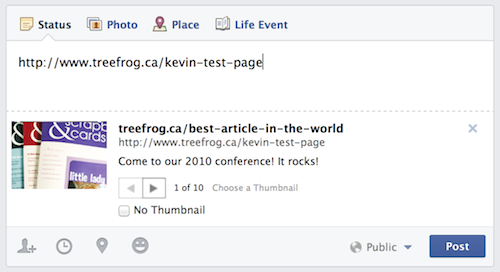
A client called in recently with a conundrum about Facebook. They asked us how Facebook managed to find information about one of their old conferences and apply it to their new post.

They had created a web page on their site and posted the link as a status update on Facebook. The problem was, the link appeared to be grabbing old information from somewhere and attributing it to their post.

Where was this old information coming from?

Take a look at the image above. When you drop a link into Facebook, it pulls data from that webpage.

What the… That’s totally not the information we have on our page. Where is it getting that title and description from? 2010 is over, isn’t it?

You’ve spent all this time creating a great webpage, and then Facebook goes and pulls some arbitrary title and description from out of nowhere. You’ll have to change that on your Facebook post if you want to make it current and relevant.

It turns out, the key to setting up your page correctly before posting it on Facebook, or any social network for that matter, is META data.

Never META Data I Didn’t Like

The mysterious thing about META data is that it is invisible to the naked eye. In fact, you can’t even see it if your eye has clothes on. It lives behind the curtain with the wizard.

META data consists of three main parts: Page title, Page keywords and page description.

Page title
Your page title is the text that appears at the top of a browser window. The page title is not to be confused with your page’s URL (link). The page title should describe the content on your page in an engaging way. The page title gets pulled as the title of your Facebook post.

Page Description
The page description should be a brief paragraph describing the content of your page.
For Facebook posts, the META description will end up being pulled into the post description. If you set this up on your webpage’s META data, you don’t have to worry about re-entering or editing it on Facebook, which will save you time and headache.

Keywords
META Keywords are not used by Facebook. In fact there are varying opinions about the validity of keywords as a whole, but that’s not for the scope of this article. For some extra reading on the relevance of populating the keyword field, you should visit this link.

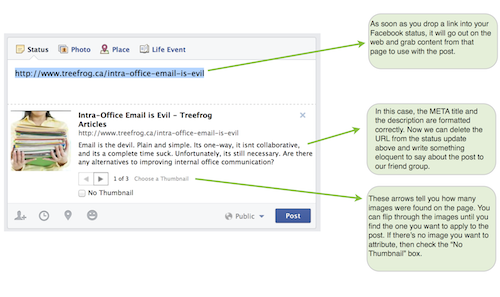
As per the photo above, as soon as you drop a link into your Facebook status, it will go out to the web and collect what it thinks is relevant data to use with the post.

in the above case, the META title and description are formatted correctly. Once that’s done, you can delete the link itself from your status update and write something attention-grabbing about the content you’re posting.

The arrows near the bottom of the post dialog box tell you how many images Facebook found on the page. You can flip through the images until you find the one you want to apply to the post. If there’s no image you want to attribute, simply check the “No Thumbnail” box.

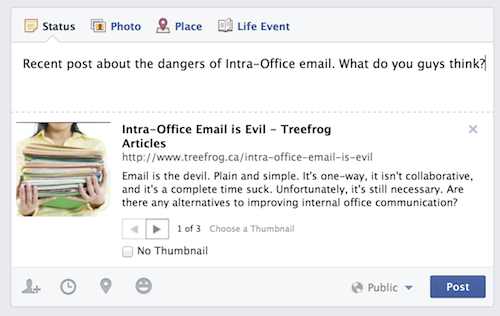
Above is an example of the post with the actual URL removed and a little intro written, ready to post to the Facebook world.

Tip: If you’re planning on posting this same content to multiple social networks, you should customize your intro. When it comes to posting something on Twitter, brevity is your friend. Your “Likes” on Facebook may prefer a more playful, jovial intro, whereas your followers on LinkedIn could be more serious. The point is: change it up, don’t just cut and paste the same intro across the board.

As part of your web page creating process, you should make sure it contains the proper META data. It’s just good practice. It will also save you time, add relevance and increase search engine optimization.

LEAP™ Makes META Insertion Easy

The META data on your page can be a very powerful tool. It is also what Google will most often use to display when your page comes up in a search result. The information should be precise and engaging. It should make people want to click on the story and read it.

Treefrog’s custom Content Management System (LEAP™) allows users to hop into the back end of their site easily and update the META content. It’s as easy as “leaping” to the administration side of the site, clicking the META button, making your edits and clicking “Update”.

Now, when you plug the link to your beautiful new web page into a Facebook status, all of that information will pull into your post. Voilà! Saves you time, and keeps things consistent.

If you still have questions about META data, let us know, we’d love to hear from you!

water drops on leaf
Hosting & Infrastructure, Web Design & Development

Domain Registry of Canada

We receive calls from customers every few months asking if the letter they received from the “Domain Registry Of Canada” is a legitimate registrar… and they are!

But they prey on anyone Canadian who owns a domain name out there and hope that the customer will take their service over their current registrar and ten times out of ten you shouldn’t go through with it honestly.

We understand it looks like an official document from even the government, but it is not – this is just a registar out there preying on customers who may be unaware of this scam.

It’s very expensive alternative and they provide no service, and gives away the control of your domain to them and we’ve heard it gets even more difficult to make changes to your domain once in their control – be very careful!

If you receive a letter and have your domain with Treefrog call us immediately, do not fill out their form. Once you do we are unable to assist you and you’ll be out the cash (although we have saved a few domains because we were the admin contact and just cancelled their transfer).

This is a warning! Be careful!

(We’re not linking to them, they don’t deserve the link but you can Google their name if you’re that inclined or have received a letter – contact them, or shred the letter and burn the pieces)

Cropped close up of angular slate floor tiles
Web Design & Development

What is a Content Management System (CMS)?

101 Information

A Content Management System, or CMS, puts you in control of the content on your website. This software is integrated into your website and offers a collection of tools that save you time and money.

A website with a CMS has many advantages, the most obvious of which is the ability to keep your site up to date, any time of day or night, without a programmer or any programming skills. You can update and change your site, publish new content, and organize your content through the menu system. This flexibility also wins you points with search engines as they want to know that you can, and do, update your content on a regular basis.

Understanding Web CMS

There are a variety of content management systems available and each varies somewhat in its functionality and possibilities. Each may have unique procedures to manage workflow, but here are some of the common facilities available to make your life easy and your website always shiny and new:

Pre-set templates and tools make it easy and convenient for users to set up new pages, add content, format, publish, update, and make changes to the website on their own. This can be done in a simple non-technical way, whenever you want or need changes, mostly through a web-based interface, without depending on web designers or programmers.

Assign permission to users on individual basis, to view or edit the content on various sections of the website and dynamically publish new information. You not only control your site’s content, you control who has access to it.

Apply the same layout consistently through your site, including navigation menus, components and design. The specific information within each page will change, but your brand and key navigational elements remain the same throughout. Your visitors will have an easier time touring your site and it will be easy for you to build your site.

Store data in the content management system, including documents, scientific data, pictures, movies etc. Make this information readily available to your clients and potential clients with download options.

There is reduction in duplication of information, increase in flexibility of the website, improvement in navigation, strengthened security, and less time and money required for site maintenance.

A CMS helps to manage the site structure, provide increased cross-linking of internal pages, and some offer simple drag and drop options to restructure the site as per individual choices and requirements.

Authorized users can perform in-context editing by clicking on hidden or special buttons on the web pages even while browsing normally and switch the page into editing mode, and immediately view the changes made.

Incorporation of WYSIWYG controls makes it easier for non-technical people to work on the site, without having to work with or understand HTML code.

Content management systems includes various helpful built-in features like online surveys and polls, which can collect data for marketing initiatives and other projects. RSS feeds offer a steady stream of new information, which can help bring traffic to the website.

CMS keep design and the content separate, facilitating change in design of the website without any change in the content layout.

Content management systems can support your business by helping you to communicate with your clients through your website with updated information. It can improve the user experience of your website, increasing their satisfaction by helping them to find what they are looking for with a well-structured information system. You can also improve sales by improving coordination between various departments, to better serve your business goals and strategies.

Design process of a logo graphic
Branding & Design

What’s in a logo

Logo design, and for that matter brand design, are not cookie-cutter solutions.

Sure, an agency can state that they have stock imagery that gets “close” to a logo design that captures the essence of your business. That’s like trying to be authentic by hanging a box-store piece of art in your living room, knowing that somewhere out there, thousands of other living rooms are donning the same badge of “authenticity”.

At Treefrog, we’re very passionate about design. It’s what makes us unique. Our attention to artistic creativity and visual impact is what sets us apart from other agencies.

We are also passionate about defending the work that goes into good design.

There’s been an emergence of online stock design companies recently. These companies create tension in the market because it makes people think that a brand is something you can just choose and move on. As if you could pick your corporate identity off a shelf and carry it to the checkout line.

Why You Should Invest In Your Logo

What’s in a logo, really? It’s just a graphic that identifies your company brand. What’s so complicated about that? Anyone can create a logo. Right?

Some may think so, but then you have to ask yourself why so many high profile companies spend so much on logo design.

What makes a powerful company logo? Why do some logos stick out from others? What makes us remember them? If they’re so simple that just anyone could do them, then why doesn’t every company have an unforgettable logo?

Consider that your logo is a tactical piece of a brand. A logo is not a brand. If a company comes to Treefrog asking for a new brand, expecting only a new logo, we’ll challenge their thinking.

The fact is, if your company is in need of a brand revamp, you’re not going to fix the problem with a logo. Don’t confuse an iconic symbol of your business as being the entirety of your brand identity. There’s far more to the concept of brand than a logo.

That is not to say that a logo is not an important part of your brand; quite the contrary. This is partly because of the fact that people can immediately tell a shoddy logo from one that’s quality. Your logo can immediately cause people to identify your company as either slapdash, or serious. That’s a pretty powerful sentiment to leave people with as a first impression.

Ideally, the logo will convey a feeling. Maybe it’s powerful enough to spark a memory. It needs the depth of meaning in order to foster an emotional attachment with people.

Keep in mind that a brand encapsulates all the pieces that a company uses to communicate with the world; from business cards, letterhead, brochures, colour uses, typography and image choice. A logo is just the tip of the iceberg when it comes to establishing a brand.

The Potato Factor

Gaby Hart, a faculty member at Georgian College for design, summed up logo design succinctly by saying: “A logo is a mark that a company can be remembered by; it should be so simple that you could draw it in the sand with a stick.”

In a similar vein, at Treefrog, we say that you should be able to cut your logo out of a potato. Think of all the things you want to do with your logo—feature it on print pages, your website, have it emblazoned on T-shirts and display it on trade show booth signs that need to be visible from hundreds of yards away. Who knows, you may actually want to have your logo in potato form.

Your logo should be able to stand out in a group of other logos listed on a partner webpage. It should be clear, definitive, and identifiable. There’s a lot of thinking that goes into the development of a logo, word mark or brand identity.

One of the many things we pride ourselves on as an agency is our personal touch. We want to spend time with you to understand your business and how you operate. Is the cost going to be higher than simply picking a logo off a shelf of dozens more like it? Sure. But you get the benefit of a team of experienced designers working with you on your brand rejuvenation.

We want to show off your logo as an emblem of our successful partnership. After all, the best logo designs are derived from collaboration, and a deep understanding of what makes your company unique.

Online Agencies: The Bargain Bin of Logo Design

Some wonder why there are agencies who charge premium amounts for logo design, when there are companies on the web kicking them out for a hundred bucks a piece. The question usually gets around to: what are you actually paying for in a logo design?

First of all, your business has its own unique identity, something that gives people the perception of character. You’ve put time and energy into your business and your brand. Would you really want to hire a stock logo company to shoehorn a look into your corporate identity? Think of it this way: who would you rather have write your autobiography, someone you know, or someone you just found online?

When your company wants a new logo, you have a few options.

1) You can go to a stock logo company.

Right away, the terms, conditions and deliverables are likely going to be different for each one you find. These companies often offer a fast turn around, and a handful of concepts for you to choose from. They may also allow you to make a number of revisions, depending on the price level you choose. Once approved, your logo may be sent to you in a variety of file formats that you will need for printing.

Where you may run into trouble: these are often online companies, i.e. they may not be locally based, so you can’t pop over to discuss your concept with the designer. They may even be in a completely different country, and there may be a language barrier. Discussing logos can often be a very abstract process and be quite an emotional experience. Email often doesn’t work when conveying emotion. Clients often cannot easily verbalize what is bugging them about a concept. A face-to-face meeting with a designer who can help you through the design jargon to focus in on the key areas can be very useful. Furthermore, with an online stock logo company, once you’ve maxed out your number of revisions, that’s it. If you’re not happy, then you have to pay for more revisions.

2) You can use a competitive design website.

These are sites where a client can post their project and the specifications and state how much they want to pay the designer. Designers then can “bid” on the job and post their ideas. After a predefined amount of time, the client then chooses which design they like most, pay the designer and the logo file is supplied.

Again, there are problems inherent in this method. This puts a lot of responsibility in the client’s hand, they have to be able to cohesively communicate the requirements of the project to a broad audience. A lot of people aren’t creatively minded, nor do they really know how to communicate what they really want. What you put in the brief will be taken literally by the designers on the site. If you’re not clear on what you want, then it’s highly likely that you won’t get what you want.

Also, since graphic design is not currently regulated by an authoritative body that checks that designers are at a particular level, ANYONE can post a design on a competitive design website. There is no regulation for quality or skill level. You may have to scroll through thousands of sub-par designs in the hope of finding your new logo. What if no one submits a design in response to your brief? That logo you desperately need will not get done until a designer, wherever they may be in the world, decides to do it.

As for revisions, it all depends on whether they were negotiated when you submitted the brief. The designer may provide the logo “as is” in which case you’d better be happy with what you got. Who knows whether the artwork file will even be constructed properly for a printer?

Here’s an analogy: imagine having a plumbing issue in your house. You know what’s wrong, but you don’t know the source of the problem. You describe the issue to the best of your ability on a website, say how much you’re willing to pay, and hit “submit”. Then you sit and wait for a plumber to come fix your problem. When (or more accurately if) that plumber arrives, you have no idea of their skill level, whether they are a legitimate plumber (maybe they do it part-time, maybe they’re a student!), whether they have any work experience and if they even know what they’re doing. The end result? Your plumbing issue might be fixed, or it might not, and you may have just flooded your house and be down $500.

3) You work with Treefrog or another Graphic Design/Branding company.

First off, you can go look at our website, get to know us, look at our portfolio of work, come meet with us and check that we’re real human beings. If you’re then happy to partner with us, you’ll soon be sitting down with our Art Director and a Designer to discuss your new logo, and the goals of your project. This is usually an in-person meeting and can be an hour or more of in-depth discussion about your company, your long term and short term goals, your likes and dislikes as well as your target market and applications.

After this meeting our designers will work on your logo. We have a team of designers and we will often work collaboratively on a project to refine ideas and come up with a wide range of concepts. Our designers have all had at minimum four years of Graphic Design training prior to working with Treefrog, and are all Graduates of recognized educational institutions. Our designers also have a wide range of skills, with backgrounds in illustration, fashion design, and editorial design—not to mention being skilled web designers. Our Art Director will work with the design team to refine your logo concepts until we’re sure they’re at the level of excellence that we aspire to here at Treefrog. These concepts will take into account your target market, the goals and future extensibility of the brand as well as adaptations for alternative printing techniques (such an embroidering on a T-shirt).

After presenting you with the concepts, we will plan another meeting, sometimes over the phone or in person (your choice) to discuss your thoughts on the presented ideas. We will then work closely with you to refine the logo concept to the final piece, until you are 100% happy. After the logo is approved we will save out a wide range of file formats and colour options to suit most, if not all possible ways that you may need the logo in the future. If you lose these files, we’ll always have backups to send to you if you need them.

At Treefrog, personality is very important. We know your company has a story, and we’d love to help you tell it. We also know that budget is a factor. But the good thing about working with an actual agency, is that we can work with you directly, and not expect you to have to conform to a rigid price structure or process for what should be a rewarding creative experience.

The point is, a brand and a logo are made up of so much more than just a stock image or your company name in a font.

What’s in a logo? You are.

Scroll to Top