
Author name: Treefrog Editorial Team

Insights from the senior strategists at Treefrog Inc., a full-service marketing agency founded in 1989 in Newmarket, Ontario. We write about marketing strategy, pipeline, revenue operations and AI for growing companies.

Close up of hands holding a mobile phone
Marketing Strategy

4 Reasons Your Email Unsubscribe Numbers Are on the Rise

Are you taking a ‘megaphone’ approach to your email marketing campaigns in an effort to reach as many people as possible? The key to keeping your customers engaged comes down to sending targeted messages at precisely the right time

It’s the winter and a weeklong cold spell has you shivering. Snow and ice are everywhere. As an icy wind freezes your face while you stand outside waiting for a bus to arrive, you feel your mobile phone vibrate in your pocket. You peel off one of your gloves to check your messages only to find you’ve received an email about ice cream, frosty milkshakes, and frozen desserts.

You wouldn’t think a company would send such an ill-timed and poorly targeted marketing message, but it happens more often than not, and it typically prompts the recipient to hit the “unsubscribe” link in fine print at the bottom of that email.

Irrelevant messaging is a significant driver of unsubscribe rates, and importantly, it’s an annoyance to your customers. According to IBM Silverpop’s annual global report on email marketing dubbed, “2015 Email Marketing Metrics Benchmark Study”, Canadian brands posted markedly lower email opening rates compared to companies in the U.S., U.K., the Asia-Pacific region, Europe, the Mideast, and Africa. It could be because of many reasons including consumers are quick to delete emails that don’t resonate with them immediately.

In addition to the content of marketing communications, the format of marketing emails may also be a factor. A study by Litmus found nearly half of emails are now opened on either a smartphone or tablet. That’s a dramatic increase from 2011 when only 8% of emails were opened on a mobile device. In light of this finding, marketers would be wise to adopt a mobile-friendly approach to the content and design of their emails, and they should reduce the number of calls-to-action to one or two per email.

When Email Open Rates Slide and Unsubscribes Spike

Though your email open rates data shouldn’t be used as a sole indicator of a marketing campaign’s success or failure, it is a useful metric to measure. Your email subscribers are valuable. Reducing email list churn is dependent upon understanding why existing and prospective customers unsubscribe from your communications.

After spending the effort (and money) to get your customers to opt-in or subscribe to your marketing emails and to keep them engaged, it is disheartening and frustrating to see unsubscribe levels increase. Outside of irrelevant messaging, there are four primary reasons why people are unsubscribing from your email lists:

  • You’re emailing them too often. When was the last time you heard someone complain they don’t receive enough email? Determining what the right frequency is to send your subscribers an email is multifaceted, but it comes down to the size of your list, the quality of your email content, and the unknowable: how receptive your subscribers truly are to reading your emails.
  • Your emails aren’t smartphone-friendly. Email remains the most effective and affordable digital marketing tool at your disposal to reach your customers, but are you crafting and designing your marketing emails for mobile device readers? With an estimated 68% of all emails in 2015 opened on a mobile device (tablets comprise about 16% of that total) versus on a desktop, it’s wise to assume your emails will be read on a smartphone.
  • All you do is try to sell to them. Are you hitting people over the head with an unending stream of “buy this!” type of content? It’s good to make your customers aware of current and upcoming promotions, but if all you’re doing with your email marketing content is pushing your recipients to purchase something, they’ll start to tune you out.
  • Your content is repetitive and uninteresting. If your email content triggers déjà vu in your audience, or it’s merely uninspiring drivel that serves no real purpose, all you’re succeeding at is inviting people to hit the unsubscribe button.

“The aim of marketing is to know and understand the customer so well the product or service fits him (or her) and sells itself.”
– PETER DRUCKER

Zeroing in on Targeted Messaging

Not all of your marketing communications will be relevant to all of your customers, so choose smartly, and don’t lose sight of your marketing campaign objectives. Keep these key points in mind before you hit the “send” button:

  • Define your target audience. Knowing who to market to and why will dictate the success of your email campaigns. You need to understand who has a need for your product or service, who is most likely to purchase it, and what’s most appealing about it to them.
  • Be specific. Your brand is at the heart of your messaging, so narrow down what it is you’re trying to tell your audience and clearly state it. Are you trying to get them to purchase something new? Are you attempting to provide advice? Or are you wanting to draw attention to something your company has done for the betterment of the local community? Avoid emailing mixed messages; they only lead to confusion (and the virtual trash bin).
  • Tailor your messages per channel. Don’t clone your marketing messages. In other words, whatever messaging you use in an email, shouldn’t be the same messaging you have on your website, use on your social media channels, or have printed on brochures. Particularly now in the age of mobile computing, you need to strategize how best to reach your targeted audiences via varying avenues or mediums and customize your content accordingly.
  • Timing is everything. Use your customer data to determine the best time of day to send your marketing emails. If you do, in all likelihood you’ll see a high number of emails opened, and the links within it clicked. Moreover, you won’t annoy your recipients by sending them an email in the winter about ice cream.
  • Get permission first. The most important point to remember is to make sure you have every recipient’s permission orally or in writing (electronic consent is acceptable) before you send them any marketing-related email. Moreover, take steps to protect your customers’ privacy. You should also make it simple for anyone to unsubscribe from or opt-out of your emails. Nobody likes to be spammed. And lest we forget, Canada’s Anti-Spam Legislation (CASL) expressly forbids companies and marketers from engaging in such shady practices. CASL applies to all forms of commercial electronic messaging, not only email.

One last noteworthy point on the subject of CASL: According to the Canadian Marketing Association, July 1, 2016, marks CASL’s two-year anniversary, and it’s the deadline for two-year implied consent agreements to expire. That means you need to ensure you have permission for all of your electronic messages (emails, texts, etc.) from your list of recipients unless you have an existing business relationship with them. It’s also important to be mindful that as of July 1, 2017, Canadian citizens will have the legal right to sue organizations for CASL violations.

Want to learn how to create more sales leads via email marketing? Let’s talk. We can help you create meaningful content for your subscribers, develop a strategy for cultivating an effective email list, and analyze the performance of your campaigns.


close up on hands, using pen and laptop
Creative Strategy

Tips for Writing Impactful Content

Your content needs to be thought-provoking, meaningful, and it must resonate with your target audience

The power of online publishing is such that every company is a media company nowadays, but is your company producing engaging and informative content?

According to data from the Nielsen Norman Group, you have less than one minute to entice a visitor to your website to stick around and explore. That’s not a lot of time to inspire rapt attention. If your site’s content doesn’t affect or appeal to its intended audience instantly and in an intellectual or emotional way, they’ll quickly lose interest, and you will lose business.

There are theories as to why and how cringeworthy content resides on so many business websites. It could be because of the oft-repeated “content is king” cliché that’s bandied about with wild abandon by marketing cheerleaders induces people to produce content for content’s sake. (Don’t do this) Or it’s possible business owners and decision-makers don’t want to pay a professional writer to help them. Regardless, if brands want to be successful publishers and use content to create relationships and up sales leads, they need to produce clear but compelling content consistently, and ensure it’s optimized for social media sharing.

Whether you’re writing for a corporate website, a blog, company e-newsletter, an advertisement, or emails to your customers, on the web, and especially in a world that’s increasingly dialled in via a mobile device, you have mere seconds to make that connection with your readers.

In general, there appears to be four content- or writing-related errors many brands make online:

  • Their content is poorly written and full of grammatical or spelling errors
  • The language used is sheer flimflam or gibberish, and it’s not the language their customers use
  • It offers no new perspectives or fails to recommend a solution to readers’ problems
  • It’s a standalone piece of work that’s not part of an overall content marketing strategy

Ergo if you’re scratching your head wondering why your website and marketing efforts aren’t bringing home the bacon, it could be because your content lacks sizzle, or it completely misses the mark.

“Words can be like X-Rays if you use them properly – they’ll go through anything. You read and you’re pierced.”
– ALDOUS HUXLEY

There are many good reasons that you should consider hiring a professional writer to help you and your team consistently produce quality blogs, marketing materials, and website copy. These may include:

  • Writing isn’t your forte. Writing is hard work and writing well doesn’t come naturally or easily to a lot of people. There’s no shame in that. But if you forgo investing in a professional writer to help concisely articulate what it is you do, and the value your company provides to your customers and potential customers, you’re essentially handicapping your business. Nothing scorns the prospect of new business and potentially damages your company’s reputation than a website rife with bad or unnecessary copy.
  • You’re busy running your business. Undoubtedly, managing or running a business swallows up most of your waking hours. As a decision-maker or business leader, do you have the time to write website copy, advertising copy, blogs, social media content, case studies, white papers, and press releases? Chances are you don’t.
  • You lack objectivity. In other words, you’re the DNA your business needs to survive, but you’re so close to the heart of it, and so knowledgeable, you simply can’t write effectively about it to your target audience. Sometimes, we need a friend or colleague to point out to us that which we cannot readily identify. When it comes to writing content about your firm or industry, the same truth applies. It could be that something your company does which might seem trivial or unimportant to you may be what dazzles and delights your customers.
  • Your approach to marketing is flawed. You need to know who your target audience is, what they care about and the issues they need to solve, and how your products and services can help them overcome their challenges and reach their goals. But are all of your marketing efforts in-synch? Are your marketing campaigns tied to achievable goals? Are you speaking the language of your customers and leveraging search engine optimization (SEO) best practices in order to ensure your website ranks high in organic searches? Your marketing messages (in whatever form) need to be as smooth as silk and should feature a takeaway or call-to-action that matters to your audience. In general, it’s critical to understand that writing or producing content is but one important part of a holistic marketing strategy.

The Quality of Your Content Impacts Your Site’s Performance

Professional wordsmiths hang on every word they write. They agonize over every sentence and they analyze and assess how those words read, sound, and flow from one paragraph to the next. They rely on keyword analysis and recommended SEO best practices when choosing words to craft a sentence. It can be time-consuming, but it’s a wholly valuable and worthwhile exercise.

A well-designed website with high-quality images and photos and intuitive navigation is important. But don’t let these things overshadow your site’s readability. Content and messaging that’s clear, simple, and bold will increase the number of visitors to your website. It builds trust, positions you as a thought leader, and in turn, leads to conversions whereby prospective customers will have conversations with you about how your services can help them. To quote Mark Twain, “use the right word, not its second cousin.” Indeed.

But it isn’t solely a matter of choosing the right words. It’s also important to ably express what your business is all about, and what challenges you help your customers overcome. Doing so across all of your digital marketing channels will help your business stand out from others in online search rankings, and swell your social media follower count.

Consider these six do’s and don’ts when thinking about drafting content for your website:

  1. Do use a dictionary, the spellcheck feature in your word processing software, and have one or two people proofread your content before posting it live online to ensure there are no spelling and grammar errors. Read your content aloud to catch errors. If it doesn’t sound right, it probably isn’t.
  2. Do write with authority and write for your audience. No one knows your company and its products and services better than you. Let your knowledge and confidence show.
  3. Do produce fresh content regularly. It works wonders for your website SEO rankings by keeping your brand front and centre, establishing you and your team as industry thought leaders, and it will keep people coming back to your site to read more.
  4. Don’t use fanciful, flowery words to promise everything under the sun and then underperform. It’s the opposite you need to shoot for. Under-promise and then exceed your customers’ expectations.
  5. Don’t use meaningless strings of keyword-stuffed jargon. Use plain language to get your message across sensibly and clearly articulate to your customers the value of your firm’s products and services.
  6. Don’t write excessively long marketing content, especially online. On one hand, it’s important to share your breadth of knowledge and expertise with useful, in-depth information. On the other hand, mobile computing and the Internet is changing how we consume the written word so dispense with unnecessary verbiage. You need to find the right balance between producing quality content efficiently without shortchanging your readers by being too vague.

We hope you’ve found this list of ideas for injecting content marketing into your business helpful.

Not sure where to start? Have writer blocks when it comes to content marketing? Get in touch with us. Our experienced team knows how to make your marketing materials sing.

Close up of clock gears
Brand Strategy

7 Ways to Audit Your Brand

Is it time for a brand refresh?

Your logo is one of the most critical parts of your branding. It is the visual manifestation of your business, voice, messaging and values. It multitasks, acting as your signpost, your calling card, your signature. It ties together every aspect of your marketing efforts and customer experience, from your website and signage to your invoices and receipts.

Your brand, however, is so much more than just your logo. It is your company’s personality and reputation. More importantly, it affects your customers’ recognition and positive impression of these elements. The most memorable and enduring logos stem from strong brand identities. Think of Nike, or Coca-Cola. Understanding your brand is the foundation for the visuals of your corporate character.

As with any part of your business, it is important to stay up to date with your branding.

How do you know that your brand needs an update? Here are seven important considerations.

1. You’ve recently changed your business

If you have acquired a new company, grown your business, or if you’ve started offering new services, it is a perfect time to update your brand. Your brand must speak to your marketing and consumers. If your business changes, your brand should adapt to reflect those changes.

2. There is inconsistency between branches of your business

We see this all too often with companies who have extensive, divided sectors of their organization. These sectors should compliment one another to promote a concise, consolidated brand.

3. You cringe or apologize when you show someone your logo or website

If this is you, stop reading right now and call Treefrog. You should be proud of your brand, your logo and your website. If you aren’t, your customers will know it.

4. Your competitors have updated their brands

We don’t mean this in a “keeping up with the Joneses” sort of way, but if your competitors are updating their brands, it means that they are going after new potential clients. That means, your potential clients. If they have a sexy new look that better represents their company, then something needs to be done about it.

5. It’s been 10 years since you updated your branding

A decade is a long time. Look at the differences in time between the 1990s to now. Your brand should keep up with how you do business. At no point should someone look at your logo and think “That looks so 1999!” Changing your brand does not mean losing sight of who you are. In fact, it means the opposite. Updating your brand carefully shapes your business while maintaining the authenticity, history and evolution of your company.

6. Your previous logo was not designed by a professional

If you used clip-art or a stock company to create your logo, you have not invested in your brand. Creating a brand should be a thoughtful, thought-provoking exercise that takes into account all the aspects of your company. It should be an investment into the identity of your organization.

7. You have lost your voice, audience or identity

If your current marketing is not working for you, it’s time to re-evaluate. You cannot expect to continue with your marketing as-is and expect different results. If you are not reaching your audience with the tactics you are using, then it’s time to change the conversation.

Your brand should capture and align with what your ideal customer is looking for. It should stand out from the crowd and invoke an immediate trust in your business.

Treefrog can help you gain new perspective on the perception of what your brand is, and what its potential could be. We can also help you understand your customers’ opinions and incorporate this into your messaging. Once we’ve helped you create a brand image that fits, we’ll help you transform the concepts into insightful and imaginative visuals that will make an unforgettable statement.

For more information or to inquire about updating your brand, contact us today.

gold ore
Technology Strategy

What’s the Best Payment Gateway Provider for Canadian Businesses?

Choosing the right online payment system for your company website can be tricky as it depends on multiple factors. Each provider’s platform and related services have benefits and drawbacks. Knowing what questions to ask as you weigh each one can make a difference and help you choose wisely

Managing a business and balancing the books each month is a particular trapeze act. To that end, ensuring your e-commerce site has the right payment gateway provider is a pivotal part of the equation. There are options aplenty, but which one suits your company and website best?

What is a payment gateway? It’s an application service provider that facilitates e-commerce transactions between you and your customers, allowing you to accept credit and debit card payments online. Think of it as the online version of a point-of-sale terminal you see in bricks-and-mortar retail shops, at restaurants, and other businesses serving the public.

32% of small businesses increased sales when they began to accept credit cards online

Your business is unique, thus, it has unique requirements when it comes to partnering with a payment gateway provider to accept online payments. Though not all businesses accept credit cards from their customers online, there’s a good argument for doing so. According to Visa Canada, 32% of small businesses in Canada experienced an increase in sales once they started to accept credit cards.

If you currently use InternetSecure’s platform, be advised that company was acquired by Elavon, and in the months ahead, you will be required to migrate to a new API.

Answers You Need to Know

If you’re seeking a new provider because you’ve become disenchanted with your current one, or if you’re simply weighing your options before launching your website, there are a few questions you need to ponder before making a selection, including:

  • What merchant rates and fees do they charge?
  • Will their platform integrate seamlessly with your e-commerce platform?
  • What will the customer’s experience be?
  • How responsive is their technical assistance?
  • Will their technical assistance team speak to a third party on your behalf?
  • How will their platform evolve with your business as it grows?

If you need to pick a new payment gateway provider, there are many worthwhile options to consider. Although Treefrog has the expertise to ensure your site is seamlessly integrated with the payment gateway provider of your choice, we have worked closely with PayPal and Moneris on behalf of many of our clients. Any one of the following reputable firms may provide you with what your company needs:

PayPal

The industry leader in third-party processors, PayPal is probably the most popular and most trusted digital wallet used by consumers worldwide. PayPal is easy to use, has transparent pricing, and good customer service support. For startups and small businesses, PayPal is a great choice. Its technical setup is quick and simple, and if you opt to go with a PayPal Pro account, you can access its API to allow transactions to be completed entirely on your website. Be aware, though, that the former eBay subsidiary’s merchant fees can sometimes be higher than other processors’ fees, and there is a waiting period for transferring monies earned into your bank account.

Moneris Solutions

Based in Toronto, Moneris is Canada’s largest processor of credit and debit card transactions providing a wide range of services for merchants. As of spring 2016, its technology also facilitates electronic business-to-business payments. The Moneris platform is reliable and secure, and the company provides customer support 24/7, a virtual terminal, shopping cart integration, and support for recurring payments. Through its partnerships with Sage Accounting, and its co-founders BMO and RBC, Moneris also provides inventory and sales tracking features. It’s important to note there are financial penalties if you decide to terminate your partnership with Moneris prematurely, and reportedly, there are significant new account setup fees.

Beanstream

Founded in Canada in 2000 and acquired in late 2015 by a Swedish payment-services firm, Beanstream provides payment, risk management, and authentication solutions. Considered a pioneer in the merchant e-commerce space, Beanstream offers monthly contracts, competitive fees, and good customer support services. There are no account setup fees, no monthly fees, no monthly sales minimum requirement, and no termination fee.

Amazon Payments

A subsidiary of Amazon.com, Amazon Payments competes directly with PayPal giving businesses the ability to accept online payments from their customers. Its platform integrates seamlessly with several e-commerce platforms including Shopify, Magento, and WooCommerce. Implementing Amazon Payments is a straightforward matter, and it provides one-click buying, so your customers don’t have to go through the online shopping cart rigamarole. The company’s user fees are viewable on its website, there are no setup or monthly fees, and no fees related to being PCI-compliant. Contracts with Amazon Payments are month-to-month, and there are no termination fees if you decide to end your contact with them. Furthermore, Amazon Payments offers extensive support services for its clients and their third-party developers.

Braintree Payment Solutions

Highly customizable and flexible, Braintree’s payments platform accepts PayPal, Apple Pay, Android Pay, Venmo, Bitcoin and most credit and debit cards, including Visa, MasterCard, American Express, Discover, JCB and Diner’s Club. It accepts payments from a website or mobile app. In general, integrating with Braintree is quick and straightforward, and it works with several shopping carts including Bigcommerce, Shopify, Magento, and Wufoo. There are no monthly fees, no PCI-compliant charges, and no minimum monthly transaction processing amount restriction. PayPal owns Braintree. You do need a PayPal Business Account to link to through Braintree’s administration panel.

Do you have questions about which online payment gateway provider is the right one for your company’s website? Get in touch via email or call us at +1-905-836-4442. We can help you make an informed decision.

Dandelion puffs being blown away
Marketing Strategy

Do Keywords Still Matter?

Anyone who’s been following developments in the SEO world may be quick to say things like “keywords are dead.” Well, that’s just ludicrous. How can content be king and keywords not matter? Keywords  are, in fact, words.  Is content not made from words?

You know what is dead? Keyword stuffing and gaming search engines. Search engines surpassed human intelligence like… two years ago. SEO’s don’t game the system anymore. Those that do are beheaded by Google. And then Bing comes along afterwards and gives their beheaded corpses a kick in the bum.

There’s a fundamental difference between keywords for search engines’ sake, and keywords for users’ sake. But there shouldn’t be. Content should be created for users first, there’s no doubt. But there’s also no reason that content can’t also perform well from a search engine ranking standpoint.

Keyword Optimization: The Modern Filing System

Here’s an extremely basic explanation.  Think of  a search engine as a database, and your  website as a file within that database. If your website doesn’t contain the words that someone is searching for, how will it ever be found?

Even more basic: what do you do when you file papers into folders and put them in a filing cabinet? You’d organize the papers by topic, and then label the folders with that topic, right?  Think of including keywords and optimizing your webpage somewhat like labeling the topic so that it’s easier to find. On the other hand, if you’re like me you just stack everything together and dump it into the filing cabinet in a huge papery mass. If I need that piece of paper later, I simply try to forget the reason I needed it in the first place, and then move on with my life.

Don’t be Stuffy: Write for User’s Sake

Back in the day, SEOs used to beat the keyword/labeling concept to death. They’d repeat a select keyword numerous times on a page — to the point of annoyance — rendering the page text unreadable. Well, this doesn’t cut it anymore. Actually, it didn’t cut it in 2011.

So what can you do?  Luckily, there are still some tried and true tactics to content building that you can employ to help with search engine visibility. Search engines still pay attention to your META page title. They still pay attention to headings and on-page content that is relevant to your topic. They still pay attention to the intended visibility of your webpage; that is, whether you have it  prominently  displayed and/or linked from a site-wide menu. They  pay attention to whether that page is distributed on social media, and whether people click on it and read it. They care about how many other websites are linked to your content, and whether those websites are relevant to the topic.  Search engines also  care about relevance, and user engagement. Actually they care about this last one most of all.

You need to also keep  competition in mind. For example, do your competitors have a page on their website that is ranking well for the topic you’re planning to write? Are those competitor pages written well? Do your competitors have a large social media presence? If so, then it will be much more difficult for your content to rank. It’s not that your content isn’t as good or better, it’s just that your competitors may have been at the game longer.

“Play the Long Game: Think Like the Mighty Tortoise”

Will your new webpage take a long time to start performing well? Sure it will. In some cases, it will take six months or longer. You can jump-start the page’s visibility by sharing it on social media. If you have a  client  e-mail list (people who have opted-in, of course!) then throw a teaser blurb about your content in there and link to it. Link to it from other pages on your website, and make the anchor text in-line with the topic heading.

All of the above tactics can be factored into your content, and you’ve not had to stuff one keyword. You’ve simply selected a relevant topic to write about, and you’ve done all the right things to make sure it will eventually rank well when someone researches that topic. The fact that the topic contains what could be defined as a “keyword” is merely coincidental.

So, do keywords still matter? They certainly do, if they are used for the right reason. Keep in mind: users first. Organizing the keywords and optimizing the page is really only making the job of the search engine less difficult. But the whole reason you’re doing this is to get more eyes on your content, and then get those eyes to convert into sales.

Actually, you want the people to convert into sales. Actually,  you want the people to remain people, and buy stuff from you willingly.  You get the idea.

Need help? It just so happens that  Treefrog is in the business of getting your users to convert  into sales.  We’re here for you!

A man's hands hold drawn mock ups of a website design
Creative Strategy

What is Graphic Design?

101 Information

Graphic design is art with a purpose. It involves a creative and systematic plan to solve a problem or achieve certain objectives, with the use of images, symbols or even words. It is visual communication and the aesthetic expression of concepts and ideas using various graphic elements and tools.

Elements of Graphic Design

Graphic design can use image-based designs involving photos, illustrations, logos and symbols, type-based designs, or a combination of both techniques. These designs can include various combinations of the following elements.

Lines: Straight, curved, wavy, thick, thin – when it comes to lines, the possibilities are limitless. Lines allow designers to divide a space or separate content in a layout. They can also be used to guide the eyes of the viewer, or make other elements follow a strategic path for added findability, to get the viewer easily from point A to point B.

Shapes: Shapes offer a variety of ways to fill spaces creatively, to support text and other forms of content, and to balance a design. Shapes can be created out of nothing, using white space to give a design structure and clarity.

Colour: Colour, or the absence of colour, is an important element of any visual design. With a solid understanding of colour theory, designers can amazingly influence a design and a brand, seamlessly integrating colour boldly or with brilliant subtlety.

Type: Type can transform a message from mere text to a work of art. Different fonts, combined with customized alignments, spacing, size, and colour, can add power to the point you are communicating to the world.

Texture: Even a smooth and glossy advertisement can seem tangible with texture. It gives a sense of a tactile surface through its visual appearance and adds a sense of depth, enhanced by selection of appropriate paper and material.

Tools of Graphic Design

Professional designers possess a creative mind with an artistic inclination, and so much more. Keen observation skills and analytical thinking are essential tools for graphic designers, before they dig into their physical tool kit and touch pen to paper or stylus to tablet. Designers employ a variety of methods to combine art and technology to communicate a particular message and create an impressive visual.

Sketchpads: A traditional tool used to sketch out ideas; it is the quickest way to jot down the rough designs, which designers can develop further using other tools and technologies.

Computers: Computers now occupy an essential place in every designer’s tool kit. Hardware such as tablets allow designers to expand their creative freedom and maintain that sketchpad feel while creating a digital design.

Software: Technology has opened new doors for realizing creative vision. Specialized software such as Illustrator and Photoshop can help to create illustrations, enhance photographs, stylize text, and synergize all of the pieces in incredible layouts.

Graphic Design communicates your brand and message visually with impressive business logos, enchanting brochures, newsletters with impact, and stunning posters.

Let the professional graphic designers at Treefrog Inc. turn your dreams and ideas into realistic revelations.

We have provided countless clients with beautiful, eye-catching graphic design work, but don’t just take our word for it! Let’s Talk.

The word "brand" decoratively drawn in a notebook
Brand Strategy

What is Corporate Identity?

…and Why is it Important?

The concept of corporate identity is akin to what we refer to when we talk about our own identity, the specifics that differentiate us from others. It is our personality and character that maintains our individuality, which we express through how we behave, speak, and even what we wear.

Similarly, a business makes itself distinct through the image that it presents to the world, through collateral like business cards, letterheads, brochures and other options. It is a physical expression of the company’s brand, an extension of the culture that is already expressed through communication style and behaviour exhibited to maintain the image of the business.

Corporate Identity expresses your business’s brand personality and sets you apart from the competition.

The Importance of Corporate Identity

In a fast-paced and competitive world where the consumer has innumerable options available to them, a company needs a strategy to establish a solid presence in the marketplace. There are strong reasons to believe that the right corporate identity helps achieve this business objective.

Building Corporate Persona: When we meet a person, it is the first impression that has the most impact. We tend to gather cues from what we see and feel, interpreting our observations to form our opinion about the person. This is also how we treat products and companies. To stand out from their competitors, every company needs to have a good brand image, to create a niche in the client’s mind by having a unique, pleasing appearance and identity.

Consumer Loyalty: The consistent design of a corporate identity, in accordance with objectives set for the business, uphold and reflect the ethos, culture, principles, future ambitions, or visionary goals of the business. Customers who find this to be in accordance with their philosophy and liking feel connected to this image and are more likely to develop loyalty to the business.

Business Enhancement: Personal experiences with a corporate identity influence consumers and their purchasing decisions. A corporate identity with a strong and positive impact creates a favorable mental image of the business in a consumer’s mind. A strategically planned identity gives a good return in terms of referrals and repeat business.

Businesses may occasionally need to update their corporate identity, if there is an ideological change in the target audience over time and as the world changes. Design professionals can help with attention grabbing logos, impressive business cards, elegant letterheads, inviting envelopes, stunning brochures and other identity elements. Invest in your corporate identity to develop trust, a sense of value, and a lasting connection with your customer base.

Red eyed tree frog on a leaf
Uncategorized

About Tree Frogs

There are actually several varieties of tree frogs in the world

You may find this surprising, but there are actually several varieties of tree frogs in the world. The most digitally relevant are, of course, the group of designers, programmers and website engineers who have somehow landed themselves with the name The Frogs. However, in a spirit of transparency and honesty, we would like to formally admit to the existence of a second type of frog: the amphibian.

Now, an amphibian is not a reptile, but a member of the zoological class called Amphibia. They are cold-blooded (or poikilothermic) vertebrate animals. They differ from reptiles in that they lack scales and generally return to water to breed. They are one of three types of Amphibians: Anura, also called Salientia, (frogs and toads), caudate (salamanders and newts) and caecilians (worm-like amphibians). Amphibians together with reptiles make up a larger group called Herps.

The study of reptiles and amphibians is called Herpetology. Herp comes from the Greek word herpeton, which basically means “creepy crawly things that move about on their bellies.” A herptile is an individual herp. A person who keeps and breeds herps is called a herpetoculturist and the hobby is called herpetoculture.

Decorative technology illustration
Marketing Strategy

How to Use META Data In Your Facebook Posts

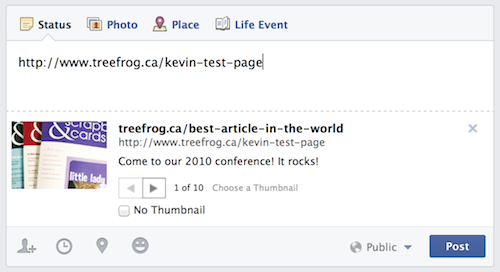
A client called in recently with a conundrum about Facebook. They asked us how Facebook managed to find information about one of their old conferences and apply it to their new post.

They had created a web page on their site and posted the link as a status update on Facebook. The problem was, the link appeared to be grabbing old information from somewhere and attributing it to their post.

Where was this old information coming from?

Take a look at the image above. When you drop a link into Facebook, it pulls data from that webpage.

What the… That’s totally not the information we have on our page. Where is it getting that title and description from? 2010 is over, isn’t it?

You’ve spent all this time creating a great webpage, and then Facebook goes and pulls some arbitrary title and description from out of nowhere. You’ll have to change that on your Facebook post if you want to make it current and relevant.

It turns out, the key to setting up your page correctly before posting it on Facebook, or any social network for that matter, is META data.

Never META Data I Didn’t Like

The mysterious thing about META data is that it is invisible to the naked eye. In fact, you can’t even see it if your eye has clothes on. It lives behind the curtain with the wizard.

META data consists of three main parts: Page title, Page keywords and page description.

Page title
Your page title is the text that appears at the top of a browser window. The page title is not to be confused with your page’s URL (link). The page title should describe the content on your page in an engaging way. The page title gets pulled as the title of your Facebook post.

Page Description
The page description should be a brief paragraph describing the content of your page.
For Facebook posts, the META description will end up being pulled into the post description. If you set this up on your webpage’s META data, you don’t have to worry about re-entering or editing it on Facebook, which will save you time and headache.

Keywords
META Keywords are not used by Facebook. In fact there are varying opinions about the validity of keywords as a whole, but that’s not for the scope of this article. For some extra reading on the relevance of populating the keyword field, you should visit this link.

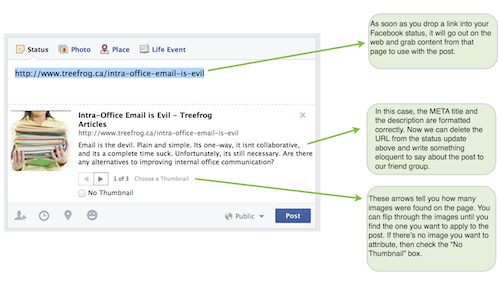
As per the photo above, as soon as you drop a link into your Facebook status, it will go out to the web and collect what it thinks is relevant data to use with the post.

in the above case, the META title and description are formatted correctly. Once that’s done, you can delete the link itself from your status update and write something attention-grabbing about the content you’re posting.

The arrows near the bottom of the post dialog box tell you how many images Facebook found on the page. You can flip through the images until you find the one you want to apply to the post. If there’s no image you want to attribute, simply check the “No Thumbnail” box.

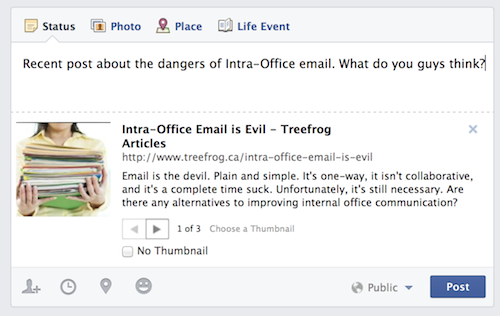
Above is an example of the post with the actual URL removed and a little intro written, ready to post to the Facebook world.

Tip: If you’re planning on posting this same content to multiple social networks, you should customize your intro. When it comes to posting something on Twitter, brevity is your friend. Your “Likes” on Facebook may prefer a more playful, jovial intro, whereas your followers on LinkedIn could be more serious. The point is: change it up, don’t just cut and paste the same intro across the board.

As part of your web page creating process, you should make sure it contains the proper META data. It’s just good practice. It will also save you time, add relevance and increase search engine optimization.

LEAP™ Makes META Insertion Easy

The META data on your page can be a very powerful tool. It is also what Google will most often use to display when your page comes up in a search result. The information should be precise and engaging. It should make people want to click on the story and read it.

Treefrog’s custom Content Management System (LEAP™) allows users to hop into the back end of their site easily and update the META content. It’s as easy as “leaping” to the administration side of the site, clicking the META button, making your edits and clicking “Update”.

Now, when you plug the link to your beautiful new web page into a Facebook status, all of that information will pull into your post. Voilà! Saves you time, and keeps things consistent.

If you still have questions about META data, let us know, we’d love to hear from you!

water drops on leaf
Technology Strategy

Domain Registry of Canada

We receive calls from customers every few months asking if the letter they received from the “Domain Registry Of Canada” is a legitimate registrar… and they are!

But they prey on anyone Canadian who owns a domain name out there and hope that the customer will take their service over their current registrar and ten times out of ten you shouldn’t go through with it honestly.

We understand it looks like an official document from even the government, but it is not – this is just a registar out there preying on customers who may be unaware of this scam.

It’s very expensive alternative and they provide no service, and gives away the control of your domain to them and we’ve heard it gets even more difficult to make changes to your domain once in their control – be very careful!

If you receive a letter and have your domain with Treefrog call us immediately, do not fill out their form. Once you do we are unable to assist you and you’ll be out the cash (although we have saved a few domains because we were the admin contact and just cancelled their transfer).

This is a warning! Be careful!

(We’re not linking to them, they don’t deserve the link but you can Google their name if you’re that inclined or have received a letter – contact them, or shred the letter and burn the pieces)

Scroll to Top