
Digital Marketing

Three smiling people look at a computer tablet.
Digital Marketing

Boost Your Business and Sales through Social Media

Are you avoiding using social tools to generate business? You’re missing out on a world of opportunities

In 2016, your company and employees ought to be using social media tools consistently to communicate with your existing clients, and get involved in online conversations with the wider world. Why? Because your business’s fortunes – and your employees’ livelihoods – depend on it.

More than 2 billion people use social media tools on a daily basis. Nowadays, even a small, independent startup is locked in intense competition with enterprises of all sizes worldwide. After all, the Internet knows no regional or national boundaries. Ergo, all businesses are international businesses, and the ones that are using social media effectively, have a competitive edge over those that are not.

Furthermore, companies that use social media tools regularly and smartly can generate more sales or potential sales. An integral part of the sales process involves developing relationships, and some social channels can help you and your sales team cultivate new leads or prospects, and find out what people are saying about your brand as well as your competition.

Why Your Business Needs to Embrace Social Media

There are five valuable points to consider as you transition your business to become a social business:

  • Facebook at Work. Not only is Facebook the English-speaking world’s most popular social platform, but it’s also continuing to grow at a healthy clip. Facebook at Work is the platform’s soon-to-be-released tool that will allow companies to create internal social networks among employees. That pits Facebook against the likes of Slack, Socialcast, Yammer and countless others eager to lead the enterprise social space. Will this be the so-called “killer app” that rings the death knell for our reliance on email? Time will tell. In any event, it’s likely to induce Facebook holdouts on your team to become more familiar with the network, and over time, turn them on to engaging with the world outside the office walls in a responsible manner.
  • Transform your employees into brand ambassadors. When it comes to promoting your business organically, there are no greater influencers in the world than the people who work with and for you. You may already have a social media team or coordinator and a public relations professional doing much of the heavy lifting, but garnering good online or public relations should be every employees’ responsibility.
  • Social media drives analytics. Each social network provides analytics tools, and the data these provide can be weighed alongside your website’s performance that’s tracked by Google Analytics. Plus, you can plug your social channels into Google Analytics for additional insights. It’s not a secret that smart business decisions are based on quantifiable data. Social data can help you identify new potential clients, provide insight into the content you’re sharing, and if/how it resonates with your intended audience.
  • Understand the role of social pay-per-click. Advertising via social media isn’t taboo provided you’re doing it properly. Regarding social pay-per-click (PPC), it’s simply a matter of advertising on a social network be it Facebook, Twitter, LinkedIn or any other platform. Different social networks provide different click-thru percentages depending on the nature of the ad, and the audience you’re targeting (e.g. if you’re selling to teenagers, don’t advertise on LinkedIn). Social PPC is unique from search engine PPC in that social PPC is tailored directly to users based on their interests, not solely on what they have searched for. It’s estimated social ad spending will grow in 2016 to US$24.2 billion, up from $19.8 billion in 2015.
  • Social-based video is exploding. In 2015, Facebook doubled its daily video views to approximately 8 billion, surpassing the hits YouTube got. Other social networks from Twitter to Snapchat have also rolled out video-sharing features. Clearly, the future of social and digital marketing is branded video content, and its influence will continue to grow year-over-year. While many companies balk at paying for professional video production, there are more cost-effective alternatives cropping up all the time.

“All businesses are international businesses, and the ones that are using social media effectively, have a competitive edge over those that are not.”

Never Forget Your Audience

What’s critical to remember when using any social channel is your audience – both your existing clients and the general public. Here’s a simple rule of thumb for using social media: be helpful, be genuine, and create value. In other words, transform your company’s marketing messages by focusing more on being human to connect effectively with others intellectually or emotionally.

Personalize your social posts to create genuine, long-lasting relationships or connections with existing and prospective clients. Understand the way your audience wants to be spoken to, and the topics they care most about. Moreover, use different content and different tones of conversation for each social platform that you’re sharing content on.

The tsunami of random or relentless marketing messages that people are swamped by on a daily basis simply encourages people to tune out. If you’re producing engaging content that is truly helpful and adds value to other people’s lives in some way, then they won’t dismiss your content as an annoying interruption. Your social content should always be educational or entertaining. We recommend spending one-third of your time on social channels doing promotions, one-third providing value-added content, and one-third engaging with others. Most importantly, as part of your overall digital ecosystem, your social content needs to mesh with your company’s website messaging, and help to support overall business growth.

Have questions about how you can transform your business into a more social business? Get in touch.

We’ve got the people, the expertise, and the technologies to help you achieve your strategic goals using social media.


A hand holds a credit card, while the other types on a laptop keyboard
Digital Marketing

5 Reasons You Shouldn’t Buy Followers on Social Media

Growing your social media presence takes time and effort, and it can be tempting to succumb to the concept of ‘buying followers’ to speed things up. However, this does more harm than good.

Here are five reasons you shouldn’t consider buying followers for your social media accounts:

1.    This is not your real audience.

These followers are not your customers or clients, if they are even real people. They will not be spending money on your products or services and they will not be engaging with your content. The goal of your social media presence should not be to have the biggest following; it should be to connect with your customers regularly so that you are top of mind for them.

2.    Your engagement will decrease.

Adding followers that don’t interact with your account results in your overall engagement rate decreasing. On some platforms, like Facebook and Instagram, this will work against you. Having a low engagement rate tells Facebook and Instagram’s algorithm that your followers aren’t interested in your posts. This means the chances of your posts appearing organically into your followers’ news feeds will decrease.

3.    You become a platform for spam.

Once you start incorporating fake followers into your community, those fake followers can target your genuine customers with their own spam. If your brand becomes known for spamming followers with irrelevant nonsense, you will begin to lose your real and genuine followers.

4.    Your reputation gets jeopardized.

Your online reputation is everything, as one of the pillars of a great brand is transparency. Being discovered for buying fake followers can be humiliating for your brand and can result in your real customers losing trust in you.

5.    It goes against the terms of conditions.

Buying followers is against the terms of service of almost every major social media network. These companies have strong policies against ‘fake followers’ and will actively delete or ban accounts that use services to buy fake followers and likes.

Buying fake followers cannot only destroy your brand, but it can also put your entire company at risk. Getting banned from popular social media platforms like Facebook, Twitter, and Instagram, will mean you can no longer access major marketing channels.

Social media brand building takes a lot of time and effort, but if you have a strong strategy in place, and work hard to gain followers organically, you can still be successful amongst your strong competitors.

Dandelion puffs being blown away
Digital Marketing

Do Keywords Still Matter?

Anyone who’s been following developments in the SEO world may be quick to say things like “keywords are dead.” Well, that’s just ludicrous. How can content be king and keywords not matter? Keywords  are, in fact, words.  Is content not made from words?

You know what is dead? Keyword stuffing and gaming search engines. Search engines surpassed human intelligence like… two years ago. SEO’s don’t game the system anymore. Those that do are beheaded by Google. And then Bing comes along afterwards and gives their beheaded corpses a kick in the bum.

There’s a fundamental difference between keywords for search engines’ sake, and keywords for users’ sake. But there shouldn’t be. Content should be created for users first, there’s no doubt. But there’s also no reason that content can’t also perform well from a search engine ranking standpoint.

Keyword Optimization: The Modern Filing System

Here’s an extremely basic explanation.  Think of  a search engine as a database, and your  website as a file within that database. If your website doesn’t contain the words that someone is searching for, how will it ever be found?

Even more basic: what do you do when you file papers into folders and put them in a filing cabinet? You’d organize the papers by topic, and then label the folders with that topic, right?  Think of including keywords and optimizing your webpage somewhat like labeling the topic so that it’s easier to find. On the other hand, if you’re like me you just stack everything together and dump it into the filing cabinet in a huge papery mass. If I need that piece of paper later, I simply try to forget the reason I needed it in the first place, and then move on with my life.

Don’t be Stuffy: Write for User’s Sake

Back in the day, SEOs used to beat the keyword/labeling concept to death. They’d repeat a select keyword numerous times on a page — to the point of annoyance — rendering the page text unreadable. Well, this doesn’t cut it anymore. Actually, it didn’t cut it in 2011.

So what can you do?  Luckily, there are still some tried and true tactics to content building that you can employ to help with search engine visibility. Search engines still pay attention to your META page title. They still pay attention to headings and on-page content that is relevant to your topic. They still pay attention to the intended visibility of your webpage; that is, whether you have it  prominently  displayed and/or linked from a site-wide menu. They  pay attention to whether that page is distributed on social media, and whether people click on it and read it. They care about how many other websites are linked to your content, and whether those websites are relevant to the topic.  Search engines also  care about relevance, and user engagement. Actually they care about this last one most of all.

You need to also keep  competition in mind. For example, do your competitors have a page on their website that is ranking well for the topic you’re planning to write? Are those competitor pages written well? Do your competitors have a large social media presence? If so, then it will be much more difficult for your content to rank. It’s not that your content isn’t as good or better, it’s just that your competitors may have been at the game longer.

“Play the Long Game: Think Like the Mighty Tortoise”

Will your new webpage take a long time to start performing well? Sure it will. In some cases, it will take six months or longer. You can jump-start the page’s visibility by sharing it on social media. If you have a  client  e-mail list (people who have opted-in, of course!) then throw a teaser blurb about your content in there and link to it. Link to it from other pages on your website, and make the anchor text in-line with the topic heading.

All of the above tactics can be factored into your content, and you’ve not had to stuff one keyword. You’ve simply selected a relevant topic to write about, and you’ve done all the right things to make sure it will eventually rank well when someone researches that topic. The fact that the topic contains what could be defined as a “keyword” is merely coincidental.

So, do keywords still matter? They certainly do, if they are used for the right reason. Keep in mind: users first. Organizing the keywords and optimizing the page is really only making the job of the search engine less difficult. But the whole reason you’re doing this is to get more eyes on your content, and then get those eyes to convert into sales.

Actually, you want the people to convert into sales. Actually,  you want the people to remain people, and buy stuff from you willingly.  You get the idea.

Need help? It just so happens that  Treefrog is in the business of getting your users to convert  into sales.  We’re here for you!

The word "brand" decoratively drawn in a notebook
Branding & Design, Digital Marketing

What is Corporate Identity?

…and Why is it Important?

The concept of corporate identity is akin to what we refer to when we talk about our own identity, the specifics that differentiate us from others. It is our personality and character that maintains our individuality, which we express through how we behave, speak, and even what we wear.

Similarly, a business makes itself distinct through the image that it presents to the world, through collateral like business cards, letterheads, brochures and other options. It is a physical expression of the company’s brand, an extension of the culture that is already expressed through communication style and behaviour exhibited to maintain the image of the business.

Corporate Identity expresses your business’s brand personality and sets you apart from the competition.

The Importance of Corporate Identity

In a fast-paced and competitive world where the consumer has innumerable options available to them, a company needs a strategy to establish a solid presence in the marketplace. There are strong reasons to believe that the right corporate identity helps achieve this business objective.

Building Corporate Persona: When we meet a person, it is the first impression that has the most impact. We tend to gather cues from what we see and feel, interpreting our observations to form our opinion about the person. This is also how we treat products and companies. To stand out from their competitors, every company needs to have a good brand image, to create a niche in the client’s mind by having a unique, pleasing appearance and identity.

Consumer Loyalty: The consistent design of a corporate identity, in accordance with objectives set for the business, uphold and reflect the ethos, culture, principles, future ambitions, or visionary goals of the business. Customers who find this to be in accordance with their philosophy and liking feel connected to this image and are more likely to develop loyalty to the business.

Business Enhancement: Personal experiences with a corporate identity influence consumers and their purchasing decisions. A corporate identity with a strong and positive impact creates a favorable mental image of the business in a consumer’s mind. A strategically planned identity gives a good return in terms of referrals and repeat business.

Businesses may occasionally need to update their corporate identity, if there is an ideological change in the target audience over time and as the world changes. Design professionals can help with attention grabbing logos, impressive business cards, elegant letterheads, inviting envelopes, stunning brochures and other identity elements. Invest in your corporate identity to develop trust, a sense of value, and a lasting connection with your customer base.

Country road going into the mountains
Digital Marketing, Web Design & Development

Site Architecture as a Writing Road Map

Find your way to writing brilliant website content

Think of building your website like heading out on the highway for an exciting road trip to new business heights. You have web design experts to help you develop an architecture and design and to manage the programming. Now you need to fill it with content.

Content Writing Road Blocks

Content writing is a massive road block for many a new website owner. If you’ve been procrastinating, you’re not alone. In Treefrog’s experience, this is the number one stage of a web design project where clients get stuck at the side of the road, completely out of gas.

It surprises many – after all, who is more of an expert on your business than you? So why does it happen?

  • You’re so close to your own business, sometimes it’s hard to step back and see things from your client’s perspective.
  • You invest your time in running your business, you don’t have time to write about it.
  • You’re great at running your business. You don’t also have to be great at writing about it.

Site Architecture to the Rescue

There is a way out of the content writing wilderness. You just need the right directions, and you already have them.

Remember that site architecture and wireframe you approved at the beginning of your project? No? You’re not alone there either. The site architecture is not just for designers and programmers. It’s for YOU.

Your site architecture is a list of the pages you want and/or need on your website when it goes live. Like the step by step directions from your GPS navigator, the architecture is a checklist that will take you through your content writing journey.

“Like any map, your site architecture is a guideline. It offers a route to website success through a user friendly structure.”

Changing Content Directions

Like any map, your site architecture is a guideline. It offers a route to website success through a user friendly structure. There are some aspects that need to be followed, but you might find shortcuts or detours along the way that will improve it, as you see how your design and writing come together.

If you proposed a page at the beginning of your project that you no longer need, you have the power to take it out. If you realize you missed something, you have the power to add it in.

Stop and Ask for Directions

If all else fails, trust the experts. Content writers in web agencies not only understand your architecture, they understand how to write for the web so that Google and other search engines will find you. They will work with you to refine your message and guide you through the twists and turns of your website content.

Decorative technology illustration
Digital Marketing

How to Use META Data In Your Facebook Posts

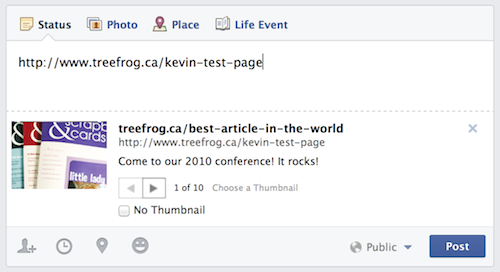
A client called in recently with a conundrum about Facebook. They asked us how Facebook managed to find information about one of their old conferences and apply it to their new post.

They had created a web page on their site and posted the link as a status update on Facebook. The problem was, the link appeared to be grabbing old information from somewhere and attributing it to their post.

Where was this old information coming from?

Take a look at the image above. When you drop a link into Facebook, it pulls data from that webpage.

What the… That’s totally not the information we have on our page. Where is it getting that title and description from? 2010 is over, isn’t it?

You’ve spent all this time creating a great webpage, and then Facebook goes and pulls some arbitrary title and description from out of nowhere. You’ll have to change that on your Facebook post if you want to make it current and relevant.

It turns out, the key to setting up your page correctly before posting it on Facebook, or any social network for that matter, is META data.

Never META Data I Didn’t Like

The mysterious thing about META data is that it is invisible to the naked eye. In fact, you can’t even see it if your eye has clothes on. It lives behind the curtain with the wizard.

META data consists of three main parts: Page title, Page keywords and page description.

Page title
Your page title is the text that appears at the top of a browser window. The page title is not to be confused with your page’s URL (link). The page title should describe the content on your page in an engaging way. The page title gets pulled as the title of your Facebook post.

Page Description
The page description should be a brief paragraph describing the content of your page.
For Facebook posts, the META description will end up being pulled into the post description. If you set this up on your webpage’s META data, you don’t have to worry about re-entering or editing it on Facebook, which will save you time and headache.

Keywords
META Keywords are not used by Facebook. In fact there are varying opinions about the validity of keywords as a whole, but that’s not for the scope of this article. For some extra reading on the relevance of populating the keyword field, you should visit this link.

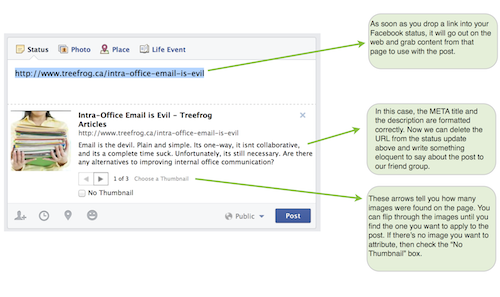
As per the photo above, as soon as you drop a link into your Facebook status, it will go out to the web and collect what it thinks is relevant data to use with the post.

in the above case, the META title and description are formatted correctly. Once that’s done, you can delete the link itself from your status update and write something attention-grabbing about the content you’re posting.

The arrows near the bottom of the post dialog box tell you how many images Facebook found on the page. You can flip through the images until you find the one you want to apply to the post. If there’s no image you want to attribute, simply check the “No Thumbnail” box.

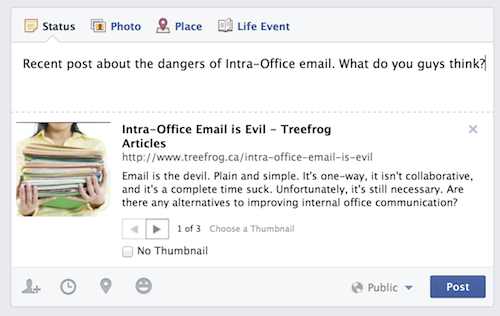
Above is an example of the post with the actual URL removed and a little intro written, ready to post to the Facebook world.

Tip: If you’re planning on posting this same content to multiple social networks, you should customize your intro. When it comes to posting something on Twitter, brevity is your friend. Your “Likes” on Facebook may prefer a more playful, jovial intro, whereas your followers on LinkedIn could be more serious. The point is: change it up, don’t just cut and paste the same intro across the board.

As part of your web page creating process, you should make sure it contains the proper META data. It’s just good practice. It will also save you time, add relevance and increase search engine optimization.

LEAP™ Makes META Insertion Easy

The META data on your page can be a very powerful tool. It is also what Google will most often use to display when your page comes up in a search result. The information should be precise and engaging. It should make people want to click on the story and read it.

Treefrog’s custom Content Management System (LEAP™) allows users to hop into the back end of their site easily and update the META content. It’s as easy as “leaping” to the administration side of the site, clicking the META button, making your edits and clicking “Update”.

Now, when you plug the link to your beautiful new web page into a Facebook status, all of that information will pull into your post. Voilà! Saves you time, and keeps things consistent.

If you still have questions about META data, let us know, we’d love to hear from you!

fireworks
Digital Marketing, Web Design & Development

Get your website live now!

Stop being a perfectionist and change!

The newest Treefrog website went live on January 23rd, 2015, after months of being worked on in the background. The simple fact is – the website has a few broken links and some spelling mistakes. It has some  errors in terms of dates and it may have a picture missing here and there. It’s going to take us months to get the site perfect. And you know the thing about perfection.

But this is the point of the new world order of the world wide web. Pay attention to the following;

  1. This new website is already better than the old website.
  2. This new website will take time for search engines to properly index.
  3. We have a CMS on the site, so changes are going to happen quickly.

So we made the call to set the site live, with all of its pimples and imperfections. We know that Google and the world will be happy to see the changes we have made and be happy that we strive for perfection. It isn’t perfect. But we aren’t forgetting about it. A website, like all good works of art, is never complete. We are going to continuously put energy into making it better.

“Google likes to see change. Google likes the fact that your website is a constant work of improvement.”

So have no fear that we won’t complete your website, and setting it live (within reason) before all of the bubbles have been pushed out of the wallpaper of perfection.

Your website needs to go live at exactly the moment you can say “this website is already better than our last one”. And your ranking on search engines will actually be better if you send it live and tweak it as you go.

Let loose your fear and click the big red button of life! Over the next few weeks, you can still make it perfect, and you will have made great strides towards your search engine ranking goals.

pen drawing digital lines
Digital Marketing

Five Essential Parts of SEO

What is SEO?

SEO (Search Engine Optimization) is a magical art, created in the center of an active volcano by a colony of friendly yet mischievous gnomes.

SEO can’t be seen, it’s hard to quantify, it’s not altogether tangible, and it’s constantly shifting and moving around like the smoky essence of the universal ether.

SEO has had a tainted history. In the past few years, snake oil salespeople have been pulling their wagons into town and offloading their wares on the unassuming villagers. SEO was packaged and sold as the way to get to number one on Google. In the past, there were some questionable ways of making this happen. Evil SEOs of old employed backlinking magic, keyword stuffing, and various other wayward tactics to fool the poor Google. And it worked. But then the Google woke up, and it was angry.

With the release of several major upgrades to its algorithm, Google changed the rules for SEOs everywhere. Instead of ranking well for using dark tactics, sites were penalized. Some companies woke up one morning to find their websites had completely fallen off the radar. Since these major shifts in the industry, the world of SEO has become a completely different place.

The Google Effect

You may be aware of the fact that Google changes its algorithm over 500 times a year. Let me put that in perspective. Think of doing something 499 times this year. Google changes its algorithm more than that. That’s more often than some people shower. Every time this happens, the SEO industry feels it. Sometimes the changes are subtle. Sometimes they are major. Either way, a big part of SEO is ensuring your website makes the grade—that is, stays in line with Google’s ranking criteria. There are forums on the Internet where SEO engineers do nothing but debate what Google is going to do next, and what it means. Deciphering Google is a full time job.

Google gets over 60% of search engine traffic

Also, let me clarify. I use the term “Google”, but what I really mean is “search engine”. Everyone knows there are other search engines out there. I think. There’s also Bing, and there’s… Bing. Fact: Google gets over 60% of the search engine traffic on the web, so for the purpose of expedience, I’ll probably just keep saying Google when referring to search engines.

As for the explanation of SEO, I have come to think of it in five distinct sections.

Technical

Technical SEO deals with applying attributes to web pages which happen on the back end, where most mild-mannered content creators choose not to venture. Technical SEO changes can include improving page load times, applying microformatting, validating the W3C markup, and various other techniques.

Search engines acknowledge the effectiveness of a website from a technical perspective, so it’s an important aspect to improved SEO. But once those technical changes are applied, they don’t keep awarding your site points with Google. Even though these updates are important, the SEO work is really only just beginning.

Content/Creative

This is the most important part of SEO. Content should be at the core of your SEO strategy. Whether it’s articles, images, videos, infographs or a collection of all of these, the more relevant and helpful your content is, the better your chances of it being found on the web.

Tactical

Tactical SEO refers to optimizing websites on a page-by-page basis, in order to ensure they make the grade for popular search engines.

Tactical SEO involves the effective insertion of keywords into on-page content throughout a website. This may sound simple enough, but keywords are different for every industry, every company, and every individual.

The wrong keywords will draw the wrong kind of traffic to a website. If the keyword is too broad, you’ll get tire-kickers. If it’s too specific and exclusionary, you may be cutting out part of your audience. Keywords use a balance, and it’s ongoing. Basically, tactical SEO involves strategic content insertion on a continual basis.

Social

Social is a great way to pull traffic to your website organically. It stems from having great content and staying engaged with your audience. Ideally your audience will share your content, comment about it, and give you feedback. All of this activity drives traffic and calls attention to your web presence.

Reporting

This is the science of SEO. Through custom reporting, SEO managers can determine whether a strategy is working. Because one client’s goals are different from the next, SEO strategies should be tailored to fit specific needs. It isn’t all about getting to number one on Google (something we’ll cover more in depth soon), it’s about identifying a client’s key performance indicators and doing everything you can to meet expectations.

As SEO Manager at Treefrog, this will not be the only article I write about SEO. It’s such an involved topic, there are hundreds of angles to cover. In fact, many of the topics brought in this article are grounds for more explanation, which I plan to provide as we go forward. In the meantime, please feel free to email your questions or flag me down on Facebook/Twitter/LinkedIn and I’ll be happy to help however I can.

I hope that you will enjoy following along this incredible journey as we learn and experience together. In the meantime, I’ll be hanging’ with the gnomes.

Out of focus artistic image of fibre optic strands
Branding & Design, Digital Marketing, Web Design & Development

CASL Deadline is Approaching

Do you think it’s unreasonable to be fined 1 – 10 million dollars for sending an unsolicited email? Sure, who wouldn’t. The new CASL legislation, the first phase of which is coming into effect July 1st, 2014, is going to hold businesses accountable for their email broadcasts. And the fines are incredible—some would say unreasonable.

Regardless of what you think of the fines, CASL is making small to medium sized businesses ask a lot of questions. There is much speculation about what will be legal, and what will be illegal after the law takes effect. And with the first phase of CASL starting up at the end of this month, things just got real.

What is CASL for?

CASL is designed to protect Canadians from receiving unsolicited commercial electronic messages (CEM). That means any type of CEM including texts, emails, malware prompts… It is meant to foster a sense of protection for Canadians online.

Canada will now have one of the most stringent anti-spam laws in effect across the globe, and it is likely that other countries will follow suit. The plus side is, the law will discourage businesses from abusing email lists. Unfortunately, it will probably have little to no effect on actual spam. You’ll still get a ton of Viagra discount messages in your inbox.

Regardless of whether you agree with the law, you need to know how CASL affects your business.

Implied or Express Consent

Here’s the main benchmark by which to measure the people on your email list. There are two types of consent. Implied, and express (also referred to as explicit). An important point: implied consent is okay, express consent is best.

Implied Consent

Implied consent means: anyone who you have an existing business relationship with, but who has not given you express consent to send them email correspondence.

People have a tendency to think that because you have a business relationship with them, you are automatically allowed to send them email correspondence. Not so, under CASL. At best, you have implied consent from this person, and that means something very specific under CASL.

Here’s an example of implied consent. I meet you at a conference. I give you my business card, and tell you you can put me on your e-mailing list. You can add me to your e-mailing list, because I have given you “implied consent”. You need to then track me in your database after that initial contact. If I don’t interact with you for two years, (meaning I do not email you, buy from you or otherwise contact you) then you have to remove me from your emailing list. Implied consent only lasts for two years, after the grace period that is in effect starting July 1st.

However, if I do happen to make contact with you at some point, other than to specifically tell you to stop sending me emails, the implied consent timeline resets. In other words, you’re good to send me emails for another two years, starting from the day I made contact with you.

You can see why this could be an administrative nightmare.

That’s why in every case, it is much better to encourage your contacts to give you their express consent. That way, you can continue to send them email correspondence, until they decide to opt out of your list.

Main points of Implied Consent:

  • Existing business relationship
  • Good for 2 years (resets if you do business with the person again or they contact you via email)
  • People who post their email addresses online who don’t specify they don’t want any spam or unsolicited CEMs could potentially be giving you implied consent (even though this one is really dodgy).

Express Consent

Express consent means anyone who has “opted-in” to receive your emails. That usually means they filled out a form on your website stating that they wanted to get your newsletter, or other email update.

You can legally send CEMs to any recipient who has given you express consent, as long as the correspondence adheres to the rules.

Any CEM you send to someone who has given express consent has to contain the following:

  • Your company name, physical mailing address and business information
  • An easy, clear way for the recipient to opt out of your correspondence, at any time.

You’d also do well to clearly label the email correspondence, whether it’s a newsletter or whatever it is, so that the person can remember signing up for it.

Keep in mind that the opt-out procedure can’t contain any duplicitous snares, like “Are you sure you want to opt out?” Of course they want to opt out. They clicked the “Unsubscribe” link.

You also can’t try to fool someone into opting in to your email list. Remember those checkboxes that were automatically checked, stating that you give the company permission to send you emails? They will have to go away. They’re illegal, according to CASL regulations.

How do you collect email?

Are you aware of how you collect email addresses? Is there a process by which you filter people signing up for your newsletters to undergo a specific opt in procedure? In short, are you making sure you can prove that a person signed up to receive your stuff? If you’re not sure, then you need to look at how that process works. What are you telling people they’re signing up for? Is that what they end up receiving?

Are you tracking what people are signing up for? If there isn’t a clear method by which you can prove that a person signed up specifically for your correspondence, then you need to tighten that up.

Keep in mind that each separate email correspondence (each channel) should be clearly identified. For example, if you are telling someone that they can expect product updates from you, then send them product updates. Don’t then start sending them updates about something else. Make sure that you identify exactly what it is you will be marketing, and have a sign up process through which you can clearly prove that people have signed up. Each channel needs a method by which you can prove people’s opt in.

If you intend to continue “scraping” email addresses form the web to build up your lists, be aware that anyone who has specified that they do not wish to receive spam would not be considered “implied” consent. Regardless of how that would be monitored, it’s just not worth it to scrape email addresses from the open web to make up your email lists. Who does that, anyway?

Permission-Based Email Marketing

Think of a pristine email list, full of people who are interested in hearing from you. That’s what you could have after adhering to CASL’s regulations and cleaning up your email collection/distribution methods. Even though your overall recipient numbers may go down at first as you clean things up, over time your open and click rates will go up. That’s what CASL could potentially bring about; a shift in consciousness when it comes to email marketing. It isn’t about grabbing as many addresses as you can for the possibility that someone will click on a link. It’s more about “Permission-Based” email marketing, where people opt in to receive your emails because they are genuinely interested in what you have to say.

When you have a list full of people who have given you permission, it becomes less about “marketing” and more about having a discussion with your supporters and brand evangelists. What a wonderful world it would be!

There are some marvelous resources out there with tons of useful tips about how to be CASL compliant.

Read:

Constant Contact Insights for Small Businesses 

Constant Contact CASL Resources

Elite Email CASL Survival Guide

Canadian Federation of Independent Business- Does Your Business Send Emails?

Watch:

CRTC Information Session Regarding CASL

Connect:

Javed Khan of Empression has done extensive speaking and training on the subject of CASL.

If you have specific questions about anything, we’d be glad to answer what we can.


TREEFROG IS AN EMAIL SERVICE PROVIDER, AND OUR E-MAIL BROADCASTING PROGRAM IS FULLY CASL COMPLIANT. THROUGH BUILDING THIS PLATFORM, WE HAVE LEARNED QUITE A BIT ABOUT WHAT IT TAKES TO BE CASL-FRIENDLY. PLEASE SEND US YOUR QUESTIONS!

DISCLAIMER: THIS ARTICLE IS FOR INFORMATION PURPOSES ONLY. FOR SPECIFIC DETAILS ABOUT CASL AND THE LEGAL IMPLICATIONS FOR YOUR BUSINESS, IT IS IN YOUR BEST INTERESTS TO CONSULT A LAWYER TO ANSWER YOUR QUESTIONS.

Close up of a keyboard, but instead of an enter key, there is a green accessibility key
Digital Marketing, Web Design & Development

AODA: Making Your Website Accessible to People with Disabilities

You may already be aware of the Accessibility for Ontarians with Disabilities Act. But are you aware that it will have an effect on how websites are developed?

The goal of the Accessibility for Ontarians with Disabilities Act (AODA) is to make Ontario and Ontario-based organizations fully accessible to people with disabilities, and that includes websites and digital content.

According to Statistics Canada, 13.7% of Canadians aged 15 or older have a disability. Additionally, the Canadian population is aging. StatsCan found seniors accounted for a record high of 14.8% of the Canadian population in 2011, up from 13.7% in 2006.

AODA states all privately held or non-profit organizations in Ontario with more than 50 employees must ensure their websites and digital content conform to World Wide Web Consortium’s Web Content Accessibility Guidelines (WCAG) 2.0. There are three levels of the WCAG 2.0 – Level A, Level AA, and Level AAA. Your organization’s site needs to be WCAG 2.0 Level A-compliant today.

By January 1, 2021, all public organizations and companies with more than 50 employees must meet WCAG 2.0 Level AA. WCAG 2.0 Level AA includes captioning for both live and pre-recorded video and audio available online.

Find Out How AODA Relates to Your Business

The timeline for your organization to be AODA-compliant depends on the size and nature of your business or non-profit entity.

The timeline for implementation is complex because the law deals with many facets of business, of which website accessibility is one. To give you an idea, here’s a PDF created by the Government of Ontario that gives a timeline detailing requirements and compliance deadlines.

The Government of Ontario website features a wizard you can use to find out what category your organization belongs in, and which gives you a sense of the deadlines that directly affect your business.

What You Can Do Now

When you’re developing your website strategy, consider implementing the following functionality:

  • Write your content in clear language that is easy to understand
  • Use strong contrast for text on backgrounds to make it easier to read
  • Provide alternate text for images and captions
  • Mark decorative images — images that have no direct relevance to an article — as null text Tag: (alt=“”)
  • Ensure that your website is navigable with a keyboard
  • Provide text transcriptions for audio recordings
  • Provide text transcriptions and captions for videos
  • Avoid blinking images or potential seizure-inducing visual elements
  • Use clear link text (instead of “click here”, describe the link and its content)

WCAG 2.0 Accessibility Will Improve Your Site SEO

Search Engine Optimization (SEO) is the practice of making your site discoverable on the web via search engines. It’s an involved process that involves leveraging your content so that Google takes notice of your site.

Complying with WCAG standards ties in with good SEO practices. For example, alternative text tags should describe images in the context of the article in which they are placed. The description shouldn’t just be a bunch of keywords stuffed into a text field at random. These tags are read aloud by screen readers. They need to make sense. Plus, Google likes it better when they do.

The more you make your site accessible, user-friendly and transparent, the higher your rankings will be. In other words, the more accessible you make your website to people with disabilities, the more Google will acknowledge your credibility.

AODA is Already Law: The Time is Now

If you factor in accessibility measures to your site at the outset of the project, the process will be far easier. There are guidelines and accessibility checklists available you can use to test your site’s compatibility.

AODA will encourage businesses to make their websites more accessible to potentially millions of additional users, making the internet a much more accommodating place for the millions of people with disabilities in Canada, and around the world.

For more information about AODA-compliant websites and how Treefrog can help, get in touch with us.

PLEASE NOTE THAT THIS IS NOT A LEGAL DOCUMENT, AND SHOULD NOT BE RELIED UPON FOR LEGAL ADVICE.

More Resources:

Web Content Accessibility Guidelines (WCAG) 2.0

WebAIM’s WCAG 2.0 Checklist for HTML documents

WebAIM Introduction to Web Accessibility 

Scroll to Top