
SEO

Close up of a hand holding a computer tablet
Digital Marketing, Web Design & Development

Is Your Website Mobile-Friendly?

Mobile device usage is more prominent today than traditional desktop computing. If your site doesn’t provide an enticing mobile experience, you will lose business

Are you reading this article on a mobile device? If you are, then you already know what the No. 1 benefit is of visiting a website that is responsive: you can easily view, navigate, and interact with it regardless of the computing device you’re using.

That’s the gist of what’s known as responsive web design. Whenever someone surfs to your website on a mobile device, the site automatically optimizes its appearance to conform to the size of the screen accessing it. For sites that feature e-commerce capabilities, a responsive website is all the more important given m-commerce (mobile commerce) is gaining traction year-over-year. For instance, during the 2015 festive holiday season stateside, consumers’ mobile sales (58.9%) trumped desktop-based sales (41.1%). From a global perspective, consultancy Research and Markets forecast the mobile wallet market will grow at a compound annual growth rate of 34.58% by revenue through to 2020, and that one of its key drivers will be high m-commerce transaction volumes.

“The future is mobile computing – smartphones and tablets are just elements of it. The industry is on the verge of a whole new paradigm.”
– THORSTEN HEINS

Regrettably, Statistics Canada data shows a dismal 19% of Canadian companies have responsive websites. According to research conducted by technology and networking solution provider Cisco Systems, responsive web design has become increasingly important as the amount of global mobile traffic now accounts for more than half of total internet traffic. Moreover, the number of global mobile devices that connected to the ’net in 2015 grew to 7.9 billion, up from 7.3 billion in 2014. Of those estimated 563 million new mobile devices, smartphones accounted for most of the growth.

Think about that for a moment. In all likelihood, your customers and potential customers aren’t visiting your website using a laptop or a desktop computer, but a smartphone or a tablet.

Why You Need a Responsive Website

There are four primary benefits of having a responsive website:

  1. Increased visibility. When it comes to local searches, 50% of consumers who do so on a smartphone visit the business within 24 hours, and local mobile-based searches lead to more sales (18%) than non-local searches (7%).
  2. M-commerce is the future. Currently, mobile phones are the most widely used computing devices on Earth. As more people access the internet via a phone or tablet, more people are using them to purchase goods and services. Additionally, solution provider mporium (formerly MoPowered) estimates 30% of mobile shoppers will abandon a transaction if the shopping experience is not optimized for a mobile device.
  3. It will juice your SEO ranking. In the ongoing effort to up or maintain your site’s search engine optimization (SEO) ranking, a responsive site has to factor into the equation. Google favours responsive sites. In fact, responsive design is Google’s recommended design pattern.
  4. A lack of speed kills. Page load times and streamlined experiences on mobile devices are extremely important. According to a Google/Ipsos study, an estimated 29% of smartphone users will immediately switch to another site or app if they can’t find the information they want or if the site loads too slowly.

Interested in knowing what percentage of your website traffic is mobile? Call us for a complimentary review.


Dew on spider silk
Digital Marketing

What is Search Engine Optimization (SEO)?

101 Information

Search Engine Optimization (SEO) is essential for having a prominent web presence and attracting more visitors to your website. People primarily use search engines to find what they need on the web, including your products and services. You need to be visible on search result pages in order to be found by prospective clients.

SEO is about maximizing the quality of your web pages on multiple levels so that they can be properly indexed by search engines. Search engines have a variety of criteria they look for in a website. Google’s search ranking algorithm changes over 500 times a year, to give you an indication of its complexity.

Ultimately, search engines are looking for the best answer to a searcher’s question. If your site provides the best answer, and it is also technically sound, and if several other websites are linking to it as an authority on a given subject, your changes of ranking will be higher than a site that has none of these things going for it.

The SEO Process

There’s no way to summarize all the intricacies of SEO in a single post. That would be like fitting War and Peace onto one piece of foolscap. The following general tips can help you to attain higher organic search engine raking and maximize traffic to your website.

Determine the best keywords to win relevant traffic. Keywords are the words and phrases that people use to search for information, so you want to select terms that are specific to your business, and write content to reflect those terms so that people can find your pages.

Create original, quality, useful content for all web pages. Use your keywords naturally and with an appropriate density (i.e. use them in a meaningful way; search engines don’t like overstuffed keywords). Including keywords in page titles can also be advantageous to your ranking. If your content is good enough, then other sites may even link to it, and these backlinks can be beneficial to search engine ranking.

Continuously add new and fresh content. Encourage visitors to come back again and again by giving them something new to read. Post multiple articles offering information about your products in a way that informs and educates. This content increases your site’s depth and expands potential visibility of your primary keywords.

Don’t forget the Metadata. Create unique, informative Meta Tags and Meta Descriptions for each page, so that you entice searchers to click on your page from search results.

Create on-site links. Make sure you have sufficient links from your content text to relevant pages throughout your website. This helps users find pages they may not have seen otherwise, and it helps crawlers identify authoritative pages on your site that are linked to often.

Navigation matters! Have a solid architecture to facilitate easy understanding and navigation, so that visitors and search engines can easily move around your site and find what they are looking for with as few clicks as possible. Adding a site map to your website is also recommended.

You should also submit the site map for your content-rich site to search engines or directories to make them aware of your site.

Professional search engine optimization (SEO) strategists use various tools to monitor ranking performance. As the search engines keep changing their search algorithms, SEO strategists have to be on their toes all the time, constantly monitoring the keywords and reworking the information, analyzing your website to keep it competitive in ranking results.

Among all other forms of marketing, search engine optimization (SEO) is integral in getting traffic to your website. Combining SEO engineering and quality content is the best path to ranking success.

Abstract close up of a plant
Digital Marketing

Why Are SEO Discovery and Audit Services Important?

Effective SEO isn’t solely about how your website ranks in an organic Google search

Search engine optimization (SEO) is vital to your company’s online presence. The purpose of SEO is to obtain high visibility for your website on Google, Bing, Yahoo! and elsewhere by ensuring it ranks on the first page of the organic searches people perform. In other words, SEO makes it easy for your customers to find you online.

An oft-misunderstood online marketing tactic, SEO is an increasingly vast and complex methodology, and it’s one of many crucial elements comprising a holistic digital marketing strategy. Search engines rank websites based on multiple factors; no one digital marketing method alone will rocket your website to the top of Google’s list and keep it there indefinitely, and that includes SEO.

The effectiveness of SEO is reliant on many other components and services including:

Done well, SEO can improve your search engine rankings, thereby increasing your website’s organic traffic, and in turn, helping you score new customers, earn more revenue, and realize a high return on your SEO investment. But understand SEO isn’t only about your site’s ranking. One of your webpages may be ranking well for a keyword you’ve identified as relevant to your business, but if visitors to that webpage aren’t finding what they need quickly upon arrival, they’ll “bounce” or go elsewhere. Thus, user engagement is a major factor in Google’s determination of the value of any website. If large volumes of visitors are leaving your website rapidly, it will hurt your overall SEO ranking in the long run.

Research from multiple sources has quantified the value SEO provides for companies in both business-to-business (B2B) and business-to-consumer (B2C) industry verticals. For instance, when conducting online procurement research an estimated 89% of B2B professionals start with a generic search. From a B2C perspective, about 72% of consumers who perform an organic search for a specific product or service visited a store or business within 8 kilometres of their location, and four out of five consumers use a search engine to find businesses in their vicinity.

However, like all things within the realm of business, there is no magic wand to wave that will produce instantaneous results. SEO involves research and analysis. Among the first steps to improving your site’s SEO ranking requires what’s known as an SEO discovery and audit session. It helps to determine which of your webpages are ranking as per targeted keywords, which ones aren’t, and what needs to be done to improve overall performance.

“Discovery consists of looking at the same thing as everyone else and thinking something different.”
– ALBERT SZENT-GYÖRGYI DE NAGYRÁPOLT

Learning about Your Business and Customers

Before an in-depth site audit is performed to gauge the health of your website’s current SEO ranking and how it can be improved, a pre-audit discovery session is required. An integral part of an effective SEO strategy, the purpose of a discovery session is straightforward: it sets the stage for an organized, useful, and strategic audit.

There are five things an SEO discovery session should include:

  • A comprehensive client interview. We need to learn about your business and industry and your products and services. We need to know who your existing, and prospective customers are, the lexicon you and they use, how and where they connect with you online, and what’s driving online conversions or sales today.
  • Determining what your goals are. A goal without a plan is but a wish. Setting realistic, executable goals serves two important functions: it clarifies what it is you want to achieve with your website, and how compiled data should be measured.
  • Access to real-time analytics. Assuming your company uses Google Analytics to track how online traffic arrives at your site, how long visitors dwell on your webpages, and whether they buy or bounce. The more historical data you can provide, the better it is during the audit phase and for plotting your future. If your business uses or has used Google AdWords, the data it can provide helps paint a more complete picture of your website’s performance to date.
  • What keywords you think are best and why. Forget about your current SEO ranking for the time being. In the discovery session, we need to have a clear understanding of the keywords you think are relevant to your business, and why you think your customers would use those keywords to search for your products and services.
  • The quality of your site’s current content. How often do you refresh your website’s content? What is the quality of the content on your site? Your content needs to be well-written, impactful, and it should accurately and succinctly articulate what benefits your business and products provide. If it’s rife with spelling errors, poor grammar, and rambling, incoherent jargon, it will severely diminish your SEO ranking.

Auditing Your Website

With the discovery session complete, we conduct a thorough SEO audit of all of your web properties, and subsequently, provide you with the details of that review and our strategic recommendations that are tailored to your company’s needs.

Our SEO audits and assessments typically include:

  • Competitive intelligence on your competitors
  • Keyword analysis and recommended targeted keywords
  • Reconfiguring your Google Analytics and AdWords to reap more insightful data
  • Local search optimization for Google My Business and other directories
  • Gauging your site’s mobile responsiveness and how mobile search impacts your SEO
  • The usefulness of your inbound links versus your competitors’
  • Recommendations about your site as a whole to improve engagement and increase visitor conversions

An in-depth SEO audit and discovery session takes the guesswork out of what resonates with your existing and potential customers, and it helps to determine a path forward based on data and your business’s strategic goals. It also lays the foundation for building your ongoing marketing plan to ensure you’ve got inspiring and effective content and messaging, a high-quality, responsive web presence, and above all, a compelling reason for the world to land on your pages first and foremost.

Do you have questions about SEO and its effectiveness in conjunction with other digital marketing methodologies? Talk to us. Whether your company is big or small, a startup or a recognized brand, we have the expertise and the experience to optimize your site and boost your website traffic.

Two people working and pointing at a laptop.
Digital Marketing

5 Steps to Creating Knockout Content Campaigns

An effective content campaign can help your company reach new audiences and generate more sales leads. Learn how to build focused, impactful content campaigns that will resonate with your customers

It’s common knowledge that content marketing is what drives traffic to websites, improves a site’s search engine optimization (SEO) rankings, and generates sales leads. But how do you use content effectively to do that? And what’s the difference between content marketing and a content campaign?

Content marketing encompasses many types of content including blogs, email broadcasts, social media posts, pay-per-click (PPC) advertisements, podcasts and videos, e-newsletters, and more. Its purpose is straightforward: to create and share content for free that is informative and entertaining, and helps your firm build trust with readers so they will become your customers.

In general, content marketing is designed to draw people to your website and entice them into your sales funnel. It’s the most critical ingredient in the commercial digital marketing stew. According to a 2015 poll of marketers conducted by Smart Insights, 29.6% ranked content marketing ahead of all other marketing techniques in importance, including marketing automation (12.8%), mobile marketing (11%), social media marketing (8.9%), and PPC marketing (3%).

A content campaign is a long-term, focused effort to drive awareness of your company and its services, or to change an impression people have of your company with content you have created that centres on a single topic.

Your content campaigns are not sales pitches. They contain targeted, relevant, useful information that is designed to educate or answer your readers’ questions. They address specific issues that your desired audience cares about while positioning your company as a thought leader in your industry. For example, a heating, ventilation, and air conditioning company may launch a content campaign each autumn explaining to homeowners how they should winter-proof their homes to help reduce their energy bills.

How to Build an Impactful Content Campaign

At one time, some companies would produce irrelevant, forgettable content stuffed with keywords as a means of spiking their SEO rankings. Thankfully, that methodology has fallen by the wayside. Now, search engines determine their rankings based on both keywords and valuable content.

There are five steps you need to take to develop a useful and impactful content campaign:

Be credible. Building trust demands credibility. That is to say, readers (or consumers) are more inclined to trust a company that consistently provides positive, personal experiences, quality products, useful information, and which responds to problems when they arise quickly and transparently.

Serve your audience with knowledge. Understanding quality, relevant content is the glue that holds your company’s sales funnel together, give your audience what they value: answers to questions they may have. Do it well, and you’re more likely to increase your sales in the short- and long-term.

Use keywords strategically. Using a select number of keywords is useful but don’t rely on them solely. From an SEO point of view, it’s important to use them to help people find your content, but keywords alone won’t help you create fantastic content that will resonate with people. It’s also critical to understand that SEO techniques are useless without meaningful content. Content is the foundation on which SEO sits.

Tap into your team’s creativity. Brainstorm with your colleagues and come up with interesting topics for content campaigns that will capture both your existing customers’ and desired prospects’ attention. Sometimes, you can discover terrific topic ideas simply by scouting Twitter hashtags relevant to your business or targeted audience.

Define what your goals are. What is the objective of your content campaign? Is it simply to give sales a boost? Then ponder how a content campaign can achieve that since using content to make a blatant sales pitch rarely works. Is it to increase email subscribers? Now flip the question and ask yourself, “how will someone who reads your content benefit from it? What matters to your targeted audience?”

Measuring the Results

After you’ve published your content and run the campaign, analyze the results to see what worked and what didn’t. Make changes where required, then begin anew. Bear in mind that determining a return-on-investment (ROI) on your content campaigns is not a straightforward calculation, and don’t lose sight of the big picture: you’re playing the long game with content. It’s a brand-builder, it inspires trust, and it helps position your company as an industry leader.

When measuring results to determine the ROI, you first need to know:

  • How valuable each new visitor to your website is and the length of time they spend at your site
  • How valuable is improving your visibility on Google
  • What the worth is of new visitors to specific product pages on your company’s site
  • The level of importance to place on the growing number of your social followers

Are you looking for a digital marketing partner to help you grow your company’s sphere of influence, and in turn, its revenues? We can help. Tell us what you want to achieve and let’s get started positioning your business as an authority in your industry.

Dandelion puffs being blown away
Digital Marketing

Do Keywords Still Matter?

Anyone who’s been following developments in the SEO world may be quick to say things like “keywords are dead.” Well, that’s just ludicrous. How can content be king and keywords not matter? Keywords  are, in fact, words.  Is content not made from words?

You know what is dead? Keyword stuffing and gaming search engines. Search engines surpassed human intelligence like… two years ago. SEO’s don’t game the system anymore. Those that do are beheaded by Google. And then Bing comes along afterwards and gives their beheaded corpses a kick in the bum.

There’s a fundamental difference between keywords for search engines’ sake, and keywords for users’ sake. But there shouldn’t be. Content should be created for users first, there’s no doubt. But there’s also no reason that content can’t also perform well from a search engine ranking standpoint.

Keyword Optimization: The Modern Filing System

Here’s an extremely basic explanation.  Think of  a search engine as a database, and your  website as a file within that database. If your website doesn’t contain the words that someone is searching for, how will it ever be found?

Even more basic: what do you do when you file papers into folders and put them in a filing cabinet? You’d organize the papers by topic, and then label the folders with that topic, right?  Think of including keywords and optimizing your webpage somewhat like labeling the topic so that it’s easier to find. On the other hand, if you’re like me you just stack everything together and dump it into the filing cabinet in a huge papery mass. If I need that piece of paper later, I simply try to forget the reason I needed it in the first place, and then move on with my life.

Don’t be Stuffy: Write for User’s Sake

Back in the day, SEOs used to beat the keyword/labeling concept to death. They’d repeat a select keyword numerous times on a page — to the point of annoyance — rendering the page text unreadable. Well, this doesn’t cut it anymore. Actually, it didn’t cut it in 2011.

So what can you do?  Luckily, there are still some tried and true tactics to content building that you can employ to help with search engine visibility. Search engines still pay attention to your META page title. They still pay attention to headings and on-page content that is relevant to your topic. They still pay attention to the intended visibility of your webpage; that is, whether you have it  prominently  displayed and/or linked from a site-wide menu. They  pay attention to whether that page is distributed on social media, and whether people click on it and read it. They care about how many other websites are linked to your content, and whether those websites are relevant to the topic.  Search engines also  care about relevance, and user engagement. Actually they care about this last one most of all.

You need to also keep  competition in mind. For example, do your competitors have a page on their website that is ranking well for the topic you’re planning to write? Are those competitor pages written well? Do your competitors have a large social media presence? If so, then it will be much more difficult for your content to rank. It’s not that your content isn’t as good or better, it’s just that your competitors may have been at the game longer.

“Play the Long Game: Think Like the Mighty Tortoise”

Will your new webpage take a long time to start performing well? Sure it will. In some cases, it will take six months or longer. You can jump-start the page’s visibility by sharing it on social media. If you have a  client  e-mail list (people who have opted-in, of course!) then throw a teaser blurb about your content in there and link to it. Link to it from other pages on your website, and make the anchor text in-line with the topic heading.

All of the above tactics can be factored into your content, and you’ve not had to stuff one keyword. You’ve simply selected a relevant topic to write about, and you’ve done all the right things to make sure it will eventually rank well when someone researches that topic. The fact that the topic contains what could be defined as a “keyword” is merely coincidental.

So, do keywords still matter? They certainly do, if they are used for the right reason. Keep in mind: users first. Organizing the keywords and optimizing the page is really only making the job of the search engine less difficult. But the whole reason you’re doing this is to get more eyes on your content, and then get those eyes to convert into sales.

Actually, you want the people to convert into sales. Actually,  you want the people to remain people, and buy stuff from you willingly.  You get the idea.

Need help? It just so happens that  Treefrog is in the business of getting your users to convert  into sales.  We’re here for you!

Decorative technology illustration
Digital Marketing

How to Use META Data In Your Facebook Posts

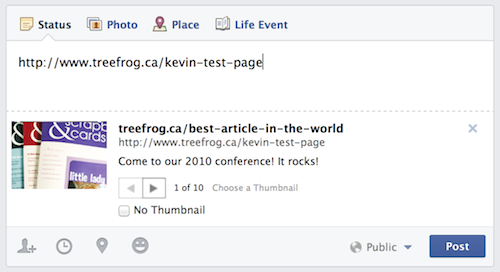
A client called in recently with a conundrum about Facebook. They asked us how Facebook managed to find information about one of their old conferences and apply it to their new post.

They had created a web page on their site and posted the link as a status update on Facebook. The problem was, the link appeared to be grabbing old information from somewhere and attributing it to their post.

Where was this old information coming from?

Take a look at the image above. When you drop a link into Facebook, it pulls data from that webpage.

What the… That’s totally not the information we have on our page. Where is it getting that title and description from? 2010 is over, isn’t it?

You’ve spent all this time creating a great webpage, and then Facebook goes and pulls some arbitrary title and description from out of nowhere. You’ll have to change that on your Facebook post if you want to make it current and relevant.

It turns out, the key to setting up your page correctly before posting it on Facebook, or any social network for that matter, is META data.

Never META Data I Didn’t Like

The mysterious thing about META data is that it is invisible to the naked eye. In fact, you can’t even see it if your eye has clothes on. It lives behind the curtain with the wizard.

META data consists of three main parts: Page title, Page keywords and page description.

Page title
Your page title is the text that appears at the top of a browser window. The page title is not to be confused with your page’s URL (link). The page title should describe the content on your page in an engaging way. The page title gets pulled as the title of your Facebook post.

Page Description
The page description should be a brief paragraph describing the content of your page.
For Facebook posts, the META description will end up being pulled into the post description. If you set this up on your webpage’s META data, you don’t have to worry about re-entering or editing it on Facebook, which will save you time and headache.

Keywords
META Keywords are not used by Facebook. In fact there are varying opinions about the validity of keywords as a whole, but that’s not for the scope of this article. For some extra reading on the relevance of populating the keyword field, you should visit this link.

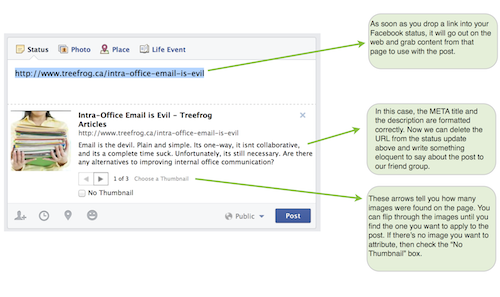
As per the photo above, as soon as you drop a link into your Facebook status, it will go out to the web and collect what it thinks is relevant data to use with the post.

in the above case, the META title and description are formatted correctly. Once that’s done, you can delete the link itself from your status update and write something attention-grabbing about the content you’re posting.

The arrows near the bottom of the post dialog box tell you how many images Facebook found on the page. You can flip through the images until you find the one you want to apply to the post. If there’s no image you want to attribute, simply check the “No Thumbnail” box.

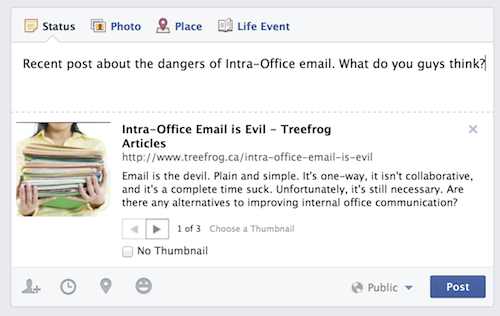
Above is an example of the post with the actual URL removed and a little intro written, ready to post to the Facebook world.

Tip: If you’re planning on posting this same content to multiple social networks, you should customize your intro. When it comes to posting something on Twitter, brevity is your friend. Your “Likes” on Facebook may prefer a more playful, jovial intro, whereas your followers on LinkedIn could be more serious. The point is: change it up, don’t just cut and paste the same intro across the board.

As part of your web page creating process, you should make sure it contains the proper META data. It’s just good practice. It will also save you time, add relevance and increase search engine optimization.

LEAP™ Makes META Insertion Easy

The META data on your page can be a very powerful tool. It is also what Google will most often use to display when your page comes up in a search result. The information should be precise and engaging. It should make people want to click on the story and read it.

Treefrog’s custom Content Management System (LEAP™) allows users to hop into the back end of their site easily and update the META content. It’s as easy as “leaping” to the administration side of the site, clicking the META button, making your edits and clicking “Update”.

Now, when you plug the link to your beautiful new web page into a Facebook status, all of that information will pull into your post. Voilà! Saves you time, and keeps things consistent.

If you still have questions about META data, let us know, we’d love to hear from you!

pen drawing digital lines
Digital Marketing

Five Essential Parts of SEO

What is SEO?

SEO (Search Engine Optimization) is a magical art, created in the center of an active volcano by a colony of friendly yet mischievous gnomes.

SEO can’t be seen, it’s hard to quantify, it’s not altogether tangible, and it’s constantly shifting and moving around like the smoky essence of the universal ether.

SEO has had a tainted history. In the past few years, snake oil salespeople have been pulling their wagons into town and offloading their wares on the unassuming villagers. SEO was packaged and sold as the way to get to number one on Google. In the past, there were some questionable ways of making this happen. Evil SEOs of old employed backlinking magic, keyword stuffing, and various other wayward tactics to fool the poor Google. And it worked. But then the Google woke up, and it was angry.

With the release of several major upgrades to its algorithm, Google changed the rules for SEOs everywhere. Instead of ranking well for using dark tactics, sites were penalized. Some companies woke up one morning to find their websites had completely fallen off the radar. Since these major shifts in the industry, the world of SEO has become a completely different place.

The Google Effect

You may be aware of the fact that Google changes its algorithm over 500 times a year. Let me put that in perspective. Think of doing something 499 times this year. Google changes its algorithm more than that. That’s more often than some people shower. Every time this happens, the SEO industry feels it. Sometimes the changes are subtle. Sometimes they are major. Either way, a big part of SEO is ensuring your website makes the grade—that is, stays in line with Google’s ranking criteria. There are forums on the Internet where SEO engineers do nothing but debate what Google is going to do next, and what it means. Deciphering Google is a full time job.

Google gets over 60% of search engine traffic

Also, let me clarify. I use the term “Google”, but what I really mean is “search engine”. Everyone knows there are other search engines out there. I think. There’s also Bing, and there’s… Bing. Fact: Google gets over 60% of the search engine traffic on the web, so for the purpose of expedience, I’ll probably just keep saying Google when referring to search engines.

As for the explanation of SEO, I have come to think of it in five distinct sections.

Technical

Technical SEO deals with applying attributes to web pages which happen on the back end, where most mild-mannered content creators choose not to venture. Technical SEO changes can include improving page load times, applying microformatting, validating the W3C markup, and various other techniques.

Search engines acknowledge the effectiveness of a website from a technical perspective, so it’s an important aspect to improved SEO. But once those technical changes are applied, they don’t keep awarding your site points with Google. Even though these updates are important, the SEO work is really only just beginning.

Content/Creative

This is the most important part of SEO. Content should be at the core of your SEO strategy. Whether it’s articles, images, videos, infographs or a collection of all of these, the more relevant and helpful your content is, the better your chances of it being found on the web.

Tactical

Tactical SEO refers to optimizing websites on a page-by-page basis, in order to ensure they make the grade for popular search engines.

Tactical SEO involves the effective insertion of keywords into on-page content throughout a website. This may sound simple enough, but keywords are different for every industry, every company, and every individual.

The wrong keywords will draw the wrong kind of traffic to a website. If the keyword is too broad, you’ll get tire-kickers. If it’s too specific and exclusionary, you may be cutting out part of your audience. Keywords use a balance, and it’s ongoing. Basically, tactical SEO involves strategic content insertion on a continual basis.

Social

Social is a great way to pull traffic to your website organically. It stems from having great content and staying engaged with your audience. Ideally your audience will share your content, comment about it, and give you feedback. All of this activity drives traffic and calls attention to your web presence.

Reporting

This is the science of SEO. Through custom reporting, SEO managers can determine whether a strategy is working. Because one client’s goals are different from the next, SEO strategies should be tailored to fit specific needs. It isn’t all about getting to number one on Google (something we’ll cover more in depth soon), it’s about identifying a client’s key performance indicators and doing everything you can to meet expectations.

As SEO Manager at Treefrog, this will not be the only article I write about SEO. It’s such an involved topic, there are hundreds of angles to cover. In fact, many of the topics brought in this article are grounds for more explanation, which I plan to provide as we go forward. In the meantime, please feel free to email your questions or flag me down on Facebook/Twitter/LinkedIn and I’ll be happy to help however I can.

I hope that you will enjoy following along this incredible journey as we learn and experience together. In the meantime, I’ll be hanging’ with the gnomes.

Scroll to Top