
Marketing Strategy

The plan that turns strategy into demand: channels, campaigns, funnels, targets and measurement. Articles on marketing planning, lead generation, SEO, paid media, social and email.

Two people working and pointing at a laptop.
Marketing Strategy

4 Email Marketing Faux Pas

Email marketing is one of the most effective tools when it comes to keeping in direct contact with your customers, business partners, and suppliers. Moreover, professionally crafted and informative emails can generate new and repeat business from happy readers.

Your business can use email broadcasts to share company-related news, provide loyal customers with special offers, inform your audience of new educational or thought-provoking content, and ultimately, drive traffic to your website and increase revenue.

However, there are four major email marketing faux pas that many businesses are unknowingly committing each time they send out their broadcast:

Sending Without Strategy

When it comes to email marketing, creating a pre-launch strategy is essential. In addition to design, knowing your demographic, and creating a targeted email list, it’s also important to investigate all of the factors that make a strategy succeed:

  1. Know the best time to send your email. By understanding your ideal client, you’ll begin to identify the times in which they’re more likely to see, open, and have a moment in their day to read your email. Based on user behaviour, some data collecting systems will even make send-time suggestions for you.
  2. Know the goal and intent of your email. What are you trying to achieve? Leads? Awareness? Sponsorship? Craft an email with that goal consistently in mind.
  3. Be sure to offer plenty of opportunities for people to subscribe to your email list. Add multiple sign-up forms on your website, promote a sign-up sheet at your front desk, and also offer an easy way for people to unsubscribe – if they determine the information isn’t of interest to them after all. The reality is, not everyone will be motivated to interact with your brand, and by allowing people to unsubscribe, you are increasing the quality of the addresses on your targeted email list.
  4. Ensure you’re providing email content that has value to your subscribers. This information could take shape as a helpful blog post (that links back and drives traffic to your site) or you could provide promotional discount codes (encouraging sales). What do your readers want most out of their electronic relationship with you?
  5. Ensure you have a straightforward call to action that invites your readers to take the next step should they be interested in learning more about your offerings. CTA’s allow the reader to connect with you (while it’s fresh in their mind) and can provide you with a potential sales lead.

Lazy Subject Lines

A creative subject line can be the difference between your email being opened/read and being sent straight to the trash box. Think about it – what types of emails are you more likely to open? For the most part, friendly subject lines are much more effective than pushy sales pitches as readers don’t typically respond to anything that feels intense or threatening.

It’s important to also think about the vibe your brand wants to articulate and the ideal audience you want to reach. Is your business of a serious nature? Can you incorporate some humour into your message? What demographic is receiving your emails? What interests your subscribers? Consider these types of questions to ensure your subject line is speaking to the right kind of audience.

Poor Design

A common misconception is that email marketing is too technical and too difficult. Because of this, many companies choose to send out simpler, less organized, and less visually appealing emails. However, email marketing, when done right, can pay off, and therefore requires more attention and a deeper strategy.

High-quality images, a healthy use of brand colour, and template consistency can go a long way. When images are pixelated, or too small, and text is not formatted correctly, your email is more likely to get deleted. Why? Because unprofessional emails can come across as “spam,” even if they aren’t.

The same goes for emails that are too busy and chaotic – they scare your subscribers away! We know you want to catch your reader’s attention, but flashing GIFs and too many calls to action can be overwhelming (and annoying). Professionalism and consistency is key.

Sending Without Permission

Canada’s anti-spam legislation (CASL) has made it mandatory to have permission to send electronic messages to your list of recipients unless you have an existing business relationship with them. The CASL legislation, which came into effect on July 1st, 2014, aims to protect Canadians from spam, electronic threats, and to instill confidence in digital technology.

As a Canadian business that utilizes email marketing, it is your responsibility to ensure your broadcasts are only sent to individuals who have agreed to receive them. Should your email list include those who have not verified consent, it is wise to remove them in preparation for stricter laws and potential lawsuits.

Update: While July 1, 2017, had been scheduled to mark the day Canadian citizens would gain the legal right to sue organizations that committed CASL violations, the Canadian Government, as of June 7th, 2017, has suspended this action, pending review.

“Canadians deserve to be protected from spam and other electronic threats so that they can have confidence in digital technology. At the same time, businesses, charities and other non-profit groups should have reasonable ways to communicate electronically with Canadians. We have listened to the concerns of stakeholders and are committed to striking the right balance.”
– The Honourable Navdeep Bains, Minister of Innovation, Science and Economic Development

Sending an email without intent is never a good idea. By going through the checklist above, and ensuring you have a strategic view of your audience and the mission of your email, your business has a much better shot at securing new subscribers and new business through email marketing.

Have more questions about how to execute a top-notch email marketing campaign? Call Treefrog Inc. today at 905.836.4442.


Pen drawing a digital line
Marketing Strategy

How To Create An “images_sitemap.xml” File

Part One: What They Are, The Benefits, and Building with Screaming Frog

When having a conversation about XML sitemaps (it’s more exciting than you think), it’s pretty common to think about a style-less page within a website containing all relevant links on it so that search engine robots can more intelligently “crawl” the site, making it easier for them to include you in SERPs. This is an integral part to search engine optimization, as sitemaps serve as a way to communicate directly with search engines, notifying them of new or changed website content to ensure that it is indexed correctly, and timely.

So we know the benefits of having an XML sitemap for web pages, but what about images? Another important part of SEO is optimizing images with appropriate alt text and file names, so shouldn’t we make sure that the same robots that are crawling our website and helping show up in search engines are doing the same for our images in image search engines (ex. Google Images)?

Well, that’s where image XML sitemaps come into play.

What Is an XML Image Sitemap?

Much (exactly) like sitemaps for web pages, sitemaps for images are style-less web pages that live on a site with several links listed on it. However, instead of showing information like a URL, the last modification date, the crawl frequency and priority like on traditional sitemaps, image sitemaps can communicate to robots:

  • The type of image
  • The subject matter
  • Image alt text
  • An image title
  • A geographic location
  • Etc.

Images can be added to an existing sitemap, or you can create a specific sitemap for the images on your site – the choice is entirely up to you. Personally, I prefer to go with the latter because there is an abundance of free third-party software that you can easily use to generate several kinds of sitemaps.

The Benefits of an Image XML Sitemap

Image sitemaps are incredibly useful if you want your images to show up in Google Image search results, and you do want this. Google receives hundreds of millions of image-related search queries every day. Now, if you own a plumbing, construction, or a kind of business where lots of images might not be found on your website, this fact might not mean a lot to you. If on the other hand, you own an e-commerce or other business where images are a key part of your website, I probably just caught your attention.

E-commerce companies are known for having websites that are especially image-rich. If this sounds like you and the images on your website are a) not optimized for organic search and/or b) not included in an XML image sitemap, there is a very good chance that you’re missing out on valuable traffic that you deserve. Not good!

If images make up a large portion of your website, either from product galleries or other resources, I strongly recommend incorporating an image XML sitemap.

Creating An Image XML Sitemap

Here at Treefrog, we use Screaming Frog SEO Spider, a tool provided by Screaming Frog that collects website data and identifies technical issues that could be detrimental to your SEO efforts. To follow along, I recommend you download a free copy of Screaming Frog SEO Spider.

Step One: Getting Comfortable with Screaming Frog

At first glance, the Screaming Frog SEO Spider dashboard can be somewhat intimidating, but not to worry because creating XML sitemaps doesn’t take more than a few clicks of the mouse.

Start getting familiar with the software by doing some exploring. Look at the various aspects of a website that Screaming Frog SEO Spider has access to.

Once you feel comfortable, copy and paste the full URL of the website you would like to crawl into the search bar at the top of the dashboard. As an example, I’ll crawl our company website. Click the “start” button to begin crawling.

Step Two: Creating The Sitemap File

Depending on the size of the website you are trying to crawl, this may take a matter of seconds or minutes. It’s worth mentioning that the free version of Screaming Frog SEO Spider has a 500 URL crawl limit.

Once Screaming Frog SEO Spider has finished crawling the website, make your way to the top menu and look for “Sitemaps”. Hover over it, and then select “create images sitemap”.

Next, a series of windows labeled “Images Sitemap Export Configuration” will appear. This is to help you set up the sitemap. You will be able to control what pages get included, the priority of the pages, and finally what images to include on the sitemap.XML file. As a default, only internal HTML pages with “200” status codes will be included in the sitemap file. Typically I leave these settings alone, but it’s always good to double check. Once you are happy with the settings, click “next” to generate the sitemap file (Seriously, it’s that easy).

Rename your file to “images_sitemap-(client name).xml and simply save it to your desktop.

… And you’re done! You have just successfully created an images_sitemap.xml file that you can easily upload to your server to get noticed by search engines. In my next post, I’ll go over how to upload your sitemap.xml file to your server using FileZilla, and how to submit it to Google Search Console for proper indexing. If you have any questions about image XML sitemaps or SEO in general, feel free to contact the SEO Team!

Pensive woman looks at floating social media platform icons
Marketing Strategy

Picking The Right Social Media Platforms for Your Business

With over 2 billion active users, popular social media platforms have become marketing giants, offering businesses valuable data about their customers. However, with so many options, how do you figure out which social media platforms are right for your business?

Here are a few tips to help you get started:

Facebook

Facebook is the biggest social network on the web, with nearly 2 billion active users! Considering that Facebook has a wealth of options for any organization, it’s a great starting point for your business, regardless of your industry. Facebook can be thought of as the “social hub” of your business, where people can go to leave messages, browse through products and photos, or chat with you online.

Twitter

Twitter averages about 328 million active users worldwide and is an effective channel for marketing your business and handling customer service. With Twitter, you can share short text updates (of 140 characters or fewer), along with videos, images, links, polls and more. As with Facebook, Twitter is more effective when it is a two-way platform in which you respond to and engage with followers.

LinkedIn

LinkedIn is right for you if you are B2B or are in another industry or role in which you can provide useful insights to people who are thinking about their work, looking to make business connections, or who are exploring their next career move. Most users are in work mode on LinkedIn, so it is optimal for peer networking and industry-specific information.

Instagram

Instagram is a mobile-only visual social media platform based entirely on photo and video posts. The Facebook-owned network has more than 700 million active users, many of whom post about food, art, travel, fashion, and similar subjects. More artistic niches tend to excel on Instagram, so it’s important that the person running your account has a good eye for detail and some basic photography skills, so the photos and videos posted to your account are high quality.

Pinterest

Pinterest, another highly visual platform, is popular among women, so it is the place to be if that is your target audience. Every pin includes an image or video, and it is fairly low-maintenance in terms of post frequency. However, keeping your boards organized and search-friendly can be time-consuming. Popular categories on the site are DIY projects, fashion, exercise, beauty, photography, and food.

Woman looking at a laptop in a meeting room
Marketing Strategy

Leveraging Reddit for Paid and Organic Advertising

What if I told you that there is a social networking website that could potentially get you 20x the reach of Facebook, Instagram, or Twitter? It sounds too good to be true, right? Wrong! The website I’m talking about is called Reddit.

So what is Reddit?

By definition, Reddit is an “American social news aggregation, web content rating, and discussion website” where members can submit content such as text posts, photos, videos, or direct links into sub-categories of Reddit with specific themes and topics (these are called subreddits). The content posted to these subreddits by members is then voted up (up-votes) or down (down-votes) by other members, determining the position of the post. Posts with more up-votes stay at the top of the subreddit, while posts with less up-votes, or posts with lots of down-votes are pushed down towards the bottom of the subreddit. Essentially, just like any social networking and discussion website, posting high quality content will result in more shares, likes, comments, and maybe even conversions.

Numbers Don’t Lie

So far in 2017, Reddit has been bringing in approximately 542 million monthly visitors, 234 million of them being unique visitors, making it the 7th most visited website in America, and 22nd in the world. If that wasn’t enough, in 2015 Reddit reached 82.54 billion pageviews, 73.15 million submissions, and consisted of 853,824 subreddits.

Now that we know what Reddit is, and why it has such great potential from a marketer’s point of view, I am going to share with you my favourite tactics for leveraging Reddit for organic and paid advertising.

Paying For Targeted Ads

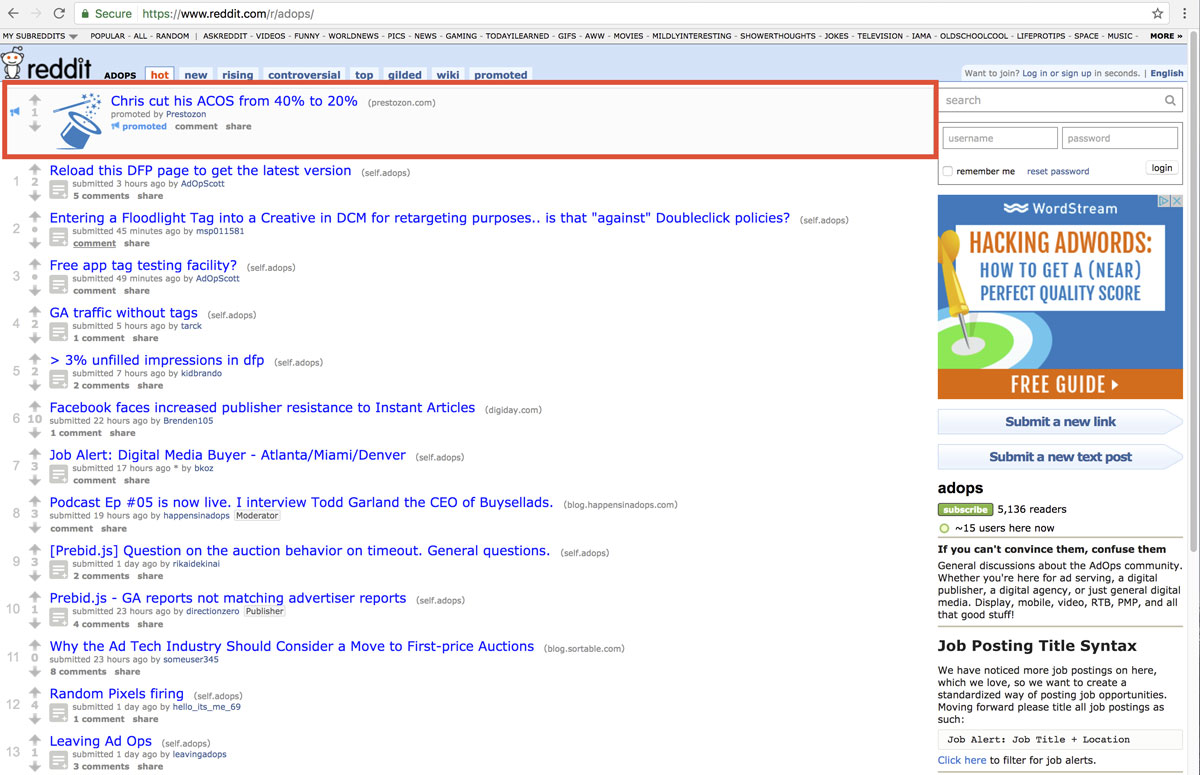
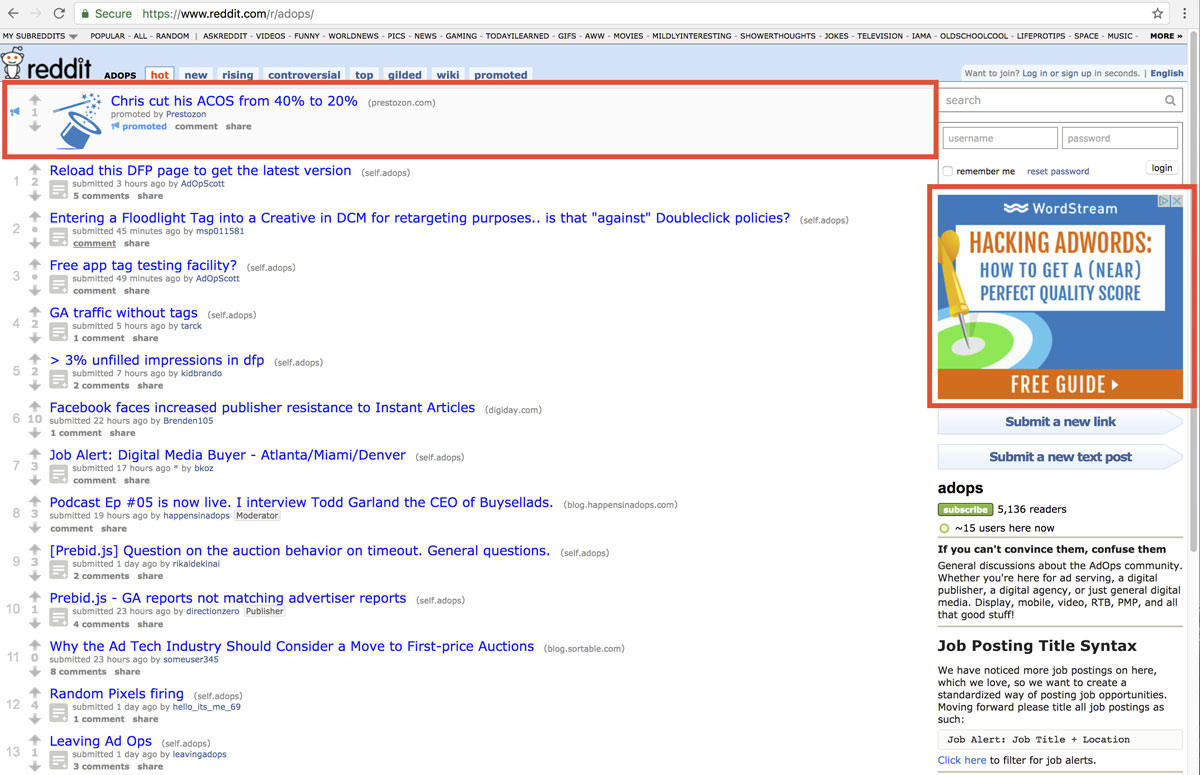
Although I don’t have actual experience with targeted ads on Reddit, I’ve seen them in action and I know they work. Reddit offers advertising options where you can actually advertise in specific subreddits, giving the advertiser an opportunity to target specific users with a super relevant ad. This is great because when a user sees a relevant ad in a relevant place, they are more likely to click through and convert. For example, when I was on the /r/adops/ subreddit earlier today, I found two paid ads that would be very relevant to the /r/adops/ community.

The first is a native looking ad at the top of the subreddit, disguising itself as a normal post:

The second ad, featured on the right side of the webpage is not a native ad. It is still however a high quality ad that is very relevant to just about anyone visiting the /r/adops/ subreddit:

How Much Does It Cost?

In order to advertise on Reddit, advertisers must be willing to spend a minimum of $5 per campaign, and a $0.75 charge per thousand pageviews. Currently, Reddit only offers CPM (cost per thousand impressions) as a cost model, and like Adwords, the CPM price you pay depends on a variety of factors, like targeting, bid, and competing ads. Reddit also allows advertisers to purchase up to 3 months prior to a campaign, so plan ahead!

Organic Marketing

Another form of advertising that I like on Reddit, and one that I have personal experience with, is organic marketing. One tactic that is arguably the easiest is to position yourself as a thought leader within the subreddit you are trying to advertise on. Let’s say that you are working for a landing page optimization company, and come across a user in the ad operations subreddit looking for information on landing page optimization. You could answer the user’s question and also provide a backlink to the company you work for. Doing this (well) would provide you with authority within the subreddit, which will benefit you should you decide to keep posting, and will drive traffic back to the website you have just linked to.

Organic marketing is trickier to pull off successfully than paid advertising, because like most people on social networking websites, people on Reddit hate ads, even more so when the ads are low quality, intrusive, aren’t relevant, or are ads disguised as regular posts. Failing to follow the rules, or “reddiquette”, you may find your content getting downvoted, and you getting banned. Having said that, there are a number of ways to organically market on Reddit without pissing off all of the people who could be potentially clicking on your ad.

Things To Avoid

As I mentioned above, Reddit users hate ads and being deceived into clicking on them. There are some things that every company should avoid doing, whether you’re marketing for Starbucks or a local coffee shop.

The big no-no is posting memes. Just don’t do it. If this is the only take away you have from this article, you’ll have still learned something valuable. It’s a risky move that few brands (if any) have managed to pull off without looking incredibly desperate.

One cringe-worthy example that demands a discussion is when Pilot posted a series of memes to various social networking sites in an effort to try to promote their new line of pens. The memes featured slogans like “The only pen that matters” and “I will not lose any of these” that make you want to put your head in your hands. Once they found their way to Reddit, users weren’t happy, and felt betrayed by the user who originally posted the memes, and maybe even by Reddit as a whole. One user even went on to say “Even if he’s [the poster] not paid by the company or an advertising agency, I don’t really want people who are just fans of some brand making accounts just to post about that product. What would Reddit be then?”

I’ve managed to track down a few of the original memes, and have attached my personal favourites. I truly hope you find them as horrible as I did.

In conclusion, marketing on Reddit is not easy or for the faint at heart. It’s a lively community that offers a huge potential for marketing. If you aren’t afraid of criticism, and are targeting certain niches – there’s really no better place to be. If done correctly, you could be on your way to tapping into a valuable goldmine of targeted traffic directly to your website, while increasing brand awareness at the same time.

Resources

Water drops on a long leaf
Marketing Strategy

The Duplicate Content Penalty

Be warned: if Google finds duplicate content, a spike will come out of the internet and impale your website horribly.

Frightened? Many are. But they shouldn’t be.

Duplicate Content Is Necessary

Let’s consider for a moment that Google, or at least some of the higher ups that hold sway at Google such as this guy, state that every website in the universe has some form of duplicate content on it. Think of press releases, blog quoting, product descriptions between manufacturers and dealers… some duplicate content is just natural. If Google were to drop the hammer on all of this content—i.e. implement a “duplicate content penalty” for any duplicate content it came across—it would make a whole lot of content syndicators really grumpy. Google often doesn’t care about making people grumpy—what it does care about is user experience, because users are the ones who click on ads.

On that note, it’s frustrating for a user to see a bunch of webpages in a search result with exactly the same content. Users like to see diverse angles and opinions on a given topic.

It comes back to user experience. We have to think of why the content is duplicated. Is there a logical and justifiable reason? If so, Google will most likely understand. Google has also given us a number of tools to use to properly outline why the content is duplicated.

The Duplicate Content Penalty

A myth that needs to be cleared up is this: there is no “duplicate content penalty”. Although in extreme situations, websites with a ton of duplicate content (hundreds of pages) have been the victim of a manual action. If Google thinks your site is trying to hone in on ranking by posting myriad pages all about the same topic, with identical content, then the skies may open up and Google will smite thee.

If you have content on your website that is the same as other pages on the same site—a paragraph or two let’s say—then you needn’t worry. As long as there is a clear and logical reason for that content to exist, you’ll be fine.

That being said, Google provides us with the necessary tools to identify and categorize our content so there’s no question about why it exists. I’ve listed some examples of these tools below.

Where Canonicalization Fits In

What the blue hell is “canonicalization”? Well, let’s say you have a product that comes in various colours. Your website may have a different webpage for that product in each colour available, which would make for several pages with the same text (describing the product) with minor differences. To keep this organized, it makes sense to define one solitary page that you wish to show up in a Google search for that product. In this case, it is best to use a practice that no one can pronounce, called “canonicalization”. N.B. I’ve actually heard this term referred to as “chocolization”, and I didn’t have the heart to correct the client.

Canonicalization basically means picking a leader. Consider a clone army. You have a bunch of clones (webpages with the same content, only minor differences, like colour red versus blue) and you only want one to step up to the plate and represent. So, you’d canonicalize all those other peon clones towards the leader. The leader will get all the authority, and she’ll be the one putting herself out there in a search result for the world to see. You’ll need to go through the leader in order to get to all of the other clones. If Google has to choose between too many webpages as the authority, it will just get bored and go acquire another company.

Point being, canonicalization will help define for Google the reason for the duplication. You have a better shot of ranking with the one authoritative leader than with several identical pages all competing for the same keywords.

Canonicalization for Pagination

Let’s say you have an article on your website that spans multiple pages. There’s a tag you can implement to tell Google that you want the first page of the article to rank, not all of the subsequent pages.

The tag is used to signal to Google that there’s a logical sequence to the order of the content.

Users wouldn’t benefit from seeing all the internal pages of an article in a search result; why would you want to start reading an article on page 3? The pagination tag allows you to indicate to Google that you’re aware the article has multiple pages, but you only need page one (the leader) to show up in a search result.

301 Redirects?

We’re not going to get into explaining 301 redirects here, but I mention them simply to point out that canonicalization and redirects are two very different things.

Put simply, you use a redirect if you want to route users and search engines to a new location for the content (a change of address). You use canonicalization when you need all the pages to still be accessible by users. The canonical tag is meant to indicate to search engines that you’re aware the content is very similar across those pages, and you only want the “leader” to show up in a search result.

Key things to remember

We need to keep in mind that canonical tags are a recommendation to Google. Whether Google actually follows this recommendation or not is another story. In other words, I can recommend that a train not hit me if I’m standing in the middle of the tracks, but there’s no guarantee it will listen. In Google’s own words, these tags are used as “hints”, not absolute directives.

Is there a good reason for the duplication? If you’re asking whether something will be perceived as duplicate content, put yourself in the mind of the user. Would someone expect the content to be there? If there’s a good reason for the duplicate content to exist, then we should be in good shape. Where we can apply one of the above tags as a hint to Google, then let’s do that.

There is no duplicate content penalty. Google will not shoot your website in the face if it crawls duplicate content. Will SEO tools pick up on duplicate content as a potential negative ranking signal? Sure. But again, let’s think of why the content is duplicated in the first place. If there’s a perfectly good reason for it to be there, then we should be good.

Unique, original content is always best. There are some cases where you may feel compelled to duplicate content. I’ve seen some clients copy and paste text from a source and use it on their own site. I would not ever recommend you do this. Best case scenario is to write your own version of that content so it’s original. Cite the original source of the content with a genuine link. That’s far more natural than simply copying the content.

Thanks for reading! Let me know if you have any questions.

More quality reading about canonicalization

More about duplicate content:


More about chocolization:

Close up of a microphone with a stage and audience out of focus in the background
Marketing Strategy

How to Become a Key Opinion Leader in the Digital World

A Key Opinion Leader.

“What’s that?” you ask.

“A Key Opinion Leader is a person who successfully combines expertise and passion, both online and off”
– Sean Stephens

A mainstay in the pharmaceutical and life sciences fields, the concept of Key Opinion Leader, or ‘KOL’, has infiltrated digital spaces as an adjunct to the popular, and perhaps cliché, concept of ‘Thought Leader’.

What makes a Key Opinion Leader? In the medical field, a Key Opinion Leader is a person with long-standing respect, who builds their influence and reputation by speaking at conferences, developing new theories, being published and re-quoted in journals, popular press, and by others who possess considerable influence. A KOL is a person who other professionals look to for answers and guidance because they have distinguished themselves by pushing the boundaries of their field.

Pharmaceutical marketing teams look for KOL’s to act as product advocates – someone who will give their ‘stamp of approval’ on the efficacy and effectiveness of the product. As advocates for the drug brand, KOLs are used to generate increased revenue by capitalizing on their popularity.

Within the realm of digital media and marketing, a KOL possesses social, rather than purely academic, influence. This social variant of a KOL is open to regular, everyday people who can become influential to their peers or “following”.

Out of our discussion with two real-life Key Opinion Leaders in the digital world, Treefrog Inc. CEO Sean Stephens, and Perfect Community Manager and local entrepreneur Lucas Chang, we’ve assessed how both content and social media can help launch and support your KOL career.

Get Social

“It’s critical to be involved and accessible.”

Sean Stephens and Lucas Chang both agreed that Key Opinion Leaders don’t necessarily need to be high profile, but they do need to get out there and be social.

If you are interested in becoming a KOL, it is critical that you make yourself accessible to your community, both in person and online. It is also important that you ensure to leave a positive impact on those you encounter, making your followers feel valued, heard, and more informed after speaking to or hearing from you.

To accomplish this, take advantage of various speaking opportunities and attend conferences in your field of expertise. Afterward, make time to shake hands, exchange contact information with those who may present further opportunities to you, and join in for pictures. The more you are seen, the more you will become recognizable and established.

Another key tip is to be engaging and active on various social media platforms. Social media will allow you to access a wider audience, as well as to spread your message instantly. By leveraging social media, your material has greater potential to be shared, liked, and commented on.

You should also consider pitching interview topics with both local and national media, increasing your platform’s visibility. Not only will producing this material build your resume, but it will also provide documented proof of your ability to lead and educate, establishing a more concrete reputation.

Make Strategic Connections

“In order to develop an opinion that isn’t just fluff, you have to surround yourself with people who are also equally engaged in the same material as you.” 

Using the analogy of iron sharpening iron, Sean Stephens stressed the importance of surrounding yourself with people who are passionate about the same material as you; yet don’t necessarily share your same exact opinion. Stephens went on to explain that Key Opinion Leaders gain credibility when they engage with other leaders and not only express their personal opinions, but also actively listen and learn.

Social media can significantly support these types of connections as social websites like Facebook contain customizable group and event pages where meetings can be set up, conferences can be advertised, and discussions can be had.

While Lucas Chang reminded us that there is still a lot of value in face-to-face interaction, social media now plays a huge role in guiding people to an actual in-person meet. Think about it. When you read a book or article that genuinely interests you, you are more likely to reach out to the author, through either social media or email. Once an online relationship is fostered, you are then more apt, (and likely more comfortable) to meet and interact with that person in real life.

Using social media as a tool, there are limited boundaries with whom you can connect with online and in person. Why not give it a try?

Become A Specialized Expert

“A KOL is a person who successfully combines expertise and passion.” 

By attending local events and networking, you can begin to build your personal brand and reputation. However, Sean Stephens reminded us that the social persona of a true Key Opinion Leader is only valuable if based on validated expertise.

KOL’s must responsibly invest in themselves, as well as their area of interest, consistently working to develop their opinion by further investigating the subject. KOL’s can become experts through online research, meeting with others who are interested in their same field, and through receiving accreditation.

Above all, creating quality publishable content will position your brand as reputable. Experts become known when their novels, theories, and opinions are published on websites or in credible magazines, newspapers, and journals. Without a foundation of content, your ‘expertise’ will be seen as just talk.

Be Consistent & Present

“Always go to the things you say you’re going to go to.” 

Sean Stephens expressed that one of the most valuable things a KOL can be is consistent and therefore reliable. He stressed that absence and lateness do not go unnoticed and that being considered inconsistent can ruin a reputation. Stephens also claims that there’s a notable difference between being present and truly having a presence both in person and online.

In a digital era, online presences can either make or break a Key Opinion Leader. When a person chooses to support a social media account by following and engaging with it, that person is essentially saying, “I like what this page has to offer me” and “I’d like to see more”. However, when media platforms are neglected, or if the posts do not reflect the messaging a follower initially followed that page for, that person is likely to un-follow and disengage with the account.

If you commit to having a social media page, be sure that you are able to set ample time aside to support that page, making frequent, appropriate, and applicable updates, which will keep your audience interested.

When strategized correctly, social media can launch your brand towards success, but when not executed well, these failed campaigns can damage your reputation.

Be Passionate

“When you can tell that someone is passionate, whether it be quietly passionate, or overtly passionate, you want to hear more about what they have to say.” 

While anyone can educate themselves on any topic, especially in a digital era, both Sean Stephens and Lucas Chang believe that passion is what sets regular experts and Key Opinion Leaders apart. When a speaker is truly passionate, their level of excitement will naturally transfer to their spectators, leaving a lasting impact.

To build one’s passion into a credible opinion, you must allow yourself to continuously learn and rediscover the meaning behind your passion as it grows. In a technology-obsessed world that is constantly changing, a KOL must be adaptable, finding new ways to keep their message interesting, informative, and up-to-date.

One of the most powerful ways to express passion is through open, genuine, and relatable online posts. Key Opinion Leaders can demonstrate love for their specialty by writing exciting articles about new finds in their field, sharing promotional material for related events on Facebook, posting pictures of themselves in action on Instagram, and more. When audiences physically can see that a Key Opinion Leader is consistently engaging with their area of interest, that person’s passion becomes believable.

Be Practical

“Any person can come up with an idea, but a majority of people never execute those ideas.”

Lucas Chang explained that aspiring KOL’s must pick a specialty that they are naturally passionate about, and then must find a way to make their dream practical. Chang claimed that most people fail in becoming a KOL when they are full of ideas and yet are unable to make their dream a tangible reality.

However, with incredible advances in technology, becoming a Key Opinion Leader has never more achievable. Social media sites are built with the intent to connect people to the things and people they find interesting, expediting one’s ability to gain momentum and success.

In the past, Key Opinion Leaders relied on content alone, to build a reputation of expertise. However, the value of printing words in a book is fading. Content now needs to be supported by the internet, making the sharing of content practical and accessible to more people.

It is then opportune for potential Key Opinion Leaders to leverage social media to support their written work, preventing incredible ideas from just being stored and ignored on a dusty bookshelf. You never know, your message might even go viral.

It is not enough to simply want to become a known expert; you must also be willing to put in the work to make it happen.

Too busy to do it alone?

Through expertise in the development of engaging social media campaigns, as well as content writing, Treefrog Inc. can help establish your Key Opinion Leadership.

By managing your social media profiles, building your website, developing blog topics, and more, the Frogs at Treefrog Inc. can customize your path to success, helping to relay your message to the right audience.

Hand on a laptop keyboard
Marketing Strategy

Search Engine Changes and How They Affect Your Content

Updates in Search Engine Optimization have brought content marketing full circle. Nowadays, Google actively abolishes websites that include keyword stuffing, multiple thin pages, misleading information—in essence, Google is encouraging us to be better writers.

But isn’t this the way it should have always been?

When you are able to develop content that is genuinely useful and interesting to your audience, that same audience is more likely to engage with your material, increasing the success of your website and business. This type of content will then also naturally improve your websites SEO results, as well as improve the quality of your online presence.

Below we explore this, as well as some other major search engine shifts, which directly affect how you should be approaching your website content. Understanding where search engines are headed will not only help to keep your website competitive, but will also ensure your message is reaching the audience it is intended for.

So with that, let’s dive in!

A Mobile-Friendly Shift

Is your website mobile-friendly? You’ve likely already run into this question many times.

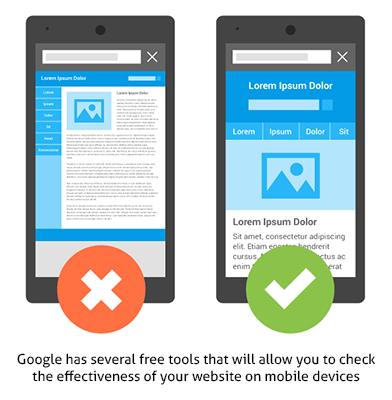
Updating their Search Quality Ratings Guidelines, Google has recently given extra emphasis on the importance of having a mobile-friendly website. As users are more frequently using their mobile phones and tablets (over laptops and desktop screens) to search for information, websites that are not mobile-friendly may fall behind. When people are unable to access, navigate, and read all of the information on your webpage with ease, they are likely to lose interest and abandon the site.

To have a mobile-friendly site means that when a person accesses your web content on their handheld device, they aren’t forced to “pinch and zoom” to get at the content. Google also recommends having a design that is responsive to the size of various screens, which is the preferred route to having a separate site for mobile devices and a separate website for desktop.

Google’s shift to mobile-friendliness affects content by forcing us to think about how someone is consuming content via the medium. After all, mobile devices have smaller reading screens, and people consuming content on mobile are often opting for a quick ‘snack’ rather than a full course meal. While content developers could still write the same detailed content as they always have, mobile users are not likely to keep scrolling and scrolling down, committing to read a long post in its entirety. When most people go looking of for an answer on their phone, they want a quick and tightly packaged response. So – while large-screen webpages have much more physical room for the development of information, writers have had to adjust to the idea of keeping marketable content as concise as possible. Content writers have also been forced to articulate an answer within the first paragraph of content – ensuring a reader receives what they’re looking for before losing interest and leaving the page to look somewhere else.

Long-form content still has a place on mobile, there’s no doubt. If it didn’t, there would not be such wide adoption of e-books on mobile. However, the medium encourages us to focus heavily on our target audience. Are they likely to consume this piece of content on a smartphone? If so, then perhaps we should consider length, the images we opt to use, our desired calls to action, etc. We not only need to think about the reader, but also consider how the reader will best engage with the content we’re putting in front of them.

Link building as PR

It’s no longer common practice, nor is it particularly effective, to purchase or incentivize links that deliver a user to content. Even asking for links is often now considered outdated. It’s far more applicable to acquire links organically; in other words, have people come across or land on your page because they want to, not because you’re asking or positioning them to.

So – how do you receive these organic engagements? Hard work. Link building isn’t what it once was—it’s now essentially a Public Relations strategy. This practice involves reaching out to bloggers and industry publication editors as an expert in a specific field, providing links to applicable sources that may benefit that organization’s developing stories. Positioning your webpage as a reliable resource validates your page as useful, and drives traffic to your site. By acquiring links from media sources naturally—because they were genuinely interested in linking to your article—the next time Google crawls from those outlets to your content, it will give your website that much more credibility, and thus improve SEO.

Engagement VS. Keywords

Traditionally, the importance of populating a webpage with keywords for search engine ranking took precedence over user happiness. SEO departments worked vigorously to compile data concerning which words, when optimized, would lure the most users to a page. SEO would pass this data on to content writers for keyword-focused content to develop.

However, a major shift has occurred. No longer are SEO specialists identifying keywords for the use of content developers – the value of content itself, is now taking priority.

Web developers realized that keywords were getting traffic to a webpage, but that content, which was created only for the purpose of including a keyword, was not providing customer-focused information. Without creating content with user intent in mind, people would stray from these pages quickly – damaging the website’s SEO performance.

Searchers normally have one of three main reasons to conduct a search online: transactional (want to buy), navigational (want to go to), and informational (want to learn). Businesses must now think of content not only in terms of the audience that they’re trying to reach, but also in terms of matching that audiences’ intent. The more you are able to focus your content on what the searcher wants, the more effective you will become at solving both reader and customer problems.

Voice Search Is on the Rise

Siri. Love her or hate her, there’s a lot to be said about what she can do. Siri, Apple’s on-board automated assistant, can help with tasks such as remembering a date, booking an appointment and sending a text message to a friend.

What is of increasing interest is how people are using automated assistants like Siri to search the web. If you ask Siri a question she can’t answer, she’ll take to a search engine (Siri uses Bing)—and that query data gets tracked. Similarly, Google Now will track voice searches from Android device users in the same way as text-based queries are tracked.

The main difference is in the way that people search via voice. They are more inclined to use natural language—including stop words like “and”, “if”, even “please” in their query. This has necessitated a search engine to decipher the true meaning of a query, while sifting through far more specific information. For example, we’re not typing “cheetah running speed”, we’re asking a search engine: “OK Google, how fast can a cheetah actually run, in kilometers per hour?”

These spoken questions are very specific, “long tail” queries. The issue is that they don’t hold enough search volume to gather trend data from. You’d be far more likely to get search query volume for something like “cheetah running speed” rather than the longer variation.

The beauty of the long tail query is that it is so specific that you have a great chance of ranking highly for it. For example, if you were to create a piece of content called “How Fast A Cheetah Can Run In Kilometers per Hour”, and you optimized the heck out of it, your chances of your content ranking when someone searched for that query would be very high.

How does this effect content? Google is pushing a shift for content to adapt to the: who, what, where, why, and how questions that audiences are asking – providing more user-friendly and immediate answers. This then challenges content writers to use alternative methods of communicating information, such as blogging, as a way to specifically target searcher intent – developing content based on common user interests and concerns.

Source: http://www.huffingtonpost.com/michael-peggs/how-voice-search-is-changing-seo_b_8926708.html

Search Ads Disguised

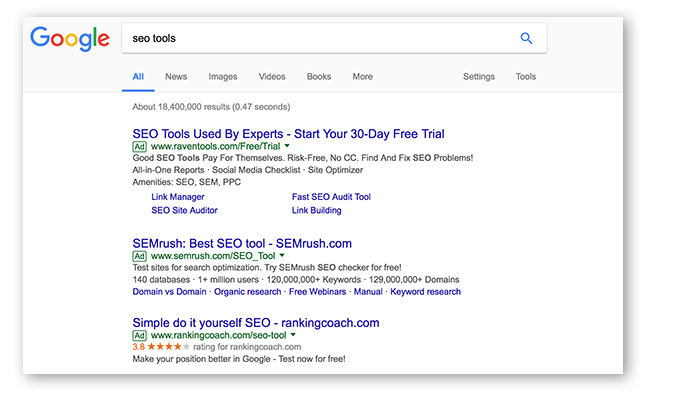
You may not have noticed, but Google has been transforming their small search result “Ad” indicator.

Over the course of AdWords history, Google got rid of the yellow backdrop (sometimes called the sandbox), introduced the small “Ad” icon, changed the icon from yellow to green, and most recently changed the icon again to be an outline; arguably even more indiscernible.

While these new design shifts may seem small, the change holds great significance. Basically, Google is trying to blur the lines between what is a paid and what is an organic search result.

It would seem that Google has done this to intentionally blend and disguise paid ad results with organically listed results, making the difference between the two less obvious. This is likely to increase visits to paid-for ad sites, as many users previously became accustomed to skipping past advertisements – noting the yellow indicator and moving to the organic green results instead.

It is then more important than ever to have engaging content on your web pages, increasing the flow of natural traffic to your site, as well as positioning your brand in a competitive place on Google’s result list.

With great content, organic users will spend more time on your site, increasing your popularity. It is also becoming critical to invest in SEO research, understanding how to make your website competitive with other paid-for advertisements.

As Google continues to improve its algorithms, it is important to keep your website’s content up to date and on trend. More than ever before, businesses must work to understand their customer demographics through detailed analysis, to get a clearer sense of what these users might be searching for. Our web content needs to be informative, helpful, and engaging for our audience, otherwise people just won’t bother reading it.

While it may seem hard to keep up, the team at Treefrog is passionate about keeping on top of industry shifts. Should you need us to help navigate your business through these changes, we’d be happy to help.

A woman's hand write on a notepad on a table
Marketing Strategy

What Is Your Strategic Marketing Plan?

Knowing which direction to take your business and how to get there requires a comprehensive and actionable marketing plan

Digital marketing trends come and go as each year passes. Being aware of them and planning to take advantage of them to give your business’s revenue a lift is useful, but concerning your strategic marketing plan, you need to take a broader view and consider both short- and long-term goals and methods.

Your marketing plan is a detailed roadmap your company will travel throughout the year. It should encompass everything including who your customers are, what your content marketing strategy is, the marketing and promotions budget you will adhere to, the campaigns and tactics you will deploy and more.

Seven Essential Steps to Strategic Marketing Planning

Every business is idiosyncratic and requires a clear marketing plan pertinent to its overall revenue goals and aims. Although there is no universal strategy your organization can adopt and follow, there are a series of established and sensible steps you can take to create an annual marketing plan that will suit your needs:

  1. Establish a Practical Promotional and Marketing Budget. Your budget will dictate what you will be able to achieve monthly, quarterly, and annually. Promoting and marketing events, products and services, and your company’s philosophy on doing business costs money. If your company’s marketing budget is modest, you will need to be creative, and allocate funds to the most important initiatives you will plan throughout the year.
  2. Revisit and Refresh Your Customer Personas. Customer or buyer personas are representations of your different customer segments, both real and desired. To get an accurate picture of who your customers are, you will need data derived from existing customer surveys and interviews, as well as other sources such as Google Analytics or Facebook Insights. Broadly defining your ideal customer personas will help your team understand who your customers are, what their needs are, and how your company can help them.
  3. Understand What Your Differentiators Are. What does your business do differently than all of your competitors? What is your unique selling proposition? What are your core values and your company’s key messages? Knowing what’s distinct about your company, its products and services, how they apply to your targeted customer persona segments as well as the messaging you will use for various media types will help you prepare a well-rounded content campaign or editorial calendar.
  4. Detail What Your Marketing Goals Are. What do you hope to achieve in the new year? Determining what your marketing goals are should go hand-in-hand with what your business’s overall goals are. Is that an increase in sales per quarter? Be realistic and ensure your goals are precise and well understood by everyone on your team.
  5. Evaluate Your Website and Marketing Collateral. Does your corporate website look outdated? Is it awkward to navigate? And is it a responsive website? What about all of your digital and printed marketing collateral? Make it an annual exercise to reassess all of your marketing channels and properties and ensure they are targeting the right audiences, and parlaying the right messages.
  6. Review Your Sales Strategy. Do you have a comprehensive and flexible sales strategy with achievable sales targets quarter-over-quarter? Or are you flying by the seat of your pants and making it up as you go? Although it is an important part of a holistic marketing strategy, your sales strategy should focus on increasing sales and meeting your quarterly revenue targets. It should include details about the customer’s journey both pre- and post-sale.
  7. Define Metrics to Measure Performance. You can’t determine success or failure or shift gears if need be without data that validates what worked and what didn’t. Once you’ve identified the key performance metrics you want to track, and the tools and methodologies you’ll use to measure your success, host regular meetings with your sales and marketing teams to decide if any changes are required and how to go about them.

Once you’ve reviewed how your company performed the previous year, and upon completing these steps above, you should be ready to craft a practical marketing strategy for the new year that will help your company meet its objectives.

Does your business need help defining its marketing plans and achieving the goals you want? Let us help. For more than 20 years we’ve been helping businesses of all sizes and in various industries grow their online presences and revenues.

Dew on spider silk
Marketing Strategy

What is Search Engine Optimization (SEO)?

101 Information

Search Engine Optimization (SEO) is essential for having a prominent web presence and attracting more visitors to your website. People primarily use search engines to find what they need on the web, including your products and services. You need to be visible on search result pages in order to be found by prospective clients.

SEO is about maximizing the quality of your web pages on multiple levels so that they can be properly indexed by search engines. Search engines have a variety of criteria they look for in a website. Google’s search ranking algorithm changes over 500 times a year, to give you an indication of its complexity.

Ultimately, search engines are looking for the best answer to a searcher’s question. If your site provides the best answer, and it is also technically sound, and if several other websites are linking to it as an authority on a given subject, your changes of ranking will be higher than a site that has none of these things going for it.

The SEO Process

There’s no way to summarize all the intricacies of SEO in a single post. That would be like fitting War and Peace onto one piece of foolscap. The following general tips can help you to attain higher organic search engine raking and maximize traffic to your website.

Determine the best keywords to win relevant traffic. Keywords are the words and phrases that people use to search for information, so you want to select terms that are specific to your business, and write content to reflect those terms so that people can find your pages.

Create original, quality, useful content for all web pages. Use your keywords naturally and with an appropriate density (i.e. use them in a meaningful way; search engines don’t like overstuffed keywords). Including keywords in page titles can also be advantageous to your ranking. If your content is good enough, then other sites may even link to it, and these backlinks can be beneficial to search engine ranking.

Continuously add new and fresh content. Encourage visitors to come back again and again by giving them something new to read. Post multiple articles offering information about your products in a way that informs and educates. This content increases your site’s depth and expands potential visibility of your primary keywords.

Don’t forget the Metadata. Create unique, informative Meta Tags and Meta Descriptions for each page, so that you entice searchers to click on your page from search results.

Create on-site links. Make sure you have sufficient links from your content text to relevant pages throughout your website. This helps users find pages they may not have seen otherwise, and it helps crawlers identify authoritative pages on your site that are linked to often.

Navigation matters! Have a solid architecture to facilitate easy understanding and navigation, so that visitors and search engines can easily move around your site and find what they are looking for with as few clicks as possible. Adding a site map to your website is also recommended.

You should also submit the site map for your content-rich site to search engines or directories to make them aware of your site.

Professional search engine optimization (SEO) strategists use various tools to monitor ranking performance. As the search engines keep changing their search algorithms, SEO strategists have to be on their toes all the time, constantly monitoring the keywords and reworking the information, analyzing your website to keep it competitive in ranking results.

Among all other forms of marketing, search engine optimization (SEO) is integral in getting traffic to your website. Combining SEO engineering and quality content is the best path to ranking success.

Abstract close up of a plant
Marketing Strategy

Why Are SEO Discovery and Audit Services Important?

Effective SEO isn’t solely about how your website ranks in an organic Google search

Search engine optimization (SEO) is vital to your company’s online presence. The purpose of SEO is to obtain high visibility for your website on Google, Bing, Yahoo! and elsewhere by ensuring it ranks on the first page of the organic searches people perform. In other words, SEO makes it easy for your customers to find you online.

An oft-misunderstood online marketing tactic, SEO is an increasingly vast and complex methodology, and it’s one of many crucial elements comprising a holistic digital marketing strategy. Search engines rank websites based on multiple factors; no one digital marketing method alone will rocket your website to the top of Google’s list and keep it there indefinitely, and that includes SEO.

The effectiveness of SEO is reliant on many other components and services including:

Done well, SEO can improve your search engine rankings, thereby increasing your website’s organic traffic, and in turn, helping you score new customers, earn more revenue, and realize a high return on your SEO investment. But understand SEO isn’t only about your site’s ranking. One of your webpages may be ranking well for a keyword you’ve identified as relevant to your business, but if visitors to that webpage aren’t finding what they need quickly upon arrival, they’ll “bounce” or go elsewhere. Thus, user engagement is a major factor in Google’s determination of the value of any website. If large volumes of visitors are leaving your website rapidly, it will hurt your overall SEO ranking in the long run.

Research from multiple sources has quantified the value SEO provides for companies in both business-to-business (B2B) and business-to-consumer (B2C) industry verticals. For instance, when conducting online procurement research an estimated 89% of B2B professionals start with a generic search. From a B2C perspective, about 72% of consumers who perform an organic search for a specific product or service visited a store or business within 8 kilometres of their location, and four out of five consumers use a search engine to find businesses in their vicinity.

However, like all things within the realm of business, there is no magic wand to wave that will produce instantaneous results. SEO involves research and analysis. Among the first steps to improving your site’s SEO ranking requires what’s known as an SEO discovery and audit session. It helps to determine which of your webpages are ranking as per targeted keywords, which ones aren’t, and what needs to be done to improve overall performance.

“Discovery consists of looking at the same thing as everyone else and thinking something different.”
– ALBERT SZENT-GYÖRGYI DE NAGYRÁPOLT

Learning about Your Business and Customers

Before an in-depth site audit is performed to gauge the health of your website’s current SEO ranking and how it can be improved, a pre-audit discovery session is required. An integral part of an effective SEO strategy, the purpose of a discovery session is straightforward: it sets the stage for an organized, useful, and strategic audit.

There are five things an SEO discovery session should include:

  • A comprehensive client interview. We need to learn about your business and industry and your products and services. We need to know who your existing, and prospective customers are, the lexicon you and they use, how and where they connect with you online, and what’s driving online conversions or sales today.
  • Determining what your goals are. A goal without a plan is but a wish. Setting realistic, executable goals serves two important functions: it clarifies what it is you want to achieve with your website, and how compiled data should be measured.
  • Access to real-time analytics. Assuming your company uses Google Analytics to track how online traffic arrives at your site, how long visitors dwell on your webpages, and whether they buy or bounce. The more historical data you can provide, the better it is during the audit phase and for plotting your future. If your business uses or has used Google AdWords, the data it can provide helps paint a more complete picture of your website’s performance to date.
  • What keywords you think are best and why. Forget about your current SEO ranking for the time being. In the discovery session, we need to have a clear understanding of the keywords you think are relevant to your business, and why you think your customers would use those keywords to search for your products and services.
  • The quality of your site’s current content. How often do you refresh your website’s content? What is the quality of the content on your site? Your content needs to be well-written, impactful, and it should accurately and succinctly articulate what benefits your business and products provide. If it’s rife with spelling errors, poor grammar, and rambling, incoherent jargon, it will severely diminish your SEO ranking.

Auditing Your Website

With the discovery session complete, we conduct a thorough SEO audit of all of your web properties, and subsequently, provide you with the details of that review and our strategic recommendations that are tailored to your company’s needs.

Our SEO audits and assessments typically include:

  • Competitive intelligence on your competitors
  • Keyword analysis and recommended targeted keywords
  • Reconfiguring your Google Analytics and AdWords to reap more insightful data
  • Local search optimization for Google My Business and other directories
  • Gauging your site’s mobile responsiveness and how mobile search impacts your SEO
  • The usefulness of your inbound links versus your competitors’
  • Recommendations about your site as a whole to improve engagement and increase visitor conversions

An in-depth SEO audit and discovery session takes the guesswork out of what resonates with your existing and potential customers, and it helps to determine a path forward based on data and your business’s strategic goals. It also lays the foundation for building your ongoing marketing plan to ensure you’ve got inspiring and effective content and messaging, a high-quality, responsive web presence, and above all, a compelling reason for the world to land on your pages first and foremost.

Do you have questions about SEO and its effectiveness in conjunction with other digital marketing methodologies? Talk to us. Whether your company is big or small, a startup or a recognized brand, we have the expertise and the experience to optimize your site and boost your website traffic.

Scroll to Top