Social Media

Wet round rocks covered by mist
Digital Marketing

Dispelling the myth of the magic social media button

“I made a post on Facebook. Why don’t I have 1000 Likes?”

Have you ever walked into a room full of people and whispered your name, hoping for everyone to turn and flock to you? It seems that many business owners believe that, because their business is unique, it will auto-magically stand out in the crowded sea of social media ships. The timeline goes as such: they register their social media profiles, make a few posts, and sit back and wonder why no one is following, liking or otherwise engaging with them.

3 Key Misconceptions

There are three key misconceptions many businesses are making when they realize they should be leveraging social media to grow their business.

We’ll call the first misconception the “illusion of presence”.

There is a widely held misconception that being present on social media is enough. As this misconception goes, the assumption is that businesses get points just for showing up (on social media). Not to be platitudinous, but being successful as a business takes commitment and hard work; social media, like any digital marketing, also takes planning, creativity, and dedication. Showing up is not good enough.

The second misconception is that businesses often feel that when they do start to build an audience, they should talk only about themselves and how great they are.

Have you ever known someone like that? At first it’s fine, but after a while it becomes intolerable and alienating when they appear uninterested in what you like, want, feel, or care about. On social media, this manifests as businesses posting only about what they are doing, selling, or interested in without the understanding that social media, like walking into a crowed room, requires that they engage, talk, query, and generally appear interested in others. This two-way communication is the distinction between being social, rather than doing social (media).

The third misconception is the most pernicious. Some people believe that social media influencers are quietly guarding the secret social media button that once pushed causes likes and followers to fall from the sky. For most industries, the social media landscape is crowded. You are not a unique snowflake, until you can provide value to your audience. Moreover, and more importantly, these platforms (Facebook, Twitter, LinkedIn, Instagram) are advertising platforms. They are a means to reach greater numbers of people in a more cost effective manner than traditional advertising. Just because it is free to create an account does not mean it’s not pay-to-play for (most) businesses.

There is no magic button, no single recipe that defines success; there is no mysterious formula that social media influencers have cooked up and are unwilling to share. Doesn’t exist. Research, dedication, monitoring, planning, and experimentation are the answer.

These misconceptions are the albatross hanging around the neck of your social media success. But, you ask, how can I be successful on social?

Top three recommendations


1. Provide value

Give your audience something engaging, interesting, and relevant to them. How can you tell which types of content resonate with your audience? Check out your analytics and monitor the engagement (Likes, Comments, Shares) on your content to discern potential new content development opportunities.

2. Distinguish yourself from your competitors

Try video, be creative, and experiment. Have you ever tried Instagram Memories or Facebook Live? If not, maybe you should. They are a great way to generate live content and provide a look “behind-the-scenes”. If you are not sure what Memories or Facebook Live are or how to use them, we can help.

3. Increase your reach and presence using ads

Using Facebook, Instagram, or Twitter ads can accelerate your profile growth and visibility. They can draw users back to your website or lead them to your profile. They are highly customizable, trackable, and editable, on-the-fly.

Want to learn more about how social media can help your business grow? Let’s chat!

Close up of a hand holding a mobile phone
Digital Marketing

Fall in love with the Rule of Thirds

Social Media

As part of the social media team here at Treefrog, conducting social media analyses when receiving a new client has become second nature to me. What’s a social media analysis, you ask? Well, truth be told, you’ve probably conducted a few yourself. That time you found the Instagram account of that cute Starbucks barista and spent a few more minutes than you’d like to admit scrolling down their feed, creeping their photos, and praying to the thumb gods for no accidental double-tap…you were kind-of conducting a social media analysis.

Social media competitive analyses are a great way to get information. Questions like, “What is this brand’s personality?”, “Who is their target audience?”, and “Is cute Barista Alex single?” can be answered through each post, each photo, and each comment.

After having done a number of these analyses, something very disturbing has become clear to me: many companies seem to think it’s okay to talk only about themselves on social. Post after post it’s “Hey, check out OUR website!”, or, “This is what WE sell! Buy it now!”, or, “Here’s OUR phone number to learn more about US!”

To put this into perspective, imagine stumbling on Cute Barista Alex’s Facebook page and finding the only thing Alex shares are selfies and statuses about what he’s currently doing. In your eyes, Alex might start looking a little self-absorbed and a lot less cute. In contrast, imagine finding Alex’s Facebook page and seeing he’s shared information about upcoming local volunteer opportunities, posted links for “Study Time” playlists for fellow students during exam week, and has commented on every “Happy Birthday!” post he received to say thank you and wish each person well. Suddenly your interest is further peaked; he’s into music, he’s involved in a  great community, he has plenty of meaningful relationships in his life…and you already know your wedding photos are going to be SO Pinterest-worthy. Companies need to be the Alex we want to marry! They need to show us they care about more than just themselves. So if you’re a brand reading this and wondering how you can make sure your audience falls in love with you, this is what we tell all our clients during social media training: Follow the Rule of Thirds.

The Rule of Thirds states that the content you share on your company’s social channels should be evenly divided as such: 1/3 of it should be promotional, 1/3 should be valuable, and 1/3 should be engaging.

Promotional

This is the one that most companies already have a firm grasp on. This is the content that overtly pushes your goal, such as selling your newest product, or getting people to attend your upcoming event. This content is important because, first and foremost, you are a business and conversions are what keep you up and running. Sharing links to your website’s products and services page or e-flyers for in-store promotion helps your audience find out vital information they need to make a transaction (e.g. Where? How?).

Something to keep in mind is that this content, if done excessively, can come off as too pushy, too self-motivating, and too corporate (something consumers are turning their noses up at nowadays).

Valuable

This content will help balance out your promotional content and ensure your company doesn’t look too “Me, me, me!” That’s because this content revolves around your viewer and what’s important and meaningful to them, whether it’s a news article that they might be interested in, or links to exciting events in their city. A clever way to still tie this kind of content to your brand so it doesn’t seem random and out-of-place is to think about themes around your brand and share content with similar themes. For example, an auto shop in a suburban area populated with new families could share a magazine article about road trip tips for parents with young children.

Engaging

This content will also help to make sure your feed doesn’t come off as too promotional. Similar to valuable content, engaging content takes a step back from “Me, me, me!” and instead says, “We”. Through this type of content, you create an opportunity for two-way interaction between your viewer and your brand. A fashion brand might tweet, “Seems like suede pants are making a comeback. Is this a fashion YAY or NAY to you?”, inviting their followers to tweet back at them and participate in discussion on the topic. It’s a great way to show your audience that you care about what they have to say, solidify meaningful relationships, and gain loyal fans.

So, next time you’re trying to decide what to post on your company’s social media page, scroll down and see what type of content you could use some more of. Use the Rule of Thirds to even things out and make your audience swoon…we hear the cash registers dinging and the wedding bells ringing already.

Want to learn more? We’d love to chat!

Man holding a computer tablet. There is a coffee mug in the foreground.
Digital Marketing

To Be or Not to Be – Social!

Content is arguably one of the most valuable marketing tools for any company. When you produce relevant and shareable content, you engage readers, build trust for our brand, products, and services while informing and inspiring people to new ways of thinking.

Investing in content marketing creates an opportunity to directly and articulately connect with customers and show them why they should choose to work with you over your competitors.

Once you’ve created that content, you need to get it out into the world. That’s where social media comes into play.

Sure, your product or mission may be cool and trendy, innovative and progressive, but what do you have to say as a company or organization? Why should people “like” your Facebook page or follow you on Instagram and Twitter? What makes engaging with your online presence worth their time?

Why Great Social Content Matters

1. Establishing Target Markets Drives Profitability

A good social marketing team will work with you to pinpoint your target market. When it comes to content, it is important to understand the difference between, “who would be interested in this?” and “who do I want to be interested in this?”. When your desired market doesn’t match with the content you are creating, innovation is key.

With an ever-changing marketing landscape, companies must actively look for new ways to reach their demographic. Establishing a true target market, along with collecting data on what those potential clients are drawn to drive profitability and ensures your content is reaching the people who are most likely to use your service or product and creating a connection with them.

2. A Concise Message Is A Message Well Received

Imagine you enter an elevator with the CEO of a potential investor in your start-up business. This is your shot! You’ve got two minutes to explain why your product or business is valuable and worth their interest. What do you say?

This exercise is understandably difficult. It is not an easy task to rein in all of your many creative ideas into one neat package.  However, in the realm of social media, this practice is important. When creating a company biography for Facebook, or writing an “About Us” section on your website, your message needs to be clear and accurate. When these sections are too long, or too vague, people get bored and stop reading! This practice is especially important for use on social media sites like Twitter – where your post-able word count is limited.

Filling your Tweets and Facebook ads with either unimportant or data-intense information can make customers hesitant and less likely to engage. Articulating a healthy balance of informative and interesting content is no easy task, but it is key to your social media success.

3. When Your Clients Feel Important, They Return

Do your content ideas consider the perceptions of your customers? As an owner or manager it can become difficult to detach yourself, seeing your product or business from the outside looking in. It is important to seek a new set of eyes, playing devil’s advocate with any points of disconnect between your company’s mission and what is really being conveyed to potential customers.

It is also important to consider how you can become not only a product provider, but a “friend” to your users. People are more likely to use a product or consult with a company (and people) that makes them feel happy, valued, and secure.

A great way to do this through retweeting or replying to user questions and concerns on your social media pages. Instead of just stating dry information, ask them questions, add some personality to your messages, and show your appreciation for their business. Clients are more likely to engage and be returning customers if they feel important and recognized.

“People want to do business with you because you help them get what they want. They don’t do business with you to help you get what you want.”
– DON CROWTHER (@DON_CROWTHER)

4. Keywords Make A Difference.

Social content cannot rely on creative ideas alone. It is necessary to also compile search engine research data – identifying rich and attractive keywords that will set your business’ content above the rest.

For example, popular hashtags help to link your specific postings to all other posts made under that same hashtag umbrella. If someone is looking for #GreenSocks and you happen to be a company that specifically sells #GreenSocks, you can locate this customer and reach out to them.

Identifying these keywords is essential to your success as they help to increase your online presence, allow users to more effortlessly locate you through search engines like Google, and it helps your customers to see the true value you bring to their specific needs!

5. Advertising Is Changing. It’s Time To Adapt.

Every day we are bombarded by billboards, commercials, and print advertising messages. Due to this over-sell, these types of advertising methods have become less and less effective. This is because customers have become bitter and annoyed by the repetition, and have therefore found ways to avoid them (such as recording their favourite show and fast forwarding over the commercials or by using ad blockers). It is then necessary that companies work towards developing new and intriguing ways to reach customers without unsettling or bothering them, and instead interacting and connecting with them.

One of the ways companies can draw business, without a forward in-your-face sell, is through (you guessed it) – social content marketing! People are more likely to read and share a blog article that they find value in and believe others will as well.

For example: Instead of reading why she should buy shampoo from XYZ company, Sally is more interested to read about,  “The 7 Benefits of Shampoos that contain Coconut Oil” – something that XYZ company specifically includes in their product! Then, when XYZ company shares this blog article, customers read about the benefits of this same shampoo, without feeling like they’re reading a direct advertisement.

“Think like a publisher, not a marketer.”
David Meerman Scott (@dmscott)

6. Consistency & Tone Create A Lasting Effect

Setting the tone for your social media plan is critical. If your brand is funky and hipster, then the lingo you use in your online posts need to mesh with this pre-established foundation. However, if your company is of a more serious or traditional nature, don’t be timid about fostering new ideas that will change up those potentially “dry” stereotypes people may have about you. Yes, your website may be full of important data and statistics, but your social media accounts allow for you to communicate important things with a bit more flare and edge – that’s what they’re there for.

Let’s dive deeper. Static website content is not always great social media content because readers often look past it as “boring”. This is because website and social content often speak to different audiences and have different goals – information vs. engagement. Social media is built to encourage and sustain interaction (and get new leads!), so be mindful of how these helpful tools need to be approached in different ways.

What exactly makes social media content different, you ask? Its tone is consistently creative, often fun, “digestible” (straightforward and not jargon-heavy), and can include an image, infographic, video, or other media component. This type of engaging and creative work takes time, but this is time very well spent. When people see this type of interesting content being produced regularly, they are more likely to engage with the posts and return to see more because they enjoy keeping up to date with a brand that speaks to them.

7. Monitoring Results Increases Customer Satisfaction.

So, here’s where things get tricky. More important than having people engage with your social media accounts, you need to drive referral traffic back to your website – the centre of your digital presence.

Through website analytics you will be able to track how many new people have found your website, as well as how long they have stayed on the page, reading more detailed content and navigating the site to additional pages. Effective social media convinces the engager that you are a company worthy of their time and money and helps to lead them to your website in order to learn more.

“If you make customers unhappy in the physical world, they might each tell 6 friends. If you make customers unhappy on the Internet, they can each tell 6,000 friends.”
– JEFF BEZOS

It is important to monitor your social media engagement results, both the good and the bad. When your company receives a great review on social media, this information can be shared and celebrated across your different sites. When your company receives a bad review, social media gives you a voice to be able to communicate with the unhappy customer and to try to repair the relationship. Opening the dialogue and ensuring that a customers care is of the utmost importance shows great initiative and ownership to other potential clients. This response also tells the client that their opinion matters and that issue will be rectified in some way.

Engaging content is the foundation of any social media engagement strategy. “This is all great knowledge”, you say. “But I don’t have time to write it and I don’t know where to start!”. That’s where we come in. We can help source, write, and curate your content for social media sharing. If you are in need of new content for your websites and social media platforms, contact us today.

“Content is fire, social media is gasoline”
– Ryan Kahn

A hand touches an illustration of a computer tablet, making lots of icons fly out
Digital Marketing

Online Advertising: How to Use PPC and Social PPC

Raising awareness, increasing conversions, and growing revenues – it’s your strategic goals that determine how and what digital advertising avenues you should travel along

Using pay-per-click (PPC) ads and social media advertising – aka social PPC – to raise your company’s profile and increase revenues can be highly effective strategies. However, knowing which is best for your campaign hinges on what your goals are, who you’re trying to reach, and what actions you want your targeted audience to take by interacting with your campaign.

Although PPC and social PPC advertising can be complementary, they each serve unique purposes. Think of PPC advertising this way: it’s a strategy to deploy to target a particular search term or woo people who are in the Zero Moment of Truth (the way consumers search for information online and ultimately make purchasing decisions on the spur of the moment).

Highly customizable, PPC ads can target Google’s search network, its Display Network, or both. What’s the difference? PPC ads used on Google search are fine-tuned to appear in results from searches users conduct that are tied to a topic or specific keywords. PPC ads placed on Google’s Display Network use text, images, and video and are more likely to appear alongside blogs, news articles, and websites. Each can drive conversion rates.

This short video will help you understand the differences between various Google AdWords campaigns:

PPC ads on Google search can entice someone to click-thru because they may answer the searcher’s query. Display campaigns, meanwhile, can drive conversions provided the messaging and incentives associated with the campaign are attractive to the intended audience.

Advertising on Social Networks

Social PPC is a newer advertising vertical that businesses are increasingly using to promote themselves on social media. And now, social PPC ads created on Facebook’s platform are not confined to the social network—they also appear on websites and apps. Other social channels such as Twitter, Pinterest, and Instagram are also innovating to provide a more targeted experience.

Social PPC ads are effective at generating awareness by reaching large amounts of people in their leisure time – social media is still widely considered to be a recreational activity. But be advised: social PPC ads, like Google PPC ads, are not the “set and forget” variety. They require ongoing analysis and, sometimes, optimization to achieve your aims. Furthermore, social PPC ads do not necessarily require a landing page. Instead, they can link directly to a website or a mobile app. It depends on what your goals are.

Complementary but Different Strategies

Different types of advertising campaigns call for different tactics and channels. Here are four important points to consider when devising your digital advertising campaign:

  • Think mobile. Whatever type of ad you run, and the landing page or website it links to needs to be optimized for a slick experience on a smartphone or any other mobile device. Why? Because more people conduct searches on mobile devices than they do on desktop computers or laptops.
  • Choose the right keywords. For PPC ads earmarked for search results, relevance matters. Be careful you’re selecting the right targeted keywords, and that your ad’s content and the landing page content are unified in their messages. Be honest and transparent. Done well, your ad’s visibility will rise, and the cost-per-click will decrease.
  • Be socially active. To help ensure your social PPC ad campaign is successful, have active and fully completed profiles on the social networks where you intend to deploy the ad. On that note, as Facebook is the most popular social platform, you may wish to advertise using Facebook Ads. Facebook provides lots of options for how ads are created. They can be designed using images, videos, carousels of images, or be immersive using Facebook Canvas. Facebook also offers complimentary stock images for ads.
  • Use video. With each passing year, the importance of using video for digital marketing and advertising grows exponentially. An estimated 51.9% of marketers believe video provides the best ROI. More importantly, in the second half of 2015 mobile devices drove video ad impressions up to 49% from 38% in the first half of the year.

Using Google or social PPC ads or both are worthwhile to amplify your brand’s message, raise awareness of a cause, or promote a product or service as part of your overall marketing strategy. As a general rule for all types of digital content, ensure your message is informative, concise, readable, and interesting. Monitor the results, and be prepared to make changes on-the-fly to ensure you’re reaching your target audience.

Get the best possible ROI you can with your digital advertising campaigns. Talk to us about how our savvy team of marketers can create, manage, and monitor your PPC advertising campaigns.

Man with his arms up, stand on a cliff
Digital Marketing

Social Media Audit: Gain the Competitive Edge You Need

Using social media in a way that resonates with your audience, builds trust, improves engagement, and drives sales begin with accurate insight

Twitter me this: What do most companies wrestle with when it comes to using social media tools? If you guessed “ROI” (return-on-investment), you earned a red heart (on Twitter, you can “like” a tweet by tapping the red heart icon).

While it’s important to sort out what type of social content you should produce to generate sales or accomplish other strategic goals, there’s an even greater uphill climb for businesses using social media to conquer: defining a holistic digital marketing strategy.

Furthermore, and as noted by the Harvard Business Review, research shows consumers’ so-called “electronic word-of-mouth” referrals or remarks on social networks about businesses and their services can significantly affect a company’s perceived value.

What Is a Social Media Audit?

Whether it’s determining your company’s ROI using social media, figuring out an end-to-end digital marketing strategy, both, or striving to reach other corporate goals, a social media audit is a research-based way to ascertain whether you’re achieving results using the social tools you are, and where you may be falling short.

It can also provide insight into which social channels you need to be on, and which ones to switch off if they’re not producing any tangible results. For example, does your company need to spend time using Snapchat or Pinterest? Are your customers or the bulk of your targeted audience using those platforms? An audit can help you find out.

It can also show you what posts or content you shared resonated the most with your customers, or that generated the greatest amount of engagement.

“To ask, ‘what is the ROI of social media?’ makes as much sense as asking, ‘what’s the ROI of the telephone?”
– SAMUEL SCOTT

Why Vetting Your Social Presence Is Paramount

Some of the primary benefits an audit of your social network presence includes:

  • Competitive intelligence.

    Get the lay of your competitive landscape by analyzing what your primary and secondary competitors are doing on social networks. Take note of both the good and bad because it can help you and your team be more effective with your efforts.
  • Audience analysis. 

    Who is your audience and what social networks are they on? Do you have any social influencers or people who engage with you frequently? And what are your primary objectives for using social networks? A social media audit won’t definitively answer all of these questions – that’s where a social strategy comes in – but it will help you compile the information you need to get there.
  • It’s the foundation for your social marketing strategy.

    To accomplish corporate goals using social media, you must have a thoughtful plan. To establish an in-depth and forward-looking social media marketing plan, you need to review how and what results you’ve achieved to date.
  • It’s integral to measuring your digital marketing performance.

    You need to know where your company is in the social media sphere. An audit can help you shift from a broadcasting mentality to one of engagement. That’s the genesis for building trust with your customers and followers: being helpful and creating value.

Are you ready to aim a magnifying glass on your social media performance? Get in touch. A social media audit can help you identify the strengths, weaknesses, opportunities, and threats you need to understand in order to develop an impactful social marketing strategy.

Close up of hands holding a mobile phone
Digital Marketing

Social Media Management is About Being Helpful and Creating Value

Your company’s social strategy needs to be about more than simply chasing click-thrus or likes and growing follower counts

Engaging with existing and prospective customers on social networks effectively, growing those audiences, and racking up followers and ‘likes’ or stars is a matter of providing audiences with useful and engaging content. But the number of followers you have, and the amount of likes and stars you accumulate shouldn’t be your primary goal. Far from it.

Pardon the buzzword, but on social channels, engaging effectively with people requires producing what’s known as “snackable content” (short-form content that is easily and quickly consumed whether on a mobile device or otherwise; like a tweet, short video, or an infographic). At other times, and depending on the subject and social platform, it also means consistently producing long-form and long-tail content of high quality that is either educational, informative, or which provides value to your intended audience in some way. After all, as business strategist and author Dion Hinchcliffe once wrote, “we need to understand that digital engagement is a moving target.” Indeed.

Recognizing and understanding that necessity is crucial to evolving your company into what’s known as a “next-generation enterprise.” Certainly, the ongoing development of various technologies – social tools, analytics, big data, the mobile web, the Internet of Things – and their convergence with digital marketing, as well as the personalization of content, is the key to cultivating and unleashing your business’s digital DNA.

“Your audience is one single reader. I have found that sometimes it helps to pick out one person – a real person you know, or an imagined person – and write to that one.”
– JOHN STEINBECK

Making the Social Transformation

It’s worthwhile to note in its Building Your Digital DNA report, professional services consultancy Deloitte recommends companies consider three core factors when looking to enhance their digital maturity levels: leadership, talent management, and organizational design.

Concerning organizational design, the report states, “Culturally open, dynamic, and flexible structures built on mutual trust are the basis for the information economy, and should be a long-term aspiration for many organizations.”

Thus, becoming what’s often referred to in digital marketing circles as a “social business” does not mean creating a company profile on every social network under the sun and blaring out your marketing messages with wild abandon. Furthermore, your social media marketing strategy should not be concocted outside of your overall marketing blueprint. It’s an integral part of that plan, not an afterthought or an outlier.

Cultivating your digital DNA and contending with rapid change requires asking questions about how and what your firm does what it does, why it matters, and to whom. Doing so will not only help you define a thoughtful, well-rounded digital marketing strategy, but it will also spur your employees to think of new innovative ways to do their jobs, and in turn, grow your business.

Enabling New Business Opportunities

Your social strategy needs to be bold and in-depth. It needs to be about more than simply chasing click-thrus and growing follower counts. Using social media tools effectively for business is not a meaningless popularity contest. It demands less navel-gazing and more listening to what your audience is saying. To put it another way, no one cares about photos of your grinning employees at a conference they’re attending, posted without context. They are more likely to care about what those employees think about or heard from others on any given subject at that event.

If it’s a broader audience you’re after, then you need to put their interests and concerns at the forefront of your social strategy. You need to think of your followers or readers as prized acquaintances that must be respected and intelligently engaged. That may require your company to adapt and quickly to address their concerns or satisfy their demand for knowledge as it relates to your business’s products, services, or industry.

Did you know that the Canada-Ontario Jobs Grant can provide your business with funding to train your team on how to use social media effectively? If you need assistance charting a new course for your organization’s social strategy, let’s chat.

Macro photography of flower petals
Digital Marketing

Influencer Marketing: Putting Your Customers at the Heart of Things

Taking a more personal, magnified approach to your marketing efforts can yield impressive results

The notion of influencer marketing has gained significant traction in the global marketing community over the last few years and for good reason: in our social media-driven world, influencer or influence marketing is an increasingly important customer acquisition and retention strategy.

What is influencer marketing? It’s a practice that involves focusing your social media outreach efforts on one person or a specific group of people who may be able to influence others to buy your products or services. Ideally, the followers of these influencers may become your most ardent and loyal customers. As you and community influencers help to create advocates, these advocates add their voluntary efforts on social networks to promote your business to your broader marketing strategy. But to encourage people to become your third-party influence marketers, you need to pay close attention to them first.

According to data contained in We Are Social’s “Digital 2016” report, there are more than 2.3 billion daily active social media users. Of that massive worldwide audience, users prefer knowledgeable online influencers instead of traditional advertising tactics. Additionally, and according to data from MDG Advertising, 70% of internet users want to learn about products through content rather than through traditional advertisements.

“Solving the problem means helping the customer to understand why you’re the best person for the job.”
– CHRIS MURRAY

Personalized Messaging Turns Customers into Fans

It’s common knowledge that word-of-mouth referrals from friends and family are typically the major driver of consumers’ purchasing decisions. Data gathered by McKinsey & Company found word-of-mouth referrals from a trusted source is the primary influential factor behind 20% to 50% of all consumer purchasing decisions. And influencer marketing is the evolution of the word-of-mouth methodology through socially targeted messaging or personalization.

In both business-to-business (B2B) business-to-consumer (B2C) industry verticals, customers crave personalized messages from the brands to which they have an intellectual or emotional connection. It’s an excellent way to keep your existing customer base and your business partners engaged, and it should be a cornerstone of your social media marketing efforts.

Targeted personalized messaging boosts brand loyalty, and it can inspire delighted customers to become evangelists or influencers who will speak well of your business on social networks. That, in turn, will help grow your audience, and ultimately increase sales.

Why Influencer Marketing Matters

There are a few ways third-party influencer marketers can help your brand grow its sphere of influence and, over time, its revenues:

  • They have access to a different and possibly a larger audience than your company does
  • High-quality content you share online may not be taken at face value, but if an influencer shares it, it’s more likely you’ll get the click-thrus you desire
  • It will help you build meaningful, long-lasting relationships with your customers

Do you want to learn how your organization can leverage the power of influencer marketing to grow your revenues? Drop us a line.

Three smiling people look at a computer tablet.
Digital Marketing

Boost Your Business and Sales through Social Media

Are you avoiding using social tools to generate business? You’re missing out on a world of opportunities

In 2016, your company and employees ought to be using social media tools consistently to communicate with your existing clients, and get involved in online conversations with the wider world. Why? Because your business’s fortunes – and your employees’ livelihoods – depend on it.

More than 2 billion people use social media tools on a daily basis. Nowadays, even a small, independent startup is locked in intense competition with enterprises of all sizes worldwide. After all, the Internet knows no regional or national boundaries. Ergo, all businesses are international businesses, and the ones that are using social media effectively, have a competitive edge over those that are not.

Furthermore, companies that use social media tools regularly and smartly can generate more sales or potential sales. An integral part of the sales process involves developing relationships, and some social channels can help you and your sales team cultivate new leads or prospects, and find out what people are saying about your brand as well as your competition.

Why Your Business Needs to Embrace Social Media

There are five valuable points to consider as you transition your business to become a social business:

  • Facebook at Work. Not only is Facebook the English-speaking world’s most popular social platform, but it’s also continuing to grow at a healthy clip. Facebook at Work is the platform’s soon-to-be-released tool that will allow companies to create internal social networks among employees. That pits Facebook against the likes of Slack, Socialcast, Yammer and countless others eager to lead the enterprise social space. Will this be the so-called “killer app” that rings the death knell for our reliance on email? Time will tell. In any event, it’s likely to induce Facebook holdouts on your team to become more familiar with the network, and over time, turn them on to engaging with the world outside the office walls in a responsible manner.
  • Transform your employees into brand ambassadors. When it comes to promoting your business organically, there are no greater influencers in the world than the people who work with and for you. You may already have a social media team or coordinator and a public relations professional doing much of the heavy lifting, but garnering good online or public relations should be every employees’ responsibility.
  • Social media drives analytics. Each social network provides analytics tools, and the data these provide can be weighed alongside your website’s performance that’s tracked by Google Analytics. Plus, you can plug your social channels into Google Analytics for additional insights. It’s not a secret that smart business decisions are based on quantifiable data. Social data can help you identify new potential clients, provide insight into the content you’re sharing, and if/how it resonates with your intended audience.
  • Understand the role of social pay-per-click. Advertising via social media isn’t taboo provided you’re doing it properly. Regarding social pay-per-click (PPC), it’s simply a matter of advertising on a social network be it Facebook, Twitter, LinkedIn or any other platform. Different social networks provide different click-thru percentages depending on the nature of the ad, and the audience you’re targeting (e.g. if you’re selling to teenagers, don’t advertise on LinkedIn). Social PPC is unique from search engine PPC in that social PPC is tailored directly to users based on their interests, not solely on what they have searched for. It’s estimated social ad spending will grow in 2016 to US$24.2 billion, up from $19.8 billion in 2015.
  • Social-based video is exploding. In 2015, Facebook doubled its daily video views to approximately 8 billion, surpassing the hits YouTube got. Other social networks from Twitter to Snapchat have also rolled out video-sharing features. Clearly, the future of social and digital marketing is branded video content, and its influence will continue to grow year-over-year. While many companies balk at paying for professional video production, there are more cost-effective alternatives cropping up all the time.

“All businesses are international businesses, and the ones that are using social media effectively, have a competitive edge over those that are not.”

Never Forget Your Audience

What’s critical to remember when using any social channel is your audience – both your existing clients and the general public. Here’s a simple rule of thumb for using social media: be helpful, be genuine, and create value. In other words, transform your company’s marketing messages by focusing more on being human to connect effectively with others intellectually or emotionally.

Personalize your social posts to create genuine, long-lasting relationships or connections with existing and prospective clients. Understand the way your audience wants to be spoken to, and the topics they care most about. Moreover, use different content and different tones of conversation for each social platform that you’re sharing content on.

The tsunami of random or relentless marketing messages that people are swamped by on a daily basis simply encourages people to tune out. If you’re producing engaging content that is truly helpful and adds value to other people’s lives in some way, then they won’t dismiss your content as an annoying interruption. Your social content should always be educational or entertaining. We recommend spending one-third of your time on social channels doing promotions, one-third providing value-added content, and one-third engaging with others. Most importantly, as part of your overall digital ecosystem, your social content needs to mesh with your company’s website messaging, and help to support overall business growth.

Have questions about how you can transform your business into a more social business? Get in touch.

We’ve got the people, the expertise, and the technologies to help you achieve your strategic goals using social media.

A hand holds a credit card, while the other types on a laptop keyboard
Digital Marketing

5 Reasons You Shouldn’t Buy Followers on Social Media

Growing your social media presence takes time and effort, and it can be tempting to succumb to the concept of ‘buying followers’ to speed things up. However, this does more harm than good.

Here are five reasons you shouldn’t consider buying followers for your social media accounts:

1.    This is not your real audience.

These followers are not your customers or clients, if they are even real people. They will not be spending money on your products or services and they will not be engaging with your content. The goal of your social media presence should not be to have the biggest following; it should be to connect with your customers regularly so that you are top of mind for them.

2.    Your engagement will decrease.

Adding followers that don’t interact with your account results in your overall engagement rate decreasing. On some platforms, like Facebook and Instagram, this will work against you. Having a low engagement rate tells Facebook and Instagram’s algorithm that your followers aren’t interested in your posts. This means the chances of your posts appearing organically into your followers’ news feeds will decrease.

3.    You become a platform for spam.

Once you start incorporating fake followers into your community, those fake followers can target your genuine customers with their own spam. If your brand becomes known for spamming followers with irrelevant nonsense, you will begin to lose your real and genuine followers.

4.    Your reputation gets jeopardized.

Your online reputation is everything, as one of the pillars of a great brand is transparency. Being discovered for buying fake followers can be humiliating for your brand and can result in your real customers losing trust in you.

5.    It goes against the terms of conditions.

Buying followers is against the terms of service of almost every major social media network. These companies have strong policies against ‘fake followers’ and will actively delete or ban accounts that use services to buy fake followers and likes.

Buying fake followers cannot only destroy your brand, but it can also put your entire company at risk. Getting banned from popular social media platforms like Facebook, Twitter, and Instagram, will mean you can no longer access major marketing channels.

Social media brand building takes a lot of time and effort, but if you have a strong strategy in place, and work hard to gain followers organically, you can still be successful amongst your strong competitors.

Decorative technology illustration
Digital Marketing

How to Use META Data In Your Facebook Posts

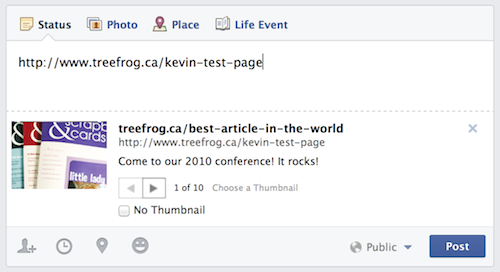
A client called in recently with a conundrum about Facebook. They asked us how Facebook managed to find information about one of their old conferences and apply it to their new post.

They had created a web page on their site and posted the link as a status update on Facebook. The problem was, the link appeared to be grabbing old information from somewhere and attributing it to their post.

Where was this old information coming from?

Take a look at the image above. When you drop a link into Facebook, it pulls data from that webpage.

What the… That’s totally not the information we have on our page. Where is it getting that title and description from? 2010 is over, isn’t it?

You’ve spent all this time creating a great webpage, and then Facebook goes and pulls some arbitrary title and description from out of nowhere. You’ll have to change that on your Facebook post if you want to make it current and relevant.

It turns out, the key to setting up your page correctly before posting it on Facebook, or any social network for that matter, is META data.

Never META Data I Didn’t Like

The mysterious thing about META data is that it is invisible to the naked eye. In fact, you can’t even see it if your eye has clothes on. It lives behind the curtain with the wizard.

META data consists of three main parts: Page title, Page keywords and page description.

Page title
Your page title is the text that appears at the top of a browser window. The page title is not to be confused with your page’s URL (link). The page title should describe the content on your page in an engaging way. The page title gets pulled as the title of your Facebook post.

Page Description
The page description should be a brief paragraph describing the content of your page.
For Facebook posts, the META description will end up being pulled into the post description. If you set this up on your webpage’s META data, you don’t have to worry about re-entering or editing it on Facebook, which will save you time and headache.

Keywords
META Keywords are not used by Facebook. In fact there are varying opinions about the validity of keywords as a whole, but that’s not for the scope of this article. For some extra reading on the relevance of populating the keyword field, you should visit this link.

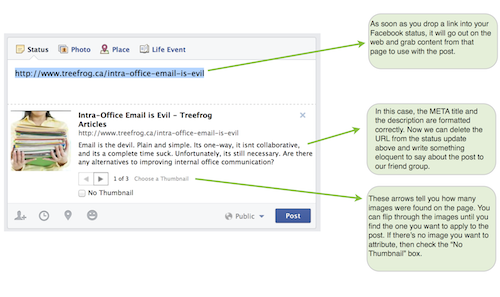
As per the photo above, as soon as you drop a link into your Facebook status, it will go out to the web and collect what it thinks is relevant data to use with the post.

in the above case, the META title and description are formatted correctly. Once that’s done, you can delete the link itself from your status update and write something attention-grabbing about the content you’re posting.

The arrows near the bottom of the post dialog box tell you how many images Facebook found on the page. You can flip through the images until you find the one you want to apply to the post. If there’s no image you want to attribute, simply check the “No Thumbnail” box.

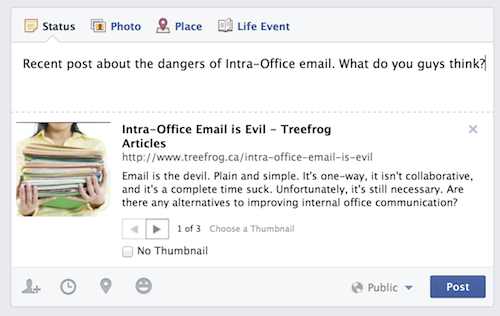
Above is an example of the post with the actual URL removed and a little intro written, ready to post to the Facebook world.

Tip: If you’re planning on posting this same content to multiple social networks, you should customize your intro. When it comes to posting something on Twitter, brevity is your friend. Your “Likes” on Facebook may prefer a more playful, jovial intro, whereas your followers on LinkedIn could be more serious. The point is: change it up, don’t just cut and paste the same intro across the board.

As part of your web page creating process, you should make sure it contains the proper META data. It’s just good practice. It will also save you time, add relevance and increase search engine optimization.

LEAP™ Makes META Insertion Easy

The META data on your page can be a very powerful tool. It is also what Google will most often use to display when your page comes up in a search result. The information should be precise and engaging. It should make people want to click on the story and read it.

Treefrog’s custom Content Management System (LEAP™) allows users to hop into the back end of their site easily and update the META content. It’s as easy as “leaping” to the administration side of the site, clicking the META button, making your edits and clicking “Update”.

Now, when you plug the link to your beautiful new web page into a Facebook status, all of that information will pull into your post. Voilà! Saves you time, and keeps things consistent.

If you still have questions about META data, let us know, we’d love to hear from you!

Scroll to Top