It’s almost the end of the year, and you know what that means, its time to start thinking about your marketing strategy for 2022. When it comes to planning for the new year, people tend to forget that it’s better to start now than already the new year.
When developing your strategy, you need to be asking yourself some important questions, such as what worked this year and what didn’t and what you need to focus on to grow your business?
We’ve been sharing this planner for many years, and this year we’ve made it even better. So make sure to download it below and if you’re looking for more marketing tips for 2022, check out our blog post on Digital Marketing Trends to Watch Out for in 2022.
Treefrog’s Marketing Strategy Planner for 2022
We’ve ensured that our marketing strategy planner simple, free and easy to use. We recommend that you use this plan as your guide to planning your marketing strategy for your business in 2022.
Treefrog is Here to Help
Want help with your 2022 marketing strategy? The digital marketing experts at Treefrog are here to help you with your strategy or any other tactics your business needs for 2022. We can help you design, build and execute your plan and make sure it’s aligned with your budget and business goals.
Fill out the form below, and your copy of the 2022 Marketing Strategy Planner will be emailed to you.
2021 is almost here. At this time of year, people are so focused on Christmas; they neglect to think about how to prepare their business for the new year.
Businesses need to start thinking ahead to the new year and asking themselves, what drives sales and interest in our product or services? The simple answer is a marketing strategy.
Out of all of the years we’ve done this, this is the year to share one of our most valuable tools for planning upcoming marketing. Right now is the perfect time to reflect on your business. Ask yourself what worked and what didn’t and what you should focus on in the new year to grow your business?
Treefrog’s Marketing Strategy Planner for 2021
Use this plan as your guide to marketing your business in the new year. It’s simple, free and easy to use. We’ve done all the work for you, and all you need to do is fill in the dates you want to complete the job.
At the very least, it’s a lot easier to decide what marketing activities aren’t part of your plan for 2021, so you don’t waste any energy wondering what could have been.
If we can help you with your strategy or any other tactics in 2021, let us know! We can help you design, build and execute your plan once it’s been intelligently reviewed and aligned with your budget and business goals for the next decade.
Fill out the form below and your copy of the 2021 Marketing Strategy Planner will be emailed to you.
Successfully navigating the world of digital marketing requires a strategy, a map if you will. You need to know where you are (point A) and where you want to go (point B, and possibly points C, D, and E too). These points on the map are your goals – the reasons you’re taking this journey and the places you want to go.
And once you know where you are and where you want to go, a content campaign that involves content development, search engine optimization, and social dissemination, will plot your best route to get there.
In part one and part two of our series on digital presence analyses, we explored how to perform a SWOT analysis on your brand and how to develop consumer personas. In part three, we’ll explore how to use both tools to develop and execute a content campaign that will raise your brand awareness and revitalize your business.
So, how do you create a content campaign?
Creating A Content Campaign
A content campaign combines social media, content, and SEO to create a unified digital strategy that will leverage identified personas, as well as the information collected in a DPA, to outline actionable items that will support a common goal.
Often underrated, content is the backbone of every marketing strategy as it provides material that can be shared through social, and that will be crawled and ranked by search engines like Google – positioning your company in front of your audience.
But what does a content plan look like?
The answer? It’s different for every company, as a content campaign should be completely unique to each brand – assessing needs and providing creative branded solutions to achieve those goals.
Let’s explore an example:
Should a footwear company wish to market a new shoe each month, monthly content campaign’s could be created to reach the audience who is most likely to be interested in that specific ‘shoe of the month.’
This could include targeted:
Blog posts about the features of the shoe
Email broadcasts promoting the shoe of the month
Social posts to share blog content about the shoe
Video teasers that showcase the shoe
Keyword optimization for the shoe name and features
Targeted PPC and SPPC ads for the shoe
Print materials that show imagery of the shoe, and more.
And as each of these marketing materials would adapt each month, as the target market shifts, new content would be developed with the audience in mind.
Example:
January Featured Shoe: Women’s Pink Breast Cancer Running Shoe – Brand X
Target Audience: Women who support breast cancer research and women’s charities, are athletic, like the colour pink, like yoga and exercising, are between the ages of 18-38, etc.
VS.
February Featured Shoe: Water Resistant Hiking Shoe – Brand Y
Target Audience: Men and women, ages 25-59, who are athletic and enjoy exercising, hiking, rock climbing, swimming, camping, etc.
While some characteristics, such as athleticism and a love of exercising are constant, the other characteristics may shift each month, demanding that the advertising and content campaign remain agile and follow a strategy that can speak to those unique and more specific niche audiences.
Therefore, the content campaign, in this case, would need to project a plan that runs months into the future, including what materials will be developed and shared on the month-to-month basis.
Content Development & Social Sharing
Content should tell a story, explain a concept, and persuade readers to take action. In other words, content should always aim to educate, inspire, entertain, and convince. However, without the right strategy and tools, content can fall flat and cause potential customers to look elsewhere for information.
Content campaigns require consistency between the content being created and the content being shared, and it is always best to create content that you can own and have control over. Owning quality content will increase your SEO, position your brand as a Key Opinion Leader in your industry, and help you to connect with your audience in a more authentic way.
However, in addition to sharing content that is branded and unique, you can also share content that has been curated by other sources.
For example, if you own a boutique that sells accessories, and you’ve recently begun selling a new line of scarves that you want to create a campaign around, you could share articles, published by other writers, which discuss:
How to wear a scarf
What to wear a scarf with
Why scarves are the best accessories
The specific brand you’re selling, and more.
Though this content is not native to your brand, curated content can fill in the gaps between the unique content you’ve crafted and will keep your audience engaged on a more regular basis. Leveraging programs like HootSuite, you’ll be able to schedule these posts months in advance, saving you time and the stress of having to remember to post frequently.
For tips on social media success, check out our article “Why Social Media Works”.
Search Engine Optimization
Your SEO ranking and performance is dependent on the content that exists on your website. To improve your ranking, it is important to analyze the following items before embarking on a content campaign:
Is your current content relevant and valuable?
Is your current website user-friendly?
Do you create content that is sharable (Ex: blog)?
Has your content been optimized using proper keywords, meta descriptions, etc.?
Within a content campaign, it is critical to consider the rules of SEO, as well as to optimize content so that your material will impact your visibility to potential customers. Through Google Analytics, you may also track the success of your campaign, monitoring increases in views, time spent on page, conversions, and other measurable results.
For more insights into the value of SEO, check out our blog ‘Conversion Rate Optimization & What It Can Do For You.’
Leveraging A Digital Presence Analysis: A Checklist
So, while this all may seem overwhelming, we’ve compiled a checklist, in the most simplified way we could, to remind you of the steps covered in our three-part series:
Perform a SWOT analysis
Develop personas
Brainstorm
Create a content calendar
Write content
Optimize content
Create a social sharing promotional plan
Publish the content
Share the content
Measure your campaign success
Should you require support in navigating your digital presence analysis or content campaign, be sure to reach out to us at905-836-4442.
Our professional team of content, social media, and SEO specialists can provide you with solutions that will increase your brand recognition and overall marketing success.
In part one of our series on digital presence analyses, we explored how to perform a ‘SWOT Analysis to Review Your Digital Presence’. This included information on how to evaluate the strengths and weaknesses of your brand, as well as how to identify the opportunities and risks your brand may access and face.
However, while it’s a great step to have completed a SWOT analysis, many of you may be asking: What do I do with all of that information?What’s next?
In part two of our series, we will discuss how to leverage the information collected in a SWOT analysis to create customer profiles of whom your strategic digital presence will target.
Identifying Consumer Personas
Before you can begin actioning the goals identified in your SWOT analysis, you’ll need to use the information you’ve collected to build quality and well-rounded consumer personas.
44% of the B2B marketers have already discovered the power of Personas
83% of B2B marketers expect to use Personas in the near future.
A fictional digital persona taps into the psyche of the people who are most likely to engage with your brand. Persona’s take hours of research to develop and can include details as specific as age, gender, occupation, education, where a person shops, what types of social media networks they use, how many kids they have, and so much more.
Think of the buyer journey as a story in three parts:
Persona: Defines the main character in the buyer story. Who they are, what they do, and why they do it. This includes their pain points, their fears, what brings them joy, and what stirs them.
Scenario: Where does the story take place? In a store? Online? How does the persona behave in that environment? Why did they arrive there instead of somewhere else?
Goal: What does the persona want out of their buying experience? What needs do they have? What is their motivation? What will make their experience a success?
The goal-oriented buyer persona study is important because without knowing whom your specific target market is and how they act, how will you know how to cater your marketing initiatives? How will you know which platforms and methods of advertising you should use to connect with them?
By doing the research up front, personas will save you time and money – as your marketing ventures will target the right people right off the bat, increasing your chances of sales and conversions.
How To Create A Persona
Research is always your best tool. The more you know, that more you can strategize and make informed marketing decisions. It’s therefore crucial to first identify some basic questions about your ideal customer:
Who are they?
What questions do they ask?
Why are they ideal?
If you are able to develop a persona that is based on your ideal customer (maybe even someone who is already buying from you), your persona research process will become much more realistic and informed. From there you can ask more specific questions such as:
What is their budget?
What does their daily life look like?
Where so they spend most of their time?
What they’re drawn to and why?
This data can be gathered through customer surveys, Facebook and Google Analytics, industry statistics, interviews, focus groups, and anthropological research.
Bonus Tip:Hubspot suggests that in order to recruit people to participate in your persona research interviews or surveys, it’s always a good idea to offer incentives, to be clear that your ask for participation is not a sales call, and to make it easy to say yes – by making the process simple and flexible.
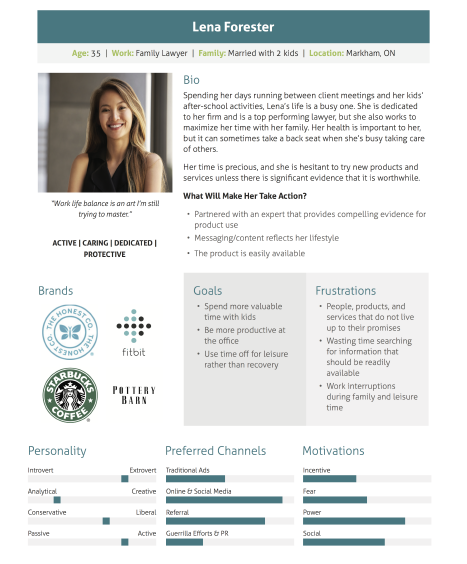
Here’s an example of a persona we’ve identified for a client here at Treefrog:
Once your persona profiles have been developed, make clear and strategic decisions as to which platforms you will use to market to them, what type of language you’ll use to speak to them, and make the effort to engage your personas in the ways they’re most likely to respond.
For example, the fictional Lena Forester is most likely to engage with social media ads, is motivated by power, is analytical, wants to spend more time with her kids while also being productive at the office, and she is drawn to products that partner with trusted experts and relate to her. It’s therefore not surprising that she is a fan of family-friendly yet sophisticated brands like Fitbit, The Honest Co., and Starbucks, as each fits her lifestyle and answers to her needs and desires.
Should another company wish to market to Lena, they will have to tap into these same things – leveraging the knowledge that she likes easily accessible products, that she hates work interruptions when at home, and that she is active and protective.
However, keep in mind that the persona’s your brand appeals to can evolve and change over time as preferences and interests shift. What appeals to Lena in 2017 and 2018, may not appeal to her in the same way when her children have grown into young adults, and she’s considering retirement. It’s therefore important to update your personas over time and to consistently check the pulse of your audience.
Putting Your Personas To Work
Once you have developed your personas, you’ll be able to use the data to specify your advertising reach – especially through content development and targeted social posting.
When it comes to blogging, understanding your audience will allow you to craft topics and provide sharable content that makes your customers say, “It’s like this article was written just for me!” By connecting with your target market on a more personal and strategized way, they’re more likely to share the content, engage with your brand, and purchase your product or service.
Creating user-driven content will also benefit your SEO as valuable content improves ranking and will help connect even more potential customers to your brand.
When it comes to social advertising, platforms like Facebook allow advertisers to insert specific persona data into the Facebook Ads system, which will position your advertisement in front of people, on both Facebook and Instagram, who most meet the specifications of your targeted persona. Incredible, isn’t it?
56% of companies have created higher quality leads using Personas.
24% of companies gained more leads using Personas.
Moving Forward
Once you have verified your top priorities and have conducted your persona research; it’s time to move into brainstorming and the dissemination of tasks.
As most digital presence initiatives cannot be completed alone – you’ll need to assemble a team, communicate the information gathered in your SWOT and persona analyses, create a content campaign, and assign to-dos based on individual strengths… but those are topics for other Treefrog articles to come! *wink, wink*
Contact Treefrog Today!
Should you require assistance to identify your brand persona profiles, consult an agency that will be able to conduct deep analysis of your customers. Understanding and developing the basis for a marketing plan is no easy task – and at Treefrog, our team is here to help.
Part One: Using SWOT Analysis to Review Your Digital Presence
Having a digital presence once upon a time meant that you had a website. Today, digital presence covers so much more than just a website; it includes your brand’s targeted keywords, strategized content, analytics about your online visitors, e-commerce and lead conversions, engagement on social media, and beyond. The lines are continually blurring between what defines “marketing”, and what defines “digital marketing”. Soon enough, these will be considered the same thing, because any business who is not considering digital as part of their overall marketing mix is missing the boat.
When it comes to understanding your digital presence, it’s important to first evaluate your goals over time by asking a few questions:
How do customers research your product?
Where can customers buy your product?
What do people think about when they see your brand?
What target market are you trying to reach?
How does your digital presence measure up against your competitors?
These are just some of the questions you need to be asking. Once we’ve started to establish a clearer understanding of our digital presence, it’s helpful to conduct an assessment of a “where are we now” overview. This can be effectively done by conducting a tried-and-true method: a SWOT analysis.
Let’s dig in:
SWOT Digital Presence Analysis
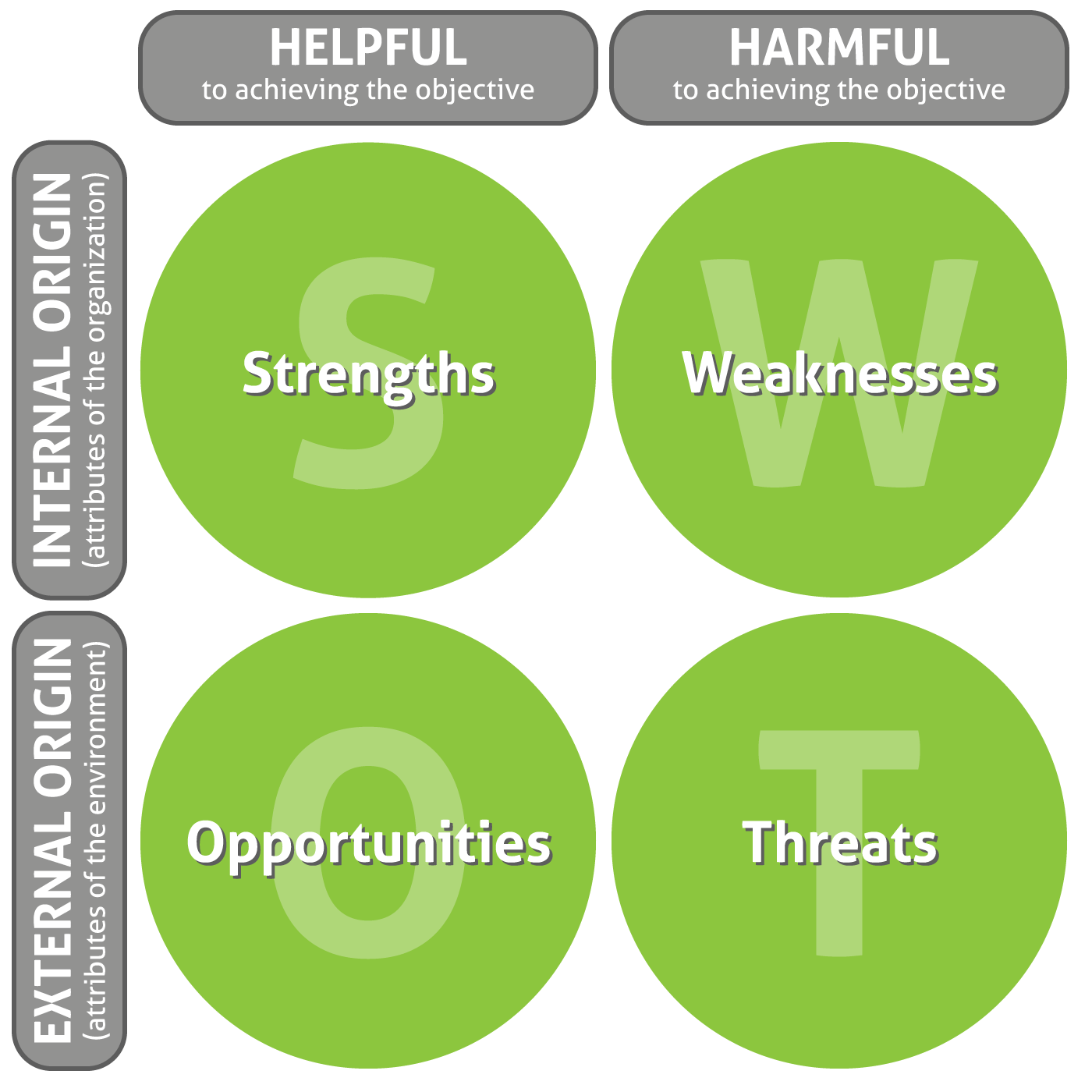
There are a number of ways to approach an assessment of your digital presence, and one insightful approach is to apply SWOT to your digital presence. SWOT stands for:
Strengths
Weaknesses
Opportunities
Threats
By leveraging the SWOT analysis method, you’ll be able to take a deeper look into what your brand is doing right online and what your brand is doing wrong. Below we examine some of the items you should consider when analyzing your online presence.
Strengths
What is your digital presence doing well
Odds are your digital presence isn’t completely terrible – unless it simply doesn’t exist or you haven’t touched it in months. To identify your strengths, it’s important to leverage available tools that can help you understand how people are currently using your website, such as Google Analytics. You should also be leveraging your social media account analytics to get a sense of how people perceive your brand. Make an effort to ask both your clients and those who have never interacted with your brand for feedback. It is best to remove your personal bias when examining what works and what doesn’t.
Strength Examples:
You have a social media posting schedule and you are engaging your audience.
You have a clear budget to make some improvements.
You have a marketing resource that can dedicate time to improving your digital presence, whether in-house or a third-party provider.
Weaknesses
What is your digital presence lacking?
Much like your strengths, you’ll be able to gain insight into your weaknesses by reviewing data and asking for external feedback. After years of attachment to your brand, you can become too narrow-minded when it comes to truly understanding the pain points of your presence. By asking outsiders to review your brand for the first time, you’ll have a much clearer understanding of the first impression your company is giving, and also the information that is not being articulated well.
Weakness Examples:
Your website is outdated, difficult to navigate, and possibly boring.
You can’t remember the last time you added new content to your site. Existing content has poor grammar, broken links, references to events that are years old… in other words, digital cobwebs.
You haven’t posted anything on social media in months (or years).
You don’t rank well on search engines where you should (yet your competitors do).
Opportunities
What opportunities would have a positive impact on your digital presence?
When it comes to your digital presence, there is always room for improvement. Now that we’ve looked at your weaknesses, we can use them to create a list of opportunities. Companies should never quit looking for new possibilities, even if they think things are just fine. Why be great when you can be innovative and set the bar as high as you can for all other companies in your industry? Not to mention you want to remain top of mind to your customers and be a bright, shining beacon to new prospects. Keep in mind also that digital changes quickly—what works today may just not work tomorrow.
Opportunity Examples:
Optimize calls to action on your website will create clear pathways from users to the information they need, and ultimately to you (a.k.a. leads!).
Leverage the content you have to connect with clients on social media to build long-lasting relationships and referrals (more leads!).
Create new content that answers the questions you hear from clients – let your website and social media be your 24-hour-a-day salesperson (did we mention leads?).
Technology is advancing all the time, and there are new channels and features to leverage.
Threats
What factors could threaten the success of your digital presence?
With change comes risk. However, never changing can pose even greater risks. By neglecting your digital presence, you face the threat of becoming irrelevant, stagnant, and forgotten. It is important always to stay ahead of the curve and to take risks and expand capabilities and knowledge to reduce threats.
Threat Examples
Competitors have a better online presence with better brand recognition, more followers, and higher rankings.
Your budget for improvement is limited.
Your internal team doesn’t have the time or marketing knowledge to build your online presence.
You don’t have any metrics to tell you what’s working and what isn’t.
Leveraging SWOT
Once you have identified your company’s strengths, weaknesses, opportunities, and threats, you should then be able to outline appropriate objectives to reach your goals. In other words, you need to know where you are and where you want to go before you can start determining a plan of how to get there.
To get your SWOT Analysis started, contact Treefrog Inc. today. By identifying your brand strengths, weaknesses, opportunities, and threats, we’ll help you to identify the areas of your business that require the most attention. Once you have a clear understanding of where you’d like your digital presence to go, we can also help to design and implement a roadmap that will help you to achieve your goals.
Marketing budgets vary per company and industry, but what’s true about all businesses, is that having a marketing budget, no matter what size, is necessary.
In this article, we discuss what should be included in your marketing plan, and provide an overview of the below checklist – which covers the action items you’ll need to complete as you head into 2018:
Organize your finances
Identify your needs and goals
Determine your spend
Develop a marketing plan
Decide how to allocate your budget
Action your plan
Organize Your Finances To Identify Your Needs
Before creating your marketing budget for 2018, you need to strategically organize and collect social and financial data that will allow you to:
Identify holes or ‘misses’ in past marketing campaigns
Identify 2017 gross revenue to predict 2018 gains
Reflect upon which areas (social, content, SEO) you are struggling in
Identify which areas of your business need attention and larger investment
Identifying Your Needs & Goals
Once your financial plan is in order, you will be in a better position to consider the state of your business and how much focus you will need to give social media, website building, design, SEO, or content marketing in the upcoming year. Having a clear understanding of this data will help you to identify your actionable needs and goals for 2018, such as:
Developing a social media campaign around a new fundraiser you’re hosting
Increasing SEO to rank higher on search engine results pages (SERPs)
Updating out-dated content on your website
Designing new marketing material to hand out at a tradeshow you’ll be attending
Starting fresh with a new website
What is your biggest priority for 2018?
Determining Your Spend & Plan
Brand New Companies
Companies that are less than a year old are likely limited to a very small marketing budget. They should, therefore, leverage predominantly free social media platforms (Ex. Facebook, Instagram, etc.) and consider attending a comprehensive Social Media Training session to begin generating buzz around their brand. By learning how to strategically publish yourself, you’ll reduce costs.
New Companies
Businesses that have been established for one to five years should consider using a healthy percentage of their gross revenue on print (Ex. brochures at tradeshows) and digital marketing (Ex. website enhancements and blog development). A larger marketing budget will help to launch awareness and boost familiarity amongst new and returning customers.
Established Companies
Companies that have been in business more than five years, and have a secure budget for marketing, should allocate a substantial amount of their gross income to brand marketing (Ex. Email marketing, PPC, and social media/content campaigns). For companies who exist in extremely competitive markets, are in need of brand reputation management, or who are promoting a new service or product, this budget should only continue to increase.
Allocating Your Budget
Branding
Graphic design can transform a boring and stagnant brand into something refreshed, relevant, and captivating. Although branding feeds into SEO, social media, content, and website integration, most branding begins in the design studio – where talented teams research and draft branding materials that reflect the vibe and intent of the company’s messaging.
If your business relies on brochure material, tradeshow booth design, or needs a complete logo and brand overhaul, your marketing budget should be catered towards branded design elements, as well as the integration of those designs – into your social media platforms, web copy, and website.
SEO Management
Companies that find they are in need of more quality leads, improved recognition, and higher visibility within search engines like Google, are in need of quality and consistent SEO management, as well as PPC advertising.
However, SEO relies heavily on quality content to rank and perform ideally. Therefore, if your business is in need of SEO, you’re also in need of new and better content – audited, identified, and strategically improved throughout your website.
61% of marketers say improving SEO and growing their organic presence is their top inbound marketing priority.
Local searches lead 50% of mobile visitors to visit stores within one day. (Google, 2014)
Web content articulates your visual brand messaging in text. In other words, content backs the intent and messaging that your branding portrays. Content also goes a step further – to provide context, drive actions, present valuable information, help your company to rank well in search engines, and, in most cases, helps users make an informed consumer decision.
While writing words for a webpage may seem easy, content marketing does more than just list details about a product and tell you why it’s great. Content marketing strategically develops copy that will speak directly to a targeted market, tap into their concerns and interests, support SEO, and drive specific conversion goals. This targeted marketing is also effective for email marketing broadcasts.
53% of marketers say blog content creation is their top inbound marketing priority. (HubSpot, 2017)
For businesses looking to improve brand recognition and to interact with their customers and clients, a new marketing budget should shift primarily to social media engagement, management, and development. With SSPC on the rise, companies need to consider investing money in social media advertising – to convert social media engagement into a potential sale of a product or service. By allocating the rest of your budget towards content development and SEO management, your online profile will continue to flourish.
83% of all marketers actively pursue social media marketing initiatives. (Aberdeen, 2016)
Nearly one-third of the world uses social networks regularly. (eMarketer, 2016)
Website Design
If your website is out-dated, hard to navigate, and is not serving the purpose it should – it’s time to dig deep and invest in SEO, content, social media, and web design. Working together to achieve the succinct goal of driving brand recognition, leads, and success for your company, each of these marketing sectors can deliver a complete overhaul for your public and online persona.
While a full website build is a major investment, the payoff of refreshing your entire brand at once will ensure the future of your business is on-trend and prosperous.
Investing In End of Year Marketing
Is your online business holiday ready? If your company relies on online sales during the end of year season, your marketing budget should allow for an increase in spend during these months. That means more social media campaigns, a stronger PPC play, content development to drive interest, and graphics to support your initiative.
81% of shoppers conduct online research before making big purchases.
Actioning Your Plan
With so many options of where to begin, it can be hard to identify which marketing venture your company should be focused on and participating in. That’s where we come in.
Treefrog Inc. – Your Digital Marketing Solutions Specialists
At Treefrog Inc., we understand that the needs of B2B and B2C clients are sometimes different, and our Client Care Advocates are well versed in identifying client needs based on their pain points and industry sector. If you’re not sure where to begin, we can help:
Social Media Training
Content Development Workshops
SEO Training
Email Marketing
Website Programming
Graphic Design
Content Marketing
Social Media Management
SEO
As one of Treefrog’s Marketing Partner’s (MP’s), your business will receive monthly project management, support, strategizing, development, and reporting – across content, SEO, and social media departments (if required).
Knowing which direction to take your business and how to get there requires a comprehensive and actionable marketing plan
Digital marketing trends come and go as each year passes. Being aware of them and planning to take advantage of them to give your business’s revenue a lift is useful, but concerning your strategic marketing plan, you need to take a broader view and consider both short- and long-term goals and methods.
Your marketing plan is a detailed roadmap your company will travel throughout the year. It should encompass everything including who your customers are, what your content marketing strategy is, the marketing and promotions budget you will adhere to, the campaigns and tactics you will deploy and more.
Seven Essential Steps to Strategic Marketing Planning
Every business is idiosyncratic and requires a clear marketing plan pertinent to its overall revenue goals and aims. Although there is no universal strategy your organization can adopt and follow, there are a series of established and sensible steps you can take to create an annual marketing plan that will suit your needs:
Establish a Practical Promotional and Marketing Budget. Your budget will dictate what you will be able to achieve monthly, quarterly, and annually. Promoting and marketing events, products and services, and your company’s philosophy on doing business costs money. If your company’s marketing budget is modest, you will need to be creative, and allocate funds to the most important initiatives you will plan throughout the year.
Revisit and Refresh Your Customer Personas. Customer or buyer personas are representations of your different customer segments, both real and desired. To get an accurate picture of who your customers are, you will need data derived from existing customer surveys and interviews, as well as other sources such as Google Analytics or Facebook Insights. Broadly defining your ideal customer personas will help your team understand who your customers are, what their needs are, and how your company can help them.
Understand What Your Differentiators Are. What does your business do differently than all of your competitors? What is your unique selling proposition? What are your core values and your company’s key messages? Knowing what’s distinct about your company, its products and services, how they apply to your targeted customer persona segments as well as the messaging you will use for various media types will help you prepare a well-rounded content campaign or editorial calendar.
Detail What Your Marketing Goals Are. What do you hope to achieve in the new year? Determining what your marketing goals are should go hand-in-hand with what your business’s overall goals are. Is that an increase in sales per quarter? Be realistic and ensure your goals are precise and well understood by everyone on your team.
Evaluate Your Website and Marketing Collateral. Does your corporate website look outdated? Is it awkward to navigate? And is it a responsive website? What about all of your digital and printed marketing collateral? Make it an annual exercise to reassess all of your marketing channels and properties and ensure they are targeting the right audiences, and parlaying the right messages.
Review Your Sales Strategy. Do you have a comprehensive and flexible sales strategy with achievable sales targets quarter-over-quarter? Or are you flying by the seat of your pants and making it up as you go? Although it is an important part of a holistic marketing strategy, your sales strategy should focus on increasing sales and meeting your quarterly revenue targets. It should include details about the customer’s journey both pre- and post-sale.
Define Metrics to Measure Performance. You can’t determine success or failure or shift gears if need be without data that validates what worked and what didn’t. Once you’ve identified the key performance metrics you want to track, and the tools and methodologies you’ll use to measure your success, host regular meetings with your sales and marketing teams to decide if any changes are required and how to go about them.
Once you’ve reviewed how your company performed the previous year, and upon completing these steps above, you should be ready to craft a practical marketing strategy for the new year that will help your company meet its objectives.
Does your business need help defining its marketing plans and achieving the goals you want? Let us help. For more than 20 years we’ve been helping businesses of all sizes and in various industries grow their online presences and revenues.